Sign in
Please select an account to continue using cracku.in
↓ →
 CAT WhatsApp Group
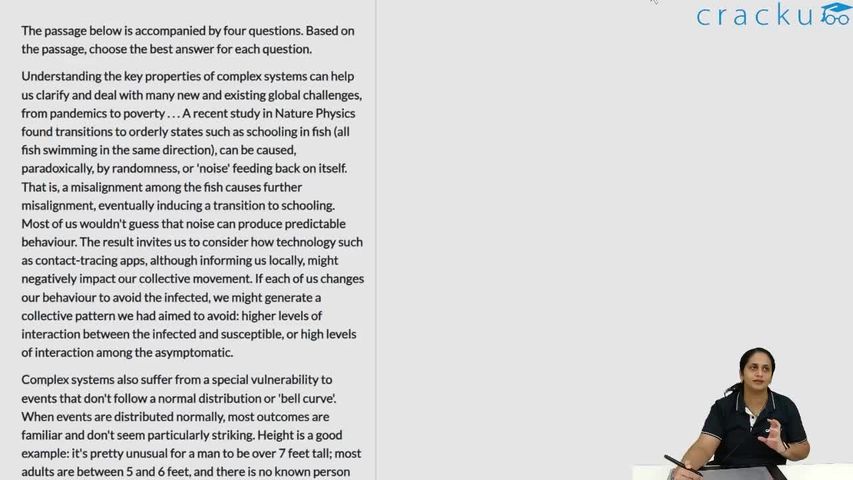
The passage below is accompanied by four questions. Based on the passage, choose the best answer for each question.
Understanding the key properties of complex systems can help us clarify and deal with many new and existing global challenges, from pandemics to poverty . . . A recent study in Nature Physics found transitions to orderly states such as schooling in fish (all fish swimming in the same direction), can be caused, paradoxically, by randomness, or 'noise' feeding back on itself. That is, a misalignment among the fish causes further misalignment, eventually inducing a transition to schooling. Most of us wouldn't guess that noise can produce predictable behaviour. The result invites us to consider how technology such as contact-tracing apps, although informing us locally, might negatively impact our collective movement. If each of us changes our behaviour to avoid the infected, we might generate a collective pattern we had aimed to avoid: higher levels of interaction between the infected and susceptible, or high levels of interaction among the asymptomatic.
Complex systems also suffer from a special vulnerability to events that don't follow a normal distribution or 'bell curve'. When events are distributed normally, most outcomes are familiar and don't seem particularly striking. Height is a good example: it's pretty unusual for a man to be over 7 feet tall; most adults are between 5 and 6 feet, and there is no known person over 9 feet tall. But in collective settings where contagion shapes behaviour - a run on the banks, a scramble to buy toilet paper - the probability distributions for possible events are often heavy-tailed. There is a much higher probability of extreme events, such as a stock market crash or a massive surge in infections. These events are still unlikely, but they occur more frequently and are larger than would be expected under normal distributions.
What's more, once a rare but hugely significant 'tail' event takes place, this raises the probability of further tail events. We might call them second-order tail events; they include stock market gyrations after a big fall and earthquake aftershocks. The initial probability of second-order tail events is so tiny it's almost impossible to calculate - but once a first-order tail event occurs, the rules change, and the probability of a second-order tail event increases.
The dynamics of tail events are complicated by the fact that they result from cascades of other unlikely events. When COVID-19 first struck, the stock market suffered stunning losses followed by an equally stunning recovery. Some of these dynamics are potentially attributable to former sports bettors, with no sports to bet on, entering the market as speculators rather than investors. The arrival of these new players might have increased inefficiencies and allowed savvy long-term investors to gain an edge over bettors with different goals. . . .
One reason a first-order tail event can induce further tail events is that it changes the perceived costs of our actions and changes the rules that we play by. This game-change is an example of another key complex systems concept: nonstationarity. A second, canonical example of nonstationarity is adaptation, as illustrated by the arms race involved in the coevolution of hosts and parasites [in which] each has to 'run' faster, just to keep up with the novel solutions the other one presents as they battle it out in evolutionary time.
The passage explains how complex systems act when faced with uncertainty and contagion. It starts by showing that randomness, or “noise,” can sometimes create order, like in fish schools. Next, it describes how systems shaped by imitation or contagion are open to heavy-tailed events, meaning extreme outcomes happen more often than a normal distribution would predict. The passage then discusses how one extreme event can lead to others, since big shocks change incentives, risk perceptions, and behaviour. This is summed up by the idea of nonstationarity, with examples from pandemics, financial markets during COVID-19, and evolutionary arms races.
Option B best summarises this sequence. It includes the opening idea that ‘noise can create order’, includes the main point about heavy-tailed events in contagion-driven systems, and notes that early shocks change the system’s rules through nonstationarity. It also uses the COVID-era market as an example, not the main point, which matches the passage’s focus.
The other options each have problems. Option A goes against the passage by saying social outcomes usually follow normal distributions and that extreme events are rare, while the passage argues the opposite. Option C overgeneralizes the example of the bettors: the passage only suggests that market dynamics may have been affected by displaced sports bettors, not that these entrants always cause inefficiency or guarantee profits for long-term investors. Moreover, option C frames the example, or rather the inference from it, as the primary argument in the passage, which is clearly a supporting argument. Option D goes beyond the scope of the passage by incorrectly associating ‘nonstationarity’ with ‘evolutionary biology’, even though the passage only applies it to markets, pandemics, and technology-driven social systems.
Click on the Email ☝️ to Watch the Video Solution
Create a FREE account and get:
Book Free CAT Mentorship
Get personalized CAT strategy from a 99%iler
500+ students mentored
OTP Verification
Enter the 6-digit code sent to your phone
Booking Summary
Enter OTP
Didn't receive the OTP?

Educational materials for CAT preparation

Ask our AI anything

AI can make mistakes. Please verify important information.
AI can make mistakes. Please verify important information.
 91- 6303239042