Sign in
Please select an account to continue using cracku.in
↓ →
 CAT WhatsApp Group
The passage below is accompanied by four questions. Based on the passage, choose the best answer for each question.
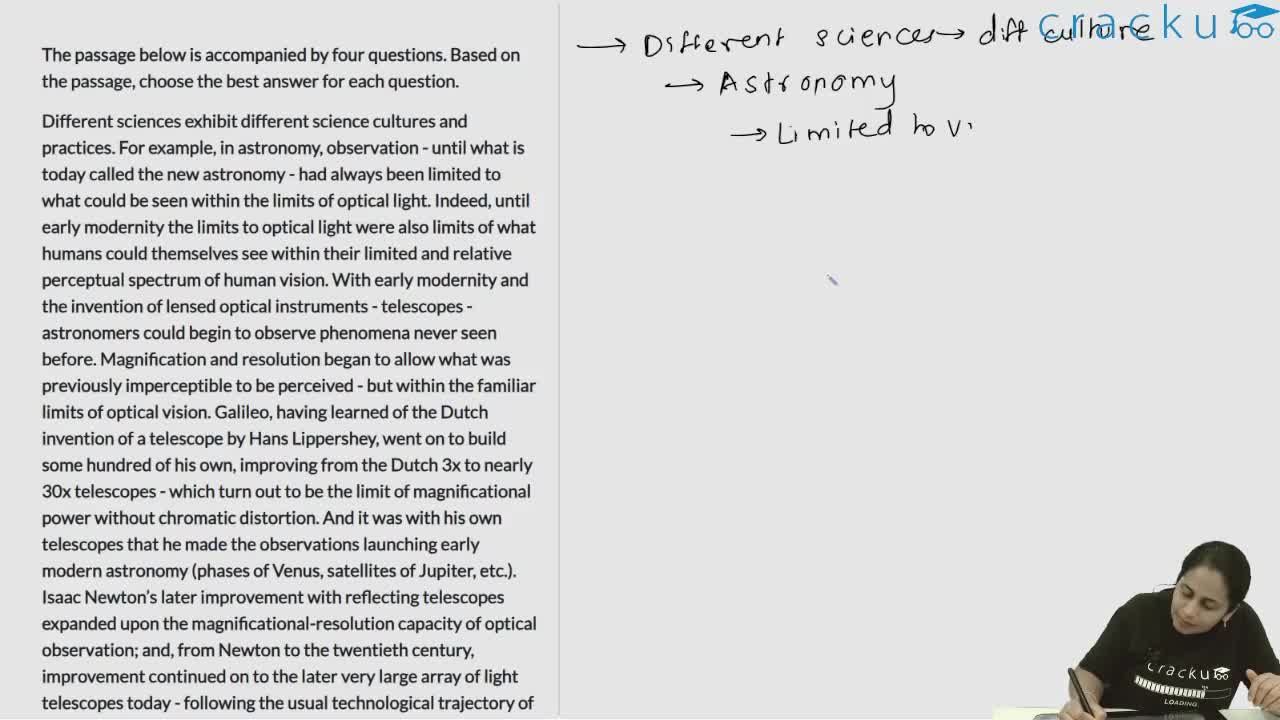
Different sciences exhibit different science cultures and practices. For example, in astronomy, observation - until what is today called the new astronomy - had always been limited to what could be seen within the limits of optical light. Indeed, until early modernity the limits to optical light were also limits of what humans could themselves see within their limited and relative perceptual spectrum of human vision. With early modernity and the invention of lensed optical instruments - telescopes - astronomers could begin to observe phenomena never seen before. Magnification and resolution began to allow what was previously imperceptible to be perceived - but within the familiar limits of optical vision. Galileo, having learned of the Dutch invention of a telescope by Hans Lippershey, went on to build some hundred of his own, improving from the Dutch 3x to nearly 30x telescopes - which turn out to be the limit of magnificational power without chromatic distortion. And it was with his own telescopes that he made the observations launching early modern astronomy (phases of Venus, satellites of Jupiter, etc.). Isaac Newton’s later improvement with reflecting telescopes expanded upon the magnificational-resolution capacity of optical observation; and, from Newton to the twentieth century, improvement continued on to the later very large array of light telescopes today - following the usual technological trajectory of “more-is-better” but still remaining within the limits of the light spectrum. Today’s astronomy has now had the benefit of some four centuries of optical telescopy. The “new astronomy,” however, opens the full known electromagnetic spectrum to observation, beginning with the accidental discovery of radio astronomy early in the twentieth century, and leading today to the diverse variety of EMS telescopes which can explore the range from gamma to radio waves. Thus, astronomy, now outfitted with new instruments, “smart” adaptive optics, very large arrays, etc., illustrates one style of instrumentally embodied science - a technoscience. Of course astronomy, with the very recent exceptions of probes to solar system bodies (Moon, Mars, Venus, asteroids), remains largely a “receptive” science, dependent upon instrumentation which can detect and receive emissions.
Contemporary biology displays a quite different instrument array and, according to Evelyn Fox- Keller, also a different scientific culture. She cites her own experience, coming from mathematical physics into microbiology, and takes account of the distinctive instrumental culture in her Making Sense of Life (2002). Here, particularly with the development of biotechnology, instrumentation is far more interventional than in the astronomy case. Microscopic instrumentation can be and often is interventional in style: “gene-splicing” and other techniques of biotechnology, while still in their infancy, are clearly part of the interventional trajectory of biological instrumentation. Yet, in both disciplines, the sciences involved are today highly instrumentalized and could not progress successfully without constant improvements upon the respective instrumental trajectories. So, minimalistically, one may conclude that the sciences are technologically, instrumentally embodied. But the styles of embodiment differ, and perhaps the last of the scientific disciplines to move into such technical embodiment is mathematics, which only contemporarily has come to rely more and more upon the computational machinery now in common use.
None of the following statements, if true, contradicts the arguments in the passage EXCEPT:

Let's examine each option one by one.
Option A does not contradict the passage. The author describes astronomy as mostly “receptive” and biology as more “interventional,” but does not say these categories cannot overlap. The phrase “largely a ‘receptive’ science” suggests there could be some crossover. The passage also does not state that instruments cannot serve both roles, so this option matches the argument.
Option B does contradict the passage. The passage says mathematics may be “the last of the scientific disciplines to move into such technical embodiment,” meaning it has only recently become heavily dependent on instruments. However, this does not mean mathematics is “only now beginning to develop a scientific culture.” So, B misrepresents the claim.
Option C does not contradict the passage. The discussion about astronomy moving beyond the visible spectrum does not mean that microscopy cannot also go beyond visible limits. The passage does not say microscopy is limited to the visible spectrum or that it cannot move beyond it. So, option C does not contradict the argument; it just goes beyond what is stated.
Option D also does not contradict the passage. The passage mentions Newton improving telescopes and their use in astronomy, but it does not say all of Newton’s discoveries depended on instruments. Newton’s discovery of gravity without instruments does not conflict with the discussion about telescopes.
Therefore, only option B contradicts the passage.
Click on the Email ☝️ to Watch the Video Solution
Create a FREE account and get:
Book Free CAT Mentorship
Get personalized CAT strategy from a 99%iler
500+ students mentored
OTP Verification
Enter the 6-digit code sent to your phone
Booking Summary
Enter OTP
Didn't receive the OTP?

Educational materials for CAT preparation

Ask our AI anything

AI can make mistakes. Please verify important information.
AI can make mistakes. Please verify important information.
 91- 6303239042