
Join Our JEE Preparation Group
Prep with like-minded aspirants; Get access to free daily tests and study material.
Sign in
Please select an account to continue using cracku.in
↓ →
Join Our JEE Preparation Group
Prep with like-minded aspirants; Get access to free daily tests and study material.
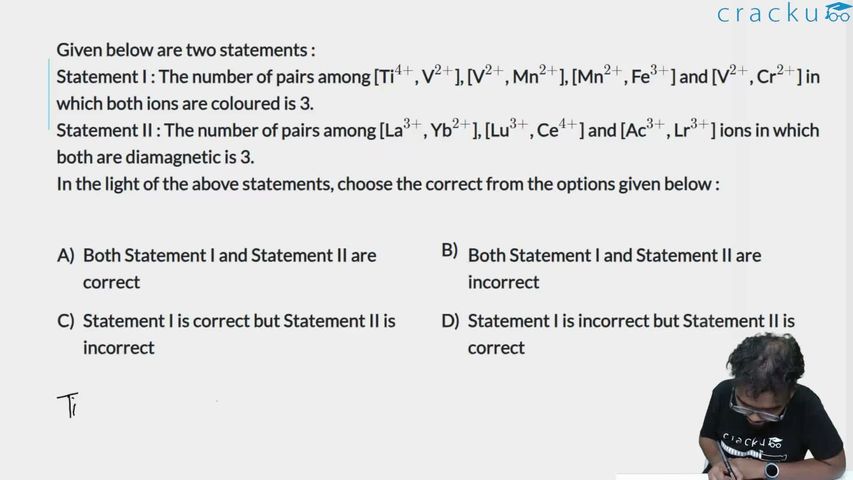
Given below are two statements :
Statement I : The number of pairs among [Ti$$^{4+}$$, V$$^{2+}$$], [V$$^{2+}$$, Mn$$^{2+}$$], [Mn$$^{2+}$$, Fe$$^{3+}$$] and [V$$^{2+}$$, Cr$$^{2+}$$] in which both ions are coloured is 3.
Statement II : The number of pairs among [La$$^{3+}$$, Yb$$^{2+}$$], [Lu$$^{3+}$$, Ce$$^{4+}$$] and [Ac$$^{3+}$$, Lr$$^{3+}$$] ions in which both are diamagnetic is 3.
In the light of the above statements, choose the correct from the options given below :
Statement I
Transition metal ions are typically coloured if they have partially filled $$d$$-orbitals ($$d^1$$ to $d^9$$ configuration), which allows for $$d\text{-}d$$ electronic transitions.
Ions with a $$d^0$$ or $$d^{10}$$ configuration are generally colourless.
There are exactly 3 pairs where both ions are coloured.
Statement I is CORRECT.
Statement II
An ion is diamagnetic if it has no unpaired electrons (i.e., all its orbitals are completely empty or completely filled).
There are exactly 3 pairs where both ions are diamagnetic.
Option A: Both Statement I and Statement II are correct
Was this solution helpful?
Click on the Email ☝️ to Watch the Video Solution
_1.webp)

Educational materials for JEE preparation

Ask our AI anything

AI can make mistakes. Please verify important information.
AI can make mistakes. Please verify important information.