In a battle, the commander-in-chief arranges his soldiers in a formation of three concentric circles. The radii of the circles are in an arithmetic progression: the smallest radius is 70m (meters) and the largest is 140m.
If each soldier is to be separated from the adjacent soldiers standing on the same circle by 1m, how many soldiers are required to complete the formation? (Consider π = 22/7.)
Solution
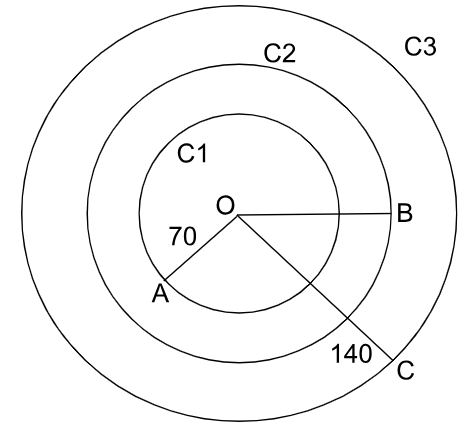
Three concentric circles C1, C2 and C3 with the radius OA, OB and OC are drawn.
OA, OB and OC are in AP (given).
OA = 70m, OB = (70 + d)m, OC = (70 + 2d)m , where, d is the common difference.
OC = 70+2d = 140 (given)
d = 35m
OB = 70 + 35 = 105m
The soldiers are standing on the circumference of these three circles at a distance of 1m. Hence, to find the total number of soldiers, we have the find the length of the circumference of all three circles.
Total circumference = $$2\pi\ \left(r1+r2+r3\right)$$
= 2 $$\times\ $$ $$\ \frac{\ 22}{7}\times\ \left(70+105+140\right)$$ = 1980
Hence, the total number of soldiers are 1980.
$$\therefore\ $$ The required answer is D.
Create a FREE account and get:
- All Quant Formulas and shortcuts PDF
- 15 XAT previous papers with solutions PDF
- XAT Trial Classes for FREE
