According to a survey conducted in a neighbourhood, at least 70% of the people read the Hindu, at least 75% of the people read the Times of India and at least 80% of the people read the Deccan Chronicle. What is the minimum percentage of people in the neighbourhood, who read all three newspapers?
SNAP Venn Diagrams Questions
Let the number of people who read exactly one newspaper be ‘a’, the number of people who read exactly two newspapers be ‘b’ and the number of people who read exactly three newspapers be ‘c’.
So, a + b + c = 100%
a + 2b + 3c >= 70% + 75% + 80% = 225%
=> b + 2c >= 125
To find the minimum percentage of people who read all three newspapers, we have to minimize ‘c’. So, we have to maximize ‘b’.
Let a = 0 => b+c = 100 and b+2c >= 125
=> c >= 25
So, the minimum value of ‘c’ is 25. In this case, b = 75 and a = 0
So, at least 25% of the people in the neighbourhood read all the three newspapers.
In a college consisting of 200 students, 112 students took the Maths Olympiad, 160 students took the Physics Olympiad and 128 students took the Chemistry Olympiad. If each student in the college takes at least one of the three exams, what is the minimum number of students who took all the three exams?
Let the number of students who took exactly one exam be ‘x’.
The number of students who took exactly two exams be ‘y’ and the number of students who took exactly three exams be ‘z’.
So, x + y + z = 200
x + 2y + 3z = 112 + 160 + 128 = 400
From these two equations, we get, y + 2z = 200
To minimize ‘z’, we have to maximize ‘y’. If z = 0, y = 200. In this case, x = 0
So, the minimum number of students who took all the three tests is 0.
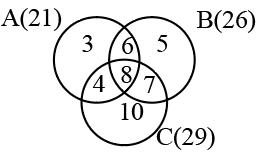
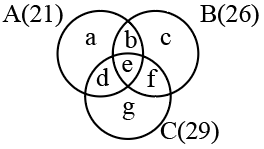
During the placement season of a class, 21 students got shortlisted for company A, 26 got shortlisted for Company B and 29 got shortlisted for company C and 14 students got shortlisted for both A and B, 12 students got shortlisted for A and C and 15 for both B and C. All the companies shortlisted 8 students from the class. Then what is the ratio of number of students who got shortlisted for only B and number of students who got shortlisted for only C?
Given e = 8
Number of students shortlisted for A and B is 14
e + b = 14
b = 6
Number of students shortlisted for A and C is 12
e + d = 12
d = 4
Number of students shortlisted for B and C is 15
e + f = 15
f = 7
Given
Number of students shortlisted for B is 26
b + f + e + c = 26
6 + 7 + 8 + c = 26
c = 5
Number of students shortlisted for C is 29
d + e + f + g = 29
g = 10
Number of students shortlisted for A is 21
b + e + d + a = 21
a = 3
Number of students shortlisted for only B = c = 5
Number of students shortlisted for only C = g = 10
Ratio = 5:10 = 1:2
Answer is option B
In a competitive exam there were 5 sections. 10% of the total number of students cleared the cut off in all the sections and 5% cleared none of the sections. From the remaining candidates 30% cleared only section 1, 20% cleared only section 2, 10% cleared only section 3 and remaining 1020 candidates cleared only section 4. How many students appeared in the competitive exam ?
Let total number of students=100x
10x=students who cleared the cut off in all the sections
5x=students who cleared none of the sections.
Remaining = 85x
Out of these 85x , 30% cleared only 1st section , 20% cleared only 2nd section, 30% cleared only section 3
Together they constitute 60% of 85x
Remaining= 40% of 85x =1020
On solving x=30
Total students=100x= 100*30=3000
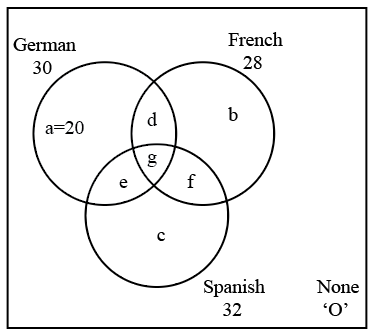
In a school where there was a compulsion to learn at least one foreign language from the choice given to them, namely German, French and Spanish. Twenty eight students took French, thirty took German and thirty two took Spanish. Six students learnt French and German, eight students learnt German and Spanish, ten students learnt French and Spanish. Fifty four students learnt only one foreign language while twenty students learnt only German. Find the number of students in the school.
Exactly 1 subject = a+b+c ---> Represented by X
Exactly 2 subjects=d+e+f -----> Represented by Y
Exactly 3 subjects= g -----> Represented by Z
So X + Y+ Z + none = total --------------> (I)
German + French + Spanish = (a+b+c) +2(d+e+f) + 3(g) = X+ 2Y + 3Z -----------> (II)
So X+2Y+3Z= 30+28+32=90
Given X = 54
So 2Y +3Z = 36--------> (1)
Given ,
French and German = 6 => d+g = 6
German and Spanish = e+g = 8
French and Spanish = f + g = 10
adding all the three (d+e+f) + 3g = 24
Y + 3Z = 24 ------> (2)
solving 1 and 2 you get Y=12 and Z=4
Therefore Total = X+Y+Z+None = 54+12+4=70
If A and B are two mutually exclusive and exhaustive events with $$P(B) = 3P(A)$$, then what is the value of $$P(\overline{B})$$?
Since P(B) and P(A) are mutually exclusive and exhaustive , thus, P(B)+P(A)=1
But we know that P(B)=3 P(A) , thus substituting in the above equation we get P(B)=3/4 and P(A)=1/4
Now they have asked P(B_) i.e. 1-P(B)=1-(3/4)=1/4
In a school students at Pioneer career Kolkata wrote Mock test which has three subjects DI, VA and QA, here is the result of these students. 80 students cleared cut off in DI, 70 in VA and 60 in QA. Only 40 students cleared all the three subjects. 10 students failed to clear cut off even in one subjects. 50 students cleared cut off in VA and QA. 5 students cleared in cut off in only QA.
What is the minimum number of students who did not clear cut off in exactly two subjects?
With the given information, we can draw the following Venn diagram:

Let the number of students who cleared the cut-off in exactly one, two and three subjects be a, b and c, respectively, and the number of students who cleared the cut-off in both VA and DI be y.
Thus, c = 40
a + 2b + 3c = 80 + 70 + 60 = 210
a + 2(5 + 10 + y) + 3(40) = 210
a + 2y = 210 - 120 - 30
a + 2y = 60
We have to find the minimum value of a.
'a' is at least 5 as the students in only QA = 5.
At a = 5, y = $$\frac{55}{2}$$. Since y needs to be an integer, a cannot be 5.
At a = 10, y = 25. But in this case, the total number of students in VA = 75. Thus, a cannot be 10.
At a = 20, y = 20. This case satisfies all the conditions.
Hence, the minimum number of students who did not clear cut off in exactly two subjects = Minimum number of students who cleared only one subject = 20.
The answer is option C.
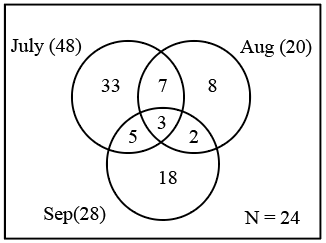
A survey was conducted of 100 people whether they have read recent issues of 'Golmal', a monthly magazine. Summarized information is presented below :
Only September: 18
September but not August: 23
September and July: 8
September: 28
July: 48
July and August: 10
None of the three months: 24
What is the number of surveyed people who have read exactly for two consecutive months?
Exactly two consecutive months include both July-August and August-September. We cannot include July-September, as these months are not consecutive.
N - none of the three months
Number of people who read in July and August only = 7
Number of people who read in August and September only = 2
Therefore, the number of surveyed people who have read exactly for two consecutive months = 7+2 = 9
Answer is option B.
Answer the questions based on the information given below
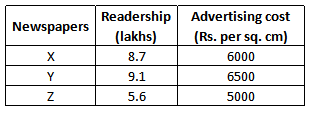
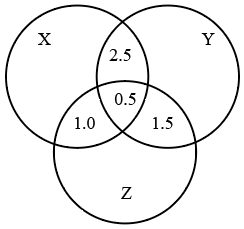
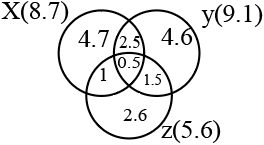
The Venn diagram given below shows the estimated readership of 3 daily newspapers (X, Y & Z) in a city. The total readership and advertising cost for each of these papers is as below

The total population of the city is estimated to be 14 million. The common readership (in lakhs) is indicated in the given Venn diagram

The number of people (in lakhs) who read only one newspaper is
Given Readership of newspaper X = 8.7
only X + 2.5 + 0.5 + 1 = 8.7
only X = 4.7
Given Readership of newspaper Y = 9.1
only Y + 2.5 + 1.5 + 0.5 = 9.1
only Y = 4.6
Given Readership of newspaper Z = 5.6
only Z + 0.5 + 1 + 1.5 = 5.6
only Z = 2.6

Number of people who read only one newspaper = 4.7 + 4.6 + 2.6 = 11.9 lakhs