For the following questions answer them individually
A particle moves from the point $$(2.0\hat{i} + 4.0\hat{j})$$ m, at $$t = 0$$, with an initial velocity $$(5.0\hat{i} + 4.0\hat{j})$$ ms$$^{-1}$$. It is acted upon by a constant force which produces a constant acceleration $$(4.0\hat{i} + 4.0\hat{j})$$ ms$$^{-2}$$. What is the distance of the particle from the origin at time 2 s?
If speed (V), acceleration (A) and force (F) are considered as fundamental units, the dimension of Young's modulus will be:
A particle of mass m is moving in a straight line with momentum p. Starting at time $$t = 0$$, a force $$F = kt$$ acts in the same direction on the moving particle during time interval T so that its momentum changes from p to 3p. Here k is a constant. The value of T is
The magnitude of torque on a particle of mass 1 kg is 2.5 Nm about the origin. If the force acting on it is 1 N, and the distance of the particle from the origin is 5 m, the angle between the force and the position vector is (in radians):
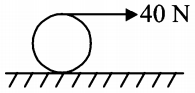
A string is wound around a hollow cylinder of mass 5 kg and radius 0.5 m. If the string is now pulled with a horizontal force of 40 N, and the cylinder is rolling without slipping on a horizontal surface (see figure), then the angular acceleration of the cylinder will be (Neglect the mass and thickness of the string)
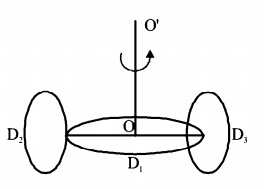
A circular disc $$D_1$$ of mass M and radius R has two identical discs $$D_2$$ and $$D_3$$ of the same mass M and radius R attached rigidly at its opposite ends (see figure). The moment of inertia of the system about the axis OO', passing through the centre of $$D_1$$, as shown in the figure, will be
The mass and the diameter of a planet are three times the respective values for the Earth. The period of oscillation of a simple pendulum on the Earth is 2 s. The period of oscillation of the same pendulum on the planet would be:
Two rods A and B of identical dimensions are at temperature $$30°C$$. If A is heated upto $$180°C$$ and B upto $$T°C$$, then the new lengths are the same. If the ratio of the coefficients of linear expansion of A and B is 4 : 3, then the value of T is
A thermometer graduated according to a linear scale reads a value $$x_0$$ when in contact with boiling water, and $$x_0/3$$ when in contact with ice. What is the temperature of an object in °C, if this thermometer in the contact with the object reads $$x_0/2$$?
In a process, temperature and volume of one mole of an ideal monoatomic gas are varied according to the relation VT = K, where K is a constant. In this process the temperature of the gas is increased by $$\Delta T$$. The amount of heat absorbed by gas is (R is gas constant):
When 100 g of a liquid A at $$100°C$$ is added to 50 g of a liquid B at temperature $$75°C$$, the temperature of the mixture becomes $$90°C$$. The temperature of the mixture, if 100 g of liquid A at $$100°C$$ is added to 50 g of liquid B at $$50°C$$, will be:
A metal ball of mass 0.1 kg is heated upto $$500°C$$ and dropped into a vessel of heat capacity $$800 \text{ JK}^{-1}$$ and containing 0.5 kg water. The initial temperature of water and vessel is $$30°C$$. What is the approximate percentage increment in the temperature of the water? [Specific Heat Capacities of water and metal are, respectively, $$4200 \text{ Jkg}^{-1} \text{K}^{-1}$$ and $$400 \text{ Jkg}^{-1} \text{K}^{-1}$$]
A pendulum is executing simple harmonic motion and its maximum kinetic energy is $$K_1$$. If the length of the pendulum is doubled and it performs simple harmonic motion with the same amplitude as in the first case, its maximum kinetic energy is $$K_2$$
A simple pendulum of length 1 m is oscillating with an angular frequency 10 rad/s. The support of the pendulum starts oscillating up and down with a small angular frequency of 1 rad/s and an amplitude of $$10^{-2}$$ m. The relative change in the angular frequency of the pendulum is best given by:
An electric field of 1000 V/m is applied to an electric dipole at angle of $$45°$$. The value of electric dipole moment is $$10^{-29}$$ C.m. What is the potential energy of the electric dipole?
Seven capacitors, each of capacitance $$2\mu F$$, are to be connected in a configuration to obtain an effective capacitance of $$\left(\frac{6}{13}\right)\mu F$$. Which of the combinations, shown in figures below, will achieve the desired value?
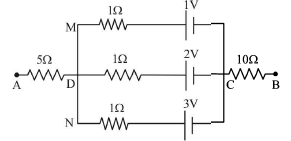
In the circuit shown, the potential difference between A and B is
A galvanometer having a resistance of $$20\Omega$$ and 30 division on both sides has figure of merit 0.005 ampere/division. The resistance that should be connected in series such that it can be used as a voltmeter upto 15 volt, is:
A paramagnetic substance in the form of a cube with sides 1 cm has a magnetic dipole moment of $$20 \times 10^{-6}$$ J/T when a magnetic intensity of $$60 \times 10^3$$ A/m is applied. Its magnetic susceptibility is:
The region between $$y = 0$$ and $$y = d$$ contains a magnetic field $$\vec{B} = B\hat{z}$$. A particle of mass m and charge q enters the region with a velocity $$\vec{v} = v\hat{i}$$. If $$d = \frac{mv}{2qB}$$, the acceleration of the charged particle at the point of its emergence at the other side is:
A particle of mass m and charge q is in an electric and magnetic field given by $$\vec{E} = 2\hat{i} + 3\hat{j}$$; $$\vec{B} = 4\hat{j} + 6\hat{k}$$. The charged particle is shifted from the origin to the point P$$(x = 1; y = 1)$$ along a straight path. The magnitude of the total work done is:
A copper wire is wound on a wooden frame, whose shape is that of an equilateral triangle. If the linear dimension of each side of the frame is increased by a factor of 3, keeping the number of turns of the coil per unit length of the frame the same, then the self inductance of the coil:
A 27 mW laser beam has a cross-sectional area of 10 mm$$^2$$. The magnitude of the maximum electric field in this electromagnetic wave is given by: [Given permittivity of space $$\epsilon_0 = 9 \times 10^{-12}$$ SI units, Speed of light $$c = 3 \times 10^8$$ m/s]
A monochromatic light is incident at a certain angle on an equilateral triangular prism and suffers minimum deviation. If the refractive index of the material of the prism is $$\sqrt{3}$$, then the angle of incidence is:
In a double-slit experiment, green light (5303Â Ã…) falls on a double slit having a separation of $$19.44 \mu m$$ and a width of $$4.05 \mu m$$. The number of bright fringes between the first and the second diffraction minima is
In a photoelectric experiment, the wavelength of the light incident on a metal is changed from 300 nm to 400 nm. The decrease in the stopping potential is close to: $$\left(\frac{hc}{e} = 1240 \text{ nm} \cdot V\right)$$
In a hydrogen like atom, when an electron jumps from the M-shell to the L-shell, the wavelength of emitted radiation is $$L$$. If an electron jumps from N-shell to the L-shell, the wavelength of emitted radiation will be:
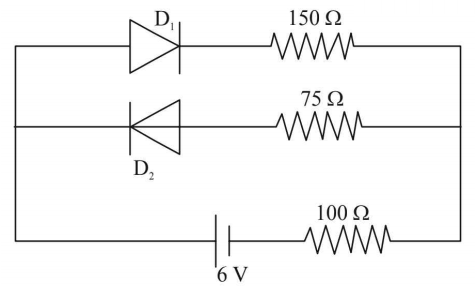
The circuit shown below contains two ideal diodes, each with a forward resistance of $$50\Omega$$. If the battery voltage is 6 V, the current through the $$100\Omega$$ resistance (in Amperes) is:
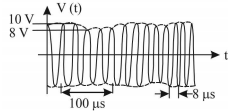
An amplitude modulated signal is plotted below. Which one of the following best describes the above signal?
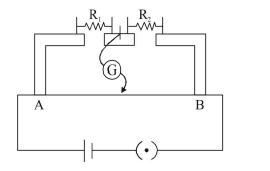
In the experimental set up of metre bridge shown in the figure, the null point is obtained at a distance of 40 cm from A. If a $$10\Omega$$ resistor is connected in series with $$R_1$$, the null point shifts by 10 cm. The resistance that should be connected in parallel with $$(R_1 + 10)\Omega$$ such that the null point shifts back to its initial position is