
Join Our JEE Preparation Group
Prep with like-minded aspirants; Get access to free daily tests and study material.
Sign in
Please select an account to continue using cracku.in
↓ →
Join Our JEE Preparation Group
Prep with like-minded aspirants; Get access to free daily tests and study material.
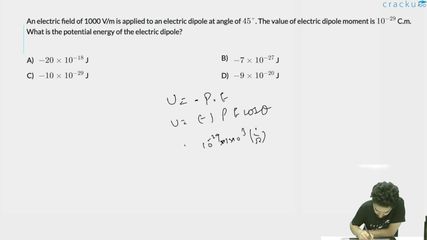
An electric field of 1000 V/m is applied to an electric dipole at angle of $$45°$$. The value of electric dipole moment is $$10^{-29}$$ C.m. What is the potential energy of the electric dipole?
We start by recalling the expression for the potential energy of an electric dipole kept in a uniform electric field. The general formula is stated as $$U = -\vec p \cdot \vec E$$, where $$\vec p$$ is the electric dipole moment and $$\vec E$$ is the electric field.
Because the dot product of two vectors is the product of their magnitudes and the cosine of the angle between them, we can rewrite the formula as
$$U = -pE\cos\theta,$$
where
$$p$$ is the magnitude of the dipole moment,
$$E$$ is the magnitude of the electric field, and
$$\theta$$ is the angle between $$\vec p$$ and $$\vec E$$.
Now we substitute the numerical values given in the problem:
$$p = 10^{-29}\ \text{C·m}$$, $$\qquad E = 1000\ \text{V/m}$$, $$\qquad \theta = 45^\circ.$$
Placing these into the formula, we have
$$U = -(10^{-29})(1000)\cos 45^\circ.$$
First, multiply the magnitudes:
$$10^{-29} \times 1000 = 10^{-29}\times 10^{3} = 10^{-26}.$$
So the expression becomes
$$U = -10^{-26}\cos 45^\circ.$$
Next, we use the trigonometric value $$\cos 45^\circ = \dfrac{1}{\sqrt{2}} \approx 0.707.$$ Substituting this value, we get
$$U = -10^{-26} \times 0.707.$$
Performing the multiplication gives
$$U \approx -7.07 \times 10^{-27}\ \text{J}.$$
When we round to one significant figure, the result is
$$U \approx -7 \times 10^{-27}\ \text{J}.$$
This numerical value matches Option B in the given list.
Hence, the correct answer is Option B.
Was this solution helpful?
Click on the Email ☝️ to Watch the Video Solution
Create a FREE account and get:
_1.webp)

Educational materials for JEE preparation

Ask our AI anything

AI can make mistakes. Please verify important information.
AI can make mistakes. Please verify important information.


