
Join Our JEE Preparation Group
Prep with like-minded aspirants; Get access to free daily tests and study material.
Sign in
Please select an account to continue using cracku.in
↓ →
Join Our JEE Preparation Group
Prep with like-minded aspirants; Get access to free daily tests and study material.
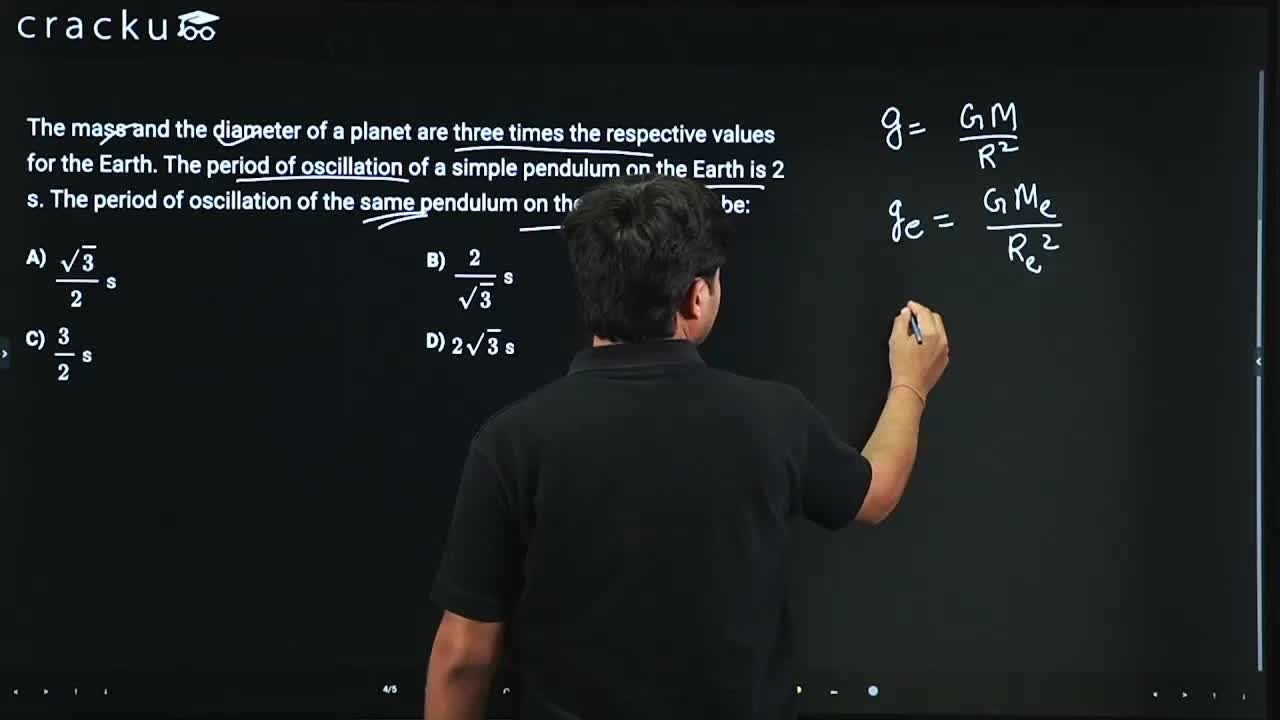
The mass and the diameter of a planet are three times the respective values for the Earth. The period of oscillation of a simple pendulum on the Earth is 2 s. The period of oscillation of the same pendulum on the planet would be:
For a simple pendulum the time‐period is given by the well-known formula
$$T = 2\pi\sqrt{\dfrac{l}{g}}\; ,$$
where $$l$$ is the length of the pendulum and $$g$$ is the acceleration due to gravity at the place of observation.
On Earth the period is provided as $$T_E = 2\ \text{s}.$$ So, on the Earth we have
$$2 = 2\pi\sqrt{\dfrac{l}{g_E}} \; ,$$
which we shall keep for later comparison. The length $$l$$ of the pendulum is the same everywhere; only $$g$$ changes from one celestial body to another.
Now we consider the given planet. Its mass is three times that of Earth, so
$$M_P = 3M_E.$$
Its diameter is also three times that of Earth, therefore its radius is three times Earth’s radius:
$$R_P = 3R_E.$$
The surface acceleration due to gravity is determined by Newton’s universal-gravitation expression
$$g = \dfrac{GM}{R^{2}},$$
where $$G$$ is the gravitational constant, $$M$$ is the mass of the body, and $$R$$ is its radius.
Applying this to the planet we write
$$g_P = \dfrac{G\,M_P}{R_P^{2}}.$$
Substituting $$M_P = 3M_E$$ and $$R_P = 3R_E$$ gives
$$g_P = \dfrac{G\,(3M_E)}{(3R_E)^{2}} = \dfrac{3G M_E}{9R_E^{2}} = \dfrac{1}{3}\,\dfrac{G M_E}{R_E^{2}} = \dfrac{g_E}{3}.$$
Thus the planet’s gravitational acceleration is one-third that of Earth:
$$g_P = \dfrac{g_E}{3}.$$
We now compute the pendulum’s period on the planet. Using the same length $$l$$ in the original period formula, we have
$$T_P = 2\pi\sqrt{\dfrac{l}{g_P}} = 2\pi\sqrt{\dfrac{l}{g_E/3}} = 2\pi\sqrt{\dfrac{3l}{g_E}} = \sqrt{3}\,\bigl(2\pi\sqrt{\dfrac{l}{g_E}}\bigr).$$
The expression in large parentheses is exactly the Earth period $$T_E$$, so
$$T_P = \sqrt{3}\,T_E.$$
Given $$T_E = 2\ \text{s},$$ we substitute:
$$T_P = \sqrt{3}\times 2 = 2\sqrt{3}\ \text{s}.$$
Hence, the correct answer is Option D.
Was this solution helpful?
Click on the Email ☝️ to Watch the Video Solution
Create a FREE account and get:
_1.webp)

Educational materials for JEE preparation

Ask our AI anything

AI can make mistakes. Please verify important information.
AI can make mistakes. Please verify important information.


