
Join Our JEE Preparation Group
Prep with like-minded aspirants; Get access to free daily tests and study material.
Sign in
Please select an account to continue using cracku.in
↓ →
Join Our JEE Preparation Group
Prep with like-minded aspirants; Get access to free daily tests and study material.
A circular disc $$D_1$$ of mass M and radius R has two identical discs $$D_2$$ and $$D_3$$ of the same mass M and radius R attached rigidly at its opposite ends (see figure). The moment of inertia of the system about the axis OO', passing through the centre of $$D_1$$, as shown in the figure, will be
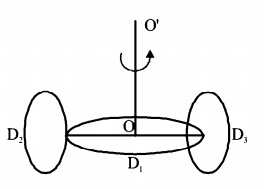
Moment of inertia of central disc $$D_1$$ about axis $$OO'$$: $$I_1 = \frac{1}{2}MR^2$$
Moment of inertia of outer disc $$D_2$$ (or $$D_3$$) about its own diameter parallel to $$OO'$$: $$I_{\text{cm}} = \frac{1}{4}MR^2$$
Distance from center of $$D_1$$ to center of $$D_2$$ (or $$D_3$$): $$d = R$$
Applying parallel axis theorem for one outer disc ($$D_2$$ or $$D_3$$) about axis $$OO'$$:
$$I_2 = I_3 = I_{\text{cm}} + Md^2 = \frac{1}{4}MR^2 + MR^2 = \frac{5}{4}MR^2$$
Total moment of inertia of the system:
$$I_{\text{total}} = I_1 + I_2 + I_3 = \frac{1}{2}MR^2 + 2\left(\frac{5}{4}MR^2\right) = \frac{1}{2}MR^2 + \frac{5}{2}MR^2 = 3MR^2$$
Was this solution helpful?
Create a FREE account and get:
_1.webp)

Educational materials for JEE preparation

Ask our AI anything

AI can make mistakes. Please verify important information.
AI can make mistakes. Please verify important information.


