
Join Our JEE Preparation Group
Prep with like-minded aspirants; Get access to free daily tests and study material.
Sign in
Please select an account to continue using cracku.in
↓ →
Join Our JEE Preparation Group
Prep with like-minded aspirants; Get access to free daily tests and study material.
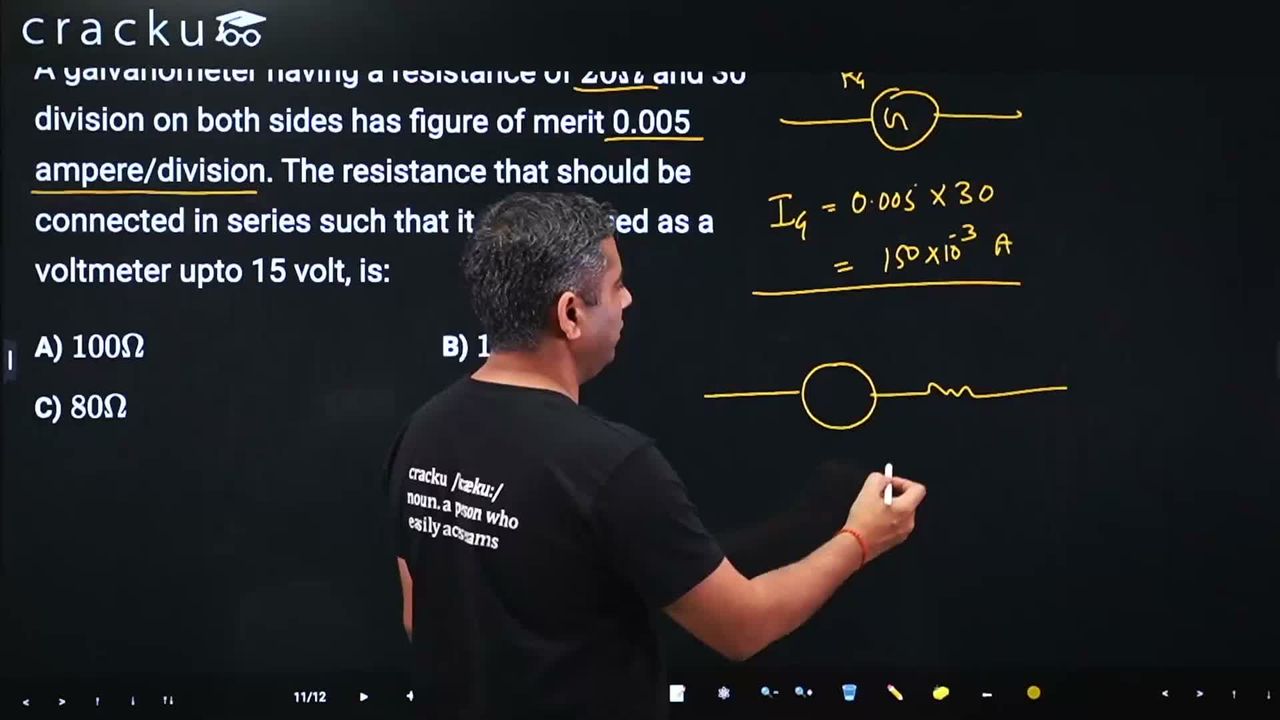
A galvanometer having a resistance of $$20\Omega$$ and 30 division on both sides has figure of merit 0.005 ampere/division. The resistance that should be connected in series such that it can be used as a voltmeter upto 15 volt, is:
We are given a moving-coil galvanometer whose resistance is $$R_g = 20\Omega$$. The scale has 30 divisions on either side of the zero, so a full-scale deflection corresponds to a movement of 30 divisions. We are also told that the figure of merit (current needed for one-division deflection) is $$k = 0.005\text{ ampere/division}$$.
The current required for full-scale deflection of the galvanometer, usually denoted by $$I_g$$, is obtained simply by multiplying the figure of merit by the number of divisions that constitute the full scale. Hence
$$I_g = k \times (\text{number of divisions}) = 0.005\;{\rm A/div}\times 30\;{\rm divisions} = 0.15\;{\rm A}.$$
To convert a galvanometer into a voltmeter that can read up to a given voltage $$V_{\max}$$, we connect a suitable resistance in series with it. The idea is that, at the maximum voltage, the same full-scale current $$I_g$$ must flow through the galvanometer. The total resistance that the source “sees’’ is therefore
$$R_{\text{total}} = \frac{V_{\max}}{I_g}.$$
For this problem the desired range is up to $$V_{\max} = 15\text{ V}$$, so
$$R_{\text{total}} = \frac{15\ \text{V}}{0.15\ \text{A}} = 100\ \Omega.$$
This total resistance is made up of the galvanometer’s own resistance $$R_g$$ in series with an external resistance $$R_s$$ that we have to add. Therefore we write
$$R_{\text{total}} = R_g + R_s \quad\Longrightarrow\quad R_s = R_{\text{total}} - R_g.$$
Substituting the known numbers gives
$$R_s = 100\ \Omega - 20\ \Omega = 80\ \Omega.$$
Thus the required series resistance is $$80\ \Omega$$.
Hence, the correct answer is Option C.
Was this solution helpful?
Click on the Email ☝️ to Watch the Video Solution
Create a FREE account and get:
_1.webp)

Educational materials for JEE preparation

Ask our AI anything

AI can make mistakes. Please verify important information.
AI can make mistakes. Please verify important information.


