
Join Our JEE Preparation Group
Prep with like-minded aspirants; Get access to free daily tests and study material.
Sign in
Please select an account to continue using cracku.in
↓ →
Join Our JEE Preparation Group
Prep with like-minded aspirants; Get access to free daily tests and study material.
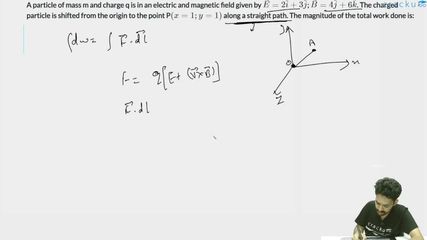
A particle of mass m and charge q is in an electric and magnetic field given by $$\vec{E} = 2\hat{i} + 3\hat{j}$$; $$\vec{B} = 4\hat{j} + 6\hat{k}$$. The charged particle is shifted from the origin to the point P$$(x = 1; y = 1)$$ along a straight path. The magnitude of the total work done is:
First, recall the general Lorentz force law on a charged particle:
$$\vec{F}=q\left(\vec{E}+\vec{v}\times\vec{B}\right)$$
The differential work done $$dW$$ by this force when the particle is displaced by an infinitesimal vector $$d\vec{l}$$ is obtained from the dot product of force and displacement:
$$dW=\vec{F}\cdot d\vec{l}=q\left(\vec{E}+\vec{v}\times\vec{B}\right)\cdot d\vec{l}$$
Now, note an important fact: the magnetic part $$q(\vec{v}\times\vec{B})$$ is always perpendicular to the instantaneous velocity $$\vec{v}$$, and therefore perpendicular to the displacement element $$d\vec{l}$$ (because $$d\vec{l}=\vec{v}\,dt$$). The dot product of two perpendicular vectors is zero, so the magnetic term does no work:
$$\left(\vec{v}\times\vec{B}\right)\cdot d\vec{l}=0$$
Hence, the total work comes solely from the electric field, and we may write
$$dW=q\,\vec{E}\cdot d\vec{l}$$
To find the total work, integrate along the given path from the origin O$$(0,0,0)$$ to the point P$$(1,1,0)$$:
$$W=\int_{O}^{P} q\,\vec{E}\cdot d\vec{l}=q\int_{O}^{P}\vec{E}\cdot d\vec{l}$$
The electric field is uniform and constant:
$$\vec{E}=2\hat{i}+3\hat{j}$$
Because it is constant, we may pull it out of the integral and simply dot it with the net displacement vector $$\Delta\vec{r}$$:
$$W=q\,\vec{E}\cdot\Delta\vec{r}$$
The displacement from O to P is
$$\Delta\vec{r}=(1-0)\hat{i}+(1-0)\hat{j}+(0-0)\hat{k}=1\hat{i}+1\hat{j}$$
Now take the dot product:
$$\vec{E}\cdot\Delta\vec{r}=(2\hat{i}+3\hat{j})\cdot(1\hat{i}+1\hat{j})=2\cdot1+3\cdot1=2+3=5$$
Substituting this result into the work expression, we obtain
$$W=q\times5=5q$$
This value is already positive, so its magnitude is simply $$5q$$.
Hence, the correct answer is Option B.
Was this solution helpful?
Click on the Email ☝️ to Watch the Video Solution
Create a FREE account and get:
_1.webp)

Educational materials for JEE preparation

Ask our AI anything

AI can make mistakes. Please verify important information.
AI can make mistakes. Please verify important information.


