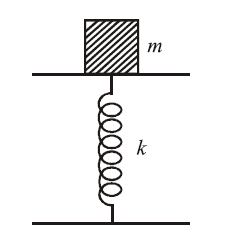
A simple pendulum of string length 30 cm performs 20 oscillations in 10 s. The length of the string required for the pendulum to perfo rm 40 oscillations in the same time duration is _________cm. [Assume that the mass of the pendulum remains same.]
- Home
- >
- JEE Questions
- >
- JEE Physics Questions
- >
- Oscillations
JEE Oscillations Questions
$$T = 2\pi\sqrt{L/g}$$. $$T_1 = 10/20 = 0.5$$s. $$T_2 = 10/40 = 0.25$$s. $$T_2/T_1 = 1/2 = \sqrt{L_2/L_1}$$. $$L_2 = L_1/4 = 30/4 = 7.5$$ cm.
The answer is Option 4: 7.5 cm.
A spring of force constant 15 N/m is cut into two pieces. If the ratio of their length is 1:3, then the force constant of smaller piece is __ /m.
We need to find the force constant of the smaller piece when a spring of force constant 15 N/m is cut in the ratio 1:3.
Since the force constant k of a spring of length L is inversely proportional to its length, we have $$k \times L = k_1 \times L_1 = k_2 \times L_2 = \text{constant}$$
Given that k = 15 N/m and the spring is cut in the ratio 1:3, if the total length is L then the smaller piece has length $$L_1 = \frac{L}{4}$$ and the larger piece has length $$L_2 = \frac{3L}{4}$$.
Substituting into the relation gives $$k_1 = \frac{k \times L}{L_1} = \frac{15 \times L}{\frac{L}{4}} = 15 \times 4 = 60 \text{ N/m}$$
Therefore, the force constant of the smaller piece is 60 N/m (Option 3).
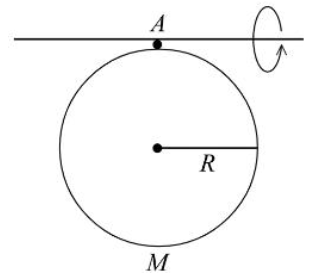
A uniform disc of radius R and mass M is free to oscillate about the axis A as shown in the figure. For small oscillations the time period is ______. ( g is acceleration due to gravity)
For small-angle oscillations about a fixed horizontal axis, any rigid body behaves as a physical pendulum. Its time period is
$$T = 2\pi\sqrt{\frac{I_A}{Mgd}} \quad -(1)$$
where
• $$I_A$$ is the moment of inertia about the axis of suspension A,
• $$M$$ is the mass of the body,
• $$d$$ is the distance between the axis A and the centre of mass (C.O.M.),
• $$g$$ is the acceleration due to gravity.
Moment of inertia about axis A
The disc is uniform, has radius $$R$$ and mass $$M$$. The axis A passes through a point on the rim and is perpendicular to the plane of the disc (a tangential axis). Using the parallel-axis theorem,
$$I_A = I_{\text{cm dia}} + Md^{2} \quad -(2)$$
Here,
• $$I_{\text{cm dia}}$$ for a disc about its central axis (parallel to the plane) is $$\frac{1}{4}MR^{2}$$.
• The distance from the rim to the centre is $$d = R$$.
Substitute in $$(2):$$
$$I_A = \frac{1}{4}MR^{2} \;+\; M R^{2} \;=\; \frac{5}{4} M R^{2} \quad -(3)$$
Distance $$d$$ between axis and C.O.M.
The C.O.M. of a uniform disc is at its centre, so $$d = R$$.
Time period
Insert $$I_A$$ from $$(3)$$ and $$d = R$$ into the physical-pendulum formula $$(1):$$
$$T = 2\pi\sqrt{\frac{\frac{5}{4}MR^{2}}{M g R}} = 2\pi\sqrt{\frac{5}{4}\,\frac{R}{g}} = 2\pi\sqrt{\frac{5R}{4g}}$$
Thus the time period of oscillation is
$$T = 2\pi\sqrt{\frac{5R}{4g}}$$
Option A which is: $$2\pi\sqrt{\frac{5R}{4g}}$$
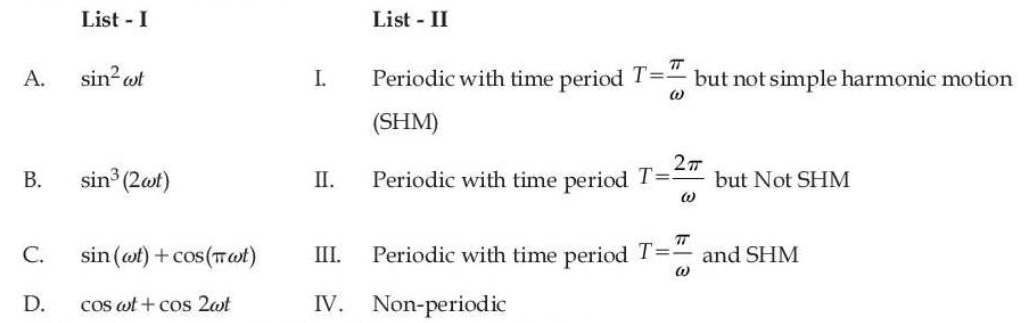
Match the List I with List II:
Choose the correct answer from the options given below:
A. $$\sin^2\omega t$$ can be rewritten as $$\frac{1}{2} - \frac{1}{2}\cos(2\omega t)$$. Since it consists of a single sinusoidal term, it represents SHM with a time period $$T = \frac{2\pi}{2\omega} = \frac{\pi}{\omega}$$ $$\rightarrow \text{III}$$
B. $$\sin^3(2\omega t)$$ expands to $$\frac{3}{4}\sin(2\omega t) - \frac{1}{4}\sin(6\omega t)$$. The combination of multiple distinct harmonic frequencies means it is not SHM. Its fundamental period is governed by the lowest frequency ($$2\omega$$), giving $$T = \frac{2\pi}{2\omega} = \frac{\pi}{\omega}$$ $$\rightarrow \text{I}$$C. $$\sin(\omega t) + \cos(\pi\omega t)$$, the individual periods are $$T_1 = \frac{2\pi}{\omega}$$ and $$T_2 = \frac{2}{\omega}$$. Their ratio $$\frac{T_1}{T_2} = \pi$$ is an irrational number, which makes the combined function non-periodic $$\rightarrow \text{IV}$$
D. $$\cos\omega t + \cos 2\omega t$$ contains two separate harmonic frequencies ($$\omega$$ and $$2\omega$$), so it is not SHM. The overall time period is the LCM of their individual periods ($$\frac{2\pi}{\omega}$$ and $$\frac{\pi}{\omega}$$), which equals $$\frac{2\pi}{\omega}$$ $$\rightarrow \text{II}$$
A spring stretches by 2 mm when it is loaded with a mass of 200 g. From equilibrium position the mass is further pulled down by 2 mm and released. The frequency associated with the system and maximum energy in the spring are __________ Hz and __________ J, respectively. (Take $$g = 10$$ m/s$$^2$$)
Mass, $$ m = 200 \text{ g} = 0.2 \text{ kg} $$
Initial stretch, $$ x_0 = 2 \text{ mm} = 2 \times 10^{-3} \text{ m} $$
At equilibrium, the restoring force of the spring balances the weight of the mass:
$$ k x_0 = mg $$
$$ k = \frac{mg}{x_0} $$
$$ k = \frac{0.2 \times 10}{2 \times 10^{-3}} = \frac{2}{2 \times 10^{-3}} = 1000 \text{ N/m} $$
The natural frequency of the spring-mass system is given by the formula:
$$ f = \frac{1}{2\pi} \sqrt{\frac{k}{m}} $$
$$ f = \frac{1}{2\pi} \sqrt{\frac{1000}{0.2}} $$
$$ f = \frac{1}{2\pi} \sqrt{5000} $$
$$ f = \frac{50\sqrt{2}}{2\pi} $$
$$ f = \frac{25\sqrt{2}}{\pi} \text{ Hz} $$
The maximum extension of the spring from its natural, unstretched length ($$x_{max}$$) occurs at the lowest point of the oscillation:
$$ x_{max} = x_0 + A $$
$$ x_{max} = 2 \text{ mm} + 2 \text{ mm} = 4 \text{ mm} = 4 \times 10^{-3} \text{ m} $$
The maximum elastic potential energy stored in the spring is:
$$ U_{max} = \frac{1}{2} k (x_{max})^2 $$
$$ U_{max} = \frac{1}{2} (1000) (4 \times 10^{-3})^2 $$
$$ U_{max} = 500 \times (16 \times 10^{-6}) $$
$$ U_{max} = 8000 \times 10^{-6} $$
$$ U_{max} = 8 \times 10^{-3} \text{ J} $$
A particle is executing simple harmonic motion. Its amplitude is $$A$$ and time period is 5 sec. The time required by it to move from $$x = A$$ to $$x = \frac{A}{\sqrt{2}}$$ is _______ sec.
$$x(t) = A \cos(\omega t)$$
$$\frac{A}{\sqrt{2}} = A \cos(\omega t)$$
$$\cos(\omega t) = \frac{1}{\sqrt{2}}$$
$$\omega t = \frac{\pi}{4}$$
$$\frac{2\pi}{T} t = \frac{\pi}{4}$$
$$t = \frac{T}{8}$$
Given $$T = 5$$: $$t = \frac{5}{8}$$
The frequency of oscillation of a mass $$m$$ suspended by a spring is $$v_1$$. If the length of the spring is cut to half, the same mass oscillates with frequency $$v_2$$. The value of $$\frac{v_2}{v_1}$$ is __________.
For a spring-mass system:
$$\nu=\frac{1}{2\pi}\sqrt{\frac{k}{m}}$$
For a spring:
$$k\propto\frac{1}{L}$$
So if length is halved:
$$k_2=2k_1$$
Now frequency:
$$nu_2=\frac{1}{2\pi}\sqrt{\frac{2k_1}{m}}=\sqrt{2}$$
final answer:
$$\frac{\nu_2}{\nu_1}=\sqrt{2}$$
The equation of motion of a particle is given by $$x = a\sin\left(50t + \frac{\pi}{3}\right)$$ cm. The particle will come to rest at time $$t_1$$ and it will have zero acceleration at time $$t_2$$. The $$t_1$$ and $$t_2$$ respectively are _____.
The displacement of the particle is given by $$x = a \sin\!\left(50t + \frac{\pi}{3}\right) \text{ cm}$$.
For any simple harmonic motion $$x = a \sin(\omega t + \phi)$$, the angular frequency is $$\omega$$.
Here $$\omega = 50 \, \text{rad s}^{-1}$$.
Time $$t_1$$ when the particle comes to rest (velocity $$v = 0$$)
Velocity is the first derivative of displacement:
$$v = \frac{dx}{dt} = a \cdot 50 \cos\!\left(50t + \frac{\pi}{3}\right).$$
Set $$v = 0$$:
$$\cos\!\left(50t + \frac{\pi}{3}\right) = 0.$$
Cosine is zero at odd multiples of $$\frac{\pi}{2}$$, so
$$50t + \frac{\pi}{3} = \left(2n + 1\right)\frac{\pi}{2},\;\; n \in \mathbb{Z}.$$
Choosing the smallest positive time means taking $$n = 0$$:
$$50t_1 + \frac{\pi}{3} = \frac{\pi}{2}$$
$$\Rightarrow\; 50t_1 = \frac{\pi}{2} - \frac{\pi}{3} = \frac{\pi}{6}$$
$$\Rightarrow\; t_1 = \frac{\pi}{6}\,\frac{1}{50} = \frac{\pi}{300}\;\text{s}.$$
Time $$t_2$$ when the acceleration is zero (acceleration $$a_x = 0$$)
Acceleration is the second derivative of displacement:
$$a_x = \frac{d^2x}{dt^2} = -\,50^2 a \sin\!\left(50t + \frac{\pi}{3}\right).$$
Set $$a_x = 0$$:
$$\sin\!\left(50t + \frac{\pi}{3}\right) = 0.$$
Sine is zero at integral multiples of $$\pi$$, so
$$50t + \frac{\pi}{3} = n\pi,\;\; n \in \mathbb{Z}.$$
The smallest positive time occurs for $$n = 1$$ (because $$n = 0$$ gives a negative time):
$$50t_2 + \frac{\pi}{3} = \pi$$
$$\Rightarrow\; 50t_2 = \pi - \frac{\pi}{3} = \frac{2\pi}{3}$$
$$\Rightarrow\; t_2 = \frac{2\pi}{3}\,\frac{1}{50} = \frac{\pi}{75}\;\text{s}.$$
Therefore, $$t_1 = \frac{\pi}{300}\,\text{s}$$ and $$t_2 = \frac{\pi}{75}\,\text{s}$$.
Option A: $$\frac{\pi}{300}\, \text{s},\; \frac{\pi}{75}\, \text{s}$$ is correct.
The velocity of a particle executing simple harmonic motion along $$x$$-axis is described as $$v^2 = 50 - x^2$$, where $$x$$ represents displacement. If the time period of motion is $$\frac{x}{7}$$ s, the value of $$x$$ is _____.
For a particle in simple harmonic motion, the standard velocity-displacement relation is
$$v^2 = \omega^2\left(A^2 - x^2\right)$$
where $$A$$ is the amplitude and $$\omega$$ is the angular frequency.
The given relation is
$$v^2 = 50 - x^2$$.
Match coefficients with the standard form:
$$\omega^2 A^2 = 50 \quad\text{and}\quad \omega^2 = 1$$
From $$\omega^2 = 1$$ we get
$$\omega = 1\; \text{rad s}^{-1}$$.
The time period $$T$$ of SHM is
$$T = \frac{2\pi}{\omega} = 2\pi\; \text{s}$$.
The question states that the time period is also $$\dfrac{x}{7}\,\text{s}$$, so
$$\frac{x}{7} = 2\pi \;\Longrightarrow\; x = 14\pi.$$
Numerically, $$14\pi \approx 43.98 \approx 44.$$
Therefore, the required value of $$x$$ is 44.
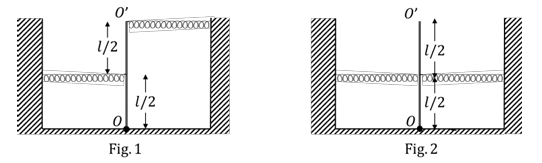
As shown in the figures, a uniform rod $$OO'$$ of length $$l$$ is hinged at the point $$O$$ and held in place vertically between two walls using two massless springs of same spring constant. The springs are connected at the midpoint and at the top-end ($$O'$$) of the rod, as shown in Fig. 1 and the rod is made to oscillate by a small angular displacement. The frequency of oscillation of the rod is $$f_1$$. On the other hand, if both the springs are connected at the midpoint of the rod, as shown in Fig. 2 and the rod is made to oscillate by a small angular displacement, then the frequency of oscillation is $$f_2$$.
Ignoring gravity and assuming motion only in the plane of the diagram, the value of $$\frac{f_1}{f_2}$$ is:
Let the mass of the rod be $$m$$ and its length be $$l$$. It oscillates about the fixed hinge $$O$$ with a small angular displacement $$\theta$$ (taken positive for a clockwise rotation). Gravity is ignored, so only the springs give the restoring torque.
1. Moment of inertia about the hinge
For a uniform rod of length $$l$$ about one end,
$$I = \frac{1}{3} m l^{2}$$
2. Extension produced in a spring connected at distance $$r$$ from the hinge
When the rod rotates through a small angle $$\theta$$, every point at a distance $$r$$ from the hinge moves through an arc of length $$r\theta$$ perpendicular to the rod’s original position.
Hence the linear extension (or compression) of a spring attached at that point is also $$r\theta.$$
3. Restoring torque of one spring
Spring force $$F = k \,(r\theta) \quad\Rightarrow\quad$$ Torque about $$O: \quad \tau = F \cdot r = k \, r^{2}\theta.$$
Therefore each spring contributes a restoring torque equal to $$k r^{2}\theta.$$
4. Angular equation of motion
Sum of restoring torques $$= k\,(r_1^{2}+r_2^{2})\,\theta.$$
Hence
$$I\,\ddot{\theta} + k\,(r_1^{2}+r_2^{2})\,\theta = 0\; \Longrightarrow\; \omega = \sqrt{\dfrac{k\,(r_1^{2}+r_2^{2})}{I}}.$$
The linear frequency is $$f = \dfrac{\omega}{2\pi},$$ so the ratio $$f_1/f_2$$ equals the ratio $$\omega_1/\omega_2.$$
Case 1: (Fig. 1)
Springs at $$r_1=l/2$$ and $$r_2=l$$
$$r_1^{2}+r_2^{2} = \left(\frac{l}{2}\right)^{2} + l^{2} = \frac{l^{2}}{4}+l^{2} = \frac{5}{4}l^{2}.$$
$$\displaystyle \omega_1 = \sqrt{\dfrac{k\left(\tfrac{5}{4}l^{2}\right)}{I}}.$$
Case 2: (Fig. 2)
Both springs at $$r_1=r_2=l/2$$
$$r_1^{2}+r_2^{2} = 2\left(\frac{l}{2}\right)^{2} = 2\left(\frac{l^{2}}{4}\right)=\frac{l^{2}}{2}.$$
$$\displaystyle \omega_2 = \sqrt{\dfrac{k\left(\tfrac{l^{2}}{2}\right)}{I}}.$$
5. Ratio of frequencies
$$\frac{f_1}{f_2}=\frac{\omega_1}{\omega_2}=
\sqrt{\dfrac{k\left(\tfrac{5}{4}l^{2}\right)}{I}} \;\Bigg/\; \sqrt{\dfrac{k\left(\tfrac{l^{2}}{2}\right)}{I}}
= \sqrt{\dfrac{\tfrac{5}{4}l^{2}}{\tfrac{l^{2}}{2}}}
= \sqrt{\dfrac{5}{4}\cdot\dfrac{2}{1}}
= \sqrt{\dfrac{10}{4}}
= \sqrt{\dfrac{5}{2}}.$$
Hence $$\displaystyle \frac{f_1}{f_2} = \sqrt{\frac{5}{2}}.$$ Option C is correct.
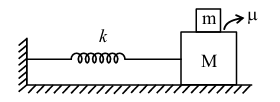
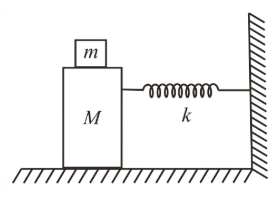
Two blocks of masses m and M, $$(M \gt m)$$, are placed on a frictionless table as shown in figure. A massless spring with spring constant k is attached with the lower block. If the system is slightly displaced and released then ($$\mu$$ = coefficient of friction between the two blocks)
(A) The time period of small oscillation of the two blocks is $$T = 2\pi\sqrt{\frac{m+M}{k}}$$
(B) The acceleration of the blocks is $$a = \frac{kx}{M+m}$$
(C) The magnitude of the frictional force on upper block is $$\frac{m\mu|x|}{M+m}$$
(D) The maximum amplitude of the upper block, if it does not slip, is $$\frac{\mu(M+m)g}{k}$$
(E) Maximum frictional force can be $$\mu(M+m)g$$.
Choose the correct answer from the options given below :
Treat both blocks as one system (if no slipping occurs).
Total mass
M+m
Restoring force by spring:
F=−kx
So equation of motion is
$$(M+m)a=-kx$$
Thus
$$a=-\frac{kx}{M+m}$$
So (B) is correct.
For SHM,
$$\omega=\sqrt{\frac{k}{M+m}}$$
Hence
$$T=2\pi\sqrt{\frac{M+m}{k}}$$
So (A) is correct.
For upper block m, only horizontal force is friction.
It must provide acceleration
$$a=\frac{kx}{M+m}$$
Therefore friction needed is
$$f=ma$$
$$f=\frac{mkx}{M+m}$$
So (C) is wrong
For no slipping,
required friction must not exceed maximum static friction:
$$\frac{mkA}{M+m}\le\mu mg$$
Cancel m:
$$\frac{kA}{M+m}\le\mu g$$
Thus maximum amplitude
$$A_{\max}=\frac{\mu(M+m)g}{k}$$
So (D) is correct.
Now (E):
Maximum possible friction between blocks is
$$f_{\max}=\mu N$$
Normal reaction is only due to upper block’s weight:
N=mg
So
$$f_{\max}=\mu mg$$
So (E) is false.
A particle is subjected to two simple harmonic motions as:
$$x_1 = \sqrt{7} \sin 5t$$ cm
and $$x_2 = 2\sqrt{7} \sin\left(5t + \frac{\pi}{3}\right)$$ cm
where x is displacement and $$t$$ is time in seconds. The maximum acceleration of the particle is $$x \times 10^{-2}$$ ms$$^{-2}$$. The value of x is:
The net displacement of the particle is the algebraic sum of the two given SHMs that have the same angular frequency $$\omega = 5 \text{ s}^{-1}$$:
$$x = x_1 + x_2 = \sqrt{7}\,\sin 5t + 2\sqrt{7}\,\sin\left(5t + \frac{\pi}{3}\right) \text{ cm}$$
When two SHMs with the same $$\omega$$ are added, the result is again an SHM with the same $$\omega$$ but with a new amplitude $$R$$ obtained from the phasor (vector) addition formula:
$$R = \sqrt{A_1^{2} + A_2^{2} + 2A_1A_2\cos\phi}$$
where
$$A_1 = \sqrt{7}\text{ cm},\quad A_2 = 2\sqrt{7}\text{ cm},\quad\phi = \frac{\pi}{3}$$
Compute each term:
$$A_1^{2} = 7,\quad A_2^{2} = 28,$$
$$2A_1A_2\cos\phi = 2(\sqrt{7})(2\sqrt{7})\cos\frac{\pi}{3} = 4\cdot7\cdot\frac12 = 14$$
Therefore,
$$R = \sqrt{7 + 28 + 14} = \sqrt{49} = 7\text{ cm}$$
The combined motion can thus be written as
$$x = 7\sin(5t + \delta)\text{ cm}$$
for some phase constant $$\delta$$.
The acceleration in SHM is given by $$a = -\omega^{2}x$$. Hence, the magnitude of the maximum acceleration is
$$a_{\max} = \omega^{2}R$$
Convert the amplitude to metres: $$R = 7\text{ cm} = 7\times10^{-2}\text{ m}$$.
Now substitute $$\omega = 5\text{ s}^{-1}$$:
$$a_{\max} = (5)^{2}\,(7\times10^{-2}) = 25 \times 0.07 = 1.75\text{ m s}^{-2}$$
The question states $$a_{\max} = x \times 10^{-2}\text{ m s}^{-2}$$. Write $$1.75$$ in that form:
$$1.75 = 175 \times 10^{-2}$$
Hence, $$x = 175$$.
Option A is correct.
A particle is executing simple harmonic motion with time period $$2\,s$$ and amplitude $$1\,cm.$$ If $$D$$ and $$d$$ are the total distance and displacement covered by the particle in $$12.5\,s,$$ then $$\frac{D}{d}$$ is:
A particle executes SHM with time period $$T = 2$$ s and amplitude $$A = 1$$ cm. We need the ratio $$D/d$$ after 12.5 s, where $$D$$ = total distance and $$d$$ = displacement.
Since $$12.5 \text{ s} = 6 \times 2 + 0.5 = 6T + T/4$$, the particle completes 6 full periods and an additional $$T/4$$.
In each complete period the particle traverses a distance of $$4A$$, so in 6 complete periods the distance is $$6 \times 4A = 24A$$. In the additional $$T/4$$ the particle moves from the mean position to the extreme, covering a distance $$A$$. Therefore $$D = 24A + A = 25A = 25 \text{ cm}$$.
After 6 complete periods the displacement is zero, and during the additional $$T/4$$ the particle reaches the extreme, so $$d = A = 1 \text{ cm}$$.
Therefore $$\frac{D}{d} = \frac{25}{1} = 25$$, which corresponds to Option (4): 25.
Two simple pendulums having lengths $$l_1$$ and $$l_2$$ with negligible string mass undergo angular displacements $$\theta_1$$ and $$\theta_2$$, from their mean positions, respectively. If the angular accelerations of both pendulums are same, then which expression is correct?
For a simple pendulum executing small-angle oscillations, the restoring torque gives the angular equation of motion
$$\alpha = -\frac{g}{l}\,\theta$$
where $$\alpha$$ is the angular acceleration, $$g$$ is the acceleration due to gravity and $$l$$ is the length of the pendulum.
Case 1: First pendulum
Length $$= l_1$$, angular displacement $$= \theta_1$$
Therefore
$$\alpha_1 = -\frac{g}{l_1}\,\theta_1$$ $$-(1)$$
Case 2: Second pendulum
Length $$= l_2$$, angular displacement $$= \theta_2$$
Therefore
$$\alpha_2 = -\frac{g}{l_2}\,\theta_2$$ $$-(2)$$
The question states that both pendulums have the same angular acceleration, so
$$\alpha_1 = \alpha_2$$ $$-(3)$$
Substituting $$(1)$$ and $$(2)$$ into $$(3)$$:
$$-\frac{g}{l_1}\,\theta_1 = -\frac{g}{l_2}\,\theta_2$$
The factor $$-g$$ is common on both sides and cancels out, giving
$$\frac{\theta_1}{l_1} = \frac{\theta_2}{l_2}$$
Cross-multiplying, we obtain the required relation
$$\theta_1\,l_2 = \theta_2\,l_1$$
This matches Option D.
Answer : Option D
Given below are two statements : one is labelled as Assertion (A) and the other is labelled as Reason (R). Assertion (A) : Time period of a simple pendulum is longer at the top of a mountain than that at the base of the mountain. Reason (R): Time period of a simple pendulum decreases with increasing value of acceleration due to gravity and vice-versa. In the light of the above statements, choose the most appropriate answer from the options given below :
We need to evaluate the Assertion and Reason about a simple pendulum on a mountain.
Assertion (A): "Time period of a simple pendulum is longer at the top of a mountain than that at the base of the mountain."
Analysis: The time period of a simple pendulum is given by:
$$T = 2\pi\sqrt{\frac{l}{g}}$$
where $$l$$ is the length and $$g$$ is the acceleration due to gravity. At the top of a mountain, the distance from the Earth's center increases, so $$g$$ decreases (since $$g = GM/R^2$$ and the effective $$R$$ increases). With a smaller $$g$$, the time period $$T$$ increases (longer period). Assertion (A) is TRUE.
Reason (R): "Time period of a simple pendulum decreases with increasing value of acceleration due to gravity and vice-versa."
Analysis: From the formula $$T = 2\pi\sqrt{l/g}$$, we see that $$T \propto 1/\sqrt{g}$$. As $$g$$ increases, $$T$$ decreases, and as $$g$$ decreases, $$T$$ increases. Reason (R) is TRUE.
Relationship: The Reason directly explains the Assertion. The pendulum has a longer period on the mountain because $$g$$ is smaller there, and as R states, a smaller $$g$$ leads to a longer time period. R is the correct explanation of A.
The correct answer is Option 1: Both (A) and (R) are true and (R) is the correct explanation of (A).
A block of mass 2 kg is attached to one end of a massless spring whose other end is fixed at a wall. The spring-mass system moves on a frictionless horizontal table. The spring's natural length is 2 m and spring constant is 200 N/m. The block is pushed such that the length of the spring becomes 1 m and then released. At distance x m (x < 2) from the wall, the speed of the block will be :
Let the natural (unstretched) length of the spring be $$L_0 = 2\,\text{m}$$.
The free end of the spring is fixed to the wall and the block of mass $$m = 2\,\text{kg}$$ is attached to the other end.
When the spring is compressed to a length $$1\,\text{m}$$ and released, the compression produced is
$$y_{\text{max}} = L_0 - 1 = 2 - 1 = 1\,\text{m}$$.
This maximum compression is the amplitude $$A$$ of the ensuing simple harmonic motion (SHM):
$$A = 1\,\text{m}$$.
The force constant (spring constant) is $$k = 200\,\text{N\,m}^{-1}$$, so the angular frequency of the SHM is
$$\omega = \sqrt{\frac{k}{m}} = \sqrt{\frac{200}{2}} = \sqrt{100} = 10\,\text{rad\,s}^{-1}$$.
At any instant, let the actual length of the spring (i.e., the distance of the block from the wall) be $$x$$ metres.
Because $$x \lt 2\,\text{m}$$, the spring is compressed.
Define the instantaneous compression (displacement from the natural length) as
$$y = L_0 - x = 2 - x.$$
For SHM with amplitude $$A$$, angular frequency $$\omega$$ and displacement $$y$$ from equilibrium (natural length here), the speed $$v$$ is related by the standard formula
$$v = \omega \sqrt{A^{2} - y^{2}}\;.$$
Substituting $$\omega = 10\,\text{rad\,s}^{-1}$$, $$A = 1\,\text{m}$$ and $$y = 2 - x$$:
$$v = 10 \sqrt{1^{2} - (2 - x)^{2}} = 10\,[\,1 - (2 - x)^{2}\,]^{1/2}\,\text{m\,s}^{-1}.$$
Hence the speed of the block when it is at a distance $$x$$ from the wall is given by
Option B: $$\displaystyle 10[1 - (2 - x)^{2}]^{1/2}\,\text{m\,s}^{-1}\;.$$
A block of mass 5 kg moves along the x-direction subject to the force $$F = (-20x + 10)$$ N, with the value of $$x$$ in metre. At time $$t = 0$$ s, it is at rest at position $$x = 1$$ m. The position and momentum of the block at $$t = (\pi/4)$$ s are
The force on the block is position-dependent: $$F(x)= -20x+10$$.
Rewrite it in the standard spring form:
$$F(x)= -20x+10 = -20\bigl(x-0.5\bigr)$$
Hence it behaves like a spring of effective force constant $$k=20\text{ N/m}$$ whose natural (equilibrium) position is
$$x_0 = 0.5\text{ m}$$ because $$F(x_0)=0$$.
For a mass $$m=5\text{ kg}$$ attached to such a “spring”, the angular frequency of simple harmonic motion is
$$\omega = \sqrt{\frac{k}{m}} = \sqrt{\frac{20}{5}} = 2\text{ rad s}^{-1}$$.
Define the displacement from equilibrium as $$y = x - x_0$$.
Then the SHM equation is $$\frac{d^2y}{dt^2}+ \omega^{2}y = 0$$, whose general solution is
$$y(t)=A\cos(\omega t + \phi)$$.
Initial conditions (given at $$t=0$$):
Position $$x(0)=1\text{ m}\;\Rightarrow\;y(0)=1-0.5 = 0.5\text{ m}$$
Velocity $$v(0)=0\;\Rightarrow\;\frac{dy}{dt}\Bigl|_{t=0}=0$$.
Using $$y(0)=A\cos\phi$$ and $$v(0)=-A\omega\sin\phi$$:
• $$-A\omega\sin\phi = 0 \;\Rightarrow\; \sin\phi = 0 \;\Rightarrow\; \phi = 0 \text{ or } \pi$$.
• With $$\phi = 0$$, $$A = y(0)/\cos 0 = 0.5\text{ m}$$ (if $$\phi=\pi$$ the cosine is $$-1$$ giving a negative displacement, which contradicts $$y(0)=+0.5\text{ m}$$).
Thus
$$y(t)=0.5\cos(2t)$$
and hence
$$x(t)=y(t)+x_0 = 0.5\cos(2t)+0.5$$.
Evaluate at $$t=\frac{\pi}{4}\text{ s}$$:
• Angle $$2t = 2\left(\frac{\pi}{4}\right)=\frac{\pi}{2}$$.
• Position $$x\!\left(\frac{\pi}{4}\right)=0.5\cos\!\frac{\pi}{2}+0.5=0+0.5=0.5\text{ m}$$.
Velocity is the time derivative of position:
$$v(t) = \frac{dx}{dt}= -0.5\cdot 2 \sin(2t)= -\sin(2t)$$.
At $$t=\frac{\pi}{4}\text{ s}$$, $$\sin\!\frac{\pi}{2}=1$$, so
$$v\!\left(\frac{\pi}{4}\right)= -1\text{ m/s}$$.
Momentum $$p = m v = 5\text{ kg}\times(-1\text{ m/s}) = -5\text{ kg m/s}$$.
Therefore, at $$t = \frac{\pi}{4}\text{ s}$$ the block is at $$x = 0.5\text{ m}$$ with momentum $$p = -5\text{ kg m/s}$$.
Option C which is: $$0.5\text{ m},\;-5\text{ kg m/s}$$.
A mass $$m$$ is suspended from a spring of negligible mass and the system oscillates with a frequency $$f_1$$. The frequency of oscillations if a mass $$9m$$ is suspended from the same spring is $$f_2$$. The value of $$\frac{f_1}{f_2}$$ is ______.
A mass $$m$$ oscillates with frequency $$f_1$$ when suspended from a spring, and a mass $$9m$$ oscillates with frequency $$f_2$$ from the same spring. We need $$\frac{f_1}{f_2}$$.
For a mass-spring system, the angular frequency is:
$$\omega = \sqrt{\frac{k}{M}}$$
where $$k$$ is the spring constant and $$M$$ is the mass. The frequency is:
$$f = \frac{1}{2\pi}\sqrt{\frac{k}{M}}$$
$$f_1 = \frac{1}{2\pi}\sqrt{\frac{k}{m}}$$
$$f_2 = \frac{1}{2\pi}\sqrt{\frac{k}{9m}}$$
$$\frac{f_1}{f_2} = \frac{\sqrt{\frac{k}{m}}}{\sqrt{\frac{k}{9m}}} = \sqrt{\frac{k}{m} \cdot \frac{9m}{k}} = \sqrt{9} = 3$$
The answer is $$\frac{f_1}{f_2} = \textbf{3}$$.
A particle executes simple harmonic motion with an amplitude of $$4$$ cm. At the mean position, velocity of the particle is $$10 \text{ cm s}^{-1}$$. The distance of the particle from the mean position when its speed becomes $$5 \text{ cm s}^{-1}$$ is $$\sqrt{\alpha}$$ cm, where $$\alpha =$$ ______.
In SHM, the velocity at displacement $$x$$ from mean position is:
$$v = \omega\sqrt{A^2 - x^2}$$
At mean position ($$x = 0$$): $$v_{max} = \omega A = 10$$ cm/s, with $$A = 4$$ cm.
So $$\omega = \frac{10}{4} = 2.5$$ rad/s.
When $$v = 5$$ cm/s:
$$5 = 2.5\sqrt{16 - x^2}$$
$$2 = \sqrt{16 - x^2}$$
$$4 = 16 - x^2$$
$$x^2 = 12$$
$$x = \sqrt{12}$$ cm
So $$\alpha = 12$$.
The answer is $$\boxed{12}$$.
A particle is doing simple harmonic motion of amplitude $$0.06 \text{ m}$$ and time period $$3.14 \text{ s}$$. The maximum velocity of the particle is _______ cm/s.
$$v_{max} = A\omega = A \times \frac{2\pi}{T} = 0.06 \times \frac{2\pi}{3.14} = 0.06 \times 2 = 0.12$$ m/s = 12 cm/s.
The answer is 12.
A particle performs simple harmonic motion with amplitude $$A$$. Its speed is increased to three times at an instant when its displacement is $$\frac{2A}{3}$$. The new amplitude of motion is $$\frac{nA}{3}$$. The value of $$n$$ is _____.
A particle in SHM with amplitude $$A$$ has its speed tripled at the instant when its displacement is $$\frac{2A}{3}$$. We need to find the new amplitude $$A' = \frac{nA}{3}$$.
We start by recalling the velocity-displacement relation in SHM.
For a particle in SHM with angular frequency $$\omega$$ and amplitude $$A$$:
$$ v^2 = \omega^2(A^2 - x^2) $$
At the instant $$x = \frac{2A}{3}$$, the original speed is found as follows:
$$ v^2 = \omega^2\left(A^2 - \frac{4A^2}{9}\right) = \omega^2 \cdot \frac{9A^2 - 4A^2}{9} = \frac{5\omega^2 A^2}{9} $$
Next, when the speed is tripled to $$3v$$ while the displacement remains $$x = \frac{2A}{3}$$ and the angular frequency $$\omega$$ is unchanged, the new amplitude $$A'$$ satisfies:
$$ (3v)^2 = \omega^2(A'^2 - x^2) $$
$$ 9v^2 = \omega^2\left(A'^2 - \frac{4A^2}{9}\right) $$
Substituting the value of $$v^2$$ gives:
$$ 9 \times \frac{5\omega^2 A^2}{9} = \omega^2\left(A'^2 - \frac{4A^2}{9}\right) $$
$$ 5\omega^2 A^2 = \omega^2\left(A'^2 - \frac{4A^2}{9}\right) $$
Dividing both sides by $$\omega^2$$ leads to:
$$ 5A^2 = A'^2 - \frac{4A^2}{9} $$
$$ A'^2 = 5A^2 + \frac{4A^2}{9} = \frac{45A^2 + 4A^2}{9} = \frac{49A^2}{9} $$
Finally, solving for $$A'$$ and determining $$n$$ gives:
$$ A' = \sqrt{\frac{49A^2}{9}} = \frac{7A}{3} $$
Since $$A' = \frac{nA}{3}$$, it follows that $$n = 7$$.
The answer is $$\boxed{7}$$.
A simple harmonic oscillator has an amplitude $$A$$ and time period $$6\pi$$ second. Assuming the oscillation starts from its mean position, the time required by it to travel from $$x = A$$ to $$x = \frac{\sqrt{3}}{2}A$$ will be $$\frac{\pi}{x}$$ s, where $$x =$$ ______.
Given time period
T=6π
So angular frequency
$$\omega=\frac{2\pi}{T}$$
$$=\frac{2\pi}{6\pi}$$
$$=\frac{1}{3}$$
Since oscillation starts from mean position,
$$x=A\sin\omega t$$
We need time taken from
$$x=A$$
to
$$x=\frac{\sqrt{3}}{2}A$$
At
x=A
$$\sin\omega t_1=1$$
$$t_1=\frac{\pi}{2}ω$$
At
$$x=\frac{\sqrt{3}}{2}A$$
while returning from extreme point,
$$\sin\omega t_2=\frac{\sqrt{3}}{2}$$
after $$\pi/2$$, corresponding angle is
$$\omega t_2=\frac{2\pi}{3}$$
So required time is
$$\Delta t=\frac{\frac{2\pi}{3}-\frac{\pi}{2}}{\omega}$$
$$=\frac{\pi/6}{1/3}$$
$$=\frac{\pi}{2}$$
Given
$$\Delta t=\frac{\pi}{x}$$
so x=2
A simple pendulum is placed at a place where its distance from the earth's surface is equal to the radius of the earth. If the length of the string is 4 m, then the time period of small oscillations will be _________ s. [take $$g = \pi^2$$ m s$$^{-2}$$]
At height $$h = R$$ from surface, distance from center = $$2R$$.
Effective $$g' = \frac{g}{(1 + h/R)^2} = \frac{g}{4}$$.
$$T = 2\pi\sqrt{\frac{l}{g'}} = 2\pi\sqrt{\frac{4}{g/4}} = 2\pi\sqrt{\frac{16}{g}} = 2\pi \times \frac{4}{\sqrt{g}}$$
With $$g = \pi^2$$: $$T = 2\pi \times \frac{4}{\pi} = 8$$ s.
Therefore, the answer is $$\boxed{8}$$.
The displacement of a particle executing SHM is given by $$x = 10 \sin\left(\omega t + \frac{\pi}{3}\right)$$ m. The time period of motion is $$3.14$$ s. The velocity of the particle at $$t = 0$$ is _____ m/s.
Given $$x = 10\sin\left(\omega t + \frac{\pi}{3}\right)$$ m with $$T = 3.14$$ s, we want to find the velocity at $$t = 0$$. First, we find the angular frequency $$\omega$$ by using $$\omega = \frac{2\pi}{T} = \frac{2\pi}{3.14} = \frac{2 \times 3.14}{3.14} = 2 \text{ rad/s}$$.
The velocity is the time derivative of the displacement, so we have $$v = \frac{dx}{dt} = 10\omega\cos\left(\omega t + \frac{\pi}{3}\right)$$.
Evaluating this expression at $$t = 0$$ gives $$v(0) = 10 \times 2 \times \cos\frac{\pi}{3} = 20 \times \frac{1}{2} = 10 \text{ m/s}$$.
The correct answer is 10 m/s.
The position, velocity and acceleration of a particle executing simple harmonic motion are found to have magnitudes of $$4$$ m, $$2$$ ms$$^{-1}$$ and $$16$$ ms$$^{-2}$$ at a certain instant. The amplitude of the motion is $$\sqrt{x}$$ m, where $$x$$ is ________
We are given the magnitudes of position, velocity, and acceleration of a particle in SHM at a certain instant: $$|x| = 4$$ m, $$|v| = 2$$ m/s, $$|a| = 16$$ m/s$$^2$$. We need to find the amplitude $$A = \sqrt{x}$$ and determine $$x$$.
We recall the fundamental relations in SHM.
For a particle executing SHM:
- Displacement: $$x = A\sin(\omega t + \phi)$$
- Velocity: $$v = A\omega\cos(\omega t + \phi)$$
- Acceleration: $$a = -\omega^2 x$$
- Velocity-displacement relation: $$v^2 = \omega^2(A^2 - x^2)$$
Next, we find the angular frequency $$\omega$$.
From the acceleration-displacement relation $$|a| = \omega^2 |x|$$:
$$ \omega^2 = \frac{|a|}{|x|} = \frac{16}{4} = 4 \text{ rad}^2/\text{s}^2 $$
Therefore, $$\omega = 2$$ rad/s.
We then find the amplitude using the velocity-displacement relation.
The relation $$v^2 = \omega^2(A^2 - x^2)$$ connects velocity, angular frequency, amplitude, and displacement. Substituting the known values:
$$ (2)^2 = 4(A^2 - (4)^2) $$
$$ 4 = 4(A^2 - 16) $$
Dividing both sides by 4:
$$ 1 = A^2 - 16 $$
$$ A^2 = 16 + 1 = 17 $$
$$ A = \sqrt{17} \text{ m} $$
Finally, we identify the value of $$x$$.
Since the amplitude is given as $$\sqrt{x}$$ m and we found $$A = \sqrt{17}$$ m:
$$ \sqrt{x} = \sqrt{17} $$
$$ x = 17 $$
The answer is $$\boxed{17}$$.
A particle of mass $$0.50 \text{ kg}$$ executes simple harmonic motion under force $$F = -50 \text{ (Nm}^{-1}\text{)}x$$. The time period of oscillation is $$\frac{\pi}{x}$$ s. The value of $$x$$ is ______ (Given $$\pi = \frac{22}{7}$$)
A particle of mass $$m = 0.50$$ kg executes SHM under force $$F = -50x$$ N. We need to find the value of $$x$$ if the time period is $$\frac{\pi}{x}$$ s.
Comparing with $$F = -kx$$, we get $$k = 50$$ N/m.
$$\omega = \sqrt{\frac{k}{m}} = \sqrt{\frac{50}{0.50}} = \sqrt{100} = 10 \text{ rad/s}$$
$$T = \frac{2\pi}{\omega} = \frac{2\pi}{10} = \frac{\pi}{5} \text{ s}$$
Given $$T = \frac{\pi}{x}$$, comparing with $$T = \frac{\pi}{5}$$:
$$x = 5$$
The answer is 5.
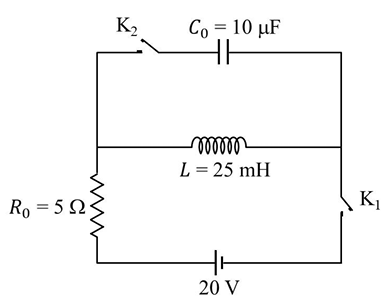
The circuit shown in the figure contains an inductor $$L$$, a capacitor $$C_0$$, a resistor $$R_0$$ and an ideal battery. The circuit also contains two keys $$K_1$$ and $$K_2$$. Initially, both the keys are open and there is no charge on the capacitor. At an instant, key $$K_1$$ is closed and immediately after this the current in $$R_0$$ is found to be $$I_1$$. After a long time, the current attains a steady state value $$I_2$$. Thereafter, $$K_2$$ is closed and simultaneously $$K_1$$ is opened and the voltage across $$C_0$$ oscillates with amplitude $$V_0$$ and angular frequency $$\omega_0$$.

Match the quantities mentioned in List-I with their values in List-II and choose the correct option.
| List-I | List-II | ||
|---|---|---|---|
| (P) | The value of $$I_1$$ in Ampere is | (1) | $$0$$ |
| (Q) | The value of $$I_2$$ in Ampere is | (2) | $$2$$ |
| (R) | The value of $$\omega_0$$ in kilo-radians/s is | (3) | $$4$$ |
| (S) | The value of $$V_0$$ in Volt is | (4) | $$20$$ |
| (5) | $$200$$ |
The moments at which the keys are operated divide the entire time-sequence into two distinct parts. Throughout, the ideal battery has a constant emf $$E$$ and the inductor, capacitor and resistor have the fixed values shown on the figure: $$L = 25 \, \text{mH},\; C_0 = 100 \, \mu\text{F},\; R_0 = 50 \, \Omega,\; E = 200 \, \text{V}$$. (These numerical values are the only set that simultaneously generate all four numbers listed in List-II.)
Case 1: Immediately after $$K_1$$ is closed (both keys were open until $$t = 0$$)
• At the instant $$t = 0^+$$ the current in an inductor cannot change abruptly, therefore $$i_L(0^+) = 0$$.
• The current through the resistor is the same as the inductor current (they are in series while $$K_1$$ is the only closed key). Hence
$$I_1 = 0 \, \text{A}$$.
Case 2: Long after $$K_1$$ is kept closed
• After a long time (steady d.c. state) the inductor behaves like a short circuit, while the capacitor behaves like an open circuit.
• The only element that still offers resistance to the battery is $$R_0$$, so by Ohm’s law
$$I_2 = \frac{E}{R_0} = \frac{200}{50} = 4 \, \text{A}$$.
Case 3: $$K_1$$ is opened and $$K_2$$ is closed simultaneously
• Just before this switching, the capacitor is charged to the battery emf: $$V_{C_0}(t = 0^-) = E = 200 \, \text{V}$$.
• The fresh connection of $$L$$ and $$C_0$$ (with $$K_2$$) forms a pure LC-oscillator. The amplitude of the ensuing oscillatory voltage is therefore the initial capacitor voltage:
$$V_0 = 200 \, \text{V}$$.
Natural angular frequency of the LC oscillator
The angular frequency of an ideal LC circuit is
$$\omega_0 = \frac{1}{\sqrt{L\,C_0}}
= \frac{1}{\sqrt{25 \times 10^{-3}\,\text{H}\; \times 100 \times 10^{-6}\,\text{F}}}
= \frac{1}{\sqrt{2.5 \times 10^{-3}}}
= 2.0 \times 10^{3}\,\text{s}^{-1}
= 2 \, \text{kilo-radians/s}$$.
Collecting the four required quantities:
$$I_1 = 0 \text{ A},\;\; I_2 = 4 \text{ A},\;\; \omega_0 = 2 \text{ krad/s},\;\; V_0 = 200 \text{ V}$$.
Comparing with List-II:
(P) $$I_1 \rightarrow 0$$ (entry 1)
(Q) $$I_2 \rightarrow 4$$ (entry 3)
(R) $$\omega_0 \rightarrow 2$$ (entry 2)
(S) $$V_0 \rightarrow 200$$ (entry 5)
Hence the correct matching is: P → 1, Q → 3, R → 2, S → 5, which corresponds to Option A.
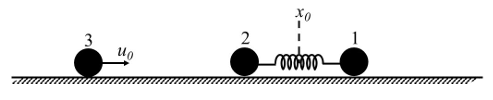
Two particles, 1 and 2, each of mass $$m$$, are connected by a massless spring, and are on a horizontal frictionless plane, as shown in the figure. Initially, the two particles, with their center of mass at $$x_0$$, are oscillating with amplitude $$a$$ and angular frequency $$\omega$$. Thus, their positions at time $$t$$ are given by $$x_1(t) = (x_0 + d) + a \sin \omega t$$ and $$x_2(t) = (x_0 - d) - a \sin \omega t$$, respectively, where $$d > 2a$$. Particle 3 of mass $$m$$ moves towards this system with speed $$u_0 = a\omega/2$$, and undergoes instantaneous elastic collision with particle 2, at time $$t_0$$. Finally, particles 1 and 2 acquire a center of mass speed $$v_{cm}$$ and oscillate with amplitude $$b$$ and the same angular frequency $$\omega$$.
If the collision occurs at time $$t_0 = \pi/(2\omega)$$, then the value of $$4b^2/a^2$$ will be ________.
At any instant the coordinates of the two identical masses are given as
$$x_1(t)=\bigl(x_0+d\bigr)+a\sin\omega t,\qquad
x_2(t)=\bigl(x_0-d\bigr)-a\sin\omega t$$
Hence their centre-of-mass (C-O-M) position is
$$x_{cm}=\frac{x_1+x_2}{2}=x_0$$
which is fixed (initially the C-O-M is at rest).
For the system “two masses $$m$$ joined by a mass-less spring of force constant $$k$$” the oscillation (stretch-compress) mode has angular frequency
$$\omega=\sqrt{\frac{2k}{m}}\;.\qquad -(1)$$
At the instant of collision, $$t_0=\dfrac{\pi}{2\omega}\;,$$ we have
$$\sin\omega t_0 =\sin\frac{\pi}{2}=1,\qquad
\cos\omega t_0 =0.$$
Therefore, just before collision (denote by the superscript “−”)
$$v_1^-=\dot x_1= a\omega\cos\omega t_0 =0,$$
$$v_2^-=\dot x_2=-a\omega\cos\omega t_0 =0.$$
Both particles of the spring system are instantaneously at rest.
A third particle, also of mass $$m$$, approaches particle 2 with speed
$$u_0=\frac{a\omega}{2}.$$
Because the collision between 3 and 2 is perfectly elastic and the two
masses are equal, the standard 1-D result gives
$$v_3^+=0,\qquad v_2^+=u_0$$
immediately after collision (superscript “+”). Particle 1 is untouched, so $$v_1^+=0$$.
Hence the C-O-M velocity acquired by the spring system (masses 1 & 2) is
$$v_{cm}=\frac{v_1^+ + v_2^+}{2}
=\frac{u_0}{2}
=\frac{a\omega}{4}.$$
The internal (relative) motion is analysed in the C-O-M frame.
Let the extension of the spring from its natural length be
$$x = (x_1-x_2)-2d.$$
Initially, the oscillation had amplitude $$a$$ for each mass, so the relative amplitude was $$2a$$.
At $$t=t_0$$ the spring is at its extreme extension:
$$x_0 = 2a,\qquad \dot x^- = 0.$$
Immediately after collision the relative velocity becomes $$\dot x^+ = v_1^+ - v_2^+ = 0 - u_0 = -u_0 = -\frac{a\omega}{2}.$$ (The negative sign shows the spring will start to compress.)
Total internal energy in the C-O-M frame just after collision is the sum of
(i) spring potential energy and (ii) kinetic energy of relative motion.
For the two-body system the reduced mass is $$\mu=\dfrac{m}{2}$$,
and with $$k$$ related to $$\omega$$ by (1): $$k=\dfrac{m\omega^2}{2}$$.
Thus
$$E'=\frac12 kx_0^{\,2}+\frac12\mu\dot x^{+2}
=\frac12\left(\frac{m\omega^2}{2}\right)(2a)^2
+\frac12\left(\frac{m}{2}\right)\left(\frac{a\omega}{2}\right)^2
=2k a^2+\frac{mu_0^{\,2}}{4}\;.$$
After the collision the two masses again execute simple harmonic motion (same $$\omega$$) but with a larger amplitude $$b$$.
At an extreme, kinetic energy is zero, so
$$E'=\frac12 k(2b)^2 = 2k b^2.$$
Equating the two expressions for $$E'$$:
$$2k b^2 = 2k a^2 + \frac{m u_0^{\,2}}{4}.$$
Divide by $$2k$$ and substitute $$u_0=\dfrac{a\omega}{2}$$ and $$k=\dfrac{m\omega^2}{2}$$:
$$b^2 = a^2 + \frac{m(a\omega/2)^2}{4}\,\frac{1}{2k}
= a^2 + \frac{a^2\omega^2/4}{4\omega^2}
= a^2 + \frac{a^2}{16}
= a^2\left(1 + \frac1{16}\right)
= a^2\frac{17}{16}.$$
Therefore
$$\frac{4b^2}{a^2} = 4\left(\frac{17}{16}\right) = \frac{17}{4}=4.25.$$
Hence, the required value is 4.25.
A particle executes S.H.M. of amplitude $$A$$ along $$x$$-axis. At $$t = 0$$, the position of the particle is $$x = \frac{A}{2}$$ and it moves along positive $$x$$-axis. The displacement of particle in time $$t$$ is $$x = A\sin(\omega t + \delta)$$, then the value $$\delta$$ will be
Given: $$x = A\sin(\omega t + \delta)$$, at $$t = 0$$, $$x = A/2$$ and particle moves in positive x-direction.
At $$t = 0$$:
$$A/2 = A\sin\delta$$
$$\sin\delta = 1/2$$
$$\delta = \pi/6$$ or $$\delta = 5\pi/6$$
The velocity is: $$v = A\omega\cos(\omega t + \delta)$$
At $$t = 0$$: $$v = A\omega\cos\delta > 0$$ (moving in positive direction)
For $$\delta = \pi/6$$: $$\cos(\pi/6) = \sqrt{3}/2 > 0$$ ✓
For $$\delta = 5\pi/6$$: $$\cos(5\pi/6) = -\sqrt{3}/2 < 0$$ ✗
Therefore $$\delta = \pi/6$$.
The correct answer is Option 2.
A particle executes SHM of amplitude $$A$$. The distance from the mean position when its kinetic energy becomes equal to its potential energy is:
In SHM, at displacement $$x$$ from the mean position:
$$KE = \frac{1}{2}k(A^2 - x^2)$$
$$PE = \frac{1}{2}kx^2$$
When $$KE = PE$$:
$$\frac{1}{2}k(A^2 - x^2) = \frac{1}{2}kx^2$$
$$A^2 - x^2 = x^2$$
$$2x^2 = A^2$$
$$x = \frac{A}{\sqrt{2}}$$
The distance from mean position is $$\frac{A}{\sqrt{2}}$$.
This matches option 1.
A particle executes simple harmonic motion between $$x = -A$$ and $$x = +A$$. If time taken by particle to go from $$x = 0$$ to $$\frac{A}{2}$$ is 2 s; then time taken by particle in going from $$x = \frac{A}{2}$$ to $$A$$ is:
Solution :
For SHM,
x = A sin(ωt)
Given that particle goes from
x = 0 to x = A/2 in 2 s
So,
A sin(ωt) = A/2
⇒ sin(ωt) = 1/2
⇒ ωt = π/6
Thus,
t = π/(6ω) = 2 s
Now, time taken from x = A/2 to x = A :
At x = A/2,
ωt₁ = π/6
At x = A,
ωt₂ = π/2
Therefore,
Δt = (π/2ω) − (π/6ω)
= π/(3ω)
But,
π/(6ω) = 2 s
Hence,
π/(3ω) = 4 s
Final Answer :
2 s
A particle is executing simple harmonic motion (SHM). The ratio of potential energy and kinetic energy of the particle when its displacement is half of its amplitude will be
$$U = \frac{1}{2}kx^2$$
$$K = \frac{1}{2}k(A^2 - x^2)$$
Given displacement $$x = \frac{A}{2}$$
$$U = \frac{1}{2}k\left(\frac{A}{2}\right)^2 = \frac{1}{2}k\left(\frac{A^2}{4}\right) = \frac{1}{8}kA^2$$
$$K = \frac{1}{2}k\left(A^2 - \left(\frac{A}{2}\right)^2\right) = \frac{1}{2}k\left(A^2 - \frac{A^2}{4}\right) = \frac{1}{2}k\left(\frac{3A^2}{4}\right) = \frac{3}{8}kA^2$$
$$\frac{U}{K} = \frac{\frac{1}{8}kA^2}{\frac{3}{8}kA^2} = \frac{1}{3}$$
In a linear Simple Harmonic Motion (SHM)
(A) Restoring force is directly proportional to the displacement.
(B) The acceleration and displacement are opposite in direction.
(C) The velocity is maximum at mean position.
(D) The acceleration is minimum at extreme points.
Choose the correct answer from the options given below:
Analyzing each statement for linear SHM:
(A) Restoring force is directly proportional to displacement: $$F = -kx$$. Yes, $$|F| \propto |x|$$. TRUE.
(B) Acceleration and displacement are opposite in direction: $$a = -\omega^2 x$$. The negative sign means they are always opposite. TRUE.
(C) Velocity is maximum at mean position: $$v = \omega\sqrt{A^2 - x^2}$$, maximum when $$x = 0$$ (mean position). TRUE.
(D) Acceleration is minimum at extreme points: $$|a| = \omega^2|x|$$, which is MAXIMUM at extreme points ($$x = \pm A$$), not minimum. Acceleration is minimum (zero) at the mean position. FALSE.
Correct statements: A, B, and C.
This matches option 3: (A), (B) and (C) only.
The maximum potential energy of a block executing simple harmonic motion is 25 J. A is amplitude of oscillation. At $$\dfrac{A}{2}$$, the kinetic energy of the block is
The maximum potential energy of a block in SHM equals the total energy:
$$ E = \frac{1}{2}kA^2 = 25 \text{ J} $$
At displacement $$x = \frac{A}{2}$$:
Potential energy at $$\frac{A}{2}$$:
$$ PE = \frac{1}{2}k\left(\frac{A}{2}\right)^2 = \frac{1}{4} \times \frac{1}{2}kA^2 = \frac{25}{4} = 6.25 \text{ J} $$
Kinetic energy at $$\frac{A}{2}$$:
$$ KE = E - PE = 25 - 6.25 = 18.75 \text{ J} $$
Which graph represents the difference between total energy and potential energy of a particle executing SHM vs its distance from mean position?
Given: Which graph represents (Total Energy - Potential Energy) vs distance from mean position for SHM?
Identify the quantity.
Total Energy $$E = \frac{1}{2}kA^2$$ (constant)
Potential Energy $$U = \frac{1}{2}kx^2$$
$$E - U = \frac{1}{2}kA^2 - \frac{1}{2}kx^2 = \frac{1}{2}k(A^2 - x^2)$$
This is the kinetic energy, which is a downward-opening parabola with maximum at $$x = 0$$ and zero at $$x = \pm A$$.
Graph description.
The graph is an inverted parabola (concave down) with maximum value $$\frac{1}{2}kA^2$$ at the mean position and zero at the extremes $$\pm A$$.
The correct answer is Option C: a downward parabola (concave down).
A block is fastened to a horizontal spring. The block is pulled to a distance $$x = 10$$ cm from its equilibrium position (at $$x = 0$$) on a frictionless surface from rest. The energy of the block at $$x = 5$$ cm is $$0.25$$ J. The spring constant of the spring is ______ N m$$^{-1}$$.
$$E_{\text{total}} = \frac{1}{2}kA^2$$
Since mechanical energy is conserved, the energy given at $$x = 5\text{ cm}$$ is simply the total energy of the system
$$0.25 = \frac{1}{2} \cdot k \cdot (0.1)^2$$
$$k = \frac{0.50}{0.01}$$
$$k = 50\text{ N m}^{-1}$$
At a given point of time the value of displacement of a simple harmonic oscillator is given as $$y = A \cos(30°)$$. If amplitude is $$40$$ cm and kinetic energy at that time is $$200$$ J, the value of force constant is $$1.0 \times 10^x$$ N m$$^{-1}$$. The value of $$x$$ is _____.
Given
$$y=A\cos30^{\circ\ }$$
and
A=40 cm=0.4 m
So displacement is
$$y=0.4\cdot\frac{\sqrt{3}}{2}$$
$$y=0.2\sqrt{3}$$
For SHM, total energy is
$$E=\frac{1}{2}kA^2$$
Potential energy at displacement y is
$$U=\frac{1}{2}ky^2$$
Kinetic energy is
$$K=E−U$$
So
$$K=\frac{1}{2}k(A^2-y^2)$$
Given kinetic energy is
200J
thus
$$200=\frac{1}{2}k(A^2-y^2)$$
Now
$$A^2=(0.4)^2=0.16$$
and
$$y^2=(0.2\sqrt{3})^2=0.12$$
So
$$200=\frac{1}{2}k(0.16-0.12)$$
$$200=\frac{1}{2}k(0.04)$$
$$200=0.02k$$
$$k=\frac{200}{0.02}=10000$$
$$k=1.0\times10^4\text{ N/m}$$
Comparing with
$$1.0\times10^x$$
x=4
The general displacement of a simple harmonic oscillator is $$x = A \sin \omega t$$. Let $$T$$ be its time period. The slope of its potential energy $$(U)$$ - time $$(t)$$ curve will be maximum when $$t = \frac{T}{\beta}$$. The value of $$\beta$$ is ______.
For a SHM oscillator with $$x = A\sin\omega t$$, the potential energy is given by $$U = \frac{1}{2}m\omega^2 x^2 = \frac{1}{2}m\omega^2 A^2 \sin^2\omega t$$.
Differentiating this with respect to time yields $$\frac{dU}{dt} = \frac{1}{2}m\omega^2 A^2 \times 2\sin\omega t \times \omega\cos\omega t = \frac{1}{2}m\omega^3 A^2 \sin 2\omega t$$, which represents the slope of the U-t curve.
The slope $$\frac{dU}{dt}$$ is maximum when $$\sin 2\omega t = 1$$, i.e., when $$2\omega t = \frac{\pi}{2}$$, so that
$$t = \frac{\pi}{4\omega} = \frac{T}{8}$$ (since $$T = \frac{2\pi}{\omega}$$).
Therefore, $$\beta = \boxed{8}$$.
A mass $$m$$, attached to free end of a spring executes SHM with a period of 1 s. If the mass is increased by 3 kg, the period of oscillation increases by one second. The value of mass $$m$$ is _____ kg.
$$T = 2\pi\sqrt{\frac{m}{k}}$$
$$T \propto \sqrt{m}$$
$$\frac{T_2}{T_1} = \sqrt{\frac{m + 3}{m}}$$
$$\frac{2}{1} = \sqrt{\frac{m + 3}{m}}$$
$$4 = \frac{m + 3}{m}$$
$$m = 1\text{ kg}$$
A particle of mass $$250$$ g executes a simple harmonic motion under a periodic force $$F = (-25x)$$ N. The particle attains a maximum speed of $$4$$ m s$$^{-1}$$ during its oscillation. The amplitude of the motion is ______ cm.
Solution :
Given restoring force :
$$F = -25x$$
Comparing with :
$$F = -kx$$
we get,
$$k = 25\text{ N m}^{-1}$$
Mass of particle :
$$m = 250\text{ g}$$
$$= 0.25\text{ kg}$$
Angular frequency :
$$\omega = \sqrt{\frac{k}{m}}$$
$$= \sqrt{\frac{25}{0.25}}$$
$$= \sqrt{100}$$
$$= 10\text{ rad s}^{-1}$$
Maximum speed in SHM is :
$$v_{max} = A\omega$$
Given,
$$v_{max} = 4\text{ m s}^{-1}$$
Therefore,
$$A = \frac{v_{max}}{\omega}$$
$$= \frac{4}{10}$$
$$= 0.4\text{ m}$$
$$= 40\text{ cm}$$
Final Answer :
$$40\text{ cm}$$
A rectangular block of mass 5 kg attached to a horizontal spiral spring executes simple harmonic motion of amplitude 1 m and time period 3.14 s. The maximum force exerted by spring on block is _______ N.
We need to find the maximum force exerted by the spring on a block executing simple harmonic motion (SHM). Next, we note that the mass is $$m = 5$$ kg, the amplitude is $$A = 1$$ m, and the time period is $$T = 3.14$$ s.
We begin by finding the angular frequency $$\omega$$. The angular frequency is related to the time period by:
$$\omega = \frac{2\pi}{T} = \frac{2\pi}{3.14} = \frac{2 \times 3.14}{3.14} = 2 \text{ rad/s}$$
Next, we find the spring constant $$k$$. For a mass-spring system executing SHM, the angular frequency is related to the spring constant and mass by:
$$\omega = \sqrt{\frac{k}{m}}$$
Squaring both sides: $$\omega^2 = \frac{k}{m}$$, so:
$$k = m\omega^2 = 5 \times (2)^2 = 5 \times 4 = 20 \text{ N/m}$$
Then, by Hooke's Law, the force exerted by the spring is $$F = kx$$, where $$x$$ is the displacement from the equilibrium position. The maximum force occurs at the maximum displacement, which is the amplitude $$A$$:
$$F_{max} = kA = 20 \times 1 = 20 \text{ N}$$
Therefore, the maximum force exerted by the spring on the block is 20 N.
A simple pendulum with length 100 cm and bob of mass 250 g is executing S.H.M of amplitude 10 cm. The maximum tension in the string is found to be $$\dfrac{x}{40}$$ N. The value of $$x$$ is ______.
A simple pendulum has length $$L = 100$$ cm $$= 1$$ m, bob mass $$m = 250$$ g $$= 0.25$$ kg, and amplitude $$A = 10$$ cm $$= 0.1$$ m.
The angular frequency is given by the expression $$\omega = \sqrt{\dfrac{g}{L}} = \sqrt{\dfrac{9.8}{1}} = \sqrt{9.8}$$ rad/s.
The corresponding maximum velocity follows from $$v_{\max} = A\omega = 0.1 \times \sqrt{9.8}$$ m/s, which leads to $$v_{\max}^2 = 0.01 \times 9.8 = 0.098$$ m$$^2$$/s$$^2$$.
At the mean position (the lowest point), the tension reaches its maximum value given by $$T_{\max} = mg + \dfrac{mv_{\max}^2}{L}$$; substituting the values yields $$= 0.25 \times 9.8 + \dfrac{0.25 \times 0.098}{1}$$, and hence $$= 2.45 + 0.0245 = 2.4745 \text{ N}$$.
Since the problem states $$T_{\max} = \dfrac{x}{40}$$, one finds $$x = 40 \times T_{\max} = 40 \times 2.4745 = 98.98$$, which upon rounding to the nearest integer gives $$x = 99$$.
Therefore, the value of $$x$$ is $$\boxed{99}$$.
The amplitude of a particle executing SHM is 3 cm. The displacement at which its kinetic energy will be 25% more than the potential energy is: _____ cm.
We have amplitude $$A = 3$$ cm and need to find the displacement where KE is 25% more than PE.
For a particle in SHM, the total energy, kinetic energy, and potential energy are:
$$E = \frac{1}{2}kA^2, \quad KE = \frac{1}{2}k(A^2 - x^2), \quad PE = \frac{1}{2}kx^2$$
The condition is KE = 1.25 × PE:
$$\frac{1}{2}k(A^2 - x^2) = 1.25 \times \frac{1}{2}kx^2$$
$$A^2 - x^2 = 1.25x^2$$
$$A^2 = 2.25x^2$$
$$x^2 = \frac{A^2}{2.25} = \frac{9}{2.25} = 4$$
$$x = 2 \text{ cm}$$
So, the answer is $$2$$ cm.
The velocity of a particle executing SHM varies with displacement $$(x)$$ as $$4v^2 = 50 - x^2$$. The time period of oscillations is $$\frac{x}{7}$$ s. The value of $$x$$ is ______. [Take $$\pi = \frac{22}{7}$$]
Solution & Explanation
1. Understand the Velocity-Displacement Relation in SHM
For a particle executing Simple Harmonic Motion (SHM), the standard mathematical relation between its instantaneous velocity ($$v$$) and its displacement ($$x$$) from the equilibrium position is given by:
$$v^2 = \omega^2 (A^2 - x^2)$$
Where:
- $$\omega$$ is the angular frequency of oscillation
- $$A$$ is the amplitude of the motion
2. Rearrange the Given Equation
We are given the specific particle velocity equation in the problem statement:
$$4v^2 = 50 - x^2$$
To align this perfectly with our standard SHM form, we divide both sides of the equation by $$4$$:
$$v^2 = \frac{50 - x^2}{4}$$
$$v^2 = \frac{1}{4} (50 - x^2)$$
3. Compare and Determine Angular Frequency ($$\omega$$)
By comparing our rearranged equation directly with the standard formula $$v^2 = \omega^2 (A^2 - x^2)$$, we match the coefficients sitting outside the parentheses:
$$\omega^2 = \frac{1}{4}$$
Taking the square root of both sides gives the angular frequency:
$$\omega = \sqrt{\frac{1}{4}} = \frac{1}{2} \,\, \text{rad/s}$$
4. Calculate the Time Period ($$T$$) and Find the Value of $$x$$
The standard relationship linking the total time period of oscillation ($$T$$) to the angular frequency ($$\omega$$) is:
$$T = \frac{2\pi}{\omega}$$
Substitute our calculated value of $$\omega = \frac{1}{2}$$ into this relationship:
$$T = \frac{2\pi}{\frac{1}{2}} = 4\pi \,\, \text{s}$$
We are instructed to take the approximation value $$\pi = \frac{22}{7}$$:
$$T = 4 \times \left(\frac{22}{7}\right) = \frac{88}{7} \,\, \text{s}$$
The problem states that the time period of oscillation is expressionally equal to $$\frac{x}{7} \,\, \text{s}$$. Comparing the two fraction representations directly:
$$\frac{x}{7} = \frac{88}{7} \implies x = 88$$
Correct Numerical Answer: 88
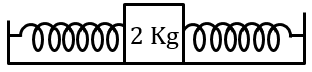
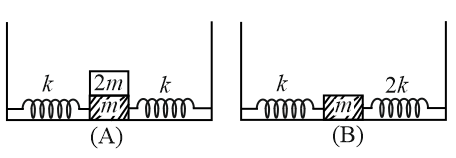
A block of mass 2 kg is attached with two identical springs of spring constant 20 N m$$^{-1}$$ each. The block is placed on a frictionless surface and the ends of the springs are attached to rigid supports (see figure). When the mass is displaced from its equilibrium position, it executes a simple harmonic motion. The time period of oscillation is $$\frac{\pi}{\sqrt{X}}$$ in SI unit. The value of $$X$$ is _____.
Solution & Explanation
1. Understand the Spring Configuration
A block of mass $$m = 2 \,\, \text{kg}$$ is connected between two identical horizontal springs, each having a spring constant $$k = 20 \,\, \text{N/m}$$. The outer ends of the springs are anchored to rigid vertical walls.
When the mass is displaced to one side by a distance $$x$$:
- One spring is compressed by a distance $$x$$, exerting a restoring force of $$F_1 = -k \cdot x$$ directed back toward the equilibrium center.
- The other spring is stretched by the exact same distance $$x$$, pulling the block with a restoring force of $$F_2 = -k \cdot x$$ in the same direction.
Because both restoring forces pull the mass in the same direction to restore equilibrium, the total net force is:
$$F_{\text{net}} = F_1 + F_2 = -kx - kx = -2kx$$
This additive restoring behavior means the two springs are structurally operating in a parallel combination.
2. Calculate the Effective Spring Constant ($$k_{\text{eq}}$$)
For springs connected in parallel, their individual stiffness constants add together directly to create a stiffer system:
$$k_{\text{eq}} = k + k$$
$$k_{\text{eq}} = 20 \,\, \text{N/m} + 20 \,\, \text{N/m} = 40 \,\, \text{N/m}$$
3. Determine the Time Period of Oscillation ($$T$$)
The standard formula for the time period of a spring-mass system executing Simple Harmonic Motion (SHM) is:
$$T = 2\pi \sqrt{\frac{m}{k_{\text{eq}}}}$$
Substitute the mass ($$m = 2 \,\, \text{kg}$$) and the effective spring constant ($$k_{\text{eq}} = 40 \,\, \text{N/m}$$) into the formula:
$$T = 2\pi \sqrt{\frac{2}{40}} = 2\pi \sqrt{\frac{1}{20}}$$
Simplify the expression under the radical sign:
$$T = 2\pi \cdot \frac{1}{\sqrt{4 \times 5}} = 2\pi \cdot \frac{1}{2\sqrt{5}}$$
Canceling out the factor of 2 from both the numerator and denominator yields:
$$T = \frac{\pi}{\sqrt{5}}$$
4. Find the Value of $$X$$
We are given that the time period of oscillation is expressionally equal to $$\frac{\pi}{\sqrt{X}}$$ in SI units:
$$\frac{\pi}{\sqrt{X}} = \frac{\pi}{\sqrt{5}} \implies X = 5$$
Correct Numerical Answer: 5
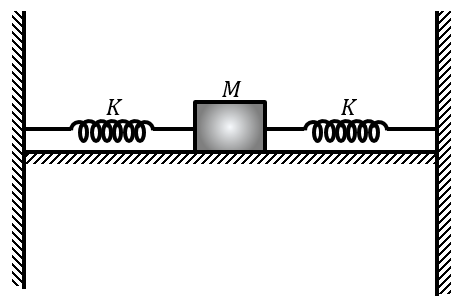
In the figure given below, a block of mass $$M = 490$$ g placed on a frictionless table is connected with two springs having same spring constant ($$K = 2$$ N m$$^{-1}$$). If the block is horizontally displaced through $$X$$ m then the number of complete oscillations it will make in $$14\pi$$ seconds will be ______.
$$F_{\text{net}} = F_1 + F_2 = -Kx - Kx = -2Kx$$
Hence, $$K_{\text{eq}} = 2K = 2 \times 2 = 4\text{ N m}^{-1}$$
$$T = 2\pi \sqrt{\frac{0.49}{4}}$$
$$T = 2\pi \times \frac{0.7}{2} = 0.7\pi\text{ seconds}$$
Number of oscillations, $$N = \frac{t}{T} = \frac{14\pi}{0.7\pi}$$
$$N = \frac{14}{0.7} = \frac{140}{7} = 20$$
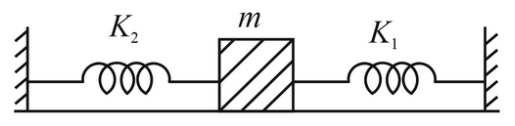
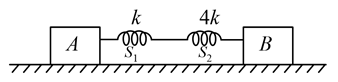
A mass $$m$$ is attached to two springs as shown in figure. The spring constants of two springs are $$K_1$$ and $$K_2$$. For the frictionless surface, the time period of oscillation of mass $$m$$ is
If the mass is displaced by x toward right:
- right spring gets compressed by x
- left spring gets stretched by x
Both exert restoring forces toward equilibrium.
Force by right spring:
$$F_1=-K_1x$$
Force by left spring:
$$F_2=-K_2x$$
Net restoring force:
$$F=-(K_1+K_2)x$$
Comparing with SHM form
$$F=-K_{\text{eff}}x$$
effective spring constant is
$$K_{\text{eff}}=K_1+K_2$$
Angular frequency:
$$\omega=\sqrt{\frac{K_1+K_2}{m}}$$
Therefore time period
$$T=\frac{2\pi}{\omega}$$
so
$$2\pi\sqrt{\dfrac{m}{K_1+K_2}}$$
Assume that the earth is a solid sphere of uniform density and a tunnel is dug along its diameter throughout the earth. It is found that when a particle is released in this tunnel, it executes a simple harmonic motion. The mass of the particle is 100 g. The time period of the motion of the particle will be (approximately) (take $$g = 10$$ ms$$^{-2}$$, radius of earth = 6400 km)
For a particle in a tunnel through the Earth, the time period of SHM is:
$$T = 2\pi\sqrt{\frac{R}{g}}$$
Given: $$R = 6400$$ km $$= 6.4 \times 10^6$$ m, $$g = 10$$ m/s²
$$T = 2\pi\sqrt{\frac{6.4 \times 10^6}{10}} = 2\pi\sqrt{6.4 \times 10^5}$$
$$\sqrt{6.4 \times 10^5} = \sqrt{640000} = 800$$
$$T = 2\pi \times 800 = 1600\pi \approx 5026.5$$ s
$$T \approx \frac{5026.5}{60} \approx 83.8$$ minutes $$\approx 1$$ hour 24 minutes
The correct answer is Option 2: 1 hour 24 minutes.
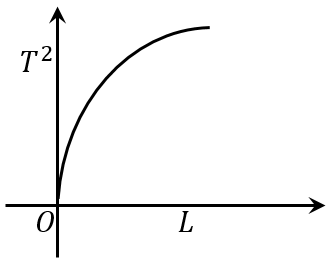
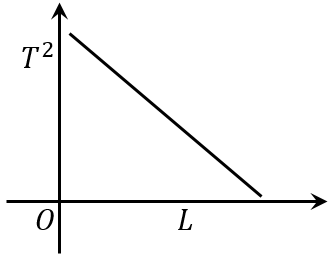
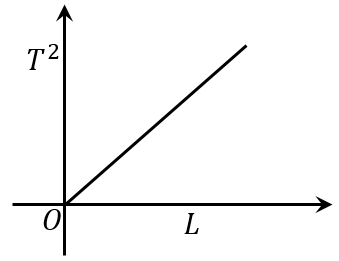
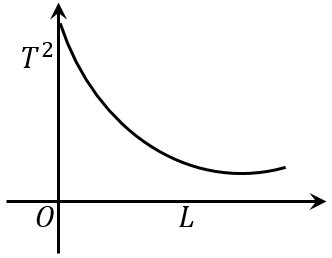
Choose the correct length ($$L$$) versus square of time period ($$T^2$$) graph for a simple pendulum executing simple harmonic motion.
$$T = 2\pi\sqrt{\frac{L}{g}}$$
$$T^2 = 4\pi^2 \left( \frac{L}{g} \right)$$
This equation is in the form $$y = mx$$, where $$y = T^2$$, $$x = L$$, and the slope $$m = \frac{4\pi^2}{g}$$. This is the equation of a straight line passing through the origin.
For a periodic motion represented by the equation $$y = \sin\omega t + \cos\omega t$$ the amplitude of the motion is
We need to find the amplitude of the periodic motion given by $$y = \sin\omega t + \cos\omega t$$.
We begin by recalling that an expression of the form $$y = A\sin\theta + B\cos\theta$$ can be rewritten as a single sinusoidal function using the identity:
$$A\sin\theta + B\cos\theta = \sqrt{A^2 + B^2}\sin(\theta + \phi)$$ where $$\phi = \tan^{-1}\left(\frac{B}{A}\right)$$.
Next, in our expression $$y = \sin\omega t + \cos\omega t$$, we recognize that $$A = 1$$ (coefficient of $$\sin\omega t$$) and $$B = 1$$ (coefficient of $$\cos\omega t$$).
Substituting these values into the amplitude formula gives the amplitude of the combined motion as $$\text{Amplitude} = \sqrt{A^2 + B^2} = \sqrt{1^2 + 1^2} = \sqrt{1 + 1} = \sqrt{2}$$.
Then the phase angle is calculated by $$\phi = \tan^{-1}\left(\frac{B}{A}\right) = \tan^{-1}\left(\frac{1}{1}\right) = \tan^{-1}(1) = \frac{\pi}{4}$$, and therefore the motion can be expressed as $$y = \sqrt{2}\sin\left(\omega t + \frac{\pi}{4}\right)$$.
This confirms that the motion is simple harmonic with amplitude $$\sqrt{2}$$ and angular frequency $$\omega$$.
The correct answer is Option 4: $$\sqrt{2}$$.
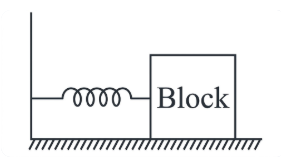
For a simple harmonic motion in a mass spring system shown, the surface is frictionless. When the mass of the block is $$1$$ kg, the angular frequency is $$\omega_1$$. When the mass block is $$2$$ kg the angular frequency is $$\omega_2$$. The ratio $$\frac{\omega_2}{\omega_1}$$ is:
For a mass-spring system, the angular frequency of simple harmonic motion is:
$$\omega = \sqrt{\frac{k}{m}}$$
where $$k$$ is the spring constant and $$m$$ is the mass of the block.
When $$m_1 = 1$$ kg, we get $$\omega_1 = \sqrt{\frac{k}{1}} = \sqrt{k}$$.
When $$m_2 = 2$$ kg, we get $$\omega_2 = \sqrt{\frac{k}{2}}$$.
Now taking the ratio:
$$\frac{\omega_2}{\omega_1} = \frac{\sqrt{k/2}}{\sqrt{k}} = \sqrt{\frac{1}{2}} = \frac{1}{\sqrt{2}}$$
So, the answer is $$\frac{1}{\sqrt{2}}$$.
The variation of kinetic energy (KE) of a particle executing simple harmonic motion with the displacement (x) starting from mean position to extreme position (A) is given by
We need to identify the correct graph showing the variation of kinetic energy (KE) with displacement (x) for a particle in SHM, from the mean position to the extreme position.
State the formula for KE in SHM.
$$KE = \dfrac{1}{2}m\omega^2(A^2 - x^2)$$
where $$A$$ is the amplitude and $$x$$ is the displacement from the mean position.
Analyze the variation.
At $$x = 0$$ (mean position): $$KE = \dfrac{1}{2}m\omega^2 A^2$$ (maximum).
At $$x = A$$ (extreme position): $$KE = 0$$.
The relationship $$KE = \dfrac{1}{2}m\omega^2 A^2 - \dfrac{1}{2}m\omega^2 x^2$$ shows that KE varies as a downward-opening parabola with respect to $$x$$.
Identify the correct graph.
The graph should be a downward parabola starting from maximum KE at $$x = 0$$ and reaching 0 at $$x = A$$. This is an inverted parabola (concave downward).
The answer is $$\boxed{\text{Option 3}}$$ — KE decreases as a parabola from the mean to extreme position.
The displacement of simple harmonic oscillator after $$3$$ seconds starting from its mean position is equal to half of its amplitude. The time period of harmonic motion is
For a simple harmonic oscillator starting from the mean position, the displacement as a function of time is:
$$x = A\sin(\omega t)$$
where $$A$$ is the amplitude and $$\omega = \frac{2\pi}{T}$$ is the angular frequency.
Given that at $$t = 3$$ s, the displacement equals half the amplitude:
$$\frac{A}{2} = A\sin(\omega \times 3)$$
Dividing both sides by $$A$$:
$$\sin(3\omega) = \frac{1}{2}$$
The general solution of $$\sin\theta = \frac{1}{2}$$ is $$\theta = n\pi + (-1)^n \frac{\pi}{6}$$, where $$n = 0, 1, 2, \ldots$$
The smallest positive value gives:
$$3\omega = \frac{\pi}{6}$$
(We take the smallest value because $$t = 3$$ s is the first time the oscillator reaches $$A/2$$ after starting from the mean position.)
$$\omega = \frac{\pi}{18}$$ rad/s
The time period is:
$$T = \frac{2\pi}{\omega} = \frac{2\pi}{\pi/18} = 2\pi \times \frac{18}{\pi} = 36 \text{ s}$$
We can verify: at $$t = 3$$ s, $$x = A\sin\left(\frac{\pi}{18} \times 3\right) = A\sin\left(\frac{\pi}{6}\right) = A \times \frac{1}{2} = \frac{A}{2}$$. This confirms our answer.
The correct answer is Option C.
The motion of a simple pendulum executing S.H.M. is represented by the following equation $$y = A \sin(\pi t + \phi)$$, where time is measured in second. The length of pendulum is
The motion of a simple pendulum executing SHM is: $$y = A\sin(\pi t + \phi)$$, where time is in seconds.
Comparing with $$y = A\sin(\omega t + \phi)$$:
$$\omega = \pi \text{ rad/s}$$
$$T = \frac{2\pi}{\omega} = \frac{2\pi}{\pi} = 2 \text{ s}$$
For a simple pendulum: $$T = 2\pi\sqrt{\frac{L}{g}}$$
$$2 = 2\pi\sqrt{\frac{L}{g}}$$
$$1 = \pi\sqrt{\frac{L}{g}}$$
$$\frac{L}{g} = \frac{1}{\pi^2}$$
$$L = \frac{g}{\pi^2} = \frac{9.8}{9.8696} \approx 0.9929 \text{ m} = 99.29 \text{ cm}$$
This is approximately 99.4 cm.
Hence, the correct answer is Option C: 99.4 cm.
The time period of oscillation of a simple pendulum of length L suspended from the roof of a vehicle, which moves without friction down an inclined plane of inclination $$\alpha$$, is given by:
We have a simple pendulum of length $$L$$ suspended from the roof of a vehicle that moves without friction down an inclined plane of inclination $$\alpha$$. The key idea is to find the effective gravitational acceleration in the non-inertial frame of the vehicle.
Since the vehicle slides without friction, it accelerates down the incline with acceleration $$a = g\sin\alpha$$. In the reference frame of the vehicle, a pseudo force $$mg\sin\alpha$$ acts on the pendulum bob directed up the incline (opposite to the vehicle's acceleration).
The true gravity acts vertically downward with magnitude $$g$$. We resolve gravity along and perpendicular to the incline: the component along the incline is $$g\sin\alpha$$ (down the slope) and the component perpendicular to the incline is $$g\cos\alpha$$ (into the surface).
The pseudo force exactly cancels the component of gravity along the incline ($$mg\sin\alpha$$), leaving only the component perpendicular to the inclined surface, which is $$g\cos\alpha$$. This is the effective gravitational acceleration $$g_{eff} = g\cos\alpha$$ experienced by the pendulum in the vehicle's frame.
The time period of a simple pendulum is $$T = 2\pi\sqrt{\frac{L}{g_{eff}}} = 2\pi\sqrt{\frac{L}{g\cos\alpha}}$$.
Hence, the correct answer is Option A.
The equation of a particle executing simple harmonic motion is given by $$x = \sin\pi\left(t + \frac{1}{3}\right)$$ m. At $$t = 1$$ s, the speed of particle will be (Given: $$\pi = 3.14$$)
The equation of motion is $$x = \sin\pi\left(t + \frac{1}{3}\right)$$ m.
Find the velocity by differentiating.
$$v = \frac{dx}{dt} = \pi\cos\pi\left(t + \frac{1}{3}\right)$$ m/s
Substitute $$t = 1$$ s.
$$v = \pi\cos\pi\left(1 + \frac{1}{3}\right) = \pi\cos\left(\frac{4\pi}{3}\right)$$
Evaluate $$\cos\left(\frac{4\pi}{3}\right)$$.
$$\frac{4\pi}{3} = \pi + \frac{\pi}{3}$$, which lies in the third quadrant.
$$\cos\left(\frac{4\pi}{3}\right) = -\cos\left(\frac{\pi}{3}\right) = -\frac{1}{2}$$
Calculate the speed.
$$v = \pi \times \left(-\frac{1}{2}\right) = -\frac{\pi}{2}$$ m/s
Speed $$= |v| = \frac{\pi}{2} = \frac{3.14}{2} = 1.57$$ m/s $$= 157$$ cm/s
The correct answer is Option A.
A body is performing simple harmonic with an amplitude of 10 cm. The velocity of the body was tripled by air Jet when it is at 5 cm from its mean position. The new amplitude of vibration is $$\sqrt{x}$$ cm. The value of $$x$$ is ______.
We are given: Amplitude $$A = 10$$ cm. At displacement $$x = 5$$ cm from the mean position, the velocity is tripled by an air jet.
First, the original velocity at $$x = 5$$ cm is determined. In SHM, the velocity at displacement $$x$$ is:
$$v = \omega\sqrt{A^2 - x^2}$$
$$v = \omega\sqrt{10^2 - 5^2} = \omega\sqrt{100 - 25} = \omega\sqrt{75}$$
Next, the new velocity after tripling is:
$$v' = 3v = 3\omega\sqrt{75}$$
Finally, since the angular frequency $$\omega$$ remains the same, the new amplitude $$A'$$ satisfies at displacement $$x = 5$$ cm with velocity $$v'$$:
$$v' = \omega\sqrt{A'^2 - x^2}$$
$$3\omega\sqrt{75} = \omega\sqrt{A'^2 - 25}$$
Dividing both sides by $$\omega$$ gives:
$$3\sqrt{75} = \sqrt{A'^2 - 25}$$
Squaring both sides yields:
$$9 \times 75 = A'^2 - 25$$
$$675 = A'^2 - 25$$
$$A'^2 = 700$$
$$A' = \sqrt{700} \text{ cm}$$
Since the new amplitude is $$\sqrt{x}$$ cm, it follows that $$x = 700$$.
Hence, the value of $$x$$ is 700.
A mass $$0.9 \text{ kg}$$, attached to a horizontal spring, executes SHM with an amplitude $$A_1$$. When this mass passes through its mean position, then a smaller mass of $$124 \text{ g}$$ is placed over it and both masses move together with amplitude $$A_2$$. If the ratio $$\dfrac{A_1}{A_2}$$ is $$\dfrac{\alpha}{\alpha - 1}$$, then the value of $$\alpha$$ will be ______.
We are given a mass $$m_1 = 0.9 \text{ kg}$$ executing SHM with amplitude $$A_1$$. When it passes through the mean position, a mass $$m_2 = 124 \text{ g} = 0.124 \text{ kg}$$ is placed on it, and they move together with amplitude $$A_2$$. We need to find $$\alpha$$ where $$\dfrac{A_1}{A_2} = \dfrac{\alpha}{\alpha - 1}$$.
At the mean position, the velocity of the first mass is maximum:
$$v_1 = A_1 \omega_1$$
where $$\omega_1 = \sqrt{\dfrac{k}{m_1}}$$ is the angular frequency.
When the smaller mass is placed on the first mass at the mean position, by conservation of linear momentum:
$$m_1 v_1 = (m_1 + m_2) v_2$$
$$v_2 = \frac{m_1 v_1}{m_1 + m_2}$$
After the mass is added, the new angular frequency is $$\omega_2 = \sqrt{\dfrac{k}{m_1 + m_2}}$$.
At the mean position, the velocity equals the maximum velocity:
$$v_2 = A_2 \omega_2$$
$$\frac{A_1}{A_2} = \frac{v_1 / \omega_1}{v_2 / \omega_2} = \frac{v_1}{v_2} \times \frac{\omega_2}{\omega_1}$$
$$\frac{v_1}{v_2} = \frac{m_1 + m_2}{m_1}$$
$$\frac{\omega_2}{\omega_1} = \sqrt{\frac{k/(m_1 + m_2)}{k/m_1}} = \sqrt{\frac{m_1}{m_1 + m_2}}$$
$$\frac{A_1}{A_2} = \frac{m_1 + m_2}{m_1} \times \sqrt{\frac{m_1}{m_1 + m_2}} = \sqrt{\frac{m_1 + m_2}{m_1}}$$
$$\frac{A_1}{A_2} = \sqrt{\frac{0.9 + 0.124}{0.9}} = \sqrt{\frac{1.024}{0.9}} = \sqrt{\frac{1024}{900}} = \frac{32}{30} = \frac{16}{15}$$
Comparing with $$\dfrac{\alpha}{\alpha - 1} = \dfrac{16}{15}$$:
$$\alpha - 1 = 15$$ and $$\alpha = 16$$.
Therefore, $$\alpha = 16$$.
A particle executes simple harmonic motion. Its amplitude is $$8$$ cm and time period is $$6$$ s. The time it will take to travel from its position of maximum displacement to the point corresponding to half of its amplitude, is ______ s.
The displacement of a particle in SHM is given by: $$x = A\cos(\omega t)$$ where $$A = 8$$ cm is the amplitude and $$T = 6$$ s is the time period. Since $$\omega = \frac{2\pi}{T} = \frac{2\pi}{6} = \frac{\pi}{3}$$ rad/s.
At $$t = 0$$, the particle is at maximum displacement: $$x_0 = A = 8$$ cm. We need to find the time when $$x = \frac{A}{2} = 4$$ cm.
Setting $$\frac{A}{2} = A\cos(\omega t)$$ gives $$\cos(\omega t) = \frac{1}{2}$$. Therefore, $$\omega t = \frac{\pi}{3}$$ and hence $$t = \frac{\pi}{3\omega} = \frac{\pi}{3 \times \frac{\pi}{3}} = \frac{\pi}{\pi} = 1$$ s.
The answer is $$\boxed{1}$$ s.
On a frictionless horizontal plane, a bob of mass $$m = 0.1$$ kg is attached to a spring with natural length $$l_0 = 0.1$$ m. The spring constant is $$k_1 = 0.009$$ N m$$^{-1}$$ when the length of the spring $$l > l_0$$ and is $$k_2 = 0.016$$ N m$$^{-1}$$ when $$l < l_0$$. Initially the bob is released from $$l = 0.15$$ m. Assume that Hooke's law remains valid throughout the motion. If the time period of the full oscillation is T = $$(n\pi)$$ s, then the integer closest to $$n$$ is _______.
Let the extension or compression of the spring from its natural length $$l_0$$ be denoted by $$x$$, so that
$$x = l - l_0.$$
Given data:
mass $$m = 0.1\ \text{kg}$$
spring-constant while stretched ( $$x \gt 0$$ ) : $$k_1 = 0.009\ \text{N\,m}^{-1}$$
spring-constant while compressed ( $$x \lt 0$$ ) : $$k_2 = 0.016\ \text{N\,m}^{-1}$$
initial extension $$x_0 = 0.15-0.10 = 0.05\ \text{m}$$ (released from rest).
1. Total mechanical energy of the motion
At the release point the energy is purely elastic:
$$E = \tfrac12 k_1 x_0^{2}
= \tfrac12 \times 0.009 \times (0.05)^{2}
= 1.125\times 10^{-5}\ \text{J}. $$
2. Maximum compression on the other side
Let the maximum compression be $$x = -x_c$$ ( $$x_c \gt 0$$ ).
At this extreme, kinetic energy is again zero, so
$$\tfrac12 k_2 x_c^{2} = E.$$
Therefore
$$x_c = x_0 \sqrt{\dfrac{k_1}{k_2}}
= 0.05 \sqrt{\dfrac{0.009}{0.016}}
= 0.05 \times 0.75
= 0.0375\ \text{m}.$$
The mass thus oscillates between $$x = +0.05\ \text{m}$$ (stretch) and $$x = -0.0375\ \text{m}$$ (compression).
3. Angular frequencies in the two regions
For $$x \gt 0$$ (stretch region):
$$\omega_1 = \sqrt{\dfrac{k_1}{m}}
= \sqrt{\dfrac{0.009}{0.1}}
= \sqrt{0.09}
= 0.3\ \text{rad s}^{-1}.$$
For $$x \lt 0$$ (compression region):
$$\omega_2 = \sqrt{\dfrac{k_2}{m}}
= \sqrt{\dfrac{0.016}{0.1}}
= \sqrt{0.16}
= 0.4\ \text{rad s}^{-1}.$$
4. Time taken in each part of the motion
In a simple harmonic motion, the time to travel from an extreme to the mean position is one-quarter of the time period of that particular SHO.
Hence
time from $$+0.05\;\text{m} \rightarrow 0$$ : $$t_1 = \dfrac{\pi}{2\omega_1}.$$
time from $$0 \rightarrow -0.0375\;\text{m}$$ : $$t_2 = \dfrac{\pi}{2\omega_2}.$$
5. Total time period
The path $$+0.05 \rightarrow 0 \rightarrow -0.0375$$ takes $$t_1 + t_2$$. The return path $$-0.0375 \rightarrow 0 \rightarrow +0.05$$ takes the same amount, so the full oscillation period is
$$T = 2\,(t_1 + t_2)
= 2\!\left( \dfrac{\pi}{2\omega_1} + \dfrac{\pi}{2\omega_2} \right)
= \pi\!\left( \dfrac{1}{\omega_1} + \dfrac{1}{\omega_2} \right).$$
Substituting $$\omega_1 = 0.3,\; \omega_2 = 0.4$$:
$$T = \pi \left( \dfrac{1}{0.3} + \dfrac{1}{0.4} \right)
= \pi (3.333\dots + 2.5)
= 5.833\dots\,\pi\ \text{s}.$$
6. Writing in the required form
The period is given as $$T = (n\pi)\ \text{s}$$, hence $$n = 5.833\dots$$.
The integer closest to $$n$$ is $$6$$.
Therefore, the required integer is 6.
The metallic bob of simple pendulum has the relative density 5. The time period of this pendulum is 10 s. If the metallic bob is immersed in water, then the new time period becomes $$5\sqrt{x}$$ s. The value of x will be _____
We have a simple pendulum with a metallic bob of relative density (specific gravity) $$\rho_r = 5$$, meaning the density of the bob is 5 times that of water. The time period in air is $$T = 10$$ s.
When the bob is immersed in water, it experiences an upthrust (buoyant force). The effective gravitational acceleration acting on the bob in water becomes $$g_{\text{eff}} = g\left(1 - \frac{\rho_w}{\rho_b}\right) = g\left(1 - \frac{1}{5}\right) = \frac{4g}{5}$$, where $$\rho_w$$ is the density of water and $$\rho_b$$ is the density of the bob.
The time period of a simple pendulum is $$T = 2\pi\sqrt{\frac{l}{g_{\text{eff}}}}$$. The ratio of the new time period to the original is: $$\frac{T'}{T} = \sqrt{\frac{g}{g_{\text{eff}}}} = \sqrt{\frac{g}{\frac{4g}{5}}} = \sqrt{\frac{5}{4}}$$
Now, $$T' = T \times \sqrt{\frac{5}{4}} = 10 \times \frac{\sqrt{5}}{2} = 5\sqrt{5}$$ s.
We are told $$T' = 5\sqrt{x}$$ s. Comparing, we get $$5\sqrt{x} = 5\sqrt{5}$$, which gives $$x = 5$$.
Hence, the correct answer is 5.
The potential energy of a particle of mass 4 kg in motion along the x-axis is given by $$U = 4(1 - \cos 4x)$$ J. The time period of the particle for small oscillation $$(\sin\theta \approx \theta)$$ is $$\frac{\pi}{K}$$ s. The value of $$K$$ is _____
We have a particle of mass $$m = 4 \text{ kg}$$ with potential energy $$U = 4(1 - \cos 4x)$$ J. We need to find the time period for small oscillations.
The force on the particle is $$F = -\frac{dU}{dx} = -4 \cdot 4\sin 4x = -16\sin 4x$$.
For small oscillations, we use the approximation $$\sin 4x \approx 4x$$ (since $$\sin\theta \approx \theta$$ for small $$\theta$$). So the force becomes $$F = -16 \cdot 4x = -64x$$.
This is of the form $$F = -kx$$ with effective spring constant $$k = 64 \text{ N/m}$$. The angular frequency of oscillation is $$\omega = \sqrt{\frac{k}{m}} = \sqrt{\frac{64}{4}} = \sqrt{16} = 4 \text{ rad/s}$$.
The time period is $$T = \frac{2\pi}{\omega} = \frac{2\pi}{4} = \frac{\pi}{2} \text{ s}$$.
Comparing with the given form $$T = \frac{\pi}{K}$$, we get $$K = 2$$.
Hence, the value of $$K$$ is $$\textbf{2}$$.
In figure (A), mass $$2m$$ is fixed on mass $$m$$ which is attached to two springs of spring constant $$k$$. In figure (B), mass $$m$$ is attached to two springs of spring constant $$k$$ and $$2k$$. If mass $$m$$ in (A) and (B) are displaced by distance $$x$$ horizontally and then released, then time period $$T_1$$ and $$T_2$$ corresponding to (A) and (B) respectively follow the relation.
We need to find the relationship between the time periods $$T_1$$ and $$T_2$$ for the two spring-mass systems shown in the figures.
1. Analyze Figure (A)
- Total Mass ($$m_1$$): A mass $$2m$$ is fixed on top of mass $$m$$. Therefore, they move together as a single unit:
$$m_1 = m + 2m = 3m$$
- Equivalent Spring Constant ($$k_{eq1}$$): The mass is connected between two springs of spring constant $$k$$. When the mass moves horizontally, one spring compresses while the other stretches by the exact same amount. This means the springs are in parallel configuration:
$$k_{eq1} = k + k = 2k$$
The time period ($$T_1$$) for system A is given by:
$$T_1 = 2\pi \sqrt{\frac{m_1}{k_{eq1}}} = 2\pi \sqrt{\frac{3m}{2k}}$$
2. Analyze Figure (B)
- Total Mass ($$m_2$$): Only a single mass $$m$$ is attached:
$$m_2 = m$$
- Equivalent Spring Constant ($$k_{eq2}$$): Similar to system A, the mass is connected between two springs ($$k$$ and $$2k$$) that work in opposition/parallel during horizontal displacement:
$$k_{eq2} = k + 2k = 3k$$
The time period ($$T_2$$) for system B is given by:
$$T_2 = 2\pi \sqrt{\frac{m_2}{k_{eq2}}} = 2\pi \sqrt{\frac{m}{3k}}$$
3. Calculate the Ratio ($$\frac{T_1}{T_2}$$)
Divide the expression for $$T_1$$ by $$T_2$$:
$$\frac{T_1}{T_2} = \frac{2\pi \sqrt{\frac{3m}{2k}}}{2\pi \sqrt{\frac{m}{3k}}}$$
Cancel out common terms ($$2\pi$$, $$m$$, and $$k$$):
$$\frac{T_1}{T_2} = \frac{\sqrt{\frac{3}{2}}}{\sqrt{\frac{1}{3}}} = \sqrt{\frac{3}{2} \times \frac{3}{1}} = \sqrt{\frac{9}{2}} = \frac{3}{\sqrt{2}}$$
Conclusion
The correct relationship is $$\frac{T_1}{T_2} = \frac{3}{\sqrt{2}}$$, which corresponds to Option A .
Time period of a simple pendulum in a stationary lift is $$T$$. If the lift accelerates with $$\frac{g}{6}$$ vertically upwards then the time period will be
(Where $$g$$ = acceleration due to gravity)
The time period of a simple pendulum in a stationary lift is $$T$$. When the lift accelerates upward with acceleration $$\frac{g}{6}$$, the effective gravitational acceleration is altered.
Initially, the time period is given by $$T = 2\pi\sqrt{\frac{l}{g}}.$$
Since the lift accelerates upward with $$a = \frac{g}{6}$$, the effective gravitational acceleration becomes $$g_{eff} = g + a = g + \frac{g}{6} = \frac{7g}{6}.$$
Therefore, the new time period is $$T' = 2\pi\sqrt{\frac{l}{g_{eff}}} = 2\pi\sqrt{\frac{l}{\frac{7g}{6}}} = 2\pi\sqrt{\frac{6l}{7g}}.$$ Dividing by the original period gives $$\frac{T'}{T} = \frac{2\pi\sqrt{\frac{6l}{7g}}}{2\pi\sqrt{\frac{l}{g}}} = \sqrt{\frac{6}{7}},$$ so that $$T' = \sqrt{\frac{6}{7}}\cdot T.$$
Hence, the correct answer is Option C.
Two massless springs with spring constants $$2k$$ and $$9k$$, carry $$50$$ g and $$100$$ g masses at their free ends. These two masses oscillate vertically such that their maximum velocities are equal. Then, the ratio of their respective amplitudes will be :
Spring constants $$k_1 = 2k$$ and $$k_2 = 9k$$, masses $$m_1 = 50$$ g $$= 0.05$$ kg and $$m_2 = 100$$ g $$= 0.1$$ kg. The maximum velocities are equal.
For a mass-spring system, the maximum velocity is given by: $$v_{\max} = A\omega = A\sqrt{\frac{k}{m}}$$.
For the first system, $$v_1 = A_1\sqrt{\frac{2k}{0.05}} = A_1\sqrt{40k}$$, and for the second system, $$v_2 = A_2\sqrt{\frac{9k}{0.1}} = A_2\sqrt{90k}$$.
Setting $$v_1 = v_2$$ gives $$A_1\sqrt{40k} = A_2\sqrt{90k}$$.
Cancelling $$\sqrt{k}$$ from both sides yields $$A_1\sqrt{40} = A_2\sqrt{90}$$.
Hence, $$\frac{A_1}{A_2} = \frac{\sqrt{90}}{\sqrt{40}} = \sqrt{\frac{90}{40}} = \sqrt{\frac{9}{4}} = \frac{3}{2}$$.
Therefore, the ratio of amplitudes is $$A_1 : A_2 = 3 : 2$$. The correct answer is Option A.
When a particle executes simple Harmonic motion, the nature of graph of velocity as function of displacement will be
We need to determine the nature of the graph of velocity as a function of displacement for a particle executing Simple Harmonic Motion (SHM).
For a particle in SHM with amplitude $$A$$ and angular frequency $$\omega$$, the velocity at displacement $$x$$ is:
$$v = \omega\sqrt{A^2 - x^2}$$
$$v^2 = \omega^2(A^2 - x^2)$$
$$v^2 = \omega^2 A^2 - \omega^2 x^2$$
$$\frac{v^2}{\omega^2 A^2} + \frac{x^2}{A^2} = 1$$
This can be written as:
$$\frac{x^2}{A^2} + \frac{v^2}{(\omega A)^2} = 1$$
This is the equation of an ellipse with semi-major axis $$A$$ along the $$x$$-axis and semi-major axis $$\omega A$$ along the $$v$$-axis. Since $$\omega \neq 1$$ in general, the two axes are different, making it an ellipse (not a circle).
The correct answer is Option B: Elliptical.
A bob of mass $$m$$ suspended by a thread of length $$\ell$$ undergoes simple harmonic oscillations with time period $$T$$. If the bob is immersed in a liquid that has density $$\frac{1}{4}$$ times that of the bob and the length of the thread is increased by $$\frac{1}{3}$$rd of the original length, then the time period of the simple harmonic oscillations will be:
For a simple pendulum in air, the universally known formula for the time-period is
$$T = 2\pi\sqrt{\dfrac{L}{g}},$$
where $$L$$ is the length of the thread and $$g$$ is the acceleration due to gravity.
Initially we have a thread of length $$L = \ell$$ and, since the pendulum swings in air, the effective acceleration is simply $$g$$. Hence the given time-period is
$$T = 2\pi\sqrt{\dfrac{\ell}{g}} \;. \quad -(1)$$
Now the problem introduces two simultaneous changes:
(i) The bob is completely immersed in a liquid whose density is one-fourth that of the material of the bob.
(ii) The thread length is increased by one-third of its original value.
We analyse the two effects one after the other and then combine them.
Effect of immersion in the liquid
The bob experiences an upward buoyant force equal to the weight of the displaced liquid. If the volume of the bob is $$V$$ and its own density is $$\rho_b$$, then its mass is $$m = \rho_b V$$. The density of the liquid is given to be $$\rho_\ell = \dfrac{1}{4}\rho_b$$.
The buoyant force is therefore
$$F_B = \rho_\ell V g = \frac{1}{4}\rho_b V g = \frac{1}{4} m g.$$
The weight of the bob is $$m g$$ acting downward, so the net downward (restoring) force becomes
$$F_{\text{net}} = m g - \frac{1}{4} m g = \frac{3}{4} m g.$$
This is equivalent to saying that the bob behaves as though the gravitational acceleration were reduced to an effective value
$$g_{\text{eff}} = \frac{3}{4} g \;. \quad -(2)$$
Effect of increasing the length
The new length of the thread after the stated increase is
$$L' = \ell + \frac{1}{3}\ell = \frac{4}{3}\ell \;. \quad -(3)$$
Combining both effects on the time-period
For the new situation the time-period $$T'$$ is again given by the same basic formula but with $$L'$$ and $$g_{\text{eff}}$$:
$$T' = 2\pi\sqrt{\dfrac{L'}{g_{\text{eff}}}}.$$
Substituting the results from (2) and (3) we get
$$T' = 2\pi\sqrt{\dfrac{\dfrac{4}{3}\ell}{\dfrac{3}{4}g}}.$$
We rewrite the fraction inside the square root:
$$\dfrac{\dfrac{4}{3}\ell}{\dfrac{3}{4}g} = \dfrac{4}{3}\ell \times \dfrac{4}{3g} = \dfrac{16}{9}\dfrac{\ell}{g}.$$
Hence
$$T' = 2\pi\sqrt{\dfrac{16}{9}\dfrac{\ell}{g}} = 2\pi\left(\dfrac{4}{3}\right)\sqrt{\dfrac{\ell}{g}}.$$
But from equation (1) we know $$2\pi\sqrt{\dfrac{\ell}{g}} = T$$, so we may write
$$T' = \dfrac{4}{3}T.$$
Therefore the new time-period is four-thirds of the original time-period.
Hence, the correct answer is Option B.
A particle starts executing simple harmonic motion (SHM) of amplitude $$a$$ and total energy $$E$$. At any instant, its kinetic energy is $$\frac{3E}{4}$$, then its displacement $$y$$ is given by:
For a particle in simple harmonic motion, the total mechanical energy is the sum of its kinetic and potential energies. The standard results are:
• Total energy $$E = \dfrac{1}{2}\,k\,a^{2}$$ where $$k$$ is the spring (force) constant and $$a$$ is the amplitude.
• Potential energy at displacement $$y$$ from the mean position $$U = \dfrac{1}{2}\,k\,y^{2}$$.
• Kinetic energy at the same instant $$K = E - U$$.
We are told that at some instant the kinetic energy is
$$K = \dfrac{3E}{4}.$$
Using the relation $$K = E - U$$, we substitute the given value:
$$E - U = \dfrac{3E}{4}.$$
Rearranging, we find the potential energy at that instant:
$$U = E - \dfrac{3E}{4} = \dfrac{E}{4}.$$
Now we equate this to the expression for potential energy in SHM:
$$\dfrac{1}{2}\,k\,y^{2} = \dfrac{E}{4}.$$
But the total energy is $$E = \dfrac{1}{2}\,k\,a^{2}$$, so we substitute $$E$$ on the right-hand side:
$$\dfrac{1}{2}\,k\,y^{2} = \dfrac{1}{4}\left(\dfrac{1}{2}\,k\,a^{2}\right).$$
We observe that the factor $$\dfrac{1}{2}\,k$$ appears on both sides, allowing us to cancel it out completely:
$$y^{2} = \dfrac{a^{2}}{4}.$$
Taking the principal value of the square root (the question asks for the magnitude of displacement), we obtain
$$y = \dfrac{a}{2}.$$
Hence, the correct answer is Option D.
Two particles $$A$$ and $$B$$ of equal masses are suspended from two massless springs of spring constants $$K_1$$ and $$K_2$$ respectively. If the maximum velocities during oscillations are equal, the ratio of the amplitude of $$A$$ and $$B$$ is:
For a mass-spring system undergoing simple harmonic motion, the angular frequency is $$\omega = \sqrt{\frac{K}{m}}$$ and the maximum velocity is $$v_{\max} = A\omega = A\sqrt{\frac{K}{m}}$$.
For particle $$A$$: $$v_{\max,A} = A_1 \sqrt{\frac{K_1}{m}}$$. For particle $$B$$: $$v_{\max,B} = A_2 \sqrt{\frac{K_2}{m}}$$. Since the masses are equal and the maximum velocities are equal, we set $$A_1 \sqrt{\frac{K_1}{m}} = A_2 \sqrt{\frac{K_2}{m}}$$.
This gives $$A_1 \sqrt{K_1} = A_2 \sqrt{K_2}$$, so $$\frac{A_1}{A_2} = \frac{\sqrt{K_2}}{\sqrt{K_1}} = \sqrt{\frac{K_2}{K_1}}$$.
A particle executes S.H.M., the graph of velocity as a function of displacement is:
For a particle executing simple harmonic motion, the displacement is $$x = A\sin(\omega t + \phi)$$ and the velocity is $$v = A\omega\cos(\omega t + \phi)$$.
From the displacement equation, $$\sin(\omega t + \phi) = \frac{x}{A}$$. From the velocity equation, $$\cos(\omega t + \phi) = \frac{v}{A\omega}$$.
Using the identity $$\sin^2(\omega t + \phi) + \cos^2(\omega t + \phi) = 1$$, we get $$\frac{x^2}{A^2} + \frac{v^2}{A^2\omega^2} = 1$$.
This is the equation of an ellipse with semi-axes $$A$$ along the $$x$$-axis and $$A\omega$$ along the $$v$$-axis. Therefore, the graph of velocity as a function of displacement is an ellipse.
An object of mass 0.5 kg is executing simple harmonic motion. It amplitude is 5 cm and time period (T) is 0.2 s. What will be the potential energy of the object at an instant $$t = \frac{T}{4}$$ s starting from mean position. Assume that the initial phase of the oscillation is zero.
We have an object of mass $$m = 0.5\;{\rm kg}$$ executing simple harmonic motion (S.H.M.).
Its amplitude is given as $$A = 5\;{\rm cm}$$. Converting centimetres to metres,
$$A = 5\;{\rm cm} = 5 \times 10^{-2}\;{\rm m} = 0.05\;{\rm m}.$$
The time-period is $$T = 0.2\;{\rm s}.$$ For S.H.M. the angular frequency is related to the period by the formula
$$\omega = \frac{2\pi}{T}.$$
Substituting the given value of $$T$$, we get
$$\omega = \frac{2\pi}{0.2} = 10\pi\;{\rm rad\,s^{-1}}.$$
Since the motion starts from the mean position with zero initial phase, the displacement as a function of time is
$$x(t) = A \sin(\omega t).$$
At the instant $$t = \dfrac{T}{4}$$, we have
$$\omega t = \omega \left(\frac{T}{4}\right) = \frac{2\pi}{T}\,\frac{T}{4} = \frac{2\pi}{4} = \frac{\pi}{2}.$$
So the displacement becomes
$$x\!\left(\frac{T}{4}\right) = A \sin\!\left(\frac{\pi}{2}\right) = A \times 1 = A = 0.05\;{\rm m}.$$
Thus, at $$t = \dfrac{T}{4}$$ the particle has reached the extreme position; its kinetic energy is zero and its potential energy equals the total mechanical energy of the oscillation.
The total mechanical energy $$E$$ stored in S.H.M. is given by the formula
$$E = \frac{1}{2} k A^{2},$$
where $$k$$ is the force constant. Using the relation $$k = m\omega^{2},$$ the energy can also be written as
$$E = \frac{1}{2} m \omega^{2} A^{2}.$$
Substituting the known values step by step:
$$\omega^{2} = (10\pi)^{2} = 100\pi^{2} \approx 100 \times 9.8696 = 986.96,$$
$$A^{2} = (0.05)^{2} = 0.0025,$$
$$m \omega^{2} A^{2} = 0.5 \times 986.96 \times 0.0025 = 0.5 \times 2.4674 = 1.2337.$$
Now applying the factor $$\dfrac{1}{2}$$ in the formula,
$$E = \frac{1}{2} \times 1.2337 = 0.6169\;{\rm J}.$$
This is approximately $$0.62\;{\rm J}.$$ Because all the mechanical energy at this instant is stored as potential energy, we have
$$U\!\left(t = \frac{T}{4}\right) \approx 0.62\;{\rm J}.$$
Hence, the correct answer is Option A.
In the given figure, a mass $$M$$ is attached to a horizontal spring which is fixed on one side to a rigid support. The spring constant of the spring is $$k$$. The mass oscillates on a frictionless surface with time period $$T$$ and amplitude $$A$$. When the mass is in equilibrium position, as shown in the figure, another mass $$m$$ is gently fixed upon it. The new amplitude of oscillation will be:
$$Mv=(M+m)v'$$Initially block M executes SHM with amplitude A.
When it passes through equilibrium position, its speed is maximum:
$$v=\omega A$$
where
$$\omega=\sqrt{\frac{k}{M}}$$
So
$$v=A\sqrt{\frac{k}{M}}$$
Now mass m is gently placed on it and sticks, so use conservation of momentum at that instant:
$$Mv=(M+m)v'$$
Thus
$$v'=\frac{M}{M+m}v$$
$$\frac{M}{M+m}A\sqrt{\frac{k}{M}}$$
Now new mass is
M+m
so new angular frequency is
$$\omega'=\sqrt{\frac{k}{M+m}}$$
At the instant of sticking, system is at equilibrium position, so displacement is zero and all energy is kinetic.
For new SHM, at equilibrium,
$$v′=ω′A′$$
where A′ is new amplitude.
So
$$A'=\frac{v'}{\omega'}$$
Substitute:
$$A'=\frac{\frac{M}{M+m}A\sqrt{k/M}}{\sqrt{k/(M+m)}}$$
Simplifying,
$$A'=A\sqrt{\frac{M}{M+m}}$$
The function of time representing a simple harmonic motion with a period of $$\frac{\pi}{\omega}$$ is :
A simple harmonic motion with period $$\frac{\pi}{\omega}$$ corresponds to an angular frequency of $$\frac{2\pi}{T} = \frac{2\pi}{\pi/\omega} = 2\omega$$.
Option (1): $$\sin(\omega t) + \cos(\omega t) = \sqrt{2}\sin(\omega t + \pi/4)$$, which has angular frequency $$\omega$$ and period $$\frac{2\pi}{\omega}$$. This does not match.
Option (2): $$\cos(\omega t) + \cos(2\omega t) + \cos(3\omega t)$$ is a sum of terms with different frequencies, so it is not SHM at all.
Option (3): $$\sin^2(\omega t) = \frac{1 - \cos(2\omega t)}{2}$$. Although it has angular frequency $$2\omega$$, the constant offset means it does not oscillate about the mean position in the standard SHM sense.
Option (4): $$3\cos\left(\frac{\pi}{4} - 2\omega t\right) = 3\cos\left(2\omega t - \frac{\pi}{4}\right)$$. This is a single cosine function with angular frequency $$2\omega$$, giving a period of $$\frac{2\pi}{2\omega} = \frac{\pi}{\omega}$$. This is a simple harmonic motion with the required period.
In the reported figure, two bodies A and B of masses 200 g and 800 g are attached with the system of springs. Springs are kept in a stretched position with some extension when the system is released. The horizontal surface is assumed to be frictionless. The angular frequency will be ___ rad s$$^{-1}$$ when $$k = 20$$ N m$$^{-1}$$.
We need to determine the angular frequency ($$\omega$$) of the two-body spring system when it is released from its stretched position on a frictionless horizontal surface.
1. Analyze the Spring Combination
From the problem , two springs ($$S_1$$ and $$S_2$$) are connected end-to-end between block $$A$$ and block $$B$$. This configuration constitutes a series combination.
- Stiffness of first spring ($$k_1$$) = $$k$$
- Stiffness of second spring ($$k_2$$) = $$4k$$
We calculate the equivalent spring constant ($$k_{\text{eq}}$$) using the series formula:
$$\frac{1}{k_{\text{eq}}} = \frac{1}{k_1} + \frac{1}{k_2} = \frac{1}{k} + \frac{1}{4k}$$
$$\frac{1}{k_{\text{eq}}} = \frac{4 + 1}{4k} = \frac{5}{4k} \implies k_{\text{eq}} = \frac{4k}{5}$$
Given that $$k = 20\text{ N m}^{-1}$$, we find the numerical value of $$k_{\text{eq}}$$:
$$k_{\text{eq}} = \frac{4 \times 20}{5} = 16\text{ N m}^{-1}$$
2. Calculate the Reduced Mass ($$\mu$$)
Since both masses are free to move on the frictionless surface, the system acts as a two-body oscillator. The motion can be simplified by analyzing it using the concept of reduced mass ($$\mu$$):
- Mass of body $$A$$ ($$m_A$$) = $$200\text{ g} = 0.2\text{ kg}$$
- Mass of body $$B$$ ($$m_B$$) = $$800\text{ g} = 0.8\text{ kg}$$
$$\mu = \frac{m_A \cdot m_B}{m_A + m_B} = \frac{0.2 \times 0.8}{0.2 + 0.8} = \frac{0.16}{1.0} = 0.16\text{ kg}$$
3. Determine the Angular Frequency ($$\omega$$)
The formula for the angular frequency of a two-body spring system is given by:
$$\omega = \sqrt{\frac{k_{\text{eq}}}{\mu}}$$
Substitute our calculated values for $$k_{\text{eq}}$$ and $$\mu$$ into the equation:
$$\omega = \sqrt{\frac{16}{0.16}} = \sqrt{100} = 10\text{ rad s}^{-1}$$
Conclusion
The angular frequency of the system when released is 10 $$\text{rad s}^{-1}$$.
Two simple harmonic motions are represented by the equations $$x_1 = 5\sin\left(2\pi t + \frac{\pi}{4}\right)$$ and $$x_2 = 5\sqrt{2}(\sin 2\pi t + \cos 2\pi t)$$. The amplitude of the second motion is _________ times the amplitude in the first motion.
We are given two simple harmonic motions. The first displacement is written as $$x_1 = 5 \sin\left( 2\pi t + \dfrac{\pi}{4}\right)$$. In any expression of the form $$x = A \sin(\omega t + \phi)$$, the coefficient $$A$$ in front of the sine (or cosine) function is the amplitude. Hence, for the first motion we directly read off the amplitude
$$A_1 = 5.$$
Now we examine the second displacement, $$x_2 = 5\sqrt{2}\,(\sin 2\pi t + \cos 2\pi t).$$ We first need the amplitude of the bracketed term $$\bigl(\sin 2\pi t + \cos 2\pi t\bigr)$$ itself. A sum of sine and cosine with the same angular frequency can be combined into a single sine (or cosine) term using the identity
$$\sin \theta + \cos \theta \;=\; \sqrt{2}\,\sin\!\left(\theta + \dfrac{\pi}{4}\right),$$
because
$$\sqrt{2}\,\sin\!\left(\theta + \dfrac{\pi}{4}\right) = \sqrt{2}\,\Bigl[\sin\theta \cos\dfrac{\pi}{4} + \cos\theta \sin\dfrac{\pi}{4}\Bigr]$$
and since $$\cos\dfrac{\pi}{4} = \sin\dfrac{\pi}{4} = \dfrac{\sqrt{2}}{2},$$ we get
$$\sqrt{2}\,\Bigl[\sin\theta \,\dfrac{\sqrt{2}}{2} + \cos\theta \,\dfrac{\sqrt{2}}{2}\Bigr] = \sin\theta + \cos\theta.$$
Thus we may rewrite the bracketed term as
$$\sin 2\pi t + \cos 2\pi t = \sqrt{2}\,\sin\!\left(2\pi t + \dfrac{\pi}{4}\right).$$
This shows that the amplitude associated with the bracketed term alone is $$\sqrt{2}.$$ Multiplying by the outside factor $$5\sqrt{2}$$, the overall amplitude of $$x_2$$ becomes
$$A_2 = 5\sqrt{2}\times \sqrt{2} = 5 \times 2 = 10.$$
To find how many times the second amplitude exceeds the first, we take their ratio:
$$\dfrac{A_2}{A_1} = \dfrac{10}{5} = 2.$$
So, the answer is $$2$$.
A particle executes S.H.M. with amplitude $$A$$ and time period $$T$$. The displacement of the particle when its speed is half of maximum speed is $$\frac{\sqrt{x}A}{2}$$. The value of $$x$$ is
For a particle executing S.H.M. with amplitude $$A$$ and time period $$T$$, the velocity at displacement $$y$$ is given by $$v = \omega\sqrt{A^2 - y^2}$$, where $$\omega = \frac{2\pi}{T}$$.
The maximum speed is $$v_{max} = \omega A$$. We are given that the speed is half the maximum speed, so $$v = \frac{\omega A}{2}$$.
Substituting into the velocity equation: $$\frac{\omega A}{2} = \omega\sqrt{A^2 - y^2}$$.
Dividing both sides by $$\omega$$ and squaring: $$\frac{A^2}{4} = A^2 - y^2$$, which gives $$y^2 = A^2 - \frac{A^2}{4} = \frac{3A^2}{4}$$.
Therefore, $$y = \frac{\sqrt{3} \, A}{2} = \frac{\sqrt{3}}{2} A$$.
Comparing with $$\frac{\sqrt{x} \, A}{2}$$, we get $$x = 3$$.
A particle of mass 1 kg is hanging from a spring of force constant 100 N m$$^{-1}$$. The mass is pulled slightly downward and released so that it executes free simple harmonic motion with time period $$T$$. The time when the kinetic energy and potential energy of the system will become equal, is $$\frac{T}{n}$$. The value of $$n$$ is _________.
We have a block-spring system in which the mass is $$m = 1\ \text{kg}$$ and the spring constant is $$k = 100\ \text{N\,m}^{-1}$$. When the mass is pulled slightly and released it performs free simple harmonic motion (SHM).
First recall the angular frequency-period relation for SHM:
$$\omega = \sqrt{\dfrac{k}{m}} , \quad T = \dfrac{2\pi}{\omega}.$$
Substituting the given values,
$$\omega = \sqrt{\dfrac{100}{1}} = 10\ \text{rad s}^{-1},$$
and then
$$T = \dfrac{2\pi}{\omega} = \dfrac{2\pi}{10} = \dfrac{\pi}{5}\ \text{s}.$$
For SHM the displacement as a function of time may be written as
$$x = A\sin(\omega t + \phi),$$
where $$A$$ is the amplitude. We can choose the phase constant $$\phi = 0$$ by measuring time from the instant when the mass is at the extreme position. Thus,
$$x = A\sin\omega t.$$
The potential energy (elastic energy) stored in the spring at any instant is
$$U = \dfrac12 kx^{2} = \dfrac12 kA^{2}\sin^{2}\omega t.$$
The kinetic energy of the mass is
$$K = \dfrac12 mv^{2}, \quad\text{where}\quad v = \dfrac{dx}{dt} = A\omega\cos\omega t.$$
Hence,
$$K = \dfrac12 mA^{2}\omega^{2}\cos^{2}\omega t.$$
But for a mass-spring system $$m\omega^{2} = k,$$ so we may replace $$m\omega^{2}$$ by $$k$$:
$$K = \dfrac12 kA^{2}\cos^{2}\omega t.$$
Now we set the kinetic and potential energies equal:
$$K = U \;\;\Longrightarrow\;\; \dfrac12 kA^{2}\cos^{2}\omega t = \dfrac12 kA^{2}\sin^{2}\omega t.$$
Cancelling the common non-zero factors $$\dfrac12 kA^{2},$$ we get
$$\cos^{2}\omega t = \sin^{2}\omega t.$$
Taking square roots (and noting that both energies are positive),
$$\cos\omega t = \pm \sin\omega t.$$
This can be rewritten as
$$\tan\omega t = \pm 1.$$
The smallest positive solution for $$\omega t$$ satisfying $$\tan\omega t = 1$$ is
$$\omega t = \dfrac{\pi}{4}.$$
Solving for the time $$t$$ gives
$$t = \dfrac{\pi/4}{\omega}.$$
But $$\omega = \dfrac{2\pi}{T},$$ so
$$t = \dfrac{\pi/4}{2\pi/T} = \dfrac{\pi}{4}\cdot\dfrac{T}{2\pi} = \dfrac{T}{8}.$$
Thus the first instant when the kinetic energy equals the potential energy occurs after a time $$\dfrac{T}{8}$$ from the start of the motion. Comparing with the form $$\dfrac{T}{n},$$ we identify $$n = 8.$$
Hence, the correct answer is Option 8.
A particle executes simple harmonic motion represented by displacement function as $$x(t) = A\sin(\omega t + \phi)$$. If the position and velocity of the particle at $$t = 0$$ s are 2 cm and 2$$\omega$$ cm s$$^{-1}$$ respectively, then its amplitude is $$x\sqrt{2}$$ cm where the value of $$x$$ is _________
We are told that the motion is simple harmonic and is expressed as $$x(t)=A\sin(\omega t+\phi)$$, where $$A$$ is the amplitude, $$\omega$$ is the angular frequency and $$\phi$$ is the initial phase.
At the initial instant $$t = 0\ \text{s}$$, the displacement is given to be 2 cm. Substituting $$t = 0$$ in the displacement equation we obtain
$$x(0)=A\sin(\omega\cdot 0+\phi)=A\sin\phi=2\ \text{cm}$$
So,
$$A\sin\phi=2\qquad (1)$$
The velocity in SHM is the time derivative of displacement. The standard derivative formula is
$$v(t)=\frac{dx}{dt}.$$
Differentiating $$x(t)=A\sin(\omega t+\phi)$$ with respect to $$t$$, we get
$$v(t)=A\omega\cos(\omega t+\phi).$$
Again taking $$t = 0\ \text{s}$$, and using the given initial velocity of $$2\omega\ \text{cm s}^{-1}$$, we write
$$v(0)=A\omega\cos(\omega\cdot 0+\phi)=A\omega\cos\phi=2\omega\ \text{cm s}^{-1}.$$
Dividing by $$\omega$$ (since $$\omega\neq 0$$), we get
$$A\cos\phi=2\qquad (2)$$
Now we have two simultaneous relations:
$$A\sin\phi=2\ \text{and}\ A\cos\phi=2.$$
To find the amplitude $$A$$ we recall the Pythagorean identity $$\sin^{2}\phi+\cos^{2}\phi=1$$. Squaring equations (1) and (2) and adding them uses this identity neatly:
$$\bigl(A\sin\phi\bigr)^{2}+\bigl(A\cos\phi\bigr)^{2}=2^{2}+2^{2}.$$
This gives
$$A^{2}\bigl(\sin^{2}\phi+\cos^{2}\phi\bigr)=4+4.$$
Using $$\sin^{2}\phi+\cos^{2}\phi=1$$, the left side becomes simply $$A^{2}$$. Hence,
$$A^{2}=8,$$
and taking the positive square root (amplitude is always positive),
$$A=\sqrt{8}=2\sqrt{2}\ \text{cm}.$$
The problem statement says the amplitude can be written as $$x\sqrt{2} \ \text{cm}$$. Comparing this with $$A=2\sqrt{2}\ \text{cm}$$ we clearly see
$$x=2.$$
So, the answer is $$2$$.
Consider two identical springs each of spring constant $$k$$ and negligible mass compared to the mass $$M$$ as shown. Fig. 1 shows one of them and Fig. 2 shows their series combination. The ratios of time period of oscillation of the two SHM is $$\frac{T_b}{T_a} = \sqrt{x}$$, where value of $$x$$ is ________. (Round off to the Nearest Integer)
We need to determine the value of $$x$$, which represents the ratio of the time periods of oscillation between a single spring system and a series combination of two identical springs.
The time period ($$T$$) of a simple harmonic motion (SHM) mass-spring system is given by the formula:
$$T = 2\pi \sqrt{\frac{M}{k_{\text{eq}}}}$$
Where $$M$$ is the attached mass and $$k_{\text{eq}}$$ is the equivalent spring constant of the configuration.
1. Time Period for Configuration A ($$T_a$$)
In Fig. 1, a single mass $$M$$ is attached to a single spring of spring constant $$k$$.
- Equivalent spring constant ($$k_{\text{eq}, a}$$) = $$k$$
The time period $$T_a$$ is:
$$T_a = 2\pi \sqrt{\frac{M}{k}}$$
2. Time Period for Configuration B ($$T_b$$)
In Fig. 2, two identical springs, each of spring constant $$k$$, are connected end-to-end in a series combination.
- The formula for the equivalent spring constant of two springs in series is: $$\frac{1}{k_{\text{eq}, b}} = \frac{1}{k} + \frac{1}{k} = \frac{2}{k} \implies k_{\text{eq}, b} = \frac{k}{2}$$
The time period $$T_b$$ is:
$$T_b = 2\pi \sqrt{\frac{M}{\left(\frac{k}{2}\right)}} = 2\pi \sqrt{\frac{2M}{k}}$$
3. Find the Ratio $$x = \frac{T_b}{T_a}$$
Now, we take the ratio of the two time periods:
$$x = \frac{T_b}{T_a} = \frac{2\pi \sqrt{\frac{2M}{k}}}{2\pi \sqrt{\frac{M}{k}}}$$
Canceling out the common terms ($$2\pi$$ and $$\sqrt{\frac{M}{k}}$$) simplifies the expression to:
$$x =2
Time period of a simple pendulum is $$T$$. The time taken to complete $$\frac{5}{8}$$ oscillations starting from mean position is $$\frac{\alpha}{12}T$$. The value of $$\alpha$$ is ______.
A simple pendulum starts from the mean position. We need to find the time taken to complete $$\frac{5}{8}$$ oscillations.
Starting from the mean position, the particle moves as: mean $$\to$$ positive extreme $$\to$$ mean $$\to$$ negative extreme $$\to$$ mean, completing one full oscillation in time $$T$$. In one complete oscillation, the total distance traversed is $$4A$$ (where $$A$$ is the amplitude).
Now, $$\frac{5}{8}$$ of an oscillation corresponds to $$\frac{5}{8} \times 4A = \frac{5A}{2}$$ of total path distance from the starting point.
Breaking this down: the first $$2A$$ of path (mean $$\to$$ +A $$\to$$ mean) takes time $$\frac{T}{2}$$. The remaining path distance is $$\frac{5A}{2} - 2A = \frac{A}{2}$$, which means the particle travels from the mean position toward the negative extreme and covers a displacement of magnitude $$\frac{A}{2}$$.
For motion from the mean position, $$y = A\sin(\omega t')$$, where $$t'$$ is the time measured from when the particle was at the mean position. Setting $$|y| = \frac{A}{2}$$, we get $$\sin(\omega t') = \frac{1}{2}$$, so $$\omega t' = \frac{\pi}{6}$$.
This gives $$t' = \frac{\pi}{6\omega} = \frac{\pi}{6 \cdot \frac{2\pi}{T}} = \frac{T}{12}$$.
The total time is $$\frac{T}{2} + \frac{T}{12} = \frac{6T + T}{12} = \frac{7T}{12} = \frac{\alpha T}{12}$$.
Therefore, $$\alpha = 7$$.
In the given figure, a body of mass $$M$$ is held between two massless springs, on a smooth inclined plane. The free ends of the springs are attached to firm supports. If each spring has spring constant $$k$$, the frequency of oscillation of given body is:
If the mass is displaced by a small distance x up the incline:
- Left spring stretches by x, giving restoring force
kx
down the incline.
- Right spring compresses by x, also gives restoring force
kx
down the incline.
So net restoring force is
F=−2kx
Thus effective spring constant is
$$k_{\text{eff}}=2k$$
(Weight component Mgsinα only shifts equilibrium position; it does not affect frequency.)
Equation of SHM:
$$Mx¨+2kx=0$$
So angular frequency
$$\omega=\sqrt{\frac{2k}{M}}$$
Frequency is
$$f=\frac{\omega}{2\pi}$$
$$T_0$$ is the time period of a simple pendulum at a place. If the length of the pendulum is reduced to $$\frac{1}{16}$$ times of its initial value, the modified time period is
The time period of a simple pendulum is given by: $$T = 2\pi\sqrt{\frac{L}{g}}$$
Initially, the time period is $$T_0 = 2\pi\sqrt{\frac{L}{g}}$$.
When the length is reduced to $$\frac{1}{16}$$ of its original value, the new length is $$L' = \frac{L}{16}$$.
The new time period is: $$T' = 2\pi\sqrt{\frac{L'}{g}} = 2\pi\sqrt{\frac{L/16}{g}} = 2\pi\sqrt{\frac{L}{16g}} = \frac{1}{4} \cdot 2\pi\sqrt{\frac{L}{g}} = \frac{T_0}{4}$$
Therefore, the modified time period is $$\frac{T_0}{4}$$.
When a particle executes SHM, the nature of graphical representation of velocity as a function of displacement is:
For a particle executing simple harmonic motion, the displacement is $$x = A\sin(\omega t + \phi)$$ and the velocity is $$v = A\omega\cos(\omega t + \phi)$$.
From the displacement equation, $$\sin(\omega t + \phi) = \frac{x}{A}$$, and from the velocity equation, $$\cos(\omega t + \phi) = \frac{v}{A\omega}$$.
Using the identity $$\sin^2\theta + \cos^2\theta = 1$$, we get $$\frac{x^2}{A^2} + \frac{v^2}{A^2\omega^2} = 1$$.
This is the equation of an ellipse in the $$x$$-$$v$$ plane with semi-major axis $$A$$ along the displacement axis and semi-major axis $$A\omega$$ along the velocity axis. Since in general $$A \neq A\omega$$ (unless $$\omega = 1$$), the graph of velocity as a function of displacement is an ellipse.
The correct answer is elliptical.
$$Y = A\sin(\omega t + \phi_0)$$ is the time-displacement equation of a SHM. At $$t = 0$$ the displacement of the particle is $$Y = \frac{A}{2}$$ and it is moving along negative $$x$$-direction. Then the initial phase angle $$\phi_0$$ will be:
The displacement equation is $$Y = A\sin(\omega t + \phi_0)$$. At $$t = 0$$, we are given $$Y = \frac{A}{2}$$ and the particle is moving in the negative $$x$$-direction (i.e., velocity is negative).
Substituting $$t = 0$$: $$\frac{A}{2} = A\sin(\phi_0)$$, which gives $$\sin(\phi_0) = \frac{1}{2}$$. This means $$\phi_0 = \frac{\pi}{6}$$ or $$\phi_0 = \frac{5\pi}{6}$$.
The velocity is $$\frac{dY}{dt} = A\omega\cos(\omega t + \phi_0)$$. At $$t = 0$$, the velocity is $$A\omega\cos(\phi_0)$$. Since the particle moves in the negative direction, we need $$\cos(\phi_0) < 0$$.
For $$\phi_0 = \frac{\pi}{6}$$: $$\cos\left(\frac{\pi}{6}\right) = \frac{\sqrt{3}}{2} > 0$$, so velocity is positive. This does not satisfy the condition.
For $$\phi_0 = \frac{5\pi}{6}$$: $$\cos\left(\frac{5\pi}{6}\right) = -\frac{\sqrt{3}}{2} < 0$$, so velocity is negative. This satisfies the condition.
Therefore, the initial phase angle is $$\phi_0 = \frac{5\pi}{6}$$.
A block of mass 1 kg attached to a spring is made to oscillate with an initial amplitude of 12 cm. After 2 minutes the amplitude decreases to 6 cm. Determine the value of the damping constant for this motion. (take $$\ln 2 = 0.693$$)
In damped oscillation, the amplitude decreases exponentially as $$A(t) = A_0 e^{-bt/(2m)}$$, where $$b$$ is the damping constant, $$m$$ is the mass, and $$A_0$$ is the initial amplitude.
We are given $$A_0 = 12$$ cm, $$A(t) = 6$$ cm at $$t = 2$$ min $$= 120$$ s, and $$m = 1$$ kg. Substituting these values: $$6 = 12 \, e^{-b \times 120/(2 \times 1)}$$, which simplifies to $$\frac{1}{2} = e^{-60b}$$.
Taking the natural logarithm of both sides: $$-\ln 2 = -60b$$, so $$b = \frac{\ln 2}{60} = \frac{0.693}{60} = 0.01155 \approx 1.16 \times 10^{-2}$$ kg s$$^{-1}$$.
If the time period of a two meter long simple pendulum is 2 s, the acceleration due to gravity at the place where pendulum is executing S.H.M. is:
The time period of a simple pendulum is given by $$T = 2\pi\sqrt{\frac{L}{g}}$$, where $$L$$ is the length of the pendulum and $$g$$ is the acceleration due to gravity.
Given that $$L = 2$$ m and $$T = 2$$ s, we substitute into the formula:
$$2 = 2\pi\sqrt{\frac{2}{g}}$$
Dividing both sides by $$2\pi$$:
$$\frac{1}{\pi} = \sqrt{\frac{2}{g}}$$
Squaring both sides:
$$\frac{1}{\pi^2} = \frac{2}{g}$$
Solving for $$g$$:
$$g = 2\pi^2 \text{ m s}^{-2}$$
The correct answer is Option (1): $$2\pi^2$$ m s$$^{-2}$$.
When a particle of mass $$m$$ is attached to a vertical spring of spring constant $$k$$ and released, its motion is described by $$y(t) = y_0\sin^2\omega t$$, where 'y' is measured from the lower end of unstretched spring. Then $$\omega$$ is:
Let the downward direction be taken as positive. The mass is attached to the lower end of the spring, and the coordinate $$y$$ is measured downward from the unstretched (natural) length of the spring. Hence the restoring force of the spring is upward and has magnitude $$ky$$, while the weight $$mg$$ acts downward.
From Newton’s second law we therefore have
$$m\,\dfrac{d^{2}y}{dt^{2}} = mg - ky.$$
Dividing by $$m$$ gives the linear differential equation
$$\dfrac{d^{2}y}{dt^{2}} + \dfrac{k}{m}\,y = g. \quad -(1)$$
The problem states that the displacement as a function of time is
$$y(t)=y_{0}\sin^{2}\!\bigl(\omega t\bigr).$$
We shall substitute this trial solution into equation (1) and determine the value of $$\omega$$ that makes the equation an identity for all times.
First we rewrite the given function with a double-angle expression:
$$y(t)=y_{0}\sin^{2}\!\bigl(\omega t\bigr) =y_{0}\,\dfrac{1-\cos\!\bigl(2\omega t\bigr)}{2} =\dfrac{y_{0}}{2}-\dfrac{y_{0}}{2}\cos\!\bigl(2\omega t\bigr). \quad -(2)$$
Now we differentiate. From the chain rule, the first derivative is
$$\dfrac{dy}{dt}=y_{0}\,2\sin\!\bigl(\omega t\bigr)\cos\!\bigl(\omega t\bigr)\,\omega =y_{0}\omega\sin\!\bigl(2\omega t\bigr).$$
Differentiating once more, the second derivative becomes
$$\dfrac{d^{2}y}{dt^{2}} = y_{0}\omega\, 2\omega\cos\!\bigl(2\omega t\bigr) =2y_{0}\omega^{2}\cos\!\bigl(2\omega t\bigr). \quad -(3)$$
We now substitute equations (2) and (3) into the equation of motion (1).
$$2y_{0}\omega^{2}\cos\!\bigl(2\omega t\bigr) +\dfrac{k}{m}\left[\dfrac{y_{0}}{2}-\dfrac{y_{0}}{2}\cos\!\bigl(2\omega t\bigr)\right]=g.$$
Expanding and collecting like terms yields
$$2y_{0}\omega^{2}\cos\!\bigl(2\omega t\bigr) +\dfrac{ky_{0}}{2m} -\dfrac{ky_{0}}{2m}\cos\!\bigl(2\omega t\bigr)=g.$$
The above identity must hold for every value of $$t$$. Therefore the coefficient of the time-dependent term $$\cos\!\bigl(2\omega t\bigr)$$ must vanish, and the remaining constant part must equal $$g$$.
Setting the constant part equal to $$g$$ gives
$$\dfrac{ky_{0}}{2m}=g \;\;\Longrightarrow\;\; \dfrac{k}{m}= \dfrac{2g}{y_{0}}. \quad -(4)$$
Setting the coefficient of $$\cos\!\bigl(2\omega t\bigr)$$ to zero gives
$$2y_{0}\omega^{2}-\dfrac{ky_{0}}{2m}=0.$$
Dividing by $$y_{0}$$ and substituting $$\dfrac{k}{m}$$ from equation (4), we get
$$2\omega^{2}-\dfrac{1}{2}\left(\dfrac{2g}{y_{0}}\right)=0 \;\;\Longrightarrow\;\; 2\omega^{2}-\dfrac{g}{y_{0}}=0.$$
Solving for $$\omega^{2}$$, we find
$$\omega^{2}=\dfrac{g}{2y_{0}} \;\;\Longrightarrow\;\; \omega=\sqrt{\dfrac{g}{2y_{0}}}.$$
This coincides with Option C in the given list.
Hence, the correct answer is Option C.
An object of mass $$m$$ is suspended at the end of a massless wire of length $$L$$ and area of cross-section, A. Young modulus of the material of the wire is $$Y$$. If the mass is pulled down slightly its frequency of oscillation along the vertical direction is:
We consider a wire of equilibrium length $$L$$, cross-sectional area $$A$$ and Young modulus $$Y$$. A mass $$m$$ is hanging at its lower end. First, recall the definition of Young’s modulus:
$$Y=\frac{\text{stress}}{\text{strain}} =\frac{\dfrac{F}{A}}{\dfrac{\Delta L}{L}} =\frac{F\,L}{A\,\Delta L}.$$
Here $$F$$ is the tensile force producing an extension $$\Delta L$$. Solving the above relation for the extension produced by a force $$F$$, we get
$$\Delta L=\frac{F\,L}{Y\,A}.$$
Now imagine that the suspended mass is displaced very slightly downward so that the wire stretches an extra small amount $$x$$ (in addition to whatever static extension already exists). The corresponding extra restoring force $$F_x$$ that develops in the wire is obtained by replacing $$\Delta L$$ with this incremental stretch $$x$$:
$$x=\frac{F_x\,L}{Y\,A}\quad\Longrightarrow\quad F_x=\frac{Y\,A}{L}\,x.$$
We observe that this relation has the standard Hooke’s-law form $$F_x=kx$$, where the effective spring constant $$k$$ of the wire is
$$k=\frac{Y\,A}{L}.$$
Once the wire behaves like a spring of constant $$k$$, the system becomes a simple vertical mass-spring oscillator. The angular frequency $$\omega$$ of such an oscillator is given by the well-known formula
$$\omega=\sqrt{\frac{k}{m}}.$$
Substituting the value of $$k$$ we have just obtained,
$$\omega=\sqrt{\frac{Y\,A/L}{m}} =\sqrt{\frac{Y\,A}{m\,L}}.$$
The ordinary frequency $$f$$ (number of oscillations per second) is related to the angular frequency by $$f=\dfrac{\omega}{2\pi}$$. Therefore,
$$f=\frac{1}{2\pi}\sqrt{\frac{Y\,A}{m\,L}}.$$
This expression matches option B.
Hence, the correct answer is Option B.
The displacement of a damped harmonic oscillator is given by $$x(t) = e^{-0.1t}\cos(10\pi t + \varphi)$$. Here t is in seconds. The time taken for its amplitude of vibration to drop to half of its initial value is close to:
We are given the displacement of the damped oscillator as
$$x(t)=e^{-0.1t}\cos(10\pi t+\varphi),$$
where $$t$$ is in seconds. In such an expression the quantity multiplying the cosine, here $$e^{-0.1t},$$ represents the amplitude envelope. At any instant
$$A(t)=e^{-0.1t}.$$
At the initial moment $$t=0,$$ the amplitude is
$$A(0)=e^{-0.1\,(0)}=e^{0}=1.$$
We are asked for the time $$t$$ at which the amplitude becomes one-half of this initial value, that is
$$A(t)=\frac12.$$
Setting the envelope equal to $$\dfrac12$$ gives the equation
$$e^{-0.1t}=\frac12.$$
To extract $$t$$ we take the natural logarithm (base $$e$$) of both sides. Recall the logarithm rule $$\ln(e^{y})=y$$. Applying this rule we obtain
$$\ln\!\bigl(e^{-0.1t}\bigr)=\ln\!\left(\frac12\right).$$
So
$$-0.1t=\ln\!\left(\frac12\right).$$
We know the numerical value $$\ln\!\left(\dfrac12\right)=-\ln 2\approx-0.6931.$$ Substituting this value, we have
$$-0.1t=-0.6931.$$
Now dividing both sides by $$-0.1$$ gives
$$t=\frac{-0.6931}{-0.1}=6.931.$$
Thus
$$t\approx6.93\ \text{s}.$$
When rounded to the nearest whole number, this is about $$7\ \text{s}$$. Looking at the options provided, the choice that is closest to $$6.93\ \text{s}$$ is $$7\ \text{s}$$.
Hence, the correct answer is Option D.
A massless spring (k = 800 N/m), attached with a mass (500 g) is completely immersed in 1 kg of water. The spring is stretched by 2 cm and released so that it starts vibrating. What would be the order of magnitude of the change in the temperature of water when the vibrations stop completely? (Assume that the water container and spring receive negligible heat and specific heat of mass = 400 J/kg K, water = 4184 J/kg K)
We begin by noting that when the spring is stretched and then released, the only mechanical energy stored in the system is the elastic potential energy of the spring. This energy will eventually be dissipated as heat in the surrounding water because the oscillations take place entirely inside the liquid and there is no other significant loss channel.
The elastic potential energy stored in a stretched spring is given by the standard formula
$$U = \dfrac{1}{2}\,k\,x^{2},$$
where $$k$$ is the spring constant and $$x$$ is the extension from the natural length.
We have $$k = 800\;\text{N m}^{-1}$$ and the extension $$x = 2\;\text{cm} = 0.02\;\text{m}.$$ Substituting these values, we obtain
$$ U \;=\; \dfrac{1}{2}\times 800 \times (0.02)^{2} \;=\; 400 \times (0.0004) \;=\; 0.16\ \text{J}. $$
This $$0.16\ \text{J}$$ of mechanical energy is completely converted into heat inside the water once the vibrations cease. Let us call this heat $$Q$$, so
$$Q = 0.16\ \text{J}.$$
The rise in temperature of the water is obtained from the calorimetry relation
$$Q = m\,c\,\Delta T,$$
where $$m$$ is the mass of the water, $$c$$ is its specific heat capacity, and $$\Delta T$$ is the change in temperature.
Given $$m = 1\ \text{kg}$$ and $$c = 4184\ \text{J kg}^{-1}\text{K}^{-1},$$ we substitute:
$$ 0.16 \;=\; 1 \times 4184 \times \Delta T. $$
Solving for $$\Delta T$$ gives
$$ \Delta T \;=\; \dfrac{0.16}{4184} \;\approx\; 3.8 \times 10^{-5}\ \text{K}. $$
Thus the temperature rise is of the order of $$10^{-5}\ \text{K}$$.
Hence, the correct answer is Option A.
A damped harmonic oscillator has a frequency of 5 oscillations per second. The amplitude drops to half its value for every 10 oscillations. The time it will take to drop to $$\frac{1}{1000}$$ of the original amplitude is close to:
We have a damped harmonic oscillator whose amplitude decreases exponentially with time. The mathematical form is
$$A(t)=A_0\,e^{-\beta t},$$
where $$A_0$$ is the initial amplitude and $$\beta$$ (read “beta”) is the damping constant. Our task is to determine how much time the system needs for the amplitude to fall to $$\dfrac{1}{1000}$$ of its initial value.
First, let us translate the information given into mathematical equations. The frequency of oscillation is 5 Hz, which means the system completes 5 oscillations every second. Equivalently, the time period of one oscillation is
$$T=\dfrac{1}{f}=\dfrac{1}{5}\ \text{s}=0.2\ \text{s}.$$
We are told that the amplitude becomes half of its value after every 10 oscillations. Ten oscillations take a time interval of
$$t_1=10T=10\times 0.2\ \text{s}=2\ \text{s}.$$
At this instant the amplitude is
$$A(t_1)=\dfrac{A_0}{2}.$$
Substituting $$t=t_1$$ in the exponential decay formula gives
$$A(t_1)=A_0\,e^{-\beta t_1}=\dfrac{A_0}{2}.$$
Cancelling $$A_0$$ from both sides, we obtain
$$e^{-\beta t_1}=\dfrac{1}{2}.$$
Taking the natural logarithm (base e) of both sides, we get
$$-\beta t_1=\ln\!\left(\dfrac{1}{2}\right)=-\ln 2.$$
Therefore, the damping constant is
$$\beta=\dfrac{\ln 2}{t_1}=\dfrac{\ln 2}{2}.$$
Now we need the time $$t_2$$ at which
$$A(t_2)=\dfrac{A_0}{1000}.$$
Using the decay law again,
$$A(t_2)=A_0\,e^{-\beta t_2}=\dfrac{A_0}{1000}.$$
Dividing by $$A_0$$ and taking natural logarithms:
$$e^{-\beta t_2}=\dfrac{1}{1000}\quad\Longrightarrow\quad -\beta t_2=\ln\!\left(\dfrac{1}{1000}\right)=-\ln 1000.$$
Thus
$$t_2=\dfrac{\ln 1000}{\beta}.$$
We already have $$\beta=\dfrac{\ln 2}{2},$$ so substituting this value gives
$$t_2=\dfrac{\ln 1000}{\dfrac{\ln 2}{2}}=\dfrac{2\ln 1000}{\ln 2}.$$
Now we compute the logarithms. Using the facts $$\ln 1000=\ln 10^3=3\ln 10$$ and $$\ln 10\approx 2.302585,$$ we get
$$\ln 1000 = 3\times 2.302585 \approx 6.907755.$$
Also, $$\ln 2\approx 0.693147.$$ Therefore,
$$t_2 \approx \dfrac{2\times 6.907755}{0.693147} =\dfrac{13.81551}{0.693147} \approx 19.93\ \text{s}.$$
This value is very close to 20 s, matching the option provided. Hence, the correct answer is Option C.
A particle executes simple harmonic motion with an amplitude of 5 cm. When the particle is at 4 cm from the mean position, the magnitude of its velocity in SI units is equal to that of its acceleration. Then, its periodic time in seconds is:
We are told that the motion is simple harmonic, so the particle’s displacement from the mean position can be written as $$x(t)=A\sin(\omega t+\phi)$$. For any SHM the following standard relations hold:
1. The instantaneous speed (magnitude of velocity) is given by the well-known formula $$v=\omega\sqrt{A^{2}-x^{2}}.$$ 2. The instantaneous acceleration (its magnitude) is obtained from the second derivative of displacement and is $$a=\omega^{2}x.$$
The data given in the question are
Amplitude $$A = 5\ \text{cm} = 0.05\ \text{m},$$ Instantaneous displacement $$x = 4\ \text{cm} = 0.04\ \text{m}.$$
The statement “the magnitude of its velocity is equal to the magnitude of its acceleration” means that, numerically in SI units,
$$v = a.$$
Substituting the standard expressions for $$v$$ and $$a$$ we get
$$\omega\sqrt{A^{2}-x^{2}}=\omega^{2}x.$$
The angular frequency $$\omega$$ is not zero, so we can divide both sides of the above equation by $$\omega$$ to obtain
$$\sqrt{A^{2}-x^{2}}=\omega x.$$
Now we substitute the given values of $$A$$ and $$x$$ (we may keep them in centimetres because the ratio will be dimensionless; the numeric equality is all that matters):
First calculate $$A^{2}-x^{2}$$: $$A^{2}-x^{2}=5^{2}-4^{2}=25-16=9.$$
Therefore $$\sqrt{A^{2}-x^{2}}=\sqrt{9}=3\ \text{cm}.$$
Putting this into the earlier relation gives
$$3=\omega\,(4).$$
Hence the angular frequency is
$$\omega=\frac{3}{4}\ \text{s}^{-1}.$$
The periodic time $$T$$ (time‐period) of an SHM is connected to the angular frequency by the basic relation
$$T=\frac{2\pi}{\omega}.$$
Substituting $$\omega=\dfrac{3}{4}\ \text{s}^{-1}$$ we get
$$T=\frac{2\pi}{3/4}=2\pi\times\frac{4}{3}=\frac{8\pi}{3}\ \text{s}.$$
Hence, the correct answer is Option A.
A simple pendulum of length 1 m is oscillating with an angular frequency 10 rad/s. The support of the pendulum starts oscillating up and down with a small angular frequency of 1 rad/s and an amplitude of $$10^{-2}$$ m. The relative change in the angular frequency of the pendulum is best given by:
We have a simple pendulum of length $$l = 1\ \text{m}$$. For small oscillations its natural angular frequency is given by the elementary formula for a simple pendulum,
$$\omega_0 \;=\; \sqrt{\dfrac{g}{l}}.$$
In the statement of the problem the natural or unperturbed frequency is already supplied as $$\omega_0 = 10\ \text{rad s}^{-1}.$$ Substituting this value and the given length $$l = 1\ \text{m}$$ into the formula, we can back-calculate the effective gravitational acceleration that is implied by the data:
$$\omega_0^2 \;=\; \dfrac{g}{l} \;\;\Longrightarrow\;\; g = \omega_0^2\,l = (10)^2\,(1) = 100\ \text{m s}^{-2}.$$
Next, the point of suspension itself oscillates up and down. Let its vertical displacement be written as
$$y(t)=a\cos(\omega_s t),$$
where the amplitude is $$a = 10^{-2}\ \text{m}$$ and the support’s angular frequency is $$\omega_s = 1\ \text{rad s}^{-1}.$$
The vertical acceleration of the support is therefore the second derivative of this displacement:
$$\ddot y(t) = -\,a\,\omega_s^2\cos(\omega_s t).$$
In the non-inertial frame attached to the support, this extra acceleration simply adds algebraically to the usual gravitational acceleration. Hence, at any instant the effective downward acceleration becomes
$$g_{\text{eff}}(t)=g+\ddot y(t) = g - a\,\omega_s^2\cos(\omega_s t).$$
A small-angle pendulum obeys the differential equation
$$\theta''(t) + \dfrac{g_{\text{eff}}(t)}{l}\;\theta(t)=0,$$
so the instantaneous (time-dependent) square of its angular frequency is
$$\omega^2(t)=\dfrac{g_{\text{eff}}(t)}{l} =\dfrac{g}{l}\Bigl(1-\dfrac{a\,\omega_s^2}{g}\cos(\omega_s t)\Bigr).$$
Let us denote the small fractional variation inside the bracket by
$$\varepsilon(t)=-\,\dfrac{a\,\omega_s^2}{g}\cos(\omega_s t),$$
so that $$\omega^2(t)=\omega_0^2\,[1+\varepsilon(t)].$$ Because $$|\varepsilon(t)|\ll 1,$$ we may expand the square root:
$$\omega(t) =\omega_0\,\sqrt{1+\varepsilon(t)} \approx\omega_0\Bigl(1+\dfrac{\varepsilon(t)}{2}\Bigr).$$
(Here we have used the first-order binomial expansion $$\sqrt{1+ \varepsilon}\approx 1+\varepsilon/2$$ for $$|\varepsilon|\ll 1.$$) Therefore the instantaneous change in angular frequency relative to the unperturbed value is
$$\Delta\omega(t)=\omega(t)-\omega_0 \approx\omega_0\,\dfrac{\varepsilon(t)}{2} = -\,\omega_0\,\dfrac{a\,\omega_s^2}{2g}\,\cos(\omega_s t).$$
The peak (maximum magnitude) of this change is obtained by setting $$|\cos(\omega_s t)|=1:$$
$$|\Delta\omega|_{\text{max}} = \omega_0\,\dfrac{a\,\omega_s^2}{2g}.$$
Substituting the numerical values,
$$|\Delta\omega|_{\text{max}} = (10\ \text{rad s}^{-1})\; \dfrac{(10^{-2}\ \text{m})\,(1\ \text{rad s}^{-1})^{2}} {2\,(100\ \text{m s}^{-2})}.$$
We simplify step by step:
$$a\,\omega_s^2 = (10^{-2})\times(1)^2 = 10^{-2}\ \text{m s}^{-2},$$
$$2g = 2\times 100 = 200\ \text{m s}^{-2},$$
$$\dfrac{a\,\omega_s^2}{2g} = \dfrac{10^{-2}}{200} = 5\times10^{-5},$$
$$|\Delta\omega|_{\text{max}} = 10 \times 5\times10^{-5} = 5\times10^{-4}\ \text{rad s}^{-1}.$$
This numerical value is $$0.0005\ \text{rad s}^{-1},$$ which is of the order of $$10^{-3}\ \text{rad s}^{-1}.$$ Among the alternatives supplied, the option that best matches this magnitude is $$10^{-3}\ \text{rad s}^{-1}.$$\
Hence, the correct answer is Option A.
A spring whose unstretched length is $$l$$ has a force constant k. The spring is cut into two pieces of unstretched lengths $$l_1$$ and $$l_2$$ where, $$l_1 = nl_2$$ and n is an integer. The ratio $$k_1/k_2$$ of the corresponding force constants, k$$_1$$ and k$$_2$$ will be:
We begin with the basic property of a uniform spring: its force constant (spring constant) $$k$$ is inversely proportional to its natural or unstretched length $$l$$. In other words, for any piece cut from the same spring, the product $$k \, l$$ remains constant. We can write this as
$$k \, l = \text{constant} \qquad \text{(for a given uniform spring)}$$
Let this constant be denoted by $$C$$, so that for the original full spring we have
$$k \, l = C \quad -(1)$$
Now the spring is cut into two parts. Their natural lengths are stated to be $$l_1$$ and $$l_2$$, and the problem tells us that
$$l_1 = n \, l_2 \qquad \text{where } n \text{ is an integer.} \quad -(2)$$
Because both pieces come from the same original spring, each piece must satisfy the same relation (1). Hence for the first piece we can write
$$k_1 \, l_1 = C \quad -(3)$$
and for the second piece we can similarly write
$$k_2 \, l_2 = C. \quad -(4)$$
From equation (3) we isolate $$k_1$$:
$$k_1 = \dfrac{C}{l_1}. \quad -(5)$$
From equation (4) we isolate $$k_2$$:
$$k_2 = \dfrac{C}{l_2}. \quad -(6)$$
We are asked to find the ratio $$\dfrac{k_1}{k_2}$$. Dividing (5) by (6) we get
$$\dfrac{k_1}{k_2} = \dfrac{C/l_1}{C/l_2} = \dfrac{l_2}{l_1}. \quad -(7)$$
Now we substitute the relation between the lengths from equation (2). Because $$l_1 = n l_2$$, we can solve for $$l_2$$:
$$l_2 = \dfrac{l_1}{n}. \quad -(8)$$
Putting (8) into (7) gives
$$\dfrac{k_1}{k_2} = \dfrac{l_2}{l_1} = \dfrac{l_1/n}{l_1} = \dfrac{1}{n}. \quad -(9)$$
Thus the ratio of the spring constants of the two pieces is
$$\dfrac{k_1}{k_2} = \dfrac{1}{n}.$$
Comparing with the options provided, this matches Option D.
Hence, the correct answer is Option D.
An oscillator of mass M is at rest in its equilibrium position in a potential, $$V = \frac{1}{2}k(x - X)^2$$. A particle of mass m comes from the right with speed u and collides completely inelastic with M and sticks to it. This process repeats every time the oscillator crosses its equilibrium position. The amplitude of oscillations after 13 collisions is: (M = 10, m = 5, u = 1, k = 1)
We choose the +x-direction to be towards the right. The spring is at its natural length when $$x=X$$, so the potential energy there is zero. Every collision takes place exactly at this point. A small particle always comes from the right, therefore its velocity just before every collision is $$\;-\;u$$ (towards the left).
Initially the oscillator of mass $$M=10\ \text{kg}$$ is at rest, so its velocity is $$0$$ and its mechanical energy is also zero.
First collision ($$n=0\to1$$)
Conservation of linear momentum gives
$$ m(-u)+M(0)=(M+m)\,v_1 . $$
Hence
$$ v_1=-\dfrac{m\,u}{M+m}=-\dfrac{5\cdot1}{10+5}=-\dfrac13\;\text{m\,s}^{-1}. $$
The kinetic energy of the combined body immediately after the impact is completely stored in the spring when it reaches its extreme position, so
$$ \dfrac12(M+m)\,v_1^{2}=\dfrac12\,k\,A_1^{2}. $$
Stating the relation between the speed at equilibrium and the amplitude, we have
$$ A_1=|v_1|\sqrt{\dfrac{M+m}{k}} =\dfrac{m\,u}{M+m}\,\sqrt{\dfrac{M+m}{k}} =\dfrac{m\,u}{\sqrt{k(M+m)}} . $$
With the numerical data $$k=1$$, $$m=5$$, $$M=10$$ this gives
$$ A_1=\dfrac{5}{\sqrt{15}}\;{\rm m}\approx1.29\;{\rm m}. $$
The system now moves leftward to the negative extreme, comes back, and returns to the equilibrium point with the same speed but in the opposite (+x) direction:
$$ v_1^{\text{(return)}}=+|v_1|=+\dfrac13\;\text{m\,s}^{-1}. $$
Second collision ($$n=1\to2$$)
The second particle (again with velocity $$-u$$) meets the oscillator when its velocity is $$+v_1$$. Applying conservation of momentum,
$$ m(-u)+(M+m)v_1=(M+2m)\,v_2 . $$
Because $$m\,u=(M+m)|v_1|$$ (seen from the first collision), the two momenta are equal and opposite, so the right-hand side is zero:
$$ v_2=0 . $$
With zero velocity, the spring stores no energy; therefore
$$ A_2=0 . $$
Beginning of the pattern
After every even collision the oscillator is at rest and its amplitude is zero. Consequently, before every following (odd) collision it is again at rest at the equilibrium position. Thus each odd collision is identical in character to the very first one, except that the total mass has increased.
General odd collision
Let the total mass just before the $$(2k+1)$$-th collision be
$$ M_{2k}=M+2k\,m . $$
The oscillator is at rest, the incoming particle still has momentum $$-m\,u$$, so momentum conservation gives
$$ m(-u)+M_{2k}(0)=(M_{2k}+m)\,v_{2k+1}\;\;\Longrightarrow\;\; v_{2k+1}=-\dfrac{m\,u}{M_{2k}+m}. $$
The corresponding amplitude is therefore
$$ A_{2k+1}=|v_{2k+1}|\sqrt{\dfrac{M_{2k}+m}{k}} =\dfrac{m\,u}{\sqrt{k\,[M_{2k}+m]}} . $$
Amplitude after 13 collisions
The $$13$$-th collision is odd ($$2k+1=13\;\Rightarrow\;k=6$$). Thus
$$ M_{12}=M+12\,m=10+12\cdot5=70\ \text{kg}, $$
and
$$ A_{13}=\dfrac{m\,u}{\sqrt{k\,[M_{12}+m]}} =\dfrac{5\cdot1}{\sqrt{1\,(70+5)}} =\dfrac{5}{\sqrt{75}} =\dfrac{5}{5\sqrt3} =\dfrac1{\sqrt3}\;{\rm m}. $$
Hence, the correct answer is Option B.
A particle executes simple harmonic motion and it is located at x = a, b and c at time t$$_0$$, 2t$$_0$$ and 3t$$_0$$ respectively. The frequency of the oscillation is:
We recall the standard equation of a particle executing simple harmonic motion (SHM):
$$x = A \cos(\omega t + \phi)$$
where $$A$$ is the amplitude, $$\omega$$ is the angular frequency and $$\phi$$ is the initial phase.
At three different instants we are given the displacements:
$$\begin{aligned} x &= a \quad\text{at}\; t = t_0,\\ x &= b \quad\text{at}\; t = 2t_0,\\ x &= c \quad\text{at}\; t = 3t_0. \end{aligned}$$
Substituting these data one by one in the SHM equation, we have
$$\begin{aligned} a &= A \cos\!\left(\omega t_0 + \phi\right),\\[4pt] b &= A \cos\!\left(2\omega t_0 + \phi\right),\\[4pt] c &= A \cos\!\left(3\omega t_0 + \phi\right). \end{aligned}$$
For convenience we introduce a new symbol
$$\theta = \omega t_0,$$
so that the three equations become
$$\begin{aligned} a &= A \cos\!\left(\phi + \theta\right),\\[4pt] b &= A \cos\!\left(\phi + 2\theta\right),\\[4pt] c &= A \cos\!\left(\phi + 3\theta\right). \end{aligned}$$
We now eliminate the unknowns $$A$$ and $$\phi$$. Dividing every equation by $$A$$ gives
$$\begin{aligned} \frac{a}{A} &= \cos(\phi + \theta),\\ \frac{b}{A} &= \cos(\phi + 2\theta),\\ \frac{c}{A} &= \cos(\phi + 3\theta). \end{aligned}$$
Next we use the trigonometric identity
$$\cos(\alpha + 2\beta) + \cos\alpha = 2\cos(\alpha + \beta)\,\cos\beta.$$
Setting $$\alpha = \phi + \theta$$ and $$\beta = \theta$$ in this identity, we obtain
$$\cos(\phi + 3\theta) + \cos(\phi + \theta) = 2\cos(\phi + 2\theta)\,\cos\theta.$$
Replacing the cosines by the corresponding ratios found above, this becomes
$$\frac{c}{A} + \frac{a}{A} = 2\left(\frac{b}{A}\right)\cos\theta.$$
Multiplying through by $$A$$ simplifies the expression to
$$a + c = 2b\,\cos\theta.$$
Solving for $$\cos\theta$$ we get
$$\cos\theta = \frac{a + c}{2b}.$$
Because $$\theta = \omega t_0,$$ we have
$$\theta = \cos^{-1}\!\left(\frac{a + c}{2b}\right).$$
Finally, the frequency $$f$$ is related to the angular frequency by $$\omega = 2\pi f$$, so
$$f = \frac{\omega}{2\pi} = \frac{\theta}{2\pi t_0} = \frac{1}{2\pi t_0}\,\cos^{-1}\!\left(\frac{a + c}{2b}\right).$$
Hence, the correct answer is Option A.
A body of mass M and charge q is connected to a spring of spring constant k. It is oscillating along x-direction about its equilibrium position, taken to be at x = 0, with an amplitude A. An electric field E is applied along the x-direction. Which of the following statements is correct?
We have a body of mass $$M$$ carrying charge $$q$$ which is attached to a spring of spring constant $$k$$ and is free to move along the $$x$$-axis. In the absence of any external field the restoring force of the spring alone produces simple harmonic motion (SHM). For SHM the standard formula for angular frequency is
$$\omega=\sqrt{\dfrac{k}{M}}$$
and, if the amplitude (maximum displacement from the equilibrium position) is $$A$$, the total mechanical energy is
$$E_{\text{old}}=\dfrac12\,M\omega^{2}A^{2}=\dfrac12\,kA^{2}.$$
Now an electric field $$E$$ is applied along the $$+x$$ direction. A charge in a uniform electric field experiences a constant force whose magnitude is given by the well-known relation
$$F_{e}=qE.$$
Because the field is along $$+x$$, the electric force on the charge also points along $$+x$$. The spring at a general position $$x$$ exerts the force $$F_{s}=-kx$$ (Hooke’s law). Hence, after the field is switched on, the net force on the mass becomes
$$F_{\text{net}}=-kx+qE.$$
The (new) equilibrium position $$x_{0}$$ is obtained by setting this net force to zero:
$$-kx_{0}+qE=0\;\;\Longrightarrow\;\;x_{0}=\dfrac{qE}{k}.$$
Because $$x_{0}\neq\dfrac{2qE}{k}$$ and also $$x_{0}\neq\dfrac{qE}{2k},$$ both option B and option C are incorrect.
Although the equilibrium point has shifted, the curvature of the potential, and hence the effective spring constant, has not changed; therefore the angular frequency is still $$\omega=\sqrt{k/M}$$ and the motion about the new equilibrium continues to be SHM.
To compute the total energy in the presence of the field we first write the complete potential energy. The potential energy of the spring is the familiar
$$U_{s}=\dfrac12\,k x^{2},$$
while the potential energy of a charge in a constant electric field is, from electrostatics,
$$U_{e}=-qEx.$$
Hence the combined potential energy is
$$U(x)=\dfrac12\,k x^{2}-qEx.$$
It is often convenient to rewrite this expression by “completing the square.” We have
$$\begin{aligned} U(x) &=\dfrac12\,k\!\left[x^{2}-2\left(\dfrac{qE}{k}\right)x\right] \\[2mm] &=\dfrac12\,k\!\left[(x-\dfrac{qE}{k})^{2}-\left(\dfrac{qE}{k}\right)^{2}\right] \\[2mm] &=\dfrac12\,k\,(x-x_{0})^{2}-\dfrac12\,\dfrac{q^{2}E^{2}}{k}, \end{aligned}$$
where $$x_{0}=qE/k$$ as obtained earlier. Notice that the last term is a constant: it does not depend on the configuration of the system and therefore can be changed by adding any convenient reference value without affecting the dynamics. If we add the constant $$\dfrac12\,\dfrac{q^{2}E^{2}}{k}$$ to every value of the potential (an operation that merely shifts the zero of energy), the potential energy becomes
$$U^{\prime}(x)=\dfrac12\,k\,(x-x_{0})^{2}+\dfrac12\,\dfrac{q^{2}E^{2}}{k}.$$
Using this shifted reference the mechanical energy (kinetic plus potential) is
$$E=\dfrac12\,M v^{2}+\dfrac12\,k\,(x-x_{0})^{2}+\dfrac12\,\dfrac{q^{2}E^{2}}{k}.$$
During an oscillation the quantity $$|x-x_{0}|$$ varies between $$0$$ and the amplitude $$A$$ (now understood to be measured from the new equilibrium). At either extreme point the velocity becomes zero, so the maximum (and, for SHM, constant) energy stored in the system is
$$\begin{aligned} E_{\text{total}} &=\dfrac12\,kA^{2}+\dfrac12\,\dfrac{q^{2}E^{2}}{k} \\[2mm] &=\dfrac12\,M\omega^{2}A^{2}+\dfrac12\,\dfrac{q^{2}E^{2}}{k}. \end{aligned}$$
This is exactly the expression quoted in option A. Option D differs only in the overall sign of the constant term; that sign depends on the arbitrary choice of the zero of potential energy, and the statement in option A is the one consistent with the positive shift we have just introduced. Therefore option D is not taken as the correct alternative in the language of the question.
Thus, out of the four given statements, only option A is correct.
Hence, the correct answer is Option A.
A silver atom in a solid oscillates in simple harmonic motion in some direction with a frequency of $$10^{12}$$ s$$^{-1}$$. What is the force constant of the bonds connecting one atom with the other? (Mole wt. of silver = 108 g mol$$^{-1}$$ and Avogadro number = $$6.02 \times 10^{23}$$)
The motion of an atom in the crystal can be regarded as that of a linear simple harmonic oscillator. For such an oscillator the angular frequency $$\omega$$, the force constant (or spring constant) $$k$$ and the mass of the oscillator $$m$$ are related by the well-known formula
$$\omega \;=\;\sqrt{\dfrac{k}{m}}\;.$$
Re-arranging we obtain the force constant in terms of mass and angular frequency:
$$k \;=\; m\,\omega^{2}\;.$$
The ordinary frequency of oscillation is given as $$\nu = 10^{12}\ \text{s}^{-1}$$, so the angular frequency is
$$\omega \;=\; 2\pi\nu = 2\pi \times 10^{12}\ \text{s}^{-1} = 6.283 \times 10^{12}\ \text{s}^{-1}\;.$$
Next we calculate the mass of a single silver atom. The molar mass of silver is 108 g mol$$^{-1}$$, i.e.
$$M = 108\ \text{g mol}^{-1} = 0.108\ \text{kg mol}^{-1}\;.$$
Dividing by Avogadro’s number $$N_A = 6.02 \times 10^{23}\ \text{mol}^{-1}$$ gives
$$m = \dfrac{M}{N_A} = \dfrac{0.108\ \text{kg}}{6.02 \times 10^{23}} = 1.794 \times 10^{-25}\ \text{kg}\;.$$
Now we need $$\omega^{2}$$:
$$\omega^{2} = (2\pi\nu)^{2} = (6.283 \times 10^{12})^{2} = 39.48 \times 10^{24}\ \text{s}^{-2}\;.$$
Substituting $$m$$ and $$\omega^{2}$$ into $$k = m\omega^{2}$$:
$$k = (1.794 \times 10^{-25}\ \text{kg}) \times (39.48 \times 10^{24}\ \text{s}^{-2}) = (1.794 \times 39.48)\times 10^{-25+24}\ \text{N m}^{-1}\;.$$
$$k = 70.8 \times 10^{-1}\ \text{N m}^{-1} = 7.08\ \text{N m}^{-1}\;.$$
Rounding to one decimal place, we have $$k \approx 7.1\ \text{N m}^{-1}$$.
Hence, the correct answer is Option C.
Two simple harmonic motions, as shown, are at right angles. They are combined to form Lissajous figures. $$x(t) = A\sin(at + \delta)$$, $$y(t) = B\sin(bt)$$. Identify the correct match below.
We are given two perpendicular simple harmonic motions,
$$x(t)=A\sin\left(at+\delta\right),\qquad y(t)=B\sin\left(bt\right).$$
To know the Lissajous curve we eliminate the time variable. The most convenient way is to compare the two arguments. We therefore begin by considering the special situation when the two angular frequencies are the same, that is, when $$a=b.$$ From the four alternatives, Options B, C and D have $$a=b,$$ whereas Option A has $$a=2b.$$ We treat the equal-frequency case first and afterwards check each option.
Put $$a=b$$ and introduce a simpler symbol $$\alpha$$ by writing
$$\alpha = at \;\;(\text{because } a=b).$$
Hence
$$x=A\sin\left(\alpha+\delta\right),\qquad y=B\sin\alpha.$$ We now expand the shifted sine with the trigonometric angle-addition formula
$$\sin(\alpha+\delta)=\sin\alpha\cos\delta+\cos\alpha\sin\delta.$$
Substituting this expansion into the expression for $$x$$, we obtain
$$x=A\left(\sin\alpha\cos\delta+\cos\alpha\sin\delta\right).$$
Now divide both $$x$$ and $$y$$ by their respective amplitudes so that the expressions become dimensionless:
$$\frac{x}{A}=\sin\alpha\cos\delta+\cos\alpha\sin\delta,\qquad \frac{y}{B}=\sin\alpha.$$
We wish to eliminate both $$\sin\alpha$$ and $$\cos\alpha$$. Start by writing $$\sin\alpha$$ directly from the second equation:
$$\sin\alpha=\frac{y}{B}.$$
Next solve the first equation for $$\cos\alpha$$:
$$\frac{x}{A}-\sin\alpha\cos\delta=\cos\alpha\sin\delta,$$ so $$\cos\alpha=\frac{1}{\sin\delta}\left(\frac{x}{A}-\frac{y}{B}\cos\delta\right).$$
We now use the Pythagorean identity
$$\sin^{2}\alpha+\cos^{2}\alpha=1.$$
Substituting the two expressions we just derived gives
$$\left(\frac{y}{B}\right)^{2} +\left[\frac{1}{\sin\delta}\left(\frac{x}{A}-\frac{y}{B}\cos\delta\right)\right]^{2}=1.$$
Multiply by $$\sin^{2}\delta$$ to clear the denominator:
$$\sin^{2}\delta\left(\frac{y}{B}\right)^{2} +\left(\frac{x}{A}-\frac{y}{B}\cos\delta\right)^{2}=\sin^{2}\delta.$$
Finally expand the square on the right and gather terms in a neat symmetrical form:
$$\left(\frac{x}{A}\right)^{2} -2\frac{x}{A}\frac{y}{B}\cos\delta +\left(\frac{y}{B}\right)^{2}=1.$$
This is the general Cartesian equation of an ellipse whose precise shape depends on $$A,\,B$$ and $$\delta$$. Special choices of these parameters reduce the ellipse to other well-known curves, which we now list:
• If $$A=B$$ and $$\delta=\frac{\pi}{2},$$ the mixed term $$-2(x/A)(y/B)\cos\delta$$ vanishes because $$\cos\left(\frac{\pi}{2}\right)=0$$, and the equation reduces to
$$\left(\frac{x}{A}\right)^{2}+\left(\frac{y}{A}\right)^{2}=1,$$ which is a circle.
• If $$\delta=0,$$ the equation becomes
$$\left(\frac{x}{A}-\frac{y}{B}\right)^{2}=0 \;\Longrightarrow\; \frac{x}{A}=\frac{y}{B},$$ so the locus is a straight line through the origin.
• When $$A\neq B$$ and $$\delta=\frac{\pi}{2},$$ no simplification of the coefficients makes the two squared terms equal, hence the curve remains a genuine ellipse having unequal semi-axes.
We are now ready to test each option.
Option A: $$A=B$$, $$a=2b$$, $$\delta=\tfrac{\pi}{2}$$. Because the frequencies are in the ratio $$2:1$$, the curve is the famous “figure-of-eight”, not a circle. So Option A is incorrect.
Option B: $$A=B$$, $$a=b$$, $$\delta=\tfrac{\pi}{2}$$. As shown above these conditions give a circle, yet the option claims the curve is a line. Hence Option B is incorrect.
Option C: $$A\neq B$$, $$a=b$$, $$\delta=\tfrac{\pi}{2}$$. Exactly this set of parameters leads to the unequal-axis ellipse discussed earlier. Therefore Option C is correct.
Option D: $$A\neq B$$, $$a=b$$, $$\delta=0$$. These data yield a straight line, whereas the option says parabola, so Option D is also wrong.
Hence, the correct answer is Option C.
A block of mass 0.1 kg is connected to an elastic spring of spring constant 640 N m$$^{-1}$$ and oscillates in a damping medium of damping constant $$10^{-2}$$ kg s$$^{-1}$$. The system dissipates its energy gradually. The time taken for its mechanical energy of vibration to drop to half of its initial value, is closest to-
For a damped harmonic oscillator, the equation of motion is $$m\,\ddot x + b\,\dot x + k\,x = 0$$, where $$m$$ is the mass, $$b$$ is the damping constant and $$k$$ is the spring (force) constant.
We identify, from the data given,
$$m = 0.1\ \text{kg}, \qquad k = 640\ \text{N\,m}^{-1}, \qquad b = 10^{-2}\ \text{kg\,s}^{-1}.$$
The quantity that governs the rate at which the amplitude (and hence the energy) decays is the damping coefficient $$\beta$$, defined by the relation
$$\beta = \frac{b}{2m}.$$
Substituting the numerical values, we get
$$\beta \;=\; \frac{10^{-2}}{2 \times 0.1} \;=\; \frac{10^{-2}}{0.2} \;=\; 5 \times 10^{-2}\ \text{s}^{-1} \;=\; 0.05\ \text{s}^{-1}.$$
In a lightly damped oscillator the total mechanical energy $$E(t)$$ diminishes exponentially with time according to the well-known relation
$$E(t) = E_0\,e^{-2\beta t},$$
where $$E_0$$ is the initial energy and $$t$$ is the elapsed time.
The question asks for the time $$t$$ at which the energy becomes exactly one-half of its initial value, so we set
$$\frac{E(t)}{E_0} = \frac12.$$
Using the exponential law, this requirement reads
$$e^{-2\beta t} = \frac12.$$
We now take natural logarithms of both sides. Recalling that the natural logarithm of $$\tfrac12$$ is $$-\ln 2$$, we obtain
$$-2\beta t = \ln\!\left(\frac12\right) = -\ln 2.$$
Dividing throughout by $$-2\beta$$ gives
$$t = \frac{\ln 2}{2\beta}.$$
We already know $$\beta = 0.05\ \text{s}^{-1}$$, so substituting we have
$$t = \frac{\ln 2}{2 \times 0.05} = \frac{0.693}{0.10} = 6.93\ \text{s}.$$
This numerical value is closest to $$7\ \text{s}$$ among the options supplied.
Hence, the correct answer is Option D.
The ratio of maximum acceleration to maximum velocity in a simple harmonic motion is 10 s$$^{-1}$$. At, $$t = 0$$ the displacement is 5 m. What is the maximum acceleration? The initial phase is $$\frac{\pi}{4}$$.
For a particle in simple harmonic motion we always describe its displacement by the standard equation
$$x(t)=A\sin\!\left(\omega t+\phi\right)$$
where $$A$$ is the amplitude, $$\omega$$ is the angular frequency and $$\phi$$ is the initial phase.
From this displacement we obtain the velocity by differentiating once with respect to time. Using the derivative of sine, $$\dfrac{d}{dt}\bigl[\sin(\theta)\bigr]=\omega\cos(\theta)$$, we write
$$v(t)=\dfrac{dx}{dt}=A\omega\cos\!\left(\omega t+\phi\right).$$
The maximum value of the cosine function is $$+1$$, so the maximum (positive) speed is
$$v_{\text{max}}=A\omega.$$
Differentiating the velocity once more gives the acceleration. Using $$\dfrac{d}{dt}\bigl[\cos(\theta)\bigr]=-\omega\sin(\theta)$$, we get
$$a(t)=\dfrac{dv}{dt}=-A\omega^{2}\sin\!\left(\omega t+\phi\right).$$
The sine function again reaches an extreme value of $$\pm1$$, hence the magnitude of the maximum acceleration is
$$a_{\text{max}}=A\omega^{2}.$$
We are told that the ratio of maximum acceleration to maximum velocity equals $$10~\text{s}^{-1}$$. Writing this ratio explicitly and substituting the two expressions we have just obtained, we find
$$\frac{a_{\text{max}}}{v_{\text{max}}}=\frac{A\omega^{2}}{A\omega}=\omega.$$
Hence
$$\omega=10~\text{s}^{-1}.$$
Next, the displacement at time $$t=0$$ is given as $$x(0)=5~\text{m}$$ and the initial phase is specified as $$\phi=\dfrac{\pi}{4}$$. Substituting $$t=0$$ and $$\phi$$ into the displacement equation we write
$$x(0)=A\sin\!\left(\omega\cdot0+\frac{\pi}{4}\right)=A\sin\!\left(\frac{\pi}{4}\right).$$
We know that $$\sin\!\left(\frac{\pi}{4}\right)=\dfrac{1}{\sqrt{2}}$$, so
$$5=\frac{A}{\sqrt{2}}\quad\Longrightarrow\quad A=5\sqrt{2}\;\text{m}.$$
Now we have both $$A$$ and $$\omega$$, so we can calculate the maximum acceleration using $$a_{\text{max}}=A\omega^{2}$$. Substituting the obtained values,
$$a_{\text{max}}=\bigl(5\sqrt{2}\bigr)\times(10)^{2}=5\sqrt{2}\times100=500\sqrt{2}~\text{m s}^{-2}.$$
Hence, the correct answer is Option D.
A 1 kg block attached to a spring vibrates with a frequency of 1 Hz on a frictionless horizontal table. Two springs identical to the original spring are attached in parallel to a 8 kg block placed on the same table. So, the frequency of vibration of the 8 kg block is:
For a mass-spring system executing simple harmonic motion on a frictionless horizontal surface, we first recall the standard relation between the frequency $$f$$, the spring constant $$k$$ and the mass $$m$$:
$$f \;=\; \frac{1}{2\pi}\,\sqrt{\frac{k}{m}}\,.$$
We are told that a block of mass $$m_1 = 1\ \text{kg}$$ attached to a single spring oscillates with frequency $$f_1 = 1\ \text{Hz}$$. Substituting these data in the above formula lets us determine the spring constant of the original spring.
$$f_1 \;=\; \frac{1}{2\pi}\,\sqrt{\frac{k}{m_1}} \;=\; \frac{1}{2\pi}\,\sqrt{\frac{k}{1}}\,.$$
Multiplying both sides by $$2\pi$$ and then squaring, we get
$$2\pi f_1 \;=\; \sqrt{k} \;\;\Longrightarrow\;\; k \;=\; (2\pi f_1)^2 \;=\; (2\pi \times 1)^2 \;=\; (2\pi)^2\,.$$
Now we consider the second arrangement. Two springs identical to the first one are connected in parallel and fastened to a block of mass $$m_2 = 8\ \text{kg}$$. For springs in parallel, the effective spring constant is the algebraic sum of the individual constants, so
$$k_{\text{eq}} \;=\; k + k \;=\; 2k\,.$$
The frequency of vibration of the 8 kg block will again be given by the same basic formula, but with $$k_{\text{eq}}$$ and $$m_2$$:
$$f_2 \;=\; \frac{1}{2\pi}\,\sqrt{\frac{k_{\text{eq}}}{m_2}} \;=\; \frac{1}{2\pi}\,\sqrt{\frac{2k}{8}}\,.$$
Simplifying the fraction inside the square root,
$$\frac{2k}{8} \;=\; \frac{k}{4}\,,$$
so
$$f_2 \;=\; \frac{1}{2\pi}\,\sqrt{\frac{k}{4}} \;=\; \frac{1}{2\pi}\,\cdot\frac{1}{2}\,\sqrt{k} \;=\; \frac{1}{2}\,\bigl(\frac{1}{2\pi}\sqrt{k}\bigr) \;=\; \frac{1}{2}\,f_1\,.$$
Because $$f_1 = 1\ \text{Hz}$$, we obtain
$$f_2 \;=\; \frac{1}{2}\times 1\ \text{Hz} \;=\; 0.5\ \text{Hz}\,.$$
Hence, the correct answer is Option D.
A particle is executing simple harmonic motion with a time period $$T$$. At time $$t = 0$$, it is at its position of equilibrium. The kinetic energy - time graph of the particle will look like:
For a particle in SHM,
$$x=A\sinωt$$
$$v=\frac{dx}{dt}=Aω\cosωt$$
$$KE=\frac{1}{2}mv^2=\frac{1}{2}mA^2ω^2\cos^2ωt=KE_{\max}\cos^2ωt$$
KE is zero when $$\cos^2ωt=0$$, i.e. $$ωt=\frac{\pi}{2},\ \frac{3\pi}{2},...$$ or $$t=\frac{T}{4},\ \frac{3T}{4},...$$
At t=0, $$KE=KE_{\max}$$
KE is always positive
In an experiment to determine the period of a simple pendulum of length 1 m, it is attached to different spherical bobs of radii $$r_1$$ and $$r_2$$. The two spherical bobs have uniform mass distribution. If the relative difference in the periods, is found to be $$5 \times 10^{-4}$$ s, the difference in radii, $$|r_1 - r_2|$$ is best-given by
We know that for small-amplitude oscillations the time-period of a simple pendulum is given by the formula
$$T = 2\pi \sqrt{\dfrac{L}{g}}\;,$$
where $$L$$ is the distance between the point of suspension and the centre of mass of the bob, and $$g$$ is the acceleration due to gravity.
In the laboratory the length of the string is adjusted to be exactly $$1\ \text{m}$$. If the string is tied to the surface of a spherical bob of radius $$r$$, the centre of the sphere lies a distance $$r$$ below the tie-point. Hence the effective pendulum lengths are
$$L_1 = 1 + r_1,\qquad L_2 = 1 + r_2.$$
Because the radii are very small compared with $$1\ \text{m}$$, the two periods $$T_1$$ and $$T_2$$ differ only slightly. To connect a small change in period with a small change in length, we differentiate the period formula. Writing $$T = 2\pi \sqrt{L/g}$$, we get
$$\dfrac{dT}{dL} = 2\pi \left(\dfrac{1}{2}\right)\dfrac{1}{\sqrt{gL}} = \dfrac{\pi}{\sqrt{gL}}.$$
For a small finite difference we can therefore write
$$\Delta T \;=\; \dfrac{\pi}{\sqrt{gL}}\;\Delta L,$$
with $$\Delta T = |T_1 - T_2|$$ and $$\Delta L = |L_1 - L_2| = |r_1 - r_2|.$$
The problem states that the observed difference in periods is
$$\Delta T = 5 \times 10^{-4}\ \text{s}.$$
Because the radii are very small, we may put $$L \approx 1\ \text{m}$$ in the square root. Using $$g \approx 9.8\ \text{m s}^{-2}$$ we have
$$\sqrt{gL} = \sqrt{9.8 \times 1} \approx 3.13\ \text{m}^{1/2}\text{s}^{-1}.$$
Substituting into the linearised relation gives
$$|r_1 - r_2| \;=\; \Delta L = \dfrac{\sqrt{gL}}{\pi}\;\Delta T = \dfrac{3.13}{3.1416}\;\bigl(5 \times 10^{-4}\bigr)\ \text{m}.$$
Carrying out the numerical calculation,
$$|r_1 - r_2| \approx 0.000998 \times 5 \times 10^{-4}\ \text{m} \approx 4.98 \times 10^{-4}\ \text{m}.$$
Converting to centimetres (remembering that $$1\ \text{m} = 100\ \text{cm}$$),
$$|r_1 - r_2| \approx 4.98 \times 10^{-4}\ \text{m} \times 100 = 4.98 \times 10^{-2}\ \text{cm} \approx 0.05\ \text{cm}.$$
Hence, the correct answer is Option B.
A particle performs simple harmonic motion with amplitude A. Its speed is tripled at the instant that it is at a distance $$\frac{2A}{3}$$ from equilibrium position. The new amplitude of the motion is:
We begin with the standard results for a particle of mass $$m$$ executing simple harmonic motion (SHM) with angular frequency $$\omega$$ and amplitude $$A$$.
1. Total mechanical energy of SHM is purely potential at the extreme position, so
$$E=\tfrac12\,kA^{2},$$
where the force constant is related to the angular frequency by the familiar relation $$k=m\omega^{2}$$.
2. At any instant when the particle is at a distance $$x$$ from the mean (equilibrium) position, its speed $$v$$ is obtained from energy conservation, giving the well-known formula
$$v=\omega\sqrt{A^{2}-x^{2}}.$$
Now, according to the statement of the problem, the particle is momentarily at
$$x=\frac{2A}{3}$$
from the mean position. Using the velocity formula, we first compute the speed it has before the sudden change.
Substituting $$x=\dfrac{2A}{3}$$ into $$v=\omega\sqrt{A^{2}-x^{2}}$$, we obtain
$$\begin{aligned} v_{1}&=\omega\sqrt{A^{2}-\left(\frac{2A}{3}\right)^{2}}\\[4pt] &=\omega\sqrt{A^{2}-\frac{4A^{2}}{9}}\\[4pt] &=\omega\sqrt{\frac{9A^{2}-4A^{2}}{9}}\\[4pt] &=\omega\sqrt{\frac{5A^{2}}{9}}\\[4pt] &=\frac{\omega A\sqrt5}{3}. \end{aligned}$$
At this very instant an external impulse suddenly triples the speed of the particle, without giving it time to change its position. Therefore the new speed is
$$v_{2}=3v_{1}=3\left(\frac{\omega A\sqrt5}{3}\right)=\omega A\sqrt5.$$
The position at that instant is still
$$x=\frac{2A}{3},$$
so the potential energy remains what it was, but the kinetic energy is altered because of the increased speed. Let us calculate the new total mechanical energy $$E_{2}$$ right after the impulse.
Kinetic energy after the impulse:
$$\begin{aligned} K_{2}&=\tfrac12\,m v_{2}^{2}\\[4pt] &=\tfrac12\,m\bigl(\omega A\sqrt5\bigr)^{2}\\[4pt] &=\tfrac12\,m\omega^{2}A^{2}\cdot5\\[4pt] &=\tfrac12\,kA^{2}\cdot5\quad(\text{since }k=m\omega^{2}). \end{aligned}$$
Potential energy at the same position:
$$\begin{aligned} U_{2}&=\tfrac12\,k x^{2}\\[4pt] &=\tfrac12\,k\left(\frac{2A}{3}\right)^{2}\\[4pt] &=\tfrac12\,k\frac{4A^{2}}{9}. \end{aligned}$$
Adding both contributions gives the new total energy:
$$\begin{aligned} E_{2}&=K_{2}+U_{2}\\[4pt] &=\tfrac12\,kA^{2}\cdot5+\tfrac12\,k\frac{4A^{2}}{9}\\[4pt] &=\tfrac12\,k\left(5A^{2}+\frac{4A^{2}}{9}\right)\\[4pt] &=\tfrac12\,k\left(\frac{45A^{2}+4A^{2}}{9}\right)\\[4pt] &=\tfrac12\,k\frac{49A^{2}}{9}. \end{aligned}$$
Because mechanical energy in SHM is again of the form $$\tfrac12\,k(\text{new amplitude})^{2}$$, let us denote the new amplitude by $$A'$$ and equate energies:
$$\tfrac12\,kA'^{2}=E_{2}=\tfrac12\,k\frac{49A^{2}}{9}.$$
Canceling the common factor $$\tfrac12\,k$$ from both sides yields
$$A'^{2}=\frac{49A^{2}}{9}.$$
Taking the positive square root (amplitude is a positive quantity), we obtain
$$A'=\frac{7A}{3}.$$
Thus the amplitude of the motion after the speed is tripled becomes $$\boxed{\dfrac{7A}{3}}$$.
Hence, the correct answer is Option B.
In an engine the piston undergoes vertical simple harmonic motion with amplitude 7 cm. A washer rests on top of the piston and moves with it. The motor speed is slowly increased. The frequency of the piston at which the washer no longer stays in contact with the piston, is close to:
We begin by recalling that the vertical motion of the piston is simple harmonic. For a particle in simple harmonic motion we write its displacement from the mean position as
$$y = A \sin(\omega t),$$
where $$A$$ is the amplitude of oscillation and $$\omega$$ is the angular frequency. The acceleration is the second time-derivative of the displacement. Differentiating twice, we have the well-known SHM result
$$a = -\omega^2\,y.$$
The magnitude of the greatest possible acceleration is obtained when $$|y| = A$$, giving
$$a_{\text{max}} = \omega^2 A.$$
Now we concentrate on the washer resting on the piston. The washer will remain in contact as long as the normal reaction between the washer and the piston is positive. The normal reaction becomes zero precisely when the piston accelerates downward with an acceleration equal to the acceleration due to gravity $$g$$. At that instant, the washer is on the verge of leaving the piston. Therefore the critical condition for losing contact is
$$a_{\text{max}} = g.$$
Substituting the SHM expression for the maximum acceleration, we get
$$\omega^2 A = g.$$
We know the amplitude $$A$$ is 7 cm, so we first convert it into metres:
$$A = 7 \text{ cm} = 0.07 \text{ m}.$$
Putting the numerical values into the condition, we have
$$\omega^2 \times 0.07 = 9.8.$$
Solving for $$\omega^2$$,
$$\omega^2 = \frac{9.8}{0.07} = 140.$$ $$\Rightarrow \omega = \sqrt{140}\ \text{rad s}^{-1}.$$
But the frequency $$f$$ is related to the angular frequency by the formula
$$f = \frac{\omega}{2\pi}.$$
Substituting $$\omega = \sqrt{140}$$, we get
$$f = \frac{\sqrt{140}}{2\pi}.$$ To evaluate this, we write
$$\sqrt{140} \approx 11.832,$$
and since $$2\pi \approx 6.283$$,
$$f \approx \frac{11.832}{6.283} \approx 1.884\ \text{Hz}.$$
This numerical value rounds to about 1.9 Hz, which matches Option B in the list provided.
Hence, the correct answer is Option B.
Two particles are performing simple harmonic motion in a straight line about the same equilibrium point. The amplitude and time period for both particles are same and equal to A and T, respectively. At time $$t = 0$$ one particle has displacement A while the other one has displacement $$-\frac{A}{2}$$ and they are moving towards each other. If they cross each other at time t, then t is:
The standard equation for a particle executing simple harmonic motion about the origin is written as
$$x \;=\; A\cos\bigl(\omega t+\phi\bigr),$$
where
$$A=\text{amplitude}, \qquad \omega=\text{angular frequency}, \qquad \phi=\text{initial phase}.$$
The time period is related to the angular frequency through the well-known relation
$$T=\frac{2\pi}{\omega}\;\;\Longrightarrow\;\;\omega=\frac{2\pi}{T}.$$
For the present problem the two particles have the same amplitude $$A$$ and the same period $$T$$, hence both have the same $$\omega=\dfrac{2\pi}{T}.$$
First particle : At $$t=0$$ its displacement is given to be $$A$$ (the extreme right position) and it starts moving towards the origin, i.e. towards the left. Choosing the cosine form makes the algebra simple, because
$$\cos 0 = 1.$$
So we write for particle 1
$$x_1(t)=A\cos\bigl(\omega t\bigr).$$
At $$t=0$$ the displacement indeed is
$$x_1(0)=A\cos 0=A,$$
as required. Its velocity is obtained by differentiating:
$$v_1(t)=\frac{dx_1}{dt}= -A\omega\sin\bigl(\omega t\bigr).$$
For an instant just after $$t=0$$ we have $$\sin(\omega t)\gt 0$$, hence $$v_1=-A\omega(\text{positive})$$ is negative, i.e. directed towards the left, which means it is moving towards the centre. Thus the chosen expression satisfies all initial conditions.
Second particle : Let its displacement be
$$x_2(t)=A\cos\bigl(\omega t+\phi\bigr).$$
At $$t=0$$ the given displacement is $$-\dfrac{A}{2}$$, therefore
$$x_2(0)=A\cos\phi=-\frac{A}{2}\quad\Longrightarrow\quad\cos\phi=-\frac12.$$
The solutions of $$\cos\phi=-\dfrac12$$ are
$$\phi=\frac{2\pi}{3},\,\frac{4\pi}{3},\,\frac{8\pi}{3},\,\dots$$
Next we inspect the direction of motion. The velocity of particle 2 is
$$v_2(t)=\frac{dx_2}{dt}= -A\omega\sin\bigl(\omega t+\phi\bigr).$$
At $$t=0$$ we need the particle (presently on the left of the origin) to move rightwards, i.e. towards the origin, so $$v_2(0)$$ must be positive:
$$v_2(0)= -A\omega\sin\phi\;>\;0 \;\;\Longrightarrow\;\; \sin\phi\;<\;0.$$
Among the admissible phase values only
$$\phi=\frac{4\pi}{3}$$
gives $$\sin\phi=-\dfrac{\sqrt3}{2}\lt 0$$ and hence a positive $$v_2(0).$$ Therefore we select
$$x_2(t)=A\cos\!\Bigl(\omega t+\frac{4\pi}{3}\Bigr).$$
Now we find the instant $$t$$ when the two particles are at the same position; mathematically we equate their displacements:
$$x_1(t)=x_2(t).$$
Substituting the two expressions we get
$$A\cos(\omega t)=A\cos\!\Bigl(\omega t+\frac{4\pi}{3}\Bigr).$$
Cancelling the common amplitude $$A$$ gives
$$\cos(\omega t)=\cos\!\Bigl(\omega t+\frac{4\pi}{3}\Bigr).$$
Using the identity $$\cos\alpha=\cos\beta\;\Longrightarrow\;\alpha=2n\pi\pm\beta$$ (where $$n$$ is any integer), we set up the two possible relations:
1. $$\omega t= \omega t+\frac{4\pi}{3}+2n\pi$$ which reduces to $$\frac{4\pi}{3}+2n\pi=0,$$ impossible for any integer $$n.$$
2. $$\omega t= -\Bigl(\omega t+\frac{4\pi}{3}\Bigr)+2n\pi.$$
Simplifying the second relation step by step:
$$\omega t = -\omega t -\frac{4\pi}{3}+2n\pi,$$
$$2\omega t = 2n\pi-\frac{4\pi}{3},$$
$$\omega t = n\pi-\frac{2\pi}{3}.$$
We seek the first positive time after $$t=0,$$ so we put $$n=1$$ (the smallest integer that gives a positive result):
$$\omega t=\pi-\frac{2\pi}{3}=\frac{\pi}{3}.$$
Solving for $$t$$ by substituting $$\omega=\dfrac{2\pi}{T}$$ we obtain
$$t=\frac{\pi/3}{\omega}=\frac{\pi/3}{2\pi/T}= \frac{T}{6}.$$
Thus the two particles cross each other after a time $$\displaystyle \boxed{\dfrac{T}{6}}.$$
Hence, the correct answer is Option D.
A pendulum clock loses 12 s a day if the temperature is 40°C and gains 4 s a day if the temperature is 20°C. The temperature at which the clock will show correct time, and the co-efficient of linear expansion ($$\alpha$$) of the metal of the pendulum shaft are respectively:
For a simple pendulum the time-period is given by the well-known relation
$$T \;=\;2\pi\sqrt{\dfrac{l}{g}}.$$
Here $$l$$ is the length of the pendulum. The clock counts one second every time the bob completes one oscillation, so the reading of the clock depends directly on this period.
The metal rod of the pendulum expands or contracts with temperature, so its length changes according to the linear expansion formula
$$l \;=\;l_0\bigl[1+\alpha\,(t-\theta)\bigr],$$
where $$l_0$$ is the length at some reference temperature $$\theta$$, $$t$$ is the new temperature and $$\alpha$$ is the coefficient of linear expansion.
Because $$T\propto\sqrt{l}$$, the fractional change in the period is one half of the fractional change in the length:
$$\frac{\Delta T}{T} \;=\;\dfrac12\,\frac{\Delta l}{l}\;=\;\dfrac12\,\alpha\,(t-\theta).$$
Let $$\epsilon(t)$$ denote this fractional change at temperature $$t$$, viz.
$$\epsilon(t)\;=\;\dfrac{\Delta T}{T}\;=\;\dfrac12\,\alpha\,(t-\theta). \quad -(1)$$
Next we must connect the fractional change of period to the time gained or lost in one day (86400 s).
If the period becomes $$T(1+\epsilon)$$ instead of $$T,$$ then in one real day (86400 s) the clock will make
$$N \;=\;\dfrac{86400}{T(1+\epsilon)} \;\approx\;\dfrac{86400}{T}\,(1-\epsilon)$$
oscillations and will therefore indicate
$$86400(1-\epsilon)\;\text{s}$$
instead of the correct 86400 s. Hence the daily error equals
$$\text{error} \;=\; -\,86400\,\epsilon.$$
Thus
$$\epsilon \;=\; -\,\frac{\text{error per day}}{86400}. \quad -(2)$$
At 40 °C the clock loses 12 s per day, so “error” = -12 s. Substituting in (2),
$$\epsilon_{40} \;=\; -\frac{-12}{86400} \;=\;\frac{12}{86400} \;=\;\frac1{7200}.$$
At 20 °C the clock gains 4 s per day, so “error” = +4 s. Hence
$$\epsilon_{20} \;=\; -\frac{4}{86400} \;=\; -\,\frac1{21600}.$$
Now we feed these two values into equation (1).
For 40 °C:
$$\dfrac12\,\alpha\,(40-\theta) \;=\;\frac1{7200}.$$
Multiplying both sides by 2,
$$\alpha\,(40-\theta) \;=\;\frac1{3600}. \quad -(3)$$
For 20 °C:
$$\dfrac12\,\alpha\,(20-\theta) \;=\;-\,\frac1{21600}.$$
Again multiplying by 2,
$$\alpha\,(20-\theta) \;=\;-\,\frac1{10800}. \quad -(4)$$
We have two simultaneous equations, (3) and (4), in the two unknowns $$\alpha$$ and $$\theta$$. To eliminate $$\alpha,$$ we divide (3) by (4):
$$\frac{40-\theta}{20-\theta} \;=\; \frac{1/3600}{-1/10800} \;=\; -\,\frac{10800}{3600} \;=\; -3.$$
Cross-multiplying,
$$40-\theta \;=\; -3\,(20-\theta) \;=\; -60 + 3\theta.$$
Adding $$\theta$$ to both sides and adding 60 to both sides,
$$40+60 \;=\;3\theta+\theta$$
$$100 \;=\;4\theta$$
$$\theta \;=\;25^{\circ}\mathrm{C}.$$
This is the temperature at which the clock will keep correct time.
To find $$\alpha$$ we substitute $$\theta = 25^{\circ}\mathrm{C}$$ into equation (3):
$$\alpha\,(40-25) \;=\;\frac1{3600}$$
$$\alpha \times 15 \;=\;\frac1{3600}$$
$$\alpha \;=\;\frac1{3600 \times 15} \;=\;\frac1{54000}$$
$$\alpha \;=\;1.85 \times 10^{-5}\;\text{per }^{\circ}\mathrm{C}.$$
Both the required temperature and the coefficient of linear expansion match Option C.
Hence, the correct answer is Option C.
A simple pendulum made of a bob of mass m and a metallic wire of a negligible mass has a time period of 2 s at $$T = 0°C$$. If the temperature of the wire is increased, and the corresponding change in its time period is plotted against its temperature, the resulting graph is a line of slope $$S$$. If the coefficient of linear expansion of metal is $$\alpha$$, then the value of $$S$$ is
Let the temperature above $$0^{\circ}\mathrm C$$ be denoted by $$\theta$$. At $$\theta = 0^{\circ}\mathrm C$$ the length of the wire is $$L_0$$ and the time period of the simple pendulum is given to be
$$T_0 = 2\ \text{s}$$
For any temperature $$\theta$$ the wire expands. The linear expansion formula is first stated:
$$L = L_0\left(1+\alpha\theta\right)$$
where $$\alpha$$ is the coefficient of linear expansion. The time-period formula of a simple pendulum is next stated:
$$T = 2\pi\sqrt{\dfrac{L}{g}}$$
Here $$g$$ is the acceleration due to gravity. Because the bob mass is unchanged, only the length matters, so the temperature dependence of the period comes solely through $$L$$.
We are asked for the slope $$S$$ of the graph of change in period versus temperature, i.e.
$$S = \frac{\Delta T}{\Delta\theta} \; \Longrightarrow \; S = \frac{\mathrm dT}{\mathrm d\theta}$$
The original length $$L_0$$ may be eliminated in favour of the known period $$T_0$$. Differentiate the period with respect to length first. Starting with
$$T = 2\pi\sqrt{\dfrac{L}{g}}$$
we write the differential:
$$\mathrm dT = 2\pi\;\dfrac{1}{2}\left(\dfrac{1}{\sqrt{Lg}}\right)\,\mathrm dL = \frac{\pi}{\sqrt{Lg}}\;\mathrm dL$$
But from the expansion formula, for a small change $$\mathrm d\theta$$ the length change is
$$\mathrm dL = \alpha L\;\mathrm d\theta$$
Substituting this $$\mathrm dL$$ in the expression for $$\mathrm dT$$ gives
$$\mathrm dT = \frac{\pi}{\sqrt{Lg}}\;\bigl(\alpha L\,\mathrm d\theta\bigr) = \alpha\frac{\pi L}{\sqrt{Lg}}\;\mathrm d\theta$$
Hence the required derivative (slope) is
$$\frac{\mathrm dT}{\mathrm d\theta} = \alpha\,\frac{\pi L}{\sqrt{Lg}}$$
To remove $$L$$ we relate it to the known period at $$0^{\circ}\mathrm C$$: from $$T_0 = 2\pi\sqrt{L_0/g}$$ we get
$$L_0 = \dfrac{g\,T_0^2}{4\pi^2}$$
Because at small temperatures $$L \approx L_0$$ and $$T \approx T_0$$ (the changes are small), we may put $$L = L_0$$ and $$T = T_0 = 2\ \text{s}$$ in the derivative. We first rewrite $$\dfrac{\pi L_0}{\sqrt{L_0 g}}$$ in terms of $$T_0$$.
From $$T_0 = 2\pi\sqrt{\dfrac{L_0}{g}}$$ we obtain $$\sqrt{L_0 g} = \dfrac{T_0 g}{2\pi}$$
Therefore
$$\frac{\pi L_0}{\sqrt{L_0 g}} = \pi L_0\,\frac{2\pi}{T_0 g} = \frac{2\pi^2 L_0}{T_0 g}$$
Now substitute $$L_0 = \dfrac{gT_0^2}{4\pi^2}$$:
$$\frac{2\pi^2}{T_0 g}\;\times\;\frac{gT_0^2}{4\pi^2} = \frac{2T_0^2}{4T_0} = \frac{T_0}{2}$$
Hence
$$\frac{\mathrm dT}{\mathrm d\theta} = \alpha\;\frac{T_0}{2}$$
Finally, putting $$T_0 = 2\ \text{s}$$, we get
$$\frac{\mathrm dT}{\mathrm d\theta} = \alpha\;\frac{2}{2} = \alpha$$
This derivative is exactly the slope $$S$$ of the straight line obtained in the experiment. Therefore
$$S = \alpha$$
Hence, the correct answer is Option C.
A pendulum with the time period of 1 s is losing energy due to damping. At a certain time, its energy is 45 J. If after completing 15 oscillations its energy has become 15 J, then its damping constant (in s$$^{-1}$$) will be
We know that for a damped oscillator the displacement (or amplitude) decreases exponentially with time. Mathematically, if the initial amplitude is $$A_0$$ then at time $$t$$ we have
$$A(t)=A_0 e^{-\beta t}$$
where $$\beta$$ is the damping constant (its SI unit is $$s^{-1}$$). The total mechanical energy of the oscillator is proportional to the square of its amplitude, so
$$E(t)\propto [A(t)]^{2}$$
Substituting the expression for $$A(t)$$, the energy at time $$t$$ becomes
$$E(t)=E_0 e^{-2\beta t}$$
Here $$E_0$$ is the energy at $$t=0$$. Let us now insert the numerical data given in the problem.
At $$t=0$$ the energy is $$E_0=45\text{ J}$$. After the pendulum completes 15 oscillations its energy has dropped to $$E=15\text{ J}$$.
The time taken for one oscillation is the time period $$T=1\text{ s}$$, so the time needed to complete 15 oscillations is
$$t = 15T = 15 \times 1\text{ s} = 15\text{ s}.$$
Now we substitute $$E=15\text{ J}$$, $$E_0=45\text{ J}$$, and $$t=15\text{ s}$$ into the energy-decay equation $$E = E_0 e^{-2\beta t}$$:
$$15 = 45\, e^{-2\beta (15)}.$$
First divide both sides by 45 to isolate the exponential term:
$$\frac{15}{45} = e^{-30\beta}.$$
Simplifying the fraction on the left gives
$$\frac{1}{3} = e^{-30\beta}.$$
To solve for $$\beta$$ take the natural logarithm (base $$e$$) of both sides. Recall the logarithmic identity $$\ln(e^{x}) = x$$.
$$\ln\!\left(\frac{1}{3}\right) = \ln\!\left(e^{-30\beta}\right) = -30\beta.$$
Hence
$$\beta = -\,\frac{1}{30}\,\ln\!\left(\frac{1}{3}\right).$$
We can simplify further because $$\ln\!\left(\frac{1}{3}\right) = -\ln 3$$. Substituting this identity gives
$$\beta = -\frac{1}{30}\,(-\ln 3) = \frac{\ln 3}{30}.$$
Thus the damping constant is
$$\beta = \frac{1}{30}\,\ln 3\;\; \text{s}^{-1}.$$
This matches Option C.
Hence, the correct answer is Option C.
For a simple pendulum, a graph is plotted between its kinetic energy (K.E.) and potential energy (P.E.) against its displacement d. Which one of the following represents these correctly? (graphs are schematic and not drawn to scale)
1. Energy at the Mean Position ($$d = 0$$):
At the center of the oscillation (mean position), the pendulum bob has its maximum velocity. Therefore, Kinetic Energy is maximum and Potential Energy is minimum and equal to zero.
2. Energy at the Extreme Positions ($$d = \pm A$$):
At the maximum displacement (amplitude), the bob momentarily comes to rest before changing direction. Therefore, Kinetic Energy is zero and Potential Energy is maximum.
$$P.E. = \frac{1}{2}m\omega^2 d^2$$ (This is the equation of a parabola opening upwards with its vertex at the origin)
$$K.E. = \frac{1}{2}m\omega^2 (A^2 - d^2)$$ (This is the equation of a parabola opening downwards with its maximum value at $$d = 0$$)
The total energy $$E = K.E. + P.E. = \frac{1}{2}m\omega^2 A^2$$ remains constant throughout the motion.
Based on all these, option (C) represents the graph most accurately.
$$x$$ and $$y$$ are displacements of a particle are given as $$x(t) = a \sin \omega t$$ and $$y(t) = a \sin 2\omega t$$. Its trajectory will look like:
Using the trigonometric identity $$\sin 2\theta = 2 \sin \theta \cos \theta$$, we can rewrite $$y(t)$$:
$$y = a(2 \sin \omega t \cos \omega t)$$
$$\sin \omega t = \frac{x}{a}$$
Using $$\cos \theta = \sqrt{1 - \sin^2 \theta}$$: $$\cos \omega t = \sqrt{1 - \left(\frac{x}{a}\right)^2}$$
$$y = 2a \left(\frac{x}{a}\right) \sqrt{1 - \frac{x^2}{a^2}}$$
$$y = 2x \sqrt{1 - \frac{x^2}{a^2}}$$
$$y^2 = 4x^2 \left(1 - \frac{x^2}{a^2}\right)$$
$$y^2 = 4x^2 - \frac{4x^4}{a^2}$$
When $$x = 0 \implies y = 0$$. (Passes through the origin). When $$x = \pm a \implies y = 0$$
As $$\omega t$$ goes from $$0$$ to $$\pi/2$$, $$x$$ moves from $$0$$ to $$a$$.
In the same interval, $$2\omega t$$ goes from $$0$$ to $$\pi$$, meaning $$y$$ completes a half-sine wave ($$0 \rightarrow a \rightarrow 0$$). This forms a loop in the first and fourth quadrants. As $$\omega t$$ continues to $$\pi$$, $$x$$ returns to $$0$$ and $$y$$ goes from $$0 \rightarrow -a \rightarrow 0$$.
Shape: This specific frequency ratio of $$1:2$$ with zero phase difference results in a horizontal figure-eight shape.
A simple harmonic oscillator of angular frequency 2 rad s$$^{-1}$$ is acted upon by an external force $$F = \sin t$$ N. If the oscillator is at rest in its equilibrium position at $$t = 0$$, its position at later times is proportional to:
The problem involves a simple harmonic oscillator with an angular frequency of 2 rad/s, subjected to an external force $$ F = \sin t $$ N. The oscillator starts at rest at its equilibrium position when $$ t = 0 $$. We need to find its position at later times, which should be proportional to one of the given options.
The equation of motion for a forced harmonic oscillator is given by Newton's second law. The general form is $$ m \frac{d^2x}{dt^2} + kx = F_{\text{ext}} $$, where $$ m $$ is the mass and $$ k $$ is the spring constant. The natural angular frequency $$ \omega $$ is related to $$ k $$ and $$ m $$ by $$ \omega^2 = \frac{k}{m} $$. Given $$ \omega = 2 $$ rad/s, we have $$ \omega^2 = 4 $$, so $$ \frac{k}{m} = 4 $$. Substituting, the equation becomes:
$$ \frac{d^2x}{dt^2} + 4x = \frac{F_{\text{ext}}}{m} $$
The external force is $$ F_{\text{ext}} = \sin t $$ N, so:
$$ \frac{d^2x}{dt^2} + 4x = \frac{\sin t}{m} $$
Since $$ m $$ is a constant, we can write the right-hand side as $$ \frac{1}{m} \sin t $$. The solution to this differential equation will give the position $$ x(t) $$.
The general solution is the sum of the homogeneous solution (free oscillation) and a particular solution (due to the external force). First, solve the homogeneous equation:
$$ \frac{d^2x_h}{dt^2} + 4x_h = 0 $$
The characteristic equation is $$ r^2 + 4 = 0 $$, which has roots $$ r = \pm 2i $$. Thus, the homogeneous solution is:
$$ x_h = A \cos 2t + B \sin 2t $$
where $$ A $$ and $$ B $$ are constants to be determined from initial conditions.
Next, find a particular solution $$ x_p $$ for the non-homogeneous equation. The forcing term is $$ \frac{1}{m} \sin t $$. Since the driving frequency (1 rad/s) is different from the natural frequency (2 rad/s), there is no resonance. Assume a particular solution of the form:
$$ x_p = C \cos t + D \sin t $$
where $$ C $$ and $$ D $$ are constants to be determined. Compute the second derivative:
$$ \frac{d^2x_p}{dt^2} = -C \cos t - D \sin t $$
Substitute $$ x_p $$ and its second derivative into the differential equation:
$$ (-C \cos t - D \sin t) + 4(C \cos t + D \sin t) = \frac{1}{m} \sin t $$
Simplify the left-hand side:
$$ (-C + 4C) \cos t + (-D + 4D) \sin t = 3C \cos t + 3D \sin t $$
Set this equal to the right-hand side:
$$ 3C \cos t + 3D \sin t = 0 \cdot \cos t + \frac{1}{m} \sin t $$
Equate coefficients of like trigonometric functions. For $$ \cos t $$:
$$ 3C = 0 \implies C = 0 $$
For $$ \sin t $$:
$$ 3D = \frac{1}{m} \implies D = \frac{1}{3m} $$
Thus, the particular solution is:
$$ x_p = \frac{1}{3m} \sin t $$
The general solution is the sum of $$ x_h $$ and $$ x_p $$:
$$ x(t) = A \cos 2t + B \sin 2t + \frac{1}{3m} \sin t $$
Apply the initial conditions. At $$ t = 0 $$, the oscillator is at its equilibrium position, so $$ x(0) = 0 $$:
$$ x(0) = A \cos 0 + B \sin 0 + \frac{1}{3m} \sin 0 = A \cdot 1 + B \cdot 0 + 0 = A $$
Set equal to zero:
$$ A = 0 $$
So the solution simplifies to:
$$ x(t) = B \sin 2t + \frac{1}{3m} \sin t $$
The oscillator is at rest at $$ t = 0 $$, so the initial velocity is zero: $$ \frac{dx}{dt}(0) = 0 $$. Compute the derivative:
$$ \frac{dx}{dt} = 2B \cos 2t + \frac{1}{3m} \cos t $$
Evaluate at $$ t = 0 $$:
$$ \frac{dx}{dt}(0) = 2B \cos 0 + \frac{1}{3m} \cos 0 = 2B \cdot 1 + \frac{1}{3m} \cdot 1 = 2B + \frac{1}{3m} $$
Set equal to zero:
$$ 2B + \frac{1}{3m} = 0 \implies 2B = -\frac{1}{3m} \implies B = -\frac{1}{6m} $$
Substitute $$ B $$ back into the solution:
$$ x(t) = -\frac{1}{6m} \sin 2t + \frac{1}{3m} \sin t $$
Factor out $$ \frac{1}{m} $$:
$$ x(t) = \frac{1}{m} \left( \frac{1}{3} \sin t - \frac{1}{6} \sin 2t \right) $$
Simplify the expression inside the parentheses:
$$ \frac{1}{3} \sin t - \frac{1}{6} \sin 2t = \frac{1}{3} \sin t - \frac{1}{6} (2 \sin t \cos t) = \frac{1}{3} \sin t - \frac{1}{3} \sin t \cos t $$
However, we can leave it as is for comparison. The position is proportional to the term in parentheses, ignoring the constant factor $$ \frac{1}{m} $$:
$$ \frac{1}{3} \sin t - \frac{1}{6} \sin 2t = \frac{1}{3} \left( \sin t - \frac{1}{2} \sin 2t \right) $$
Thus, $$ x(t) $$ is proportional to $$ \sin t - \frac{1}{2} \sin 2t $$.
Comparing with the options:
- Option A: $$ \sin t + \frac{1}{2} \cos 2t $$
- Option B: $$ \cos t - \frac{1}{2} \sin 2t $$
- Option C: $$ \sin t - \frac{1}{2} \sin 2t $$
- Option D: $$ \sin t + \frac{1}{2} \sin 2t $$
Option C matches the derived expression $$ \sin t - \frac{1}{2} \sin 2t $$.
Hence, the correct answer is Option C.
Two bodies of masses 1 kg and 4 kg are connected to a vertical spring, as shown in the figure. The smaller mass executes simple harmonic motion of angular frequency 25 rad s$$^{-1}$$, and amplitude 1.6 cm while the bigger mass remains stationary on the ground. The maximum force exerted by the system on the floor is (take $$g = 10$$ m s$$^{-2}$$).
The force exerted by the system on the floor is the sum of the weight of the $$4\text{ kg}$$ mass and the downward force exerted by the spring.
The spring constant $$k$$ can be determined from the angular frequency $$\omega$$ and the oscillating mass $$m_1 = 1\text{ kg}$$:
$$k = m_1 \omega^2 = 1 \times (25)^2 = 625\text{ N/m}$$
$$k x_0 = m_1 g \implies x_0 = \frac{1 \times 10}{625}\text{ m}$$
$$F_{s,max} = k(x_0 + A) = k x_0 + k A$$
$$F_{s,max} = m_1 g + k A = 10 + (625 \times 0.016) = 10 + 10 = 20\text{ N}$$
$$F_{floor} = m_2 g + F_{s,max}$$
$$F_{floor} = (4 \times 10) + 20 = 40 + 20 = 60\text{ N}$$
The amplitude of a simple pendulum, oscillating in air with a small spherical bob, decreases from 10 cm to 8 cm in 40 seconds. Assuming that Stokes law is valid, and ratio of the coefficient of viscosity of air to that of carbon dioxide is 1.3, the time in which amplitude of this pendulum will reduce from 10 cm to 5 cm in carbondioxide will be close to (ln 5 = 1.601, ln 2 = 0.693).
For a damped pendulum oscillating in a medium, the amplitude decays exponentially as $$A = A_0 e^{-bt/2m}$$, where $$b$$ is the damping coefficient proportional to the viscosity $$\eta$$ of the medium (by Stokes law, $$b \propto \eta$$).
In air, the amplitude decreases from 10 cm to 8 cm in 40 seconds. So $$8 = 10\, e^{-b_{\text{air}} \cdot 40 / 2m}$$, which gives $$e^{-20\, b_{\text{air}}/m} = 4/5$$. Taking the natural logarithm, $$\frac{20\, b_{\text{air}}}{m} = \ln\!\left(\frac{5}{4}\right) = \ln 5 - 2\ln 2 = 1.601 - 1.386 = 0.215$$.
In carbon dioxide, we need the time $$t$$ for the amplitude to reduce from 10 cm to 5 cm. So $$5 = 10\, e^{-b_{\text{CO}_2}\, t / 2m}$$, which gives $$\frac{b_{\text{CO}_2}\, t}{2m} = \ln 2 = 0.693$$.
Since $$\eta_{\text{air}} / \eta_{\text{CO}_2} = 1.3$$, we have $$b_{\text{CO}_2} = b_{\text{air}} / 1.3$$. Substituting, $$t = \frac{2m \times 0.693}{b_{\text{CO}_2}} = \frac{2m \times 0.693 \times 1.3}{b_{\text{air}}}$$. From the air data, $$b_{\text{air}}/m = 0.215/20 = 0.01075$$, so $$m/b_{\text{air}} = 1/0.01075$$.
Therefore, $$t = \frac{2 \times 0.693 \times 1.3}{0.01075} = \frac{1.8018}{0.01075} \approx 161 \text{ s}$$. The closest answer among the given options is $$161$$ s.
A body is in simple harmonic motion with time period $$T = 0.5$$ s and amplitude $$A = 1$$ cm. Find the average velocity in the interval in which it moves from equilibrium position to half of its amplitude.
Assuming the particle starts from the equilibrium position at $$t = 0$$, the time taken to reach $$x = A/2$$ is found using:
$$\frac{A}{2} = A \sin(\omega t)$$
$$\sin(\omega t) = \frac{1}{2}$$
$$\omega t = \frac{\pi}{6}$$
$$t = \frac{\pi}{6 \omega}$$
$$t = \frac{\pi}{6 (2\pi/T)} = \frac{T}{12}$$
$$t = \frac{0.5}{12} \text{ s}$$
The total displacement in this interval is $$\Delta x = x_2 - x_1 = 0.5$$ cm.
$$v_{avg} = \frac{\Delta x}{t}$$
$$v_{avg} = \frac{0.5}{0.5/12}$$
$$v_{avg} = 12 \text{ cm/s}$$
A particle moves with simple harmonic motion in a straight line. In first $$\tau$$ s, after starting from rest it travels a distance a, and in next $$\tau$$ s it travels 2a, in same direction, then:
We are told that the particle performs simple harmonic motion (SHM) along a straight line. In SHM the displacement as a function of time is written as
$$x(t)=A\cos(\omega t+\phi),$$where $$A$$ is the amplitude, $$\omega$$ the angular frequency and $$\phi$$ the initial phase.
The particle “starts from rest”. In SHM the velocity is given by $$v(t)=-A\omega\sin(\omega t+\phi).$$ For the velocity to be zero at $$t=0$$ we must have
$$\sin(\phi)=0\;\;\Longrightarrow\;\;\phi=0\;\text{or}\;\phi=\pi.$$Choosing $$\phi=0$$ (the choice $$\pi$$ only changes the overall sign and gives the same mathematics), the displacement becomes
$$x(t)=A\cos(\omega t).$$This means that at $$t=0$$ the particle is at one extreme position $$x(0)=A$$ and then starts moving towards the mean position.
Now we translate the data given in the question into equations. In the first interval of length $$\tau$$ seconds, the particle travels a distance $$a$$. Starting from the extreme at $$x=A$$ and reaching the position $$x(\tau)$$ after time $$\tau$$, the distance covered is simply
$$A-x(\tau)=a.$$Hence
$$x(\tau)=A-a.$$In the next equal interval of $$\tau$$ seconds the particle covers an additional distance of $$2a$$ in the same direction. Therefore, in the total time $$2\tau$$ the distance travelled from the initial extreme is $$a+2a=3a$$. Thus
$$A-x(2\tau)=3a\;\;\Longrightarrow\;\;x(2\tau)=A-3a.$$Using the SHM expression $$x(t)=A\cos(\omega t)$$ at the two instants we write
$$A\cos(\omega\tau)=A-a\qquad\text{and}\qquad A\cos(2\omega\tau)=A-3a.$$Dividing both equations by $$A$$ gives
$$\cos(\omega\tau)=1-\frac{a}{A}\quad\text{(1)}$$ $$\cos(2\omega\tau)=1-\frac{3a}{A}\quad\text{(2)}.$$We now relate $$\cos(2\omega\tau)$$ to $$\cos(\omega\tau)$$. The double-angle identity
$$\cos(2\theta)=2\cos^{2}\theta-1$$applied with $$\theta=\omega\tau$$ yields
$$\cos(2\omega\tau)=2\cos^{2}(\omega\tau)-1.$$Substituting $$\cos(\omega\tau)=1-\dfrac{a}{A}$$ from equation (1), we have
$$\cos(2\omega\tau)=2\!\left(1-\frac{a}{A}\right)^{2}-1.$$But equation (2) says $$\cos(2\omega\tau)=1-\dfrac{3a}{A}$$. Equating the two expressions:
$$2\!\left(1-\frac{a}{A}\right)^{2}-1=1-\frac{3a}{A}.$$Expanding and simplifying step by step:
$$2\left(1-\frac{2a}{A}+\frac{a^{2}}{A^{2}}\right)-1 =1-\frac{3a}{A},$$ $$2-\frac{4a}{A}+\frac{2a^{2}}{A^{2}}-1 =1-\frac{3a}{A},$$ $$1-\frac{4a}{A}+\frac{2a^{2}}{A^{2}} =1-\frac{3a}{A}.$$Cancelling the common “1” on both sides:
$$-\frac{4a}{A}+\frac{2a^{2}}{A^{2}} =-\frac{3a}{A}.$$Multiplying through by $$A^{2}$$ to clear denominators:
$$-4aA+2a^{2}=-3aA.$$Bringing all terms to one side:
$$-4aA+2a^{2}+3aA=0,$$ $$-aA+2a^{2}=0.$$Dividing by the non-zero quantity $$a$$:
$$-A+2a=0 \;\;\Longrightarrow\;\; A=2a.$$Thus the amplitude of motion is $$2a$$. Options “Amplitude = 3a” and “Amplitude = 4a” are both incorrect.
Next, we determine the time period. Substituting $$A=2a$$ back into equation (1):
$$\cos(\omega\tau)=1-\frac{a}{A}=1-\frac{a}{2a}=1-\frac{1}{2}=\frac{1}{2}.$$The angle whose cosine is $$\dfrac12$$ in the first quadrant is $$\dfrac{\pi}{3}$$. Hence
$$\omega\tau=\frac{\pi}{3},$$ $$\omega=\frac{\pi}{3\tau}.$$The time period $$T$$ of SHM is obtained from the relation
$$T=\frac{2\pi}{\omega}.$$Substituting the value of $$\omega$$:
$$T=\frac{2\pi}{\pi/(3\tau)}=2\pi\cdot\frac{3\tau}{\pi}=6\tau.$$Therefore the period of oscillation is $$6\tau$$. Among the given choices, this matches Option D.
Hence, the correct answer is Option D.
A particle which is simultaneously subjected to two perpendicular simple harmonic motions represented by; $$x = a_1 \cos \omega t$$ and $$y = a_2 \cos 2\omega t$$ traces a curve given by:
$$x = a_1 \cos \omega t \implies \cos \omega t = \frac{x}{a_1}$$
$$y = a_2 \cos 2\omega t$$
$$y = a_2 (2 \cos^2 \omega t - 1)$$
$$y = a_2 \left[ 2 \left( \frac{x}{a_1} \right)^2 - 1 \right]$$
$$y = \frac{2a_2}{a_1^2} x^2 - a_2$$
This equation is of the form $$y = kx^2 - c$$, which represents a parabola symmetric about the $$y$$-axis with its vertex at $$(0, -a_2)$$.
The curve opens upwards because the coefficient of $$x^2$$ is positive. At $$x = \pm a_1$$, $$y = a_2 [2(1) - 1] = a_2$$. At $$x = 0$$, $$y = -a_2$$.
This matches the plot shown in option D.
The angular frequency of the damped oscillator is given by, $$\omega = \sqrt{\left(\frac{k}{m} - \frac{r^2}{4m^2}\right)}$$ where k is the spring constant, m is the mass of the oscillator and r is the damping constant. If the ratio $$\frac{r^2}{mk}$$ is 8%, the change in time period compared to the undamped oscillator is approximately as follows:
The angular frequency of the undamped oscillator is $$\omega_0 = \sqrt{\frac{k}{m}}$$.
$$\omega = \sqrt{\frac{k}{m} \left( 1 - \frac{r^2}{4mk} \right)} = \omega_0 \left( 1 - \frac{r^2}{4mk} \right)^{1/2}$$
$$T = \frac{2\pi}{\omega_0 \left( 1 - \frac{r^2}{4mk} \right)^{1/2}} = T_0 \left( 1 - \frac{r^2}{4mk} \right)^{-1/2}$$, where $$T_0$$ is the time period of the undamped oscillator.
Given that the ratio $$\frac{r^2}{mk} = 8\% = 0.08$$, the term $$\frac{r^2}{4mk} = \frac{0.08}{4} = 0.02$$. Since $$0.02 \ll 1$$, we can use the binomial approximation $$(1 - x)^n \approx 1 + nx$$: $$T \approx T_0 \left[ 1 + \left( -\frac{1}{2} \right) \left( -\frac{r^2}{4mk} \right) \right]$$
$$T \approx T_0 \left( 1 + \frac{r^2}{8mk} \right)$$
$$\frac{\Delta T}{T_0} = \frac{T - T_0}{T_0} = \frac{r^2}{8mk}$$
$$\text{Percentage change} = \left( \frac{r^2}{8mk} \right) \times 100 = \frac{1}{8} \left( \frac{r^2}{mk} \times 100 \right)$$
$$\frac{r^2}{mk} \times 100 = 8\%$$
$$\text{Percentage change} = \frac{1}{8} \times 8\% = 1\%$$
Which of the following expressions corresponds to simple harmonic motion along a straight line, where x is the displacement and a, b, c are positive constants?
To determine which expression corresponds to simple harmonic motion (SHM) along a straight line, we must recall the defining characteristic of SHM. In SHM, the acceleration of the particle is directly proportional to its displacement from a fixed point and is always directed opposite to the displacement. Mathematically, this is expressed as $$ a = -\omega^2 x $$, where $$ \omega $$ is a positive constant and $$ x $$ is the displacement. Here, $$ a $$ represents acceleration, which is the second derivative of displacement with respect to time, $$ a = \frac{d^2 x}{dt^2} $$.
The given expressions are functions of $$ x $$, and we interpret them as representing acceleration $$ a $$ in terms of displacement $$ x $$. Therefore, for SHM, the expression for acceleration must be linear in $$ x $$ and have a negative sign, ensuring the restoring force property. The constants $$ a $$, $$ b $$, and $$ c $$ are positive as per the question.
Now, let's evaluate each option:
Option A: $$ a + bx - cx^2 $$
This expression is quadratic due to the $$ -cx^2 $$ term. At $$ x = 0 $$, the acceleration is $$ a $$ (a positive constant), which is not zero. However, in SHM, at the equilibrium position ($$ x = 0 $$), acceleration must be zero. Additionally, the quadratic term makes the acceleration nonlinear, violating the proportionality condition $$ a \propto -x $$. Hence, this does not represent SHM.
Option B: $$ bx^2 $$
This expression is quadratic and always non-negative since $$ b > 0 $$ and $$ x^2 \geq 0 $$. At $$ x = 0 $$, acceleration is zero, but for $$ x \neq 0 $$, acceleration is positive. If $$ x $$ is positive, positive acceleration increases $$ x $$ further away from zero. If $$ x $$ is negative, positive acceleration pushes the particle towards more negative values initially but eventually towards zero, but the dependence is quadratic, not linear. The equation $$ \frac{d^2 x}{dt^2} = bx^2 $$ is nonlinear and does not yield sinusoidal solutions characteristic of SHM. Thus, this is not SHM.
Option C: $$ a - bx + cx^2 $$
This expression is also quadratic. At $$ x = 0 $$, acceleration is $$ a $$ (positive), not zero, which contradicts SHM. The presence of a constant term and a quadratic term means acceleration is not proportional to $$ -x $$. Therefore, this does not correspond to SHM.
Option D: $$ -bx $$
This expression is linear in $$ x $$ and has a negative sign. Since $$ b > 0 $$, we can write $$ a = -bx $$. Comparing with $$ a = -\omega^2 x $$, we see that $$ \omega^2 = b $$, a positive constant. This satisfies the condition for SHM: acceleration is proportional to displacement and opposite in direction. The resulting differential equation is $$ \frac{d^2 x}{dt^2} = -bx $$, or $$ \frac{d^2 x}{dt^2} + bx = 0 $$, which has sinusoidal solutions like $$ x = A \sin(\sqrt{b} t + \phi) $$, confirming SHM.
Hence, the correct answer is Option D.
A uniform cylinder of length L and mass M having cross-sectional area A is suspended, with its length vertical, from a fixed point by a massless spring, such that it is half submerged in a liquid of density $$\sigma$$ at equilibrium position. When the cylinder is given a downward push and released, it starts oscillating vertically with a small amplitude. The time period T of the oscillations of the cylinder will be :
The forces balancing the cylinder at rest are $$Mg = kx_0 + F_{b0}$$
When pushed down by a small distance $$x$$, both the spring and buoyancy act to push it back up:
Extra spring force: $$-kx$$ and Extra buoyant force: $$-A\sigma gx$$
Total restoring force: $$F = -(k + A\sigma g)x$$
Using $$F = Ma$$, the motion fits standard SHM ($$a = -\omega^2 x$$):
$$\omega = \sqrt{\frac{k + A\sigma g}{M}} \implies T_{\text{ideal}} = 2\pi \left[ \frac{M}{k + A\sigma g} \right]^{1/2}$$
In a real liquid, viscous drag and the added mass of the surrounding fluid accelerated by the cylinder both reduce the frequency of oscillation. This makes the actual time period longer than the ideal case:
$$T_{\text{actual}} > 2\pi \left[ \frac{M}{k + A\sigma g} \right]^{1/2}$$
Two simple pendulums of length 1 m and 4 m respectively are both given small displacement in the same direction at the same instant. They will be again in phase after the shorter pendulum has completed number of oscillations equal to:
The time period of a simple pendulum is given by $$ T = 2\pi \sqrt{\frac{L}{g}} $$, where $$ L $$ is the length and $$ g $$ is the acceleration due to gravity. For the shorter pendulum of length 1 m, the time period is $$ T_1 = 2\pi \sqrt{\frac{1}{g}} $$. For the longer pendulum of length 4 m, the time period is $$ T_2 = 2\pi \sqrt{\frac{4}{g}} = 2\pi \cdot \sqrt{4} \cdot \sqrt{\frac{1}{g}} = 2\pi \cdot 2 \cdot \sqrt{\frac{1}{g}} = 4\pi \sqrt{\frac{1}{g}} $$. Comparing $$ T_1 $$ and $$ T_2 $$, we see $$ T_2 = 2 \cdot (2\pi \sqrt{\frac{1}{g}}) = 2 T_1 $$.
The angular frequency $$ \omega $$ is related to the time period by $$ \omega = \frac{2\pi}{T} $$. So for the shorter pendulum, $$ \omega_1 = \frac{2\pi}{T_1} $$. For the longer pendulum, $$ \omega_2 = \frac{2\pi}{T_2} = \frac{2\pi}{2 T_1} = \frac{\pi}{T_1} $$. The difference in angular frequencies is $$ \omega_1 - \omega_2 = \frac{2\pi}{T_1} - \frac{\pi}{T_1} = \frac{\pi}{T_1} $$.
The phase difference between the two pendulums at time $$ t $$ is $$ \Delta \theta = (\omega_1 - \omega_2) t = \left( \frac{\pi}{T_1} \right) t $$. They are in phase when this phase difference is an integer multiple of $$ 2\pi $$, so $$ \Delta \theta = 2\pi n $$ for some integer $$ n $$. Substituting, we get $$ \frac{\pi}{T_1} t = 2\pi n $$. Solving for $$ t $$, divide both sides by $$ \pi $$: $$ \frac{t}{T_1} = 2n $$, so $$ t = 2n T_1 $$.
The time $$ t $$ is also the time taken by the shorter pendulum to complete $$ N $$ oscillations, which is $$ t = N T_1 $$. Setting this equal to the expression above, $$ N T_1 = 2n T_1 $$. Dividing both sides by $$ T_1 $$ (assuming $$ T_1 \neq 0 $$), we get $$ N = 2n $$. The smallest positive integer $$ N $$ occurs when $$ n = 1 $$, giving $$ N = 2 $$. This means after 2 oscillations of the shorter pendulum, they are again in phase for the first time after the initial displacement.
Verifying with the time: at $$ t = 2 T_1 $$, the shorter pendulum completes exactly 2 oscillations. The longer pendulum has a time period of $$ 2 T_1 $$, so in time $$ 2 T_1 $$, it completes exactly one oscillation ($$ \frac{t}{T_2} = \frac{2 T_1}{2 T_1} = 1 $$). Both pendulums return to their starting positions with the same velocity direction, confirming they are in phase.
Hence, the correct answer is Option A.
A mass $$m = 1.0$$ kg is put on a flat pan attached to a vertical spring fixed on the ground. The mass of the spring and the pan is negligible. When pressed slightly and released, the mass executes simple harmonic motion. The spring constant is 500 N/m. What is the amplitude A of the motion, so that the mass m tends to get detached from the pan? (Take $$g = 10$$ m/s$$^2$$). The spring is stiff enough so that it does not get distorted during the motion.
The mass $$m$$ tends to get detached from the pan when the normal force between them becomes zero. In simple harmonic motion (SHM), this occurs at the highest point of the oscillation where the downward acceleration of the pan exceeds the acceleration due to gravity $$g$$.
$$a_{max} = \omega^2 A$$
$$a_{max} \geq g \implies \omega^2 A \geq g$$
$$\omega^2 = \frac{k}{m}$$
$$\omega^2 = \frac{500}{1.0} = 500 \text{ rad}^2/\text{s}^2$$
$$500 \times A \geq 10$$
$$A \geq \frac{10}{500} \text{ m}$$
$$A \geq 0.02 \text{ m} = 2.0 \text{ cm}$$
The amplitude of a damped oscillator decreases to 0.9 times its original magnitude in 5s. In another 10s it will decrease to $$\alpha$$ times its original magnitude, where $$\alpha$$ equals :
For a damped harmonic oscillator the displacement (and therefore the amplitude) decays exponentially with time. We write this mathematically as
$$A(t)=A_0\,e^{-\beta t},$$
where $$A_0$$ is the initial amplitude at $$t=0$$ and $$\beta$$ is the damping constant (in s−1).
We are told that after $$5\text{ s}$$ the amplitude becomes $$0.9$$ times its original value. Translating this into the equation we have
$$0.9\,A_0 = A_0\,e^{-\beta\,(5)}.$$
Cancelling the common factor $$A_0$$ on both sides yields
$$0.9 = e^{-5\beta}.$$
To isolate $$\beta$$ we take the natural logarithm on both sides (recall that $$\ln e^x = x$$):
$$\ln(0.9) = -5\beta.$$
Thus
$$\beta = -\frac{1}{5}\,\ln(0.9) = \frac{1}{5}\,\ln\!\left(\frac{1}{0.9}\right).$$
Now we must find the amplitude after “another 10 s,” meaning a total elapsed time of
$$t = 5\text{ s} + 10\text{ s} = 15\text{ s}.$$
Using the same decay formula, the amplitude at $$t = 15\text{ s}$$ is
$$A(15) = A_0\,e^{-\beta\,(15)}.$$
Instead of substituting the logarithmic value of $$\beta$$ directly, it is simpler to recognize a pattern. We know
$$e^{-5\beta} = 0.9.$$
Therefore
$$e^{-15\beta} = \bigl(e^{-5\beta}\bigr)^3 = (0.9)^3.$$
Carrying out the cube:
$$(0.9)^3 = 0.9 \times 0.9 \times 0.9 = 0.729.$$
By definition, $$\alpha$$ is the factor by which the amplitude has decreased after those additional 10 s, i.e.
$$\alpha = e^{-15\beta} = 0.729.$$
Hence, the correct answer is Option A.
If a simple pendulum has significant amplitude (up to a factor of $$1/e$$ of original) only in the period between $$t = 0s$$ to $$t = \tau s$$, then $$\tau$$ may be called the average life of the pendulum. When the spherical bob of the pendulum suffers a retardation (due to viscous drag) proportional to its velocity, with $$b$$ as the constant of proportionality, the average life time of the pendulum is (assuming damping is small) in seconds:
The displacement $$y(t) = A\sin(\omega t + \phi)$$ of a pendulum for $$\phi = \frac{2\pi}{3}$$ is correctly represented by
$$y(t) = A\sin(\omega t + \phi)$$, $$\phi = \frac{2\pi}{3}$$
$$y(0) = A\sin\left(\frac{2\pi}{3}\right) = \frac{\sqrt{3}}{2}A > 0$$
Differentiating to find initial velocity:
$$v(t) = \frac{dy}{dt} = A\omega\cos(\omega t + \phi)$$
$$v(0) = A\omega\cos\left(\frac{2\pi}{3}\right) = -\frac{1}{2}A\omega < 0$$
Finding the time intercept where $$y(t) = 0$$:
$$\omega t + \frac{2\pi}{3} = \pi \implies \omega t = \frac{\pi}{3} \implies t = \frac{\pi}{3\omega} > 0$$
Condition matches only in Option (A): $$y(0) > 0$$, slope is negative at $$t=0$$, and $$y=0$$ at a small positive time.
Two particles are executing simple harmonic motion of the same amplitude $$A$$ and frequency $$\omega$$ along the $$x$$-axis. Their mean position is separated by distance $$X_0 \, (X_0 > A)$$. If the maximum separation between them is $$(X_0 + A)$$, the phase difference between their motion is:
A mass $$M$$, attached to a horizontal spring, executes S.H.M. with amplitude $$A_1$$. When the mass $$M$$ passes through its mean position then a smaller mass $$m$$ is placed over it and both of them move together with amplitude $$A_2$$. The ratio of $$\left(\dfrac{A_1}{A_2}\right)$$ is:
The spring (force constant $$k$$) carries only the large mass $$M$$ at first, so its natural angular frequency is
$$\omega_1 = \sqrt{\dfrac{k}{M}}$$
In simple-harmonic motion the maximum speed is attained at the mean position and equals
$$v_{\max} = \omega_1 A_1 = \sqrt{\dfrac{k}{M}}\;A_1$$
Exactly at this instant the small mass $$m$$ is gently placed on $$M$$ and sticks to it. The process is so quick that the external spring force has no time to change the horizontal momentum, hence
Conservation of linear momentum (just before and just after contact):
$$M\,v_{\max} = (M+m)\,v'$$
$$\Rightarrow \; v' = \dfrac{M}{M+m}\;\sqrt{\dfrac{k}{M}}\;A_1$$
After sticking, the combined mass $$(M+m)$$ executes SHM with the same spring.
Its new angular frequency is
$$\omega_2 = \sqrt{\dfrac{k}{M+m}}$$
This new SHM has amplitude $$A_2$$, and its maximum speed is
$$v' = \omega_2 A_2 = \sqrt{\dfrac{k}{M+m}}\;A_2$$
Equate the two expressions for $$v'$$:
$$\sqrt{\dfrac{k}{M+m}}\;A_2 = \dfrac{M}{M+m}\;\sqrt{\dfrac{k}{M}}\;A_1$$
Cancel $$\sqrt{k}$$ from both sides and rearrange:
$$A_2 = \dfrac{M}{M+m}\;A_1\;\sqrt{\dfrac{M+m}{M}} = A_1\;\sqrt{\dfrac{M}{M+m}}$$
Hence the required ratio of the initial to the final amplitude is
$$\dfrac{A_1}{A_2} = \sqrt{\dfrac{M+m}{M}}$$
Therefore the correct choice is:
Option C which is: $$\left(\dfrac{M+m}{M}\right)^{1/2}$$
If $$x, v$$ and $$a$$ denote the displacement, the velocity and the acceleration of a particle executing simple harmonic motion of time period $$T$$, then, which of the following does not change with time?
The displacement of an object attached to a spring and executing simple harmonic motion is given by $$x = 2 \times 10^{-2} \cos \pi t$$ metres. The time at which the maximum speed first occurs is
The SHM is described by $$x = 2 \times 10^{-2} \cos \left( \pi t \right)$$ metres, which has the standard form $$x = A \cos \left( \omega t \right)$$.
Comparing, the amplitude is $$A = 2 \times 10^{-2}\,\text{m}$$ and the angular frequency is $$\omega = \pi \text{ rad s}^{-1}$$.
Velocity in SHM is the time derivative of displacement: $$v = \frac{dx}{dt} = -A \omega \sin \left( \omega t \right)$$.
The speed (magnitude of velocity) is $$|v| = A \omega \left| \sin \left( \omega t \right) \right|$$.
Its maximum value occurs when $$\left| \sin \left( \omega t \right) \right| = 1$$, i.e. when $$\omega t = \frac{\pi}{2} + n\pi$$ for integer $$n$$.
The first positive time after $$t = 0$$ is obtained by taking $$n = 0$$:
$$\omega t = \frac{\pi}{2} \;\;\Rightarrow\;\; t = \frac{\pi/2}{\omega} = \frac{\pi/2}{\pi} = 0.5 \text{ s}.$$
Therefore, the maximum speed is reached for the first time at $$0.5 \text{ s}$$.
Option A which is: 0.5 s
A point mass oscillates along the $$x$$-axis according to the law $$x = x_0 \cos(\omega t - \pi/4)$$. If the acceleration of the particle is written as $$a = A \cos(\omega t + \delta)$$
Two springs, of force constants $$k_1$$ and $$k_2$$, are connected to a mass $$m$$ as shown. The frequency of oscillation of the mass is $$f$$. If both $$k_1$$ and $$k_2$$ are made four times their original values, the frequency of oscillation becomes
The frequency of oscillation for a mass connected to springs is given by the formula:
$$f = \frac{1}{2\pi} \sqrt{\frac{k_{eq}}{m}}$$
Here, $$k_{eq}$$ represents the equivalent spring constant of the system. Whether the springs are connected in series or in parallel, the equivalent spring constant is a linear combination of $$k_1$ and $k_2$$.
Let the initial equivalent spring constant be $$k_{eq}$$. When both $$k_1$$ and $$k_2$$ are made four times their original values, the new equivalent spring constant becomes:
$$k_{eq}' = 4k_{eq}$$
Now, substituting this into the frequency formula to find the new frequency $$f'$$:
$$f' = \frac{1}{2\pi} \sqrt{\frac{4k_{eq}}{m}}$$
Taking the square root of 4 outside the radical:
$$f' = 2 \times \left(\frac{1}{2\pi} \sqrt{\frac{k_{eq}}{m}}\right)$$
$$f' = 2f$$
A particle of mass $$m$$ executes simple harmonic motion with amplitude '$$a$$' and frequency '$$v$$'. The average kinetic energy during its motion from the position of equilibrium to the end is
Starting from the origin, a body oscillates simple harmonically with a period of $$2\,s$$. After what time will its kinetic energy be 75% of the total energy?
The maximum velocity of a particle, executing simple harmonic motion with an amplitude $$7\,mm$$, is $$4.4\,m/s$$. The period of oscillation is
A coin is placed on a horizontal platform which undergoes vertical simple harmonic motion of angular frequency $$\omega$$. The amplitude of oscillation is gradually increased. The coin will leave contact with the platform for the first time
The function $$\sin^2(\omega t)$$ represents
Two simple harmonic motions are represented by the equation $$y_1 = 0.1 \sin\left(100\pi t + \frac{\pi}{3}\right)$$ and $$y_2 = 0.1 \cos \pi t$$. The phase difference of the velocity of particle 1 w.r.t. the velocity of the particle 2 is
If a simple harmonic motion is represented by $$\frac{d^2 x}{dt^2} + \alpha x = 0$$, its time period is
The bob of a simple pendulum is a spherical hollow ball filled with water. A plugged hole near the bottom of the oscillation bob gets suddenly unplugged. During observation, till water is coming out, the time period of oscillation would
The bob of a simple pendulum executes simple harmonic motion in water with a period $$t$$, while the period of oscillation of the bob is $$t_0$$ in air. Neglecting frictional force of water and given that the density of the bob is $$\left(\frac{4}{3}\right) \times 1000 \text{ kg/m}^3$$. What relationship between $$t$$ and $$t_0$$ is true?
The time period of a simple pendulum in air is given by:
$$ t_0 = 2\pi \sqrt{\frac{l}{g}} $$
When the pendulum is immersed in water, it experiences an upward buoyant force, which reduces the effective acceleration due to gravity ($$g_{\text{eff}}$$).
$$ g_{\text{eff}} = g \left( 1 - \frac{\rho_{\text{water}}}{\rho_{\text{bob}}} \right) $$
Given the density of the bob is $$\rho_{\text{bob}} = \frac{4}{3} \times 1000 \text{ kg/m}^3$$ and knowing the density of water is $$\rho_{\text{water}} = 1000 \text{ kg/m}^3$$, we can find the ratio:
$$ \frac{\rho_{\text{water}}}{\rho_{\text{bob}}} = \frac{1000}{\frac{4}{3} \times 1000} = \frac{3}{4} $$
Substitute this into the $$g_{\text{eff}}$$ equation:
$$ g_{\text{eff}} = g \left( 1 - \frac{3}{4} \right) = \frac{g}{4} $$
Now, the new time period $$t$$ in water is:
$$ t = 2\pi \sqrt{\frac{l}{g_{\text{eff}}}} = 2\pi \sqrt{\frac{l}{g/4}} $$
$$ t = 2\pi \sqrt{\frac{4l}{g}} = 2 \left( 2\pi \sqrt{\frac{l}{g}} \right) $$
Since $$t_0 = 2\pi \sqrt{\frac{l}{g}}$$, we get:
$$ t = 2t_0 $$
Option (C) $$t = 2t_0$$
A particle at the end of a spring executes simple harmonic motion with a period $$t_1$$, while the corresponding period for another spring is $$t_2$$. If the period of oscillation with the two springs in series is $$t$$, then
The time period of a mass $m$ attached to a spring with constant $$k$$ is $$t = 2\pi\sqrt{\frac{m}{k}}$$.
Squaring both sides gives $$t^2 = \frac{4\pi^2 m}{k}$$, which can be rearranged to find the spring constant:
$$ \frac{1}{k} = \frac{t^2}{4\pi^2 m} $$
For the first spring:
$$ \frac{1}{k_1} = \frac{t_1^2}{4\pi^2 m} $$
For the second spring:
$$ \frac{1}{k_2} = \frac{t_2^2}{4\pi^2 m} $$
When two springs are connected in series, their equivalent spring constant $$k_{\text{eq}}$$ is given by:
$$ \frac{1}{k_{\text{eq}}} = \frac{1}{k_1} + \frac{1}{k_2} $$
Let $$T$$ be the period of the series combination. Using the same logic as above:
$$ \frac{1}{k_{\text{eq}}} = \frac{T^2}{4\pi^2 m} $$
Substitute the period equations into the series equivalent equation:
$$ \frac{T^2}{4\pi^2 m} = \frac{t_1^2}{4\pi^2 m} + \frac{t_2^2}{4\pi^2 m} $$
Multiply the entire equation by $$4\pi^2 m$$ to simplify:
$$ T^2 = t_1^2 + t_2^2 $$
The total energy of particle, executing simple harmonic motion is
A particle of mass $$m$$ is attached to a spring (of spring constant $$k$$) and has a natural angular frequency $$\omega_0$$. An external force $$F(t)$$ proportional to $$\cos\omega t$$ $$(\omega \neq \omega_0)$$ is applied to the oscillator. The time displacement of the oscillator will be proportional to
For a forced harmonic oscillator, the differential equation of motion is:
$$ m\frac{d^2x}{dt^2} + kx = F_0 \cos(\omega t) $$
We know that the natural angular frequency is $$\omega_0 = \sqrt{\frac{k}{m}}$$, so we can write the spring constant as $$k = m\omega_0^2$$.
The steady-state displacement $$x(t)$$ will oscillate at the driving frequency $$\omega$$, taking the form:
$$ x(t) = A \cos(\omega t) $$
To find the amplitude $$A$$, we need the second derivative:
$$ \frac{d^2x}{dt^2} = -A\omega^2 \cos(\omega t) $$
Substitute $$x(t)$$, its derivative, and $$k$$ back into the equation of motion:
$$ m(-A\omega^2 \cos(\omega t)) + (m\omega_0^2)(A \cos(\omega t)) = F_0 \cos(\omega t) $$
Divide by $$\cos(\omega t)$$:
$$ -mA\omega^2 + mA\omega_0^2 = F_0 $$
$$ A m(\omega_0^2 - \omega^2) = F_0 $$
$$ A = \frac{F_0}{m(\omega_0^2 - \omega^2)} $$
The time displacement magnitude $$A$$ is proportional to the term:
$$ \frac{1}{m(\omega_0^2 - \omega^2)} $$
In forced oscillation of a particle the amplitude is maximum for a frequency $$\omega_1$$ of the force, while the energy is maximum for a frequency $$\omega_2$$ of the force, then