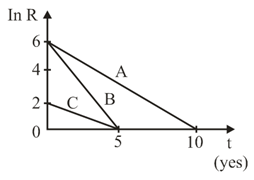
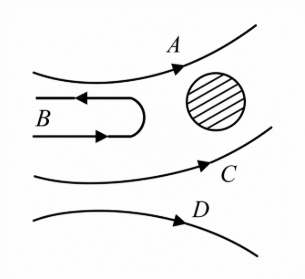
A nuclear reactor starts producing a radioactive nuclide $$X$$ from $$t=0$$, at a constant rate of $$\alpha$$ per second. Each decay of $$X$$ produces energy $$E_0$$, which is utilized to heat a liquid of mass $$m$$ and specific heat $$s$$. Assuming no heat loss from the liquid and taking $$\lambda$$ as the decay constant of $$X$$, the rate of increase in the temperature of the liquid is:
- Home
- >
- JEE Questions
- >
- JEE Physics Questions
- >
- Nuclei
JEE Nuclei Questions
An atom $$^8_{3}X$$ is bombarded by shower of fundamental particles and in 10s this atom absorbed 10 electrons, 10 protons and 9 neutrons. The percentage growth in the smface area of the nucleons is recorded by:
The nucleus of an atom is usually treated as a sphere whose radius varies with the mass number $$A$$ according to the empirical relation $$R = R_0\,A^{1/3}$$, where $$R_0$$ is a constant.
For a sphere, surface area $$S$$ is $$4\pi R^2$$. Hence,
$$S \propto R^2 \;\Longrightarrow\; S \propto \left(A^{1/3}\right)^{2}=A^{2/3} \quad -(1)$$
Initial nucleus: $$^{8}_{3}X$$ ⇒ initial mass number $$A_i = 8$$.
During the $$10\,$$s bombardment the nucleus absorbs
• $$10$$ protons ($$p$$)
• $$9$$ neutrons ($$n$$)
(The captured electrons do not stay in the nucleus, so they do not alter the nucleon count.)
Total extra nucleons $$= 10 + 9 = 19$$.
Final mass number:
$$A_f = A_i + 19 = 8 + 19 = 27$$.
Using relation $$-(1)$$, the ratio of final to initial surface areas is
$$\dfrac{S_f}{S_i}= \left(\dfrac{A_f}{A_i}\right)^{2/3} =\left(\dfrac{27}{8}\right)^{2/3}$$
Evaluate the exponent step by step:
$$\dfrac{27}{8}=3.375 \quad\Longrightarrow\quad
\left(3.375\right)^{1/3}=1.5$$ (because $$(1.5)^3 = 3.375$$).
Therefore,
$$\left(\dfrac{27}{8}\right)^{2/3}=(1.5)^2=2.25.$$(Final surface area is $$2.25$$ times the initial.)
Percentage growth is defined as
$$\text{Percentage growth}=\left(\dfrac{S_f}{S_i}\right)\times100 =2.25 \times 100 = 225\%.$$(This includes the initial 100%; the surface area becomes 225% of its original value.)
Hence, the percentage growth recorded is 225%.
Answer (Option A)
The binding energy for the following nuclear reactions are expressed in MeV.
$$ _{2}He^{3}+ _{0}n^{1} \rightarrow {}_{2}He^{4}+20$$ MeV
$$ _{2}He^{4}+ _{0}n^{1} \rightarrow {}_{2}He^{5}-0.9$$ MeV
If $$X_{3}$$, $$X_{4}$$, $$X_{5}$$ denote the stability of $${}_{2}He^{3}, {}_{2}He^{4}$$ and $${}_{2}He^{5},$$ respectively, then the correct order is :
The stability of a nucleus is measured by its total binding energy: larger binding energy ⇒ greater stability.
Let the binding energies of $${}_{2}He^{3},\; {}_{2}He^{4}$$ and $${}_{2}He^{5}$$ be $$B_3,\; B_4$$ and $$B_5$$ (in MeV).
Write the given reactions in the form
$${}_{2}He^{3} + {}_{0}n^{1} \;\longrightarrow\; {}_{2}He^{4} + 20\;{\rm MeV}$$
$${}_{2}He^{4} + {}_{0}n^{1} \;\longrightarrow\; {}_{2}He^{5} - 0.9\;{\rm MeV}$$
For any nuclear reaction,
energy released $$=\;(\text{binding energy of products})-(\text{binding energy of reactants})$$.
Case 1:
Products’ binding energy $$=\;B_4$$, reactants’ binding energy $$=\;B_3 + 0$$ (a free neutron has zero binding energy).
Hence
$$B_4 - (B_3 + 0) = 20$$ $$-(1)$$
$$\Rightarrow\; B_4 = B_3 + 20$$
Case 2:
Products’ binding energy $$=\;B_5$$, reactants’ binding energy $$=\;B_4 + 0$$.
Here the reaction absorbs 0.9 MeV, so energy released = $$-0.9$$ MeV:
$$B_5 - (B_4 + 0) = -0.9$$ $$-(2)$$
$$\Rightarrow\; B_5 = B_4 - 0.9$$
Substitute $$B_4$$ from $$(1)$$ into $$(2)$$:
$$B_5 = (B_3 + 20) - 0.9 = B_3 + 19.1$$
Thus
$$B_4 = B_3 + 20$$
$$B_5 = B_3 + 19.1$$
Since $$20 \gt 19.1 \gt 0$$, we get the order
$$B_4 \gt B_5 \gt B_3$$.
Greater binding energy means higher stability, so
$$X_4 \gt X_5 \gt X_3$$.
Therefore the correct option is Option A.
Two nuclei of mass number 3 combine with another nucleus of mass number 4 to yield a nucleus of mass number 10. If the binding energy per nucleon for the mass numbers 3, 4 and 10 are 5.6 MeV, 7.4 MeV and 6.1 MeV, respectively, then in the process, $$\Delta Mc^2$$ = _____ MeV.
The reaction is
$$\;^3X + \;^3X + \;^4Y \;\longrightarrow\; ^{10}Z$$
First write the total binding energy (BE) of each nucleus.
Binding energy of a nucleus = (binding energy per nucleon) $$\times$$ (mass number).
For mass number $$3$$:
Total BE = $$5.6\;\text{MeV per nucleon}\times 3 = 16.8\;\text{MeV}$$.
There are two such nuclei, so initial contribution = $$2 \times 16.8 = 33.6\;\text{MeV}$$.
For mass number $$4$$:
Total BE = $$7.4\;\text{MeV per nucleon}\times 4 = 29.6\;\text{MeV}$$.
Therefore, total initial binding energy is
$$E_{\text{initial}} = 33.6 + 29.6 = 63.2\;\text{MeV}$$.
For the product nucleus of mass number $$10$$:
Total BE = $$6.1\;\text{MeV per nucleon}\times 10 = 61.0\;\text{MeV}$$.
The change in binding energy (final minus initial) is
$$\Delta E = E_{\text{final}} - E_{\text{initial}} = 61.0 - 63.2 = -2.2\;\text{MeV}.$$
A negative value means the final nucleus is less tightly bound; energy of $$2.2\;\text{MeV}$$ must be supplied, which equals the increase in mass-energy of the system:
$$\Delta M c^2 = 2.2\;\text{MeV}.$$
Hence, the required value is $$2.2\;\text{MeV}$$.
Option C which is: $$2.2$$
$$7.9 MeV \alpha - \text{particle}$$ scatters from a target material of atomic muuber 79. From the given data the estimated diameter of nuclei of the target material is (approximately) ___m.
$$\left[ \frac{1}{4\pi \epsilon_{o}}=9\times 10^{9} Nm^{2}/c^{2} \text{ and electron change}=1.6\times 10^{-19}C \right ]$$
Estimate the diameter of a nucleus (Z = 79) from alpha-particle scattering data.
When an alpha particle (charge $$2e$$, kinetic energy $$KE$$) approaches a nucleus head-on, all its kinetic energy converts to electrostatic potential energy at the distance of closest approach ($$r_0$$):
$$ KE = \frac{1}{4\pi\epsilon_0} \cdot \frac{(Ze)(2e)}{r_0} $$
The diameter $$d_0 = 2r_0$$. Solving for $$r_0$$ gives
$$ r_0 = \frac{1}{4\pi\epsilon_0} \cdot \frac{2Ze^2}{KE} $$
With $$KE = 7.9$$ MeV $$= 7.9 \times 10^6 \times 1.6 \times 10^{-19}$$ J $$= 12.64 \times 10^{-13}$$ J $$= 1.264 \times 10^{-12}$$ J, we substitute numerical values into the expression for $$r_0$$:
$$ r_0 = 9 \times 10^9 \times \frac{2 \times 79 \times (1.6 \times 10^{-19})^2}{1.264 \times 10^{-12}} $$
The numerator is $$2 \times 79 = 158$$ and $$(1.6 \times 10^{-19})^2 = 2.56 \times 10^{-38}$$, so
$$158 \times 2.56 \times 10^{-38} = 404.48 \times 10^{-38} = 4.0448 \times 10^{-36}$$ and
$$9 \times 10^9 \times 4.0448 \times 10^{-36} = 36.4 \times 10^{-27} = 3.64 \times 10^{-26}$$ giving
$$r_0 = \frac{3.64 \times 10^{-26}}{1.264 \times 10^{-12}} = 2.88 \times 10^{-14}$$ m.
Therefore the diameter is $$d_0 = 2r_0 = 2 \times 2.88 \times 10^{-14} = 5.76 \times 10^{-14}$$ m, which corresponds to Option C: $$5.76 \times 10^{-14}$$ m.
The de Broglie wavelength of an oxygen molecule at $$27^{\circ}C\text{ is }x\times10^{-12}m$$. The value of x is (take Planck's constant $$=6.63\times10^{-34}J.s$$, Boltzmann constant $$=1.38\times10^{-23}J/K$$, mass of oxygen molecule $$=5.31\times10^{-26}kg$$)
We need to find the de Broglie wavelength of an O$$_2$$ molecule at 27°C. The de Broglie wavelength of a gas molecule at temperature T is: $$\lambda = \frac{h}{\sqrt{3mk_BT}}$$ where $$h$$ is Planck's constant, $$m$$ is the mass of one molecule, $$k_B$$ is Boltzmann's constant, and $$T$$ is the absolute temperature.
$$h = 6.63 \times 10^{-34} \, \text{J·s}$$
$$m = 32 \times 1.66 \times 10^{-27} \, \text{kg} = 53.12 \times 10^{-27} \, \text{kg}$$ (O$$_2$$ has molar mass 32 g/mol)
$$k_B = 1.38 \times 10^{-23} \, \text{J/K}$$
$$T = 27°C = 300 \, \text{K}$$
$$3mk_BT = 3 \times 53.12 \times 10^{-27} \times 1.38 \times 10^{-23} \times 300$$
$$= 3 \times 53.12 \times 1.38 \times 300 \times 10^{-50}$$
$$= 3 \times 21992.64 \times 10^{-50} = 65977.9 \times 10^{-50}$$
$$= 6.598 \times 10^{-46}$$
$$\sqrt{3mk_BT} = \sqrt{6.598 \times 10^{-46}} = 2.569 \times 10^{-23}$$
$$\lambda = \frac{6.63 \times 10^{-34}}{2.569 \times 10^{-23}} = 2.581 \times 10^{-11} \, \text{m} = 25.81 \times 10^{-12} \, \text{m} \approx 26 \times 10^{-12} \, \text{m}$$
So $$x = 26$$.
The correct answer is Option (4): 26.
Which of the following pair of nuclei are isobars of the element?
We need to identify which pair of nuclei are isobars.
First, we recall that isobars are nuclides with the same mass number (A) but different atomic numbers (Z), meaning they have the same total number of nucleons (protons + neutrons) yet represent different elements.
Next, we examine each option in turn.
In the first case, $$^{198}_{80}Hg$$ and $$^{197}_{79}Au$$ have mass numbers 198 and 197, respectively, so they are different and thus not isobars.
Then, $$^{3}_{1}H$$ (tritium) and $$^{3}_{2}He$$ (helium-3) both possess mass number 3 but differ in atomic number, so they share the same mass number while representing different elements; these are isobars.
By contrast, $$^{236}_{92}U$$ and $$^{238}_{92}U$$ both have atomic number 92 but mass numbers 236 and 238, making them isotopes rather than isobars.
Similarly, $$^{2}_{1}H$$ (deuterium) and $$^{3}_{1}H$$ (tritium) share atomic number 1 yet differ in mass numbers 2 and 3, so they too are isotopes, not isobars.
The correct answer is Option (2): $$^{3}_{1}H$$ and $$^{3}_{2}He$$.
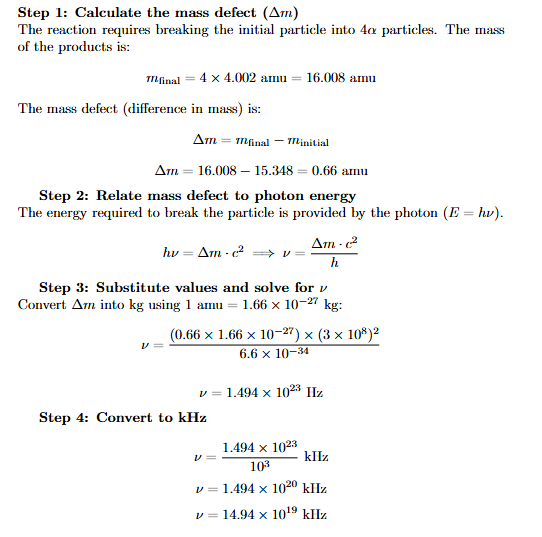
The minimum frequency of photon required to break a particle of mass 15.348 amu into $$4\alpha$$ particles is ____ kHz.
[mass of He nucleus$$=4.002amu, 1 amu=1.66\times10^{-27}kg,h=6.6\times10^{-34}J.s $$ and $$ c=3\times10^{8}m/s$$]
A nucleus has mass number $$\alpha$$ and radius $$R_{\alpha}$$ Another nucleus has mass number $$\beta$$ and radius $$R_{\beta}$$. If $$\beta=8\alpha$$ then $$R_{\alpha}/R_{\beta}$$ is:
A nucleus with mass number $$\alpha$$ has radius $$R_\alpha$$ and another with mass number $$\beta$$ has radius $$R_\beta$$. Given $$\beta = 8\alpha$$, we apply the nuclear radius formula $$R = R_0 A^{1/3}$$, where $$A$$ is the mass number and $$R_0$$ is a constant.
Substituting for the two nuclei yields $$\frac{R_\alpha}{R_\beta} = \frac{R_0 \alpha^{1/3}}{R_0 \beta^{1/3}} = \left(\frac{\alpha}{\beta}\right)^{1/3}$$. Using $$\beta = 8\alpha$$ gives $$\left(\frac{\alpha}{8\alpha}\right)^{1/3} = \left(\frac{1}{8}\right)^{1/3} = \frac{1}{2} = 0.5$$.
The correct answer is Option 3: 0.5.
The energy released if hydrogen atoms are combined to form $$^{4}_{2}$$He is __________ MeV. (Take binding energies per nucleon of $$^{2}_{1}$$H and $$^{4}_{2}$$He as 1.1 MeV and 7.2 MeV, respectively)
$$Q = \text{Total B.E. of Products} - \text{Total B.E. of Reactants}$$
$$2 \left(_{1}^{2}\text{H}\right) \longrightarrow _{2}^{4}\text{He}$$
$$\text{B.E. of one } _{1}^{2}\text{H} = 2 \times 1.1\text{ MeV} = 2.2\text{ MeV}$$
$$\text{Total B.E. of Reactants} = 2 \times 2.2\text{ MeV} = 4.4\text{ MeV}$$
$$\text{Total B.E. of Products} = 4 \times 7.2\text{ MeV} = 28.8\text{ MeV}$$
$$Q = 28.8\text{ MeV} - 4.4\text{ MeV} = 24.4\text{ MeV}$$
The smallest wavelength of Lyman series is 91 nm. The difference between the largest wavelengths of Paschen and Balmer series is nearly __ nm.
Smallest Lyman wavelength = 91 nm → $$R = 1/(91 \times 10^{-9})$$.
Largest Balmer: $$3 \to 2$$: $$\frac{1}{\lambda_B} = R(1/4-1/9) = 5R/36$$. $$\lambda_B = 36/(5R) = 36 \times 91/5 = 655.2$$ nm.
Largest Paschen: $$4 \to 3$$: $$\frac{1}{\lambda_P} = R(1/9-1/16) = 7R/144$$. $$\lambda_P = 144/(7R) = 144 \times 91/7 = 1872$$ nm.
Difference = $$1872 - 655.2 = 1216.8 \approx 1217$$ nm.
The answer is Option 4: 1217 nm.
Given below are two statements:
Statement I: For all elements, greater the mass of the nucleus, greater is the binding energy per nucleon.
Statement II: For all elements, nuclei with less binding energy per nucleon transforms to nuclei with greater binding energy per nucleon.
In the light of the above statements, choose the correct answer from the options given below
We need to evaluate two statements about nuclear binding energy.
Statement I: "For all elements, greater the mass of the nucleus, greater is the binding energy per nucleon."
This statement is FALSE. The binding energy per nucleon does not increase monotonically with mass number. It increases up to iron (Fe-56) and then decreases for heavier nuclei. For example, uranium has a lower binding energy per nucleon than iron.
Statement II: "For all elements, nuclei with less binding energy per nucleon transforms to nuclei with greater binding energy per nucleon."
This statement is TRUE. Nuclear reactions (both fission and fusion) proceed in the direction of increasing binding energy per nucleon, as this leads to more stable configurations. Light nuclei undergo fusion and heavy nuclei undergo fission, both leading to products with higher binding energy per nucleon.
Therefore, Statement I is false and Statement II is true, which corresponds to Option 4.
In Rutherford's alpha-particle scattering experiment, only a few alpha particles rebound back because
A. The size of gold nucleus is very small as compared to the size of gold atom.
B. Alpha particle and gold nucleus have equal charge.
C. The impact parameter is minimum for a few alpha particles.
D. A few alpha particles have very high kinetic energy.
E. Only a few alpha particles undergo head-on collision with the nuclei.
Choose the correct answer from the options given below:
The question asks why, in Rutherford’s gold-foil experiment, only a very small fraction of incident $$\alpha$$-particles are scattered backward (rebound through angles $$\gt 90^{\circ}$$).
To answer, recall two key ideas of Rutherford scattering:
1. The nuclear size is extremely small compared with the atomic size.
2. Large deflection (up to $$180^{\circ}$$) occurs only when the $$\alpha$$-particle passes very close to the nucleus, i.e. the impact parameter $$b$$ is extremely small. Such trajectories are often called “head-on” or “near head-on” collisions.
Using these ideas, examine each statement:
Statement A: “The gold nucleus is very small compared to the atom.”
Because the nucleus occupies only about $$10^{-15}\text{ m}$$ while the atom is about $$10^{-10}\text{ m}$$, the geometrical area that can give large deflection is tiny. Hence very few $$\alpha$$-particles come close enough to rebound. Statement A is correct.
Statement B: “$$\alpha$$-particle and gold nucleus have equal charge.”
The charges are $$+2e$$ for an $$\alpha$$-particle and $$+79e$$ for a gold nucleus; they are not equal. Therefore Statement B is wrong.
Statement C: “Impact parameter is minimum for very few particles.”
The distribution of $$\alpha$$-particles over the foil is uniform, so only a minute fraction possess a sufficiently small impact parameter $$b$$ ($$b \approx 0$$) required for large-angle scattering. Hence Statement C is correct.
Statement D: “Very few $$\alpha$$-particles have very high kinetic energy.”
All $$\alpha$$-particles in Rutherford’s beam are emitted from the same radioactive source and have nearly the same kinetic energy. The fraction with “very high” energy is not the reason for rare back-scattering. Statement D is wrong.
Statement E: “Only few $$\alpha$$-particles undergo head-on collision.”
A head-on collision corresponds to $$b \approx 0$$ and produces a $$180^{\circ}$$ reversal. Since $$b \approx 0$$ events are rare, only a few $$\alpha$$-particles rebound. Statement E is correct.
Thus the correct set of reasons is A, C, and E.
Therefore, the correct option is
Option D which is: A, C, E Only.
Assuming the experimental mass of $$^{12}_{6}C$$ as 12 u, The mass defect of $${}^{12}\text{C}$$ atom is (in MeV/$$c^2$$) :
(Mass of proton = 1.00727 u, mass of neutron = 1.00866 u, 1 u = 931.5$$ $$MeV/$$c^2$$ and c is the speed of the light in vacuum).
$$\Delta m = [Z \cdot m_p + (A - Z) \cdot m_n] - M_{\text{actual}}$$
$$m_{\text{nucleons}} = (6 \times 1.00727 \text{ u}) + (6 \times 1.00866 \text{ u})$$
$$m_{\text{nucleons}} = 6.04362 \text{ u} + 6.05196 \text{ u} = 12.09558 \text{ u}$$
$$\Delta m = 12.09558 \text{ u} - 12 \text{ u} = 0.09558 \text{ u}$$
$$\Delta m = 0.09558 \times 931.5 \text{ MeV}/c^2$$
$$\Delta m \approx 89.03277 \text{ MeV}/c^2 \approx 89.03 \text{ MeV}/c^2$$
If an alpha particle with energy 7.7 MeV is bombarded on a thin gold foil, the closest distance from nucleus it can reach is ___ m. (Atomic number of gold = 79 and $$\frac{1}{4\pi\epsilon _{0}}=9\times10^{9} \text{in SI units} )$$
An alpha particle with energy 7.7 MeV approaches a gold nucleus (Z = 79) and we need the closest distance of approach.
Apply energy conservation: at the closest distance all kinetic energy converts to electrostatic potential energy given by $$KE = \frac{1}{4\pi\epsilon_0} \cdot \frac{Z_1 Z_2 e^2}{d}$$ where $$Z_1 = 2$$, $$Z_2 = 79$$, and $$e = 1.6 \times 10^{-19}$$ C.
Since we solve for $$d$$ we write $$d = \frac{kZ_1 Z_2 e^2}{KE}$$ where $$k = 9 \times 10^9 \text{ N m}^2\text{/C}^2$$ and $$KE = 7.7 \times 10^6 \times 1.6 \times 10^{-19}$$ J.
Substituting these values yields $$d = \frac{9 \times 10^9 \times 2 \times 79 \times (1.6 \times 10^{-19})^2}{7.7 \times 10^6 \times 1.6 \times 10^{-19}}.$$
The numerator is $$9 \times 10^9 \times 158 \times 2.56 \times 10^{-38} = 3639.17 \times 10^{-29} = 3.639 \times 10^{-26}$$ and the denominator is $$12.32 \times 10^{-13} = 1.232 \times 10^{-12}$$.
This gives $$d = \frac{3.639 \times 10^{-26}}{1.232 \times 10^{-12}} = 2.95 \times 10^{-14} \text{ m}.$$
Therefore the closest distance of approach is $$2.95 \times 10^{-14} \text{ m}.$$
The binding energy per nucleon of $${}^{209}_{83}\text{Bi}$$ is _________ MeV. [Take $$m({}^{209}_{83}\text{Bi}) = 208.980388$$ u, $$m_p = 1.007825$$ u, $$m_n = 1.008665$$ u, $$1$$ u $$= 931$$ MeV/c$$^2$$]
The binding energy $$B$$ of a nucleus is obtained from the mass-defect formula
$$\Delta m = Z\,m_p + N\,m_n - m_{\text{nucleus}}$$
and $$B = \Delta m \times 931\; \text{MeV}$$ (because $$1\;{\rm u}=931\;{\rm MeV}/c^{2}$$).
For $${}^{209}_{83}\text{Bi}$$:
Atomic number $$Z = 83$$, mass number $$A = 209$$, so the number of neutrons $$N = A-Z = 209-83 = 126$$.
Mass of all free protons:
$$Z\,m_p = 83 \times 1.007825\;{\rm u} = 83.649475\;{\rm u}$$
Mass of all free neutrons:
$$N\,m_n = 126 \times 1.008665\;{\rm u} = 127.091790\;{\rm u}$$
Total mass of separated nucleons:
$$Z\,m_p + N\,m_n = 83.649475 + 127.091790 = 210.741265\;{\rm u}$$
Nuclear mass of $${}^{209}_{83}\text{Bi}$$ (given): $$m_{\text{nucleus}} = 208.980388\;{\rm u}$$
Mass defect:
$$\Delta m = 210.741265 - 208.980388 = 1.760877\;{\rm u}$$
Total binding energy:
$$B = 1.760877 \times 931\;{\rm MeV} = 1639.38\;{\rm MeV}$$
Binding energy per nucleon:
$$\frac{B}{A} = \frac{1639.38\;{\rm MeV}}{209} = 7.84\;{\rm MeV}$$ (rounded to two decimal places).
Hence, the binding energy per nucleon of $${}^{209}_{83}\text{Bi}$$ is $$7.84$$ MeV.
Option B which is: $$7.84$$
Two radioactive substances A and B of mass numbers 200 and 212 respectively, shows spontaneous $$\alpha$$-decay with same Q value of 1 MeV. The ratio of energies of $$\alpha$$-rays produced by A and B is __________.
Solution :
In $$\alpha$$-decay :
$$Q = K_\alpha + K_D$$
where :
$$K_\alpha$$ = kinetic energy of $$\alpha$$-particle
$$K_D$$ = kinetic energy of daughter nucleus
Using conservation of momentum :
$$p_\alpha = p_D$$
Therefore,
$$\frac{K_\alpha}{K_D} = \frac{M_D}{M_\alpha}$$
Hence,
$$K_\alpha = Q\left(\frac{M_D}{M_D+M_\alpha}\right)$$
For substance $$A$$ :
Mass number of parent nucleus :
$$200$$
Daughter nucleus mass number :
$$196$$
Therefore,
$$K_A = Q\left(\frac{196}{196+4}\right)$$
$$= Q\left(\frac{196}{200}\right)$$
$$= \frac{49Q}{50}$$
For substance $$B$$ :
Mass number of parent nucleus :
$$212$$
Daughter nucleus mass number :
$$208$$
Therefore,
$$K_B = Q\left(\frac{208}{208+4}\right)$$
$$= Q\left(\frac{208}{212}\right)$$
$$= \frac{52Q}{53}$$
Required ratio :
$$\frac{K_A}{K_B} = \frac{49/50}{52/53}$$
$$= \frac{49 \times 53}{50 \times 52}$$
$$= \frac{2597}{2600}$$
Final Answer :
$$\frac{2597}{2600}$$
The ratio of de Broglie wavelength of a deutron with kinetic energy E to that of an alpha particle with kinetic energy 2E, is n : 1. The value of n is __.
(Assume mass of proton= mass of neutron) :
We need to find the ratio of de Broglie wavelengths of deuteron (KE = E) and alpha particle (KE = 2E).
Formula: $$\lambda = \frac{h}{\sqrt{2mK}}$$
Deuteron: mass = 2m_p (1 proton + 1 neutron), KE = E
Alpha: mass = 4m_p (2 protons + 2 neutrons), KE = 2E
$$\frac{\lambda_d}{\lambda_\alpha} = \frac{\sqrt{2m_\alpha \times 2E}}{\sqrt{2m_d \times E}} = \sqrt{\frac{4m_p \times 2E}{2m_p \times E}} = \sqrt{\frac{8}{2}} = \sqrt{4} = 2$$
So n:1 = 2:1, meaning n = 2.
The energy released when $$\frac{7}{17.13}$$ kg of $$^7_3$$Li is converted into $$^4_2$$He by proton bombardment is $$\alpha \times 10^{32}$$ eV. The value of $$\alpha$$ is _______. (Nearest integer)
(Mass of $$^7_3$$Li = 7.0183 u, mass of $$^4_2$$He = 4.004 u, mass of proton = 1.008 u and 1 u = 931 MeV/c$$^2$$ and Avogadro number = $$6.0 \times 10^{23}$$)
The nuclear reaction for the proton bombardment of Lithium-7 is:
$$ ^{7}_{3}\text{Li} + ^{1}_{1}\text{H} \rightarrow 2 ^{4}_{2}\text{He} $$
$$ \Delta m = m(^{7}_{3}\text{Li}) + m(\text{proton}) - 2 \times m(^{4}_{2}\text{He}) $$
$$ \Delta m = 7.0183 \text{ u} + 1.008 \text{ u} - 2(4.004 \text{ u}) $$
$$ \Delta m = 8.0263 \text{ u} - 8.0080 \text{ u} $$
$$ \Delta m = 0.0183 \text{ u} $$
The energy released per reaction ($$ Q $$) is calculated using the given conversion factor $$ 1 \text{ u} = 931 \text{ MeV/c}^2 $$:
$$ Q = 0.0183 \times 931 \text{ MeV} $$
$$ Q = 17.0373 \text{ MeV} $$
$$ Q = 17.0373 \times 10^6 \text{ eV} $$
Next, calculate the number of Lithium atoms ($$ N $$) in the given sample mass.
The given mass is $$ m = \frac{7}{17.13} \text{ kg} = \frac{7000}{17.13} \text{ g} $$
The molar mass of $$ ^{7}_{3}\text{Li} $$ is approximately $$ 7 \text{ g/mol} $$.
Calculate the number of moles ($$ n $$):
$$ n = \frac{\text{Mass}}{\text{Molar Mass}} = \frac{7000 / 17.13}{7} $$
$$ n = \frac{1000}{17.13} \text{ mol} $$
Calculate the total number of atoms ($$ N $$) using Avogadro's number ($$ N_A = 6.0 \times 10^{23} $$):
$$ N = n \times N_A $$
$$ N = \left( \frac{1000}{17.13} \right) \times 6.0 \times 10^{23} $$
$$ N = \frac{6.0 \times 10^{26}}{17.13} \text{ atoms} $$
The total energy released ($$ E $$) is the total number of atoms multiplied by the energy released per reaction:
$$ E = N \times Q $$
$$ E = \left( \frac{6.0 \times 10^{26}}{17.13} \right) \times (17.0373 \times 10^6 \text{ eV}) $$
Rearranging the terms for simpler calculation:
$$ E = 6.0 \times \left( \frac{17.0373}{17.13} \right) \times 10^{32} \text{ eV} $$
Notice that the fraction is very close to 1 ($$ \frac{17.0373}{17.13} \approx 0.9946 $$):
$$ E \approx 6.0 \times 0.9946 \times 10^{32} \text{ eV} $$
$$ E \approx 5.967 \times 10^{32} \text{ eV} $$
Rounding to the nearest integer, we get:
$$ E = 6 \times 10^{32} \text{ eV} $$
Comparing this with the given format $$ \alpha \times 10^{32} \text{ eV} $$, we find the value of $$ \alpha $$:
$$ \alpha = 6 $$
A particle having electric charge $$3\times 10^{-19}$$ C and mass $$6 \times 10^{-27}$$ kg is accelerated by applying an electric Potential of 1.21 V. Wavelength of the matter wave
associated with the particle is $$\alpha \times 10^{-12}m$$. The value of $$\alpha$$ is __________. (Take Planck's constant = $$6.6 \times 10^{-34}$$ J.s. )
Charge $$q = 3 \times 10^{-19}$$ C, mass $$m = 6 \times 10^{-27}$$ kg, potential $$V = 1.21$$ V.
KE gained: $$KE = qV = 3 \times 10^{-19} \times 1.21 = 3.63 \times 10^{-19}$$ J
$$\frac{1}{2}mv^2 = 3.63 \times 10^{-19}$$
$$v^2 = \frac{2 \times 3.63 \times 10^{-19}}{6 \times 10^{-27}} = 1.21 \times 10^{8}$$
$$v = 1.1 \times 10^4$$ m/s
de Broglie wavelength: $$\lambda = \frac{h}{mv} = \frac{6.6 \times 10^{-34}}{6 \times 10^{-27} \times 1.1 \times 10^4} = \frac{6.6 \times 10^{-34}}{6.6 \times 10^{-23}} = 10^{-11}$$ m
Wait, $$\lambda = 10^{-11} = 10 \times 10^{-12}$$ m. So $$\alpha = 10$$.
The answer is 10.
The average energy released per fission for the nucleus of $$ _{92}^{235}U $$ is 190 MeV.
When all the atoms of 47g pure $$ _{92}^{235}U $$ undergo fission process, the energy released is $$\alpha \times 10^{23}$$MeV. The value of $$\alpha$$ is ______.
(Avogadro Number = 6 $$\times$$ $$10^{23}$$ per mole)
Moles of U-235 = 47/235 = 0.2. Atoms = 0.2 × 6×10²³ = 1.2×10²³. Energy = 1.2×10²³ × 190 = 228×10²³ MeV. So α = 228.
A radioactive material P first decays into Q and then Q decays to non-radioactive material R. Which of the following figure represents time dependent mass of P, Q and R?
Substance P (Parent): Initially starts at a maximum value ($$M_0$$) and undergoes continuous, pure exponential decay. Its mass decreases monotonically toward zero: $$M_P(t) = M_0 e^{-\lambda_1 t}$$
Substance Q (Intermediate): Initially starts at zero. As P decays, Q is continuously produced while simultaneously decaying into R.
At early times, its production rate from P is higher than its own decay rate, causing its mass to rise to a maximum peak. Eventually, as the supply of P depletes, its decay rate dominates, causing its mass to fall back asymptotically toward zero.
Substance R (Stable End-Product): Initially starts at zero. Because it is non-radioactive (stable), it never decays. It accumulates continuously over time, flattening out asymptotically into a maximum steady plateau ($$M_0$$) as all of P and Q are completely spent.
Option (B) shows it correctly.
During the transition of electron from state A to state C of a Bohr atom, the wavelength of emitted radiation is 2000 A˚ and it becomes 6000 A˚ when the electron jumps from state B to state C. Then the wavelength of the radiation emitted during the transition of electrons from state A to state B is:
Transition A→C corresponds to $$\lambda_1 = 2000$$ Å and B→C to $$\lambda_2 = 6000$$ Å. We denote the wavelength for A→B by $$\lambda_3$$. Since the energy of A→C equals the sum of energies of A→B and B→C, $$E_{A→C} = E_{A→B} + E_{B→C}$$. Expressing each energy as $$hc/\lambda$$ gives $$\frac{hc}{\lambda_1} = \frac{hc}{\lambda_3} + \frac{hc}{\lambda_2}$$. Substituting the given wavelengths yields $$\frac{1}{\lambda_3} = \frac{1}{\lambda_1} - \frac{1}{\lambda_2} = \frac{1}{2000} - \frac{1}{6000} = \frac{3-1}{6000} = \frac{1}{3000}$$.
This gives $$\lambda_3 = 3000$$ Å. Therefore the correct answer is $$3000$$ Å.
Given below are two statements : one is labelled as Assertion (A) and the other is labelled as Reason (R).
Assertion (A) : The density of the copper $$\left(^{64}_{29}Cu\right)$$ nucleus is greater than that of the carbon $$\left(^{12}_{6}C\right)$$ nucleus.
Reason (R) : The nucleus of mass number A has a radius proportional to $$A^{1/3}$$.
In the light of the above statements, choose the most appropriate answer from the options given below :
The nuclear radius empirical formula is $$R = r_0 A^{1/3}$$, where
$$R$$ = radius of the nucleus,
$$A$$ = mass number,
$$r_0$$ ≈ $$1.2 \times 10^{-15}\,$$m (a constant).
Hence the nuclear volume is
$$V = \frac{4}{3}\pi R^{3} = \frac{4}{3}\pi\left(r_0 A^{1/3}\right)^{3} = \frac{4}{3}\pi r_0^{3} A$$.
The mass of a nucleus is roughly $$A m_n$$, where $$m_n$$ is the nucleon mass (proton/neutron mass).
Therefore nuclear density is
$$\rho = \frac{\text{mass}}{\text{volume}} = \frac{A m_n}{\frac{4}{3}\pi r_0^{3} A} = \frac{m_n}{\tfrac{4}{3}\pi r_0^{3}}$$.
The factor $$A$$ cancels out, so $$\rho$$ is the same constant for all nuclei, independent of their mass numbers.
Assertion (A): “The density of the copper $$\left(^{64}_{29}Cu\right)$$ nucleus is greater than that of the carbon $$\left(^{12}_{6}C\right)$$ nucleus.”
We just showed that densities are practically identical for all nuclei, so Assertion (A) is incorrect.
Reason (R): “The nucleus of mass number $$A$$ has a radius proportional to $$A^{1/3}$$.”
This is exactly the empirical formula stated above, so Reason (R) is correct.
Thus, Assertion (A) is not correct but Reason (R) is correct. The appropriate choice is Option B.
Choose the correct nuclear process from the below options [p: proton, n : neutron, $$e^{-}$$:electron, $$e^{+}$$ : positron, $$\upsilon$$ : neutrino, $$\overline{\upsilon}$$ : antineutrino]
We need to identify the correct nuclear process for beta-minus decay of a neutron.
Key Concept: Beta-minus ($$\beta^-$$) Decay
In beta-minus decay, a neutron inside a nucleus (or a free neutron) transforms into a proton by emitting an electron and an antineutrino:
$$n \rightarrow p + e^- + \bar{\nu}$$
Conservation Laws:
Charge conservation: Neutron (charge 0) $$\rightarrow$$ proton (charge +1) + electron (charge -1) + antineutrino (charge 0). Total: $$0 = +1 - 1 + 0$$ $$\checkmark$$
Lepton number conservation: Left side: lepton number = 0. Right side: electron (lepton number +1) + antineutrino (lepton number -1) = 0. $$\checkmark$$
Baryon number conservation: Left side: 1. Right side: 1 + 0 + 0 = 1. $$\checkmark$$
Why other options are wrong:
- Option 1: $$n \rightarrow p + e^+ + \bar{\nu}$$ -- The positron ($$e^+$$) has charge +1, giving total charge +2 on the right. Charge not conserved.
- Option 2: $$n \rightarrow p + e^+ + \nu$$ -- Same charge violation as above.
- Option 3: $$n \rightarrow p + e^- + \nu$$ -- Lepton number: right side = +1 + 1 = +2 $$\neq$$ 0. Lepton number not conserved.
The correct answer is Option 4: $$n \rightarrow p + e^- + \bar{\nu}$$.
If $$\lambda$$ and $$K$$ are de Broglie wavelength and kinetic energy, respectively, of a particle with constant mass. The correct graphical representation for the particle will be
For a particle of constant mass $$m$$:
$$\lambda = \frac{h}{\sqrt{2mK}} \implies \lambda^2 = \frac{h^2}{2mK}$$
Isolating the variables on the axes ($$y = \frac{1}{K}$$ and $$x = \lambda$$):
$$\frac{1}{K} = \left(\frac{2m}{h^2}\right)\lambda^2$$
Comparing with standard parabola $$y = c x^2$$ where $$c > 0$$:
$$\frac{1}{K} \propto \lambda^2$$
This represents a parabolic curve opening upwards with its vertex at the origin $$(0,0)$$.
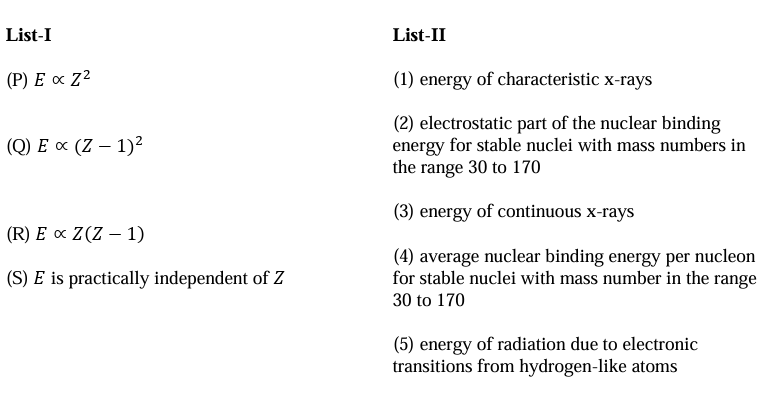
List-I shows various functional dependencies of energy ($$E$$) on the atomic number ($$Z$$). Energies associated with certain phenomena are given in List-II.
Choose the option that describes the correct match between the entries in List-I to those in List-II.
The question gives four different proportionalities of energy with atomic number $$Z$$ (List-I) and asks us to match them with the physical phenomena listed in List-II. We discuss each proportionality one by one.
Case P : $$E \propto Z^{2}$$For a hydrogen-like (one-electron) ion with nuclear charge $$+Ze$$, the Bohr model gives the energy of the $$n^{\text{th}}$$ orbit as $$E_n = -\dfrac{13.6\ \text{eV}\; Z^{2}}{n^{2}}$$ Hence the energy difference between any two levels, and therefore the photon energy emitted during an electronic transition, is proportional to $$Z^{2}$$. This exactly matches List-II entry (5) “energy of radiation due to electronic transitions from hydrogen-like atoms”.
Therefore, $$P \to 5$$.
Case Q : $$E \propto (Z-1)^{2}$$Moseley’s law for characteristic X-rays (for example, Kα, Kβ lines) is $$\nu = R\,c\,(Z-1)^{2}\left(\dfrac{1}{n_{1}^{2}}-\dfrac{1}{n_{2}^{2}}\right)$$ so the photon energy $$E = h\nu$$ also follows $$E \propto (Z-1)^{2}$$. The factor $$(Z-1)$$ accounts for the screening of one inner-shell electron.
Thus, $$Q \to 1$$ corresponding to “energy of characteristic X-rays”.
Case R : $$E \propto Z(Z-1)$$In the semi-empirical mass formula, the electrostatic (Coulomb) part of the nuclear binding energy is $$B_{C} = a_{c}\dfrac{Z (Z-1)}{A^{1/3}}$$ For medium-mass stable nuclei ($$30\le A\le170$$), $$A$$ is roughly proportional to $$Z$$, so apart from a slowly varying denominator, the numerator gives the leading dependence $$Z(Z-1)$$.
Hence, $$R \to 2$$ “electrostatic part of the nuclear binding energy for stable nuclei with mass numbers in the range 30 to 170”.
Case S : $$E$$ almost independent of $$Z$$The average binding energy per nucleon for medium-mass stable nuclei (say $$30 \le A \le 170$$) is nearly constant at about $$8\ \text{MeV}$$ and shows only a very weak dependence on $$Z$$.
This matches List-II entry (4) “average nuclear binding energy per nucleon for stable nuclei with mass number in the range 30 to 170”. Therefore, $$S \to 4$$.
Collecting all the matches:
$$P \to 5,\; Q \to 1,\; R \to 2,\; S \to 4$$
This set of correspondences is given by Option C.
The number of spectral lines emitted by atomic hydrogen that is in the $$4^{th}$$ energy level, is
The number of spectral lines emitted when an electron transitions from energy level $$n$$ to all lower levels is given by:
$$ \text{Number of lines} = \frac{n(n-1)}{2} $$
For $$n = 4$$:
$$ \text{Number of lines} = \frac{4 \times 3}{2} = 6 $$
The possible transitions are: $$4 \to 3$$, $$4 \to 2$$, $$4 \to 1$$, $$3 \to 2$$, $$3 \to 1$$, $$2 \to 1$$.
The correct answer is Option 3: 6.
Energy released when two deuterons $$(_{1}H^2)$$ fuse to form a helium nucleus $$(_{2}He^4)$$ is :
(Given : Binding energy per nucleon of $$_{1}H^2 = 1.1$$ MeV and binding energy per nucleon of $$_{2}He^4 = 7.0$$ MeV)
The energy released in a nuclear reaction equals the increase in total binding energy of the nuclei involved.
$$Q = \text{(total BE of products)} - \text{(total BE of reactants)}$$
Step 1: Binding energy of the reactants
Each deuteron $$_{1}H^{2}$$ contains $$A = 2$$ nucleons.
Given binding energy per nucleon = $$1.1$$ MeV.
Total binding energy of one deuteron = $$1.1 \times 2 = 2.2$$ MeV.
Since two deuterons take part, total BE of reactants = $$2 \times 2.2 = 4.4$$ MeV.
Step 2: Binding energy of the product
Helium-4 nucleus $$_{2}He^{4}$$ has $$A = 4$$ nucleons.
Given binding energy per nucleon = $$7.0$$ MeV.
Total binding energy of product = $$7.0 \times 4 = 28.0$$ MeV.
Step 3: Energy released
$$Q = 28.0 \text{ MeV} - 4.4 \text{ MeV} = 23.6 \text{ MeV}.$$
Therefore, the energy liberated when two deuterons fuse into a helium-4 nucleus is $$23.6$$ MeV.
Option C is correct.
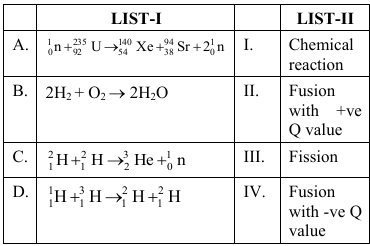
Match the LIST-I with LIST-II.

Choose the correct answer from the options given below :
First recognise the four classes given in LIST-II.
I Chemical reaction - involves only electrons, no change in nucleus, energy of the order of $$\text{kJ mol}^{-1}$$.
II Fusion with $$+$$ve Q value - two light nuclei combine, total mass decreases, energy is released ($$Q \gt 0$$).
III Fission - a heavy nucleus splits into two medium-mass nuclei and a few neutrons, energy is released ($$Q \gt 0$$).
IV Fusion with $$-$$ve Q value - two nuclei combine but the product mass is larger, energy is absorbed ($$Q \lt 0$$).
Case A: $$^{1}_{0}n + {}^{235}_{92}U \rightarrow {}^{140}_{54}Xe + {}^{94}_{38}Sr + 2\,^{1}_{0}n$$
A single heavy nucleus $$^{235}U$$ breaks into two medium nuclei plus neutrons. According to the definition, this is nuclear fission. Hence A → III.
Case B: $$2H_2 + O_2 \rightarrow 2H_2O$$
Only the electronic configuration of atoms changes; nuclei remain unchanged. This is an ordinary chemical reaction. Hence B → I.
Case C: $$^{2}_{1}H + {}^{2}_{1}H \rightarrow {}^{3}_{2}He + {}^{1}_{0}n$$
Two deuterons fuse to form a helium-3 nucleus and a neutron.
Mass of reactants: $$M_r = 2 \times 2.014102\,u = 4.028204\,u$$.
Mass of products: $$M_p = 3.016029\,u + 1.008665\,u = 4.024694\,u$$.
$$\Delta M = M_r - M_p = 0.003510\,u \gt 0$$, so $$Q = \Delta M c^2 \approx 3.27\ \text{MeV} \gt 0$$.
Energy is released; it is a fusion reaction with positive Q value. Hence C → II.
Case D: $$^{1}_{1}H + {}^{3}_{1}H \rightarrow {}^{2}_{1}H + {}^{2}_{1}H$$
Mass of reactants: $$1.007825\,u + 3.016049\,u = 4.023874\,u$$.
Mass of products: $$2 \times 2.014102\,u = 4.028204\,u$$.
$$\Delta M = M_r - M_p = -0.004330\,u \lt 0$$, so $$Q = \Delta M c^2 \approx -4.03\ \text{MeV} \lt 0$$.
Energy is absorbed; it is a fusion reaction with negative Q value. Hence D → IV.
Thus the correct matching is
A - III, B - I, C - II, D - IV.
The option representing this pattern is Option B.
Final Answer: Option B
A radioactive nucleus $$n_{2}$$ has 3 times the decay constant as compared to the decay constant of another radioactive nucleus $$n_{1}$$ . If initial number of both nuclei are the same, what is the ratio of number of nuclei of $$n_{2}$$ to the number of nuclei of $$n_{1}$$ , after one half-life of $$n_{1}$$ ?
Since the decay constant of $$n_2$$ is three times that of $$n_1$$, $$\lambda_2 = 3\lambda_1$$, we use the radioactive decay law:
$$ N = N_0 e^{-\lambda t} $$
After one half-life of $$n_1$$ (that is, $$t = T_1 = \frac{\ln 2}{\lambda_1}$$), the remaining amount of $$n_1$$ is
$$ N_1 = N_0 e^{-\lambda_1 \cdot \frac{\ln 2}{\lambda_1}} = N_0 e^{-\ln 2} = \frac{N_0}{2} $$
At the same time, the amount of $$n_2$$ is
$$ N_2 = N_0 e^{-\lambda_2 \cdot \frac{\ln 2}{\lambda_1}} = N_0 e^{-3\lambda_1 \cdot \frac{\ln 2}{\lambda_1}} = N_0 e^{-3\ln 2} = N_0 \cdot 2^{-3} = \frac{N_0}{8} $$
Hence, the ratio of the two amounts is
$$ \frac{N_2}{N_1} = \frac{N_0/8}{N_0/2} = \frac{1}{4} $$
The correct answer is Option 4: 1/4.
Given below are two statements. One is labelled as Assertion (A) and the other is labelled as Reason (R). Assertion (A) : The binding energy per nucleon is found to be practically independent of the atomic number A, for nuclei with mass numbers between 30 and 170. Reason (R): Nuclear force is long range. In the light of the above statements, choose the correct answer from the options given below :
Evaluate the assertion and reason about nuclear binding energy.
Assertion (A): The binding energy per nucleon is practically independent of A for nuclei with mass numbers between 30 and 170.
This is TRUE. The BE/nucleon curve is roughly flat (~8.5 MeV) in this range.
Reason (R): Nuclear force is long range.
This is FALSE. Nuclear force is SHORT range (about 1-2 femtometers). In fact, the saturation of binding energy per nucleon is a consequence of the short-range nature of nuclear force - each nucleon interacts only with its nearest neighbors.
The correct answer is Option 1: (A) is true but (R) is false.
For a nucleus of mass number A and radius R, the mass density of nucleus can be represented as
The nucleus is assumed to be a uniform solid sphere.
Radius-mass number relation:
Experimental data give $$R = R_0\,A^{1/3}$$, where $$R_0 \approx 1.2 \times 10^{-15}\,\text{m}$$.
Volume of the nucleus:
$$V = \frac{4}{3}\pi R^{3}$$
Substitute $$R = R_0\,A^{1/3}$$:
$$V = \frac{4}{3}\pi \left(R_0\,A^{1/3}\right)^{3} = \frac{4}{3}\pi R_0^{3}\,A$$ $$-(1)$$
Mass of the nucleus:
Each nucleon (proton or neutron) has nearly the same mass $$m_N$$, so for mass number $$A$$ the nuclear mass is approximately
$$M \approx A\,m_N$$ $$-(2)$$
Nuclear mass density $$\rho$$ is defined as mass per unit volume:
$$\rho = \frac{M}{V}$$
Insert $$(1)$$ and $$(2)$$:
$$\rho = \frac{A\,m_N}{\dfrac{4}{3}\pi R_0^{3}\,A} = \frac{3\,m_N}{4\pi R_0^{3}}$$
The factor $$A$$ cancels out; therefore $$\rho$$ does not depend on the mass number $$A$$.
Hence, the nuclear mass density is independent of A.
Correct option: Option D.
The frequency of revolution of the electron in Bohr's orbit varies with , the principal quantum number as
$$f = \frac{1}{T} = \frac{v}{2\pi r}$$
$$v \propto \frac{Z}{n}$$
$$r \propto \frac{n^2}{Z}$$
$$f \propto \frac{\left(\frac{Z}{n}\right)}{\left(\frac{n^2}{Z}\right)}$$
$$f \propto \frac{Z^2}{n^3}$$
$$f \propto \frac{1}{n^3}$$
A proton of mass $$'m_{p}'$$has same energy as that of a photon of wavelength $$'\lambda'$$. If the proton is moving at non- relativistic speed, then ratio of its deBroglie wavelength to the wavelength of photon is.
A proton of mass $$m_p$$ has the same energy $$E$$ as a photon of wavelength $$\lambda$$, and we seek the ratio of the proton’s de Broglie wavelength to the photon’s wavelength.
To begin, we express the photon energy in terms of its wavelength. For a photon, $$E = \frac{hc}{\lambda}$$, which implies $$\lambda = \frac{hc}{E}$$.
Next, we determine the proton’s de Broglie wavelength by first relating its kinetic energy to its momentum. In the non-relativistic regime, the proton’s energy is $$E = \frac{p^2}{2m_p}$$, from which the momentum follows as
$$p = \sqrt{2m_p E}$$
and hence its de Broglie wavelength is
$$\lambda_p = \frac{h}{p} = \frac{h}{\sqrt{2m_p E}}$$
Combining these expressions to form the desired ratio gives
$$\frac{\lambda_p}{\lambda} = \frac{h/\sqrt{2m_p E}}{hc/E} = \frac{h}{\sqrt{2m_p E}} \cdot \frac{E}{hc} = \frac{E}{c\sqrt{2m_p E}} = \frac{\sqrt{E}}{c\sqrt{2m_p}} = \frac{1}{c}\sqrt{\frac{E}{2m_p}}$$
The correct answer is Option D) $$\frac{1}{c}\sqrt{\frac{E}{2m_p}}$$.
A nucleus at rest disintegrates into two smaller nuclei with their masses in the ratio of $$2 : 1$$. After disintegration they will move :
By conservation of momentum: $$\vec{p}_1 + \vec{p}_2 = 0$$ (nucleus initially at rest).
So $$m_1v_1 = m_2v_2$$, and they move in opposite directions.
$$\frac{v_1}{v_2} = \frac{m_2}{m_1} = \frac{1}{2}$$.
The heavier nucleus (mass ratio 2) moves slower, and the lighter one (mass ratio 1) moves faster, in opposite directions with speeds in ratio 1:2.
The correct answer is Option 4: in opposite directions with speed in the ratio of 1:2 respectively.
If $$M_o$$ is the mass of isotope $$^{12}_5 B$$, $$M_P$$ and $$M_n$$ are the masses of proton and neutron, then nuclear binding energy of isotope is :
We need to find the nuclear binding energy of the isotope $$^{12}_5 B$$ (Boron-12), given that $$M_o$$ is its mass, $$M_p$$ is the mass of a proton, and $$M_n$$ is the mass of a neutron.
The notation $$^{12}_5 B$$ tells us that the atomic number (Z) is 5, meaning there are 5 protons, and the mass number (A) is 12, indicating a total of 12 nucleons. Therefore, the number of neutrons is A - Z = 12 - 5 = 7 neutrons.
The mass defect ($$\Delta m$$) is the difference between the total mass of the individual nucleons (protons and neutrons) when separated and the actual mass of the nucleus. This "missing mass" has been converted into binding energy that holds the nucleus together, according to Einstein's mass-energy equivalence.
The total mass of individual nucleons is:
$$m_{nucleons} = 5M_p + 7M_n$$
The mass defect is:
$$\Delta m = m_{nucleons} - M_o = 5M_p + 7M_n - M_o$$
Note that $$\Delta m$$ is positive because the bound nucleus has less mass than the individual nucleons (energy has been released during binding).
Using Einstein's relation $$E = \Delta m \cdot C^2$$, the binding energy is:
$$\text{Binding Energy} = (5M_p + 7M_n - M_o)C^2$$
The correct answer is Option (2): $$(5M_p + 7M_n - M_o)C^2$$.
Binding energy of a certain nucleus is $$18 \times 10^8 \text{ J}$$. How much is the difference between total mass of all the nucleons and nuclear mass of the given nucleus:
Binding energy = $$18 \times 10^8$$ J. Find the mass difference between nucleons and the nucleus.
$$E = \Delta m \cdot c^2$$
The binding energy represents the energy equivalent of the mass defect $$\Delta m$$.
$$\Delta m = \frac{E}{c^2} = \frac{18 \times 10^8}{(3 \times 10^8)^2} = \frac{18 \times 10^8}{9 \times 10^{16}} = 2 \times 10^{-8} \text{ kg}$$
$$1 \text{ kg} = 10^9 \; \mu\text{g}$$, so:
$$\Delta m = 2 \times 10^{-8} \times 10^9 = 20 \; \mu\text{g}$$
The correct answer is Option (2): 20 $$\mu$$g.
In a hypothetical fission reaction $$_{92}X^{236} \rightarrow _{56}Y^{141} + _{36}Z^{92} + 3R$$. The identity of emitted particles (R) is :
We are given the hypothetical fission reaction:
$$_{92}X^{236} \rightarrow \, _{56}Y^{141} + \, _{36}Z^{92} + 3R$$
We need to identify the emitted particle $$R$$.
Applying conservation of mass number (A), in any nuclear reaction the total mass number must be conserved (total on left = total on right). On the left side $$A = 236$$, and on the right side $$141 + 92 + 3A_R = 233 + 3A_R$$. Setting them equal gives $$236 = 233 + 3A_R$$, hence $$3A_R = 3$$ and $$A_R = 1$$, so each particle $$R$$ has mass number 1.
Applying conservation of atomic number (Z), the total charge (atomic number) must also be conserved. On the left side $$Z = 92$$, and on the right side $$56 + 36 + 3Z_R = 92 + 3Z_R$$. Equating these yields $$92 = 92 + 3Z_R$$, so $$3Z_R = 0$$ and $$Z_R = 0$$. Each particle $$R$$ therefore has atomic number 0 (no charge).
A particle with mass number $$A = 1$$ and atomic number $$Z = 0$$ is a neutron ($$^1_0 n$$). This makes physical sense, as neutron emission is very common in nuclear fission reactions. The emitted neutrons can go on to trigger further fission events, which is the basis of a nuclear chain reaction.
The correct answer is Option (2): Neutron.
In a nuclear fission reaction of an isotope of mass $$M$$, three similar daughter nuclei of same mass are formed. The speed of a daughter nuclei in terms of mass defect $$\Delta M$$ will be:
In nuclear fission: $$M \rightarrow 3 \times \frac{M}{3}$$. Mass defect = $$\Delta M$$.
Energy released: $$E = \Delta M c^2$$.
This energy is shared as kinetic energy among three identical daughter nuclei: $$3 \times \frac{1}{2} \cdot \frac{M}{3} \cdot v^2 = \Delta M c^2$$.
$$\frac{M v^2}{2} = \Delta M c^2$$
$$v^2 = \frac{2\Delta M c^2}{M}$$
$$v = c\sqrt{\frac{2\Delta M}{M}}$$
The answer is Option (3): $$\boxed{c\sqrt{\frac{2\Delta M}{M}}}$$.
The atomic mass of $$_6C^{12}$$ is 12.000000 u and that of $$_6C^{13}$$ is 13.003354 u. The required energy to remove a neutron from $$_6C^{13}$$, if mass of neutron is 1.008665 u, will be :
Reaction equation: $$_{6}\text{C}^{13} \rightarrow {}_{6}\text{C}^{12} + {}_{0}\text{n}^{1}$$
Mass defect: $$\Delta m = \left[m\left({}_{6}\text{C}^{12}\right) + m_n\right] - m\left({}_{6}\text{C}^{13}\right)$$
$$\Delta m = [12.000000 + 1.008665] - 13.003354 = 13.008665 - 13.003354 = 0.005311\text{ u}$$
Energy required: $$E = \Delta m \times 931.5\text{ MeV} \implies E = 0.005311 \times 931.5 \approx 4.95\text{ MeV}$$
The energy equivalent of $$1$$ g of substance is :
Using Einstein's mass-energy equivalence: $$E = mc^2$$.
Given: $$m = 1$$ g = $$10^{-3}$$ kg, $$c = 3 \times 10^8$$ m/s.
$$E = 10^{-3} \times (3 \times 10^8)^2 = 10^{-3} \times 9 \times 10^{16} = 9 \times 10^{13} \text{ J}$$
Converting to MeV: $$1$$ MeV = $$1.6 \times 10^{-13}$$ J.
$$E = \frac{9 \times 10^{13}}{1.6 \times 10^{-13}} = \frac{9}{1.6} \times 10^{26} = 5.625 \times 10^{26} \approx 5.6 \times 10^{26} \text{ MeV}$$
The correct answer is Option 2: $$5.6 \times 10^{26}$$ MeV.
The energy released in the fusion of $$2 \text{ kg}$$ of hydrogen deep in the sun is $$E_H$$ and the energy released in the fission of $$2 \text{ kg}$$ of $$^{235}U$$ is $$E_U$$. The ratio $$\frac{E_H}{E_U}$$ is approximately: (Consider the fusion reaction as $$4 \mid H + 2e^- \to {}^4_2He + 2\nu + 6\gamma + 26.7 \text{ MeV}$$, energy released in the fission reaction of $$^{235}U$$ is $$200 \text{ MeV}$$ per fission nucleus and $$N_A = 6.023 \times 10^{23}$$)
Energy from fusion of 2 kg hydrogen:
The fusion reaction: $$4\,^1H + 2e^- \to \,^4_2He + 2\nu + 6\gamma + 26.7$$ MeV
This means 4 hydrogen atoms (combined mass $$\approx 4 \times 1 = 4$$ g/mol) produce 26.7 MeV per reaction.
Moles of H in 2 kg = $$\frac{2000}{1} = 2000$$ mol
Number of fusion reactions = $$\frac{2000}{4} = 500$$ mol
Total energy: $$E_H = 500 \times N_A \times 26.7$$ MeV
Energy from fission of 2 kg $$^{235}U$$:
Moles of $$^{235}U$$ = $$\frac{2000}{235}$$ mol
Total energy: $$E_U = \frac{2000}{235} \times N_A \times 200$$ MeV
Ratio:
$$\frac{E_H}{E_U} = \frac{500 \times 26.7}{\frac{2000}{235} \times 200} = \frac{13350}{\frac{400000}{235}} = \frac{13350 \times 235}{400000} = \frac{3137250}{400000} \approx 7.84$$
The closest option is 7.62. The slight difference comes from the exact atomic masses used.
The correct answer is Option A: 7.62.
The mass number of nucleus having radius equal to half of the radius of nucleus with mass number 192 is:
We need to find the mass number of a nucleus whose radius is half that of a nucleus with mass number 192.
Nuclear Radius Formula:
$$R = R_0 A^{1/3}$$
where $$R_0 \approx 1.2$$ fm is a constant and $$A$$ is the mass number.
Setting up the equation:
$$R_2 = \frac{R_1}{2}$$, so $$R_0 A_2^{1/3} = \frac{R_0 A_1^{1/3}}{2}$$.
$$A_2^{1/3} = \frac{A_1^{1/3}}{2}$$
Cubing both sides:
$$A_2 = \frac{A_1}{8} = \frac{192}{8} = 24$$
The correct answer is Option 1: 24.
From the statements given below:
(A) The angular momentum of an electron in $$n^{th}$$ orbit is an integral multiple of $$\frac{h}{2\pi})$$.
(B) Nuclear forces do not obey inverse square law.
(C) Nuclear forces are spin dependent.
(D) Nuclear forces are central and charge independent.
(E) Stability of nucleus is inversely proportional to the value of packing fraction.
Choose the correct answer from the options given below:
$$L = \frac{nh}{2\pi} \implies L \propto h \quad$$ $$\implies$$ Statement (A) is correct.
Nuclear forces are short-range, dropping exponentially with distance $$\implies$$ Statement (B) is correct.
Nuclear forces depend on the relative alignment of nucleon spins $$\implies$$ Statement (C) is correct.
Nuclear force is non-central (contains a tensor component) $$\implies$$ Statement (D) is incorrect.
Stability $$\propto \frac{1}{\text{Packing Fraction}}$$ $$\implies$$ Statement (E) is correct.
Given below are two statements:
Statement I: Most of the mass of the atom and all its positive charge are concentrated in a tiny nucleus and the electrons revolve around it, is Rutherford's model.
Statement II: An atom is a spherical cloud of positive charges with electrons embedded in it, is a special case of Rutherford's model.
In the light of the above statements, choose the most appropriate from the options given below.
Statement I:
$$\text{Nuclear configuration} = \text{Concentrated positive core (nucleus)} + \text{Orbiting planetary electrons} \implies \text{True}$$
Statement II:
$$\text{Thomson's model} = \text{Spherical cloud of positive charge with embedded electrons} \neq \text{Rutherford's model} \implies \text{False}$$
The explosive in a Hydrogen bomb is a mixture of $$_1H^2$$, $$_1H^3$$ and $$_3Li^6$$ in some condensed form. The chain reaction is given by $$_3Li^6 + _0n^1 \rightarrow _2He^4 + _1H^3$$; $$_1H^2 + _1H^3 \rightarrow _2He^4 + _0n^1$$
During the explosion the energy released is approximately [Given: $$M(Li) = 6.01690$$ amu, $$M(_1H^2) = 2.01471$$ amu, $$M(_2He^4) = 4.00388$$ amu and $$1$$ amu $$= 931.5$$ MeV]
We need to find the total energy released in the hydrogen bomb chain reaction.
Reaction 1: $$_3Li^6 + _0n^1 \rightarrow \, _2He^4 + \, _1H^3$$
Reaction 2: $$_1H^2 + \, _1H^3 \rightarrow \, _2He^4 + \, _0n^1$$
Adding both reactions (the $$_1H^3$$ and $$_0n^1$$ cancel as they appear on opposite sides):
$$_3Li^6 + \, _1H^2 \rightarrow 2 \, _2He^4$$
Mass of reactants:
$$m_{reactants} = M(Li^6) + M(H^2) = 6.01690 + 2.01471 = 8.03161 \text{ amu}$$
Mass of products:
$$m_{products} = 2 \times M(He^4) = 2 \times 4.00388 = 8.00776 \text{ amu}$$
Mass defect:
$$\Delta m = m_{reactants} - m_{products} = 8.03161 - 8.00776 = 0.02385 \text{ amu}$$
Using the conversion factor $$1 \text{ amu} = 931.5$$ MeV:
$$E = \Delta m \times 931.5 = 0.02385 \times 931.5 = 22.22 \text{ MeV}$$
The correct answer is Option (4): 22.22 MeV.
Which of the following nuclear fragments corresponding to nuclear fission between neutron $$\binom{1}{0}n$$ and uranium isotope $$\left(_{92}^{235}U\right) $$ is correct:
We need to identify the correct nuclear fission products when a neutron hits uranium-235.
Write the nuclear reaction.
$$ {}^{235}_{92}U + {}^{1}_{0}n \rightarrow \text{products} $$
Apply conservation laws.
Total mass number on the left: $$235 + 1 = 236$$
Total atomic number on the left: $$92 + 0 = 92$$
The products must conserve both mass number and atomic number.
Check each option.
Option 1: $${}^{144}_{56}Ba + {}^{89}_{36}Kr + 4{}^{1}_{0}n$$
Mass: $$144 + 89 + 4 = 237 \neq 236$$. Rejected.
Option 2: $${}^{144}_{56}Ba + {}^{89}_{36}Kr + 3{}^{1}_{0}n$$
Mass: $$144 + 89 + 3 = 236$$ $$\checkmark$$
Atomic number: $$56 + 36 + 0 = 92$$ $$\checkmark$$
Both conservation laws are satisfied. Correct.
Option 3: $${}^{140}_{56}Xe + {}^{94}_{38}Sr + 3{}^{1}_{0}n$$
Atomic number: $$56 + 38 + 0 = 94 \neq 92$$. Rejected.
Option 4: $${}^{153}_{51}Sb + {}^{99}_{41}Nb + 3{}^{1}_{0}n$$
Mass: $$153 + 99 + 3 = 255 \neq 236$$. Rejected.
The correct answer is Option (2): $${}^{144}_{56}Ba + {}^{89}_{36}Kr + 3{}^{1}_{0}n$$.
A hydrogen atom changes its state from n = 3 to n = 2. Due to recoil, the percentage change in the wavelength of emitted light is approximately $$1 \times 10^{-n}$$. The value of n is _____. [Given Rhc = 13.6 eV, hc = 1242 eVnm, h = 6.6×10⁻³⁴ Js, mass of hydrogen atom = 1.6×10⁻²⁷ kg]
A hydrogen atom transitions from $$n = 3$$ to $$n = 2$$. We need to find $$n$$ in the expression $$1 \times 10^{-n}$$ for the percentage change in wavelength due to recoil.
Find the energy of the emitted photon.
$$ E = 13.6\left(\frac{1}{2^2} - \frac{1}{3^2}\right) = 13.6\left(\frac{1}{4} - \frac{1}{9}\right) = 13.6 \times \frac{5}{36} = 1.889 \text{ eV} $$
Find the photon momentum.
$$ p_{photon} = \frac{E}{c} = \frac{1.889 \times 1.6 \times 10^{-19}}{3 \times 10^8} = \frac{3.022 \times 10^{-19}}{3 \times 10^8} = 1.007 \times 10^{-27} \text{ kg m/s} $$
Find the recoil kinetic energy of the atom.
By conservation of momentum, the atom recoils with momentum equal to the photon's momentum:
$$ KE_{recoil} = \frac{p^2}{2M} = \frac{(1.007 \times 10^{-27})^2}{2 \times 1.6 \times 10^{-27}} = \frac{1.014 \times 10^{-54}}{3.2 \times 10^{-27}} \approx 3.17 \times 10^{-28} \text{ J} $$
Converting to eV: $$KE_{recoil} = \frac{3.17 \times 10^{-28}}{1.6 \times 10^{-19}} \approx 1.98 \times 10^{-9}$$ eV
Find the percentage change in wavelength.
Due to recoil, the actual photon energy is reduced by $$KE_{recoil}$$. Since $$E = hc/\lambda$$, a small change in energy gives:
$$ \frac{\Delta \lambda}{\lambda} = \frac{\Delta E}{E} = \frac{1.98 \times 10^{-9}}{1.889} \approx 1.05 \times 10^{-9} $$
Percentage change: $$\approx 1.05 \times 10^{-7}\%$$, which is $$\approx 10^{-7}\%$$.
Therefore $$n = \boxed{7}$$.
A nucleus has mass number $$A_1$$ and volume $$V_1$$. Another nucleus has mass number $$A_2$$ and volume $$V_2$$. If relation between mass number is $$A_2 = 4A_1$$, then $$\frac{V_2}{V_1} =$$
We need to find the ratio of volumes $$V_2/V_1$$ of two nuclei with mass numbers $$A_1$$ and $$A_2 = 4A_1$$.
The radius of a nucleus is given by the empirical relation $$R = R_0 \, A^{1/3}$$, where $$R_0 \approx 1.2 \, \text{fm}$$ is a constant and $$A$$ is the mass number. Since the nucleus is approximately spherical, its volume is $$V = \frac{4}{3}\pi R^3 = \frac{4}{3}\pi R_0^3 \, A$$, which shows that the nuclear volume is directly proportional to the mass number: $$V \propto A$$.
Thus the volumes of the two nuclei can be expressed as $$V_1 = \frac{4}{3}\pi R_0^3 \, A_1$$ and $$V_2 = \frac{4}{3}\pi R_0^3 \, A_2$$. Taking the ratio gives $$\frac{V_2}{V_1} = \frac{A_2}{A_1}$$, and substituting $$A_2 = 4A_1$$ leads to $$\frac{V_2}{V_1} = \frac{4A_1}{A_1} = 4$$.
The answer is 4.
A particular hydrogen-like ion emits the radiation of frequency $$3 \times 10^{15}$$ Hz when it makes transition from $$n = 2$$ to $$n = 1$$. The frequency of radiation emitted in transition from $$n = 3$$ to $$n = 1$$ is $$\frac{x}{9} \times 10^{15}$$ Hz, when $$x$$ = ______.
A hydrogen-like ion emits frequency $$3 \times 10^{15}$$ Hz for $$n=2 \to n=1$$. Find the frequency for $$n=3 \to n=1$$.
$$ \nu = RZ^2\left(\frac{1}{n_f^2} - \frac{1}{n_i^2}\right) $$
where $$R$$ is the Rydberg constant (in frequency units), $$Z$$ is the atomic number.
For $$n=2 \to n=1$$:
$$ 3 \times 10^{15} = RZ^2\left(\frac{1}{1^2} - \frac{1}{2^2}\right) = RZ^2\left(1 - \frac{1}{4}\right) = RZ^2 \times \frac{3}{4} $$
$$ RZ^2 = \frac{3 \times 10^{15} \times 4}{3} = 4 \times 10^{15} $$
$$ \nu' = RZ^2\left(\frac{1}{1^2} - \frac{1}{3^2}\right) = 4 \times 10^{15} \times \left(1 - \frac{1}{9}\right) = 4 \times 10^{15} \times \frac{8}{9} = \frac{32}{9} \times 10^{15} $$
Comparing with the form $$\frac{x}{9} \times 10^{15}$$: $$x = 32$$.
The answer is 32.
A star has $$100\%$$ helium composition. It starts to convert three $$^4$$He into one $$^{12}$$C via triple alpha process as $$^4$$He $$+ ^4$$He $$+ ^4$$He $$\rightarrow ^{12}$$C $$+ Q$$. The mass of the star is $$2.0 \times 10^{32}$$ kg and it generates energy at the rate of $$5.808 \times 10^{30}$$ W. The rate of converting these $$^4$$He to $$^{12}$$C is $$n \times 10^{42}$$ s$$^{-1}$$, where n is ________ [Take, mass of $$^4$$He $$= 4.0026$$ u, mass of $$^{12}$$C $$= 12$$ u]
Triple alpha process: $$3 \times {}^4\text{He} \to {}^{12}\text{C} + Q$$
Mass defect = $$3 \times 4.0026 - 12 = 12.0078 - 12 = 0.0078$$ u.
Energy released per reaction: $$Q = 0.0078 \times 931.5$$ MeV = $$7.2657$$ MeV = $$7.2657 \times 1.6 \times 10^{-13}$$ J = $$1.1625 \times 10^{-12}$$ J.
Rate of energy generation = $$5.808 \times 10^{30}$$ W.
Number of reactions per second = $$\frac{5.808 \times 10^{30}}{1.1625 \times 10^{-12}} = 4.997 \times 10^{42} \approx 5 \times 10^{42}$$ s$$^{-1}$$.
Each reaction converts 3 He atoms to 1 C atom. Rate of conversion of He = $$3 \times 5 \times 10^{42} = 15 \times 10^{42}$$ s$$^{-1}$$.
So $$n = 15$$.
The answer is $$\boxed{15}$$.
If Rydberg's constant is R, the longest wavelength of radiation in Paschen series will be $$\frac{\alpha}{7R}$$, where $$\alpha$$ = _____.
The Paschen series corresponds to transitions to $$n = 3$$. The longest wavelength corresponds to the smallest energy transition: $$n = 4 \to n = 3$$.
$$\frac{1}{\lambda} = R\left(\frac{1}{3^2} - \frac{1}{4^2}\right) = R\left(\frac{1}{9} - \frac{1}{16}\right) = R\left(\frac{16 - 9}{144}\right) = \frac{7R}{144}$$
$$\lambda = \frac{144}{7R}$$
So $$\alpha = 144$$.
The answer is $$\boxed{144}$$.
If three helium nuclei combine to form a carbon nucleus then the energy released in this reaction is ______ $$\times 10^{-2} \text{ MeV}$$. (Given $$1\text{u} = 931 \text{ MeV/c}^2$$, atomic mass of helium $$= 4.002603 \text{ u}$$)
Three helium nuclei combine to form carbon: $$3 \, ^4_2He \rightarrow \, ^{12}_6C$$
We calculate the mass defect as follows:
$$ \Delta m = 3 \times 4.002603 - 12 = 12.007809 - 12 = 0.007809 \text{ u} $$Using this mass defect, the energy released is:
$$ E = \Delta m \times 931 \text{ MeV} = 0.007809 \times 931 = 7.27 \text{ MeV} $$ $$ = 727 \times 10^{-2} \text{ MeV} $$Therefore, the final answer is 727.
In a nuclear fission process, a high mass nuclide $$(A \approx 236)$$ with binding energy $$7.6$$ MeV/Nucleon dissociated into two middle mass nuclides $$(A \approx 118)$$, having binding energy of $$8.6$$ MeV/Nucleon. The energy released in the process would be _______ MeV.
In nuclear fission:
- Parent nucleus: $$A = 236$$, binding energy per nucleon = 7.6 MeV
- Two daughter nuclei: each $$A = 118$$, binding energy per nucleon = 8.6 MeV
Total binding energy before = $$236 \times 7.6 = 1793.6$$ MeV
Total binding energy after = $$2 \times 118 \times 8.6 = 236 \times 8.6 = 2029.6$$ MeV
Energy released = Final BE - Initial BE = $$2029.6 - 1793.6 = 236$$ MeV
The answer is $$\boxed{236}$$ MeV.
In an alpha particle scattering experiment distance of closest approach for the $$\alpha$$ particle is $$4.5 \times 10^{-14} \text{ m}$$. If target nucleus has atomic number 80, then maximum velocity of $$\alpha$$-particle is ______ $$\times 10^5 \text{ m/s}$$ approximately. $$\left(\frac{1}{4\pi\epsilon_0} = 9 \times 10^9 \text{ SI unit, mass of } \alpha \text{ particle} = 6.72 \times 10^{-27} \text{ kg}\right)$$
We need to find the maximum velocity of an alpha particle in a scattering experiment.
At the distance of closest approach, all kinetic energy is converted to electrostatic potential energy:
$$\frac{1}{2}mv^2 = \frac{1}{4\pi\epsilon_0}\frac{(2e)(Ze)}{d}$$
$$Z = 80$$, $$d = 4.5 \times 10^{-14}$$ m, $$m = 6.72 \times 10^{-27}$$ kg, $$e = 1.6 \times 10^{-19}$$ C, $$\frac{1}{4\pi\epsilon_0} = 9 \times 10^9$$.
$$\frac{1}{2}mv^2 = \frac{9 \times 10^9 \times 2 \times 80 \times (1.6 \times 10^{-19})^2}{4.5 \times 10^{-14}}$$
$$9 \times 10^9 \times 160 \times 2.56 \times 10^{-38} = 9 \times 160 \times 2.56 \times 10^{-29}$$
$$= 9 \times 409.6 \times 10^{-29} = 3686.4 \times 10^{-29} = 3.6864 \times 10^{-26}$$
$$\frac{1}{2}mv^2 = \frac{3.6864 \times 10^{-26}}{4.5 \times 10^{-14}} = 8.192 \times 10^{-13}$$ J
$$v^2 = \frac{2 \times 8.192 \times 10^{-13}}{6.72 \times 10^{-27}} = \frac{16.384 \times 10^{-13}}{6.72 \times 10^{-27}} = 2.438 \times 10^{14}$$
$$v = \sqrt{2.438 \times 10^{14}} \approx 1.56 \times 10^7 \text{ m/s} = 156 \times 10^5$$ m/s
The maximum velocity is approximately $$156 \times 10^5$$ m/s.
Therefore, the answer is 156.
The disintegration energy $$Q$$ for the nuclear fission of $$^{235}U \rightarrow ^{140}Ce + ^{94}Zr + n$$ is _____ MeV. Given atomic masses of $$^{235}U : 235.0439$$ u; $$^{140}Ce : 139.9054$$ u; $$^{94}Zr : 93.9063$$ u; $$n : 1.0086$$ u, Value of $$c^2 = 931$$ MeV/u
Find the disintegration energy $$Q$$ for $$^{235}U \rightarrow ^{140}Ce + ^{94}Zr + n$$.
$$Q = (\text{mass of reactants} - \text{mass of products}) \times c^2$$
In atomic mass units with $$c^2 = 931$$ MeV/u:
$$Q = (M_U - M_{Ce} - M_{Zr} - M_n) \times 931 \text{ MeV}$$
$$Q = (235.0439 - 139.9054 - 93.9063 - 1.0086) \times 931$$
$$\Delta m = 235.0439 - 139.9054 - 93.9063 - 1.0086$$
$$= 235.0439 - 234.8203 = 0.2236 \text{ u}$$
$$Q = 0.2236 \times 931 = 208.17 \approx 208 \text{ MeV}$$
The correct answer is 208 MeV.
The mass defect in a particular reaction is $$0.4$$ g. The amount of energy liberated is $$n \times 10^7$$ kW h, where $$n$$ = _____. (speed of light $$= 3 \times 10^8 \text{ m s}^{-1}$$)
$$E = \Delta m \cdot c^2 = 0.4 \times 10^{-3} \times (3 \times 10^8)^2 = 0.4 \times 10^{-3} \times 9 \times 10^{16} = 3.6 \times 10^{13}$$ J.
Converting to kWh: $$\frac{3.6 \times 10^{13}}{3.6 \times 10^6} = 10^7$$ kWh = $$1 \times 10^7$$ kWh.
So $$n = 1$$.
The answer is $$\boxed{1}$$.
The radius of a nucleus of mass number $$64$$ is $$4.8$$ fermi. Then the mass number of another nucleus having radius of $$4$$ fermi is $$\frac{1000}{x}$$, where $$x$$ is _________.
Radius of nucleus with $$A_1 = 64$$ is $$R_1 = 4.8$$ fermi. Another nucleus has $$R_2 = 4$$ fermi. Find $$x$$ where $$A_2 = 1000/x$$.
The radius of a nucleus is proportional to the cube root of its mass number:
$$ R = R_0 A^{1/3} $$
where $$R_0 \approx 1.2$$ fermi. This relationship exists because nucleons are approximately incompressible, so nuclear volume is proportional to the number of nucleons: $$V \propto A$$, and since $$V = \frac{4}{3}\pi R^3$$, we get $$R \propto A^{1/3}$$.
Taking the ratio of the two radii gives
$$ \frac{R_1}{R_2} = \left(\frac{A_1}{A_2}\right)^{1/3} $$
Substituting the values yields
$$ \frac{4.8}{4} = \left(\frac{64}{A_2}\right)^{1/3}, $$
so
$$ 1.2 = \left(\frac{64}{A_2}\right)^{1/3}. $$
Upon cubing both sides,
$$ (1.2)^3 = \frac{64}{A_2}. $$
Since $$1.2^3 = 1.2 \times 1.2 \times 1.2 = 1.44 \times 1.2 = 1.728$$, it follows that
$$ A_2 = \frac{64}{1.728}. $$
Noting that $$1.728 = \frac{1728}{1000}$$ and $$1728 = 12^3$$ while $$64 = 4^3$$, we find
$$ A_2 = \frac{64 \times 1000}{1728} = \frac{64000}{1728} = \frac{1000}{27} $$
(since $$64000/1728 = 64/1.728 = 1000/27$$).
Since $$A_2 = \frac{1000}{x}$$, this gives $$x = 27$$.
The answer is 27.
When a hydrogen atom going from $$n = 2$$ to $$n = 1$$ emits a photon, its recoil speed is $$\frac{x}{5}$$ m s$$^{-1}$$. Where $$x =$$ _______. (Use: mass of hydrogen atom $$= 1.6 \times 10^{-27}$$ kg, charge of electron $$e = 1.6 \times 10^{-19}$$ C)
Energy of photon (n=2→n=1): $$E = 13.6(1-1/4) = 10.2$$ eV $$= 10.2 \times 1.6 \times 10^{-19}$$ J.
Momentum: $$p = E/c = 10.2 \times 1.6 \times 10^{-19}/(3 \times 10^8) = 5.44 \times 10^{-27}$$ kg⋅m/s.
Recoil speed = $$p/m = 5.44 \times 10^{-27}/(1.6 \times 10^{-27}) = 3.4$$ m/s = $$17/5$$. $$x = 17$$.
The answer is $$\boxed{17}$$.
A sample initially contains only U-238 isotope of uranium. With time, some of the U-238 radioactively decays into Pb-206 while the rest of it remains undisintegrated.
When the age of the sample is $$P \times 10^8$$ years, the ratio of mass of Pb-206 to that of U-238 in the sample is found to be 7. The value of P is ______.
[Given : Half-life of U-238 is $$4.5 \times 10^9$$ years; $$\log_e 2$$ = 0.693]
Let the sample contain $$N_0$$ atoms of $$^{238}U$$ at the start (time $$t = 0$$).
After a time $$t$$, some of these nuclei have decayed to $$^{206}Pb$$ while the rest, $$N$$, are still $$^{238}U$$.
The radioactive decay law is
$$N = N_{0}\,e^{-\lambda t}$$
where $$\lambda$$ is the decay constant of $$^{238}U$$.
The number of $$^{206}Pb$$ atoms produced is the number of decayed $$^{238}U$$ atoms:
$$N_{Pb} = N_{0} - N = N_{0}\left(1 - e^{-\lambda t}\right)$$.
The ratio given in the statement is a ratio of MASSES, not of atom numbers.
If $$m_U$$ and $$m_{Pb}$$ are the masses of $$^{238}U$$ and $$^{206}Pb$$ present after time $$t$$, then
$$m_U = N \times 238 \ (\text{atomic mass units})$$
$$m_{Pb} = N_{Pb} \times 206$$.
We are told that
$$\frac{m_{Pb}}{m_U} = 7$$.
Inserting the expressions for the masses:
$$\frac{206\,(N_{0} - N)}{238\,N} = 7$$.
Simplify by cancelling $$N_0$$ (write $$N = N_0 e^{-\lambda t}$$):
$$\frac{206\left(1 - e^{-\lambda t}\right)}{238\,e^{-\lambda t}} = 7$$.
Bring the denominator to the right-hand side:
$$206\left(1 - e^{-\lambda t}\right) = 7 \times 238\,e^{-\lambda t}$$.
Divide both sides by 206:
$$1 - e^{-\lambda t} = 7\left(\frac{238}{206}\right)e^{-\lambda t} = 7\left(\frac{119}{103}\right)e^{-\lambda t}$$.
Calculate the numerical factor:
$$\frac{119}{103} \approx 1.15534 \quad\Rightarrow\quad
7 \times 1.15534 \approx 8.0874.$$
So
$$1 - e^{-\lambda t} = 8.0874\,e^{-\lambda t}.$$
Move the exponential term to one side:
$$1 = 9.0874\,e^{-\lambda t}.$$
Hence
$$e^{-\lambda t} = \frac{1}{9.0874} \approx 0.1100.$$
Take natural logarithm:
$$-\lambda t = \ln(0.1100) \approx -2.207.$$
Therefore
$$\lambda t = 2.207.$$
The decay constant is related to the half-life $$t_{1/2}$$ by $$\lambda = \dfrac{0.693}{t_{1/2}}$$.
Given $$t_{1/2} = 4.5 \times 10^{9}\,\text{years}$$, we have
$$\lambda = \frac{0.693}{4.5 \times 10^{9}} = 1.54 \times 10^{-10}\,\text{year}^{-1}.$$
Substitute into $$\lambda t = 2.207$$:
$$t = \frac{2.207}{\lambda} = \frac{2.207}{1.54 \times 10^{-10}} \text{ years}.$$
Compute:
$$t \approx 1.4329 \times 10^{10}\ \text{years}.$$
Express the age as $$P \times 10^{8}$$ years:
$$1.4329 \times 10^{10} = 143.29 \times 10^{8}.$$
Taking the nearest integer (since data are given to two-three significant figures), $$P = 143.$$
Final Answer: 143
Given below are two statements: one is labelled as Assertion A and the other is labelled as Reason R.
Assertion A: The nuclear density of nuclides $$^{10}_5$$B, $$^{6}_3$$Li, $$^{56}_{26}$$Fe, $$^{20}_{10}$$Ne and $$^{209}_{83}$$Bi can be arranged as
$$\rho^N_{Bi} > \rho^N_{Fe} > \rho^N_{Ne} > \rho^N_{B} > \rho^N_{Li}$$
Reason R: The radius $$R$$ of nucleus is related to its mass number $$A$$ as $$R = R_0 A^{\frac{1}{3}}$$, where $$R_0$$ is a constant.
In the light of the above statement, choose the correct answer from the options given below:
Nuclear density is given by $$\rho = \frac{\text{mass}}{\text{volume}} = \frac{A \cdot m_u}{\frac{4}{3}\pi R^3}$$, where $$R = R_0 A^{1/3}$$. Substituting, $$\rho = \frac{A \cdot m_u}{\frac{4}{3}\pi R_0^3 A} = \frac{m_u}{\frac{4}{3}\pi R_0^3}$$, which is independent of the mass number $$A$$. This means all nuclei have approximately the same nuclear density, regardless of their size.
Therefore, the ordering $$\rho^N_{Bi} > \rho^N_{Fe} > \rho^N_{Ne} > \rho^N_{B} > \rho^N_{Li}$$ given in Assertion A is false — all these nuclear densities are essentially equal. Reason R, which states $$R = R_0 A^{1/3}$$, is a well-established empirical relation and is true. In fact, R being true is precisely what leads to the conclusion that nuclear density is constant, making A false.
The correct answer is Option B: A is false but R is true.
If a radioactive element having half-life of $$30$$ min is undergoing beta decay, the fraction of radioactive element remains undecayed after $$90$$ min will be:
For radioactive decay, the fraction of undecayed material after time $$t$$ is given by $$N/N_0 = \left(\dfrac{1}{2}\right)^{t/t_{1/2}}$$, where $$t_{1/2}$$ is the half-life. The type of decay (beta decay) does not affect this formula.
Here $$t = 90$$ min and $$t_{1/2} = 30$$ min, so the number of half-lives elapsed is $$n = 90/30 = 3$$. The fraction remaining is $$\left(\dfrac{1}{2}\right)^3 = \boxed{\dfrac{1}{8}}$$, which is option (A).
Substance $$A$$ has atomic mass number $$16$$ and half life of $$1$$ day. Another substance $$B$$ has atomic mass number $$32$$ and half life of $$\frac{1}{2}$$ day. If both $$A$$ and $$B$$ simultaneously start undergo radio activity at the same time with initial mass $$320$$ g each, how many total atoms of $$A$$ and $$B$$ combined would be left after $$2$$ days
We need to find the total number of atoms of A and B combined after 2 days.
The number of atoms remaining after time $$t$$ is: $$N = N_0 \left(\frac{1}{2}\right)^{t/t_{1/2}}$$
For substance A:
Atomic mass number = 16, half-life = 1 day, initial mass = 320 g.
Initial atoms: $$N_{0A} = \frac{320}{16} \times 6.02 \times 10^{23} = 20 \times 6.02 \times 10^{23} = 1.204 \times 10^{25}$$
After 2 half-lives: $$N_A = 1.204 \times 10^{25} \times \frac{1}{4} = 3.01 \times 10^{24}$$
For substance B:
Atomic mass number = 32, half-life = 0.5 day, initial mass = 320 g.
Initial atoms: $$N_{0B} = \frac{320}{32} \times 6.02 \times 10^{23} = 10 \times 6.02 \times 10^{23} = 6.02 \times 10^{24}$$
After 4 half-lives: $$N_B = 6.02 \times 10^{24} \times \frac{1}{16} = 3.7625 \times 10^{23}$$
Total atoms remaining:
$$N_{total} = 3.01 \times 10^{24} + 0.376 \times 10^{24} = 3.386 \times 10^{24} \approx 3.38 \times 10^{24}$$
The correct answer is Option 1: $$3.38 \times 10^{24}$$.
The half life of a radioactive substance is $$T$$. The time taken, for disintegrating $$\frac{7^{th}}{8}$$ part of its original mass will be:
After time $$t$$, remaining fraction = $$(1/2)^{t/T}$$. If 7/8 disintegrates, 1/8 remains.
$$(1/2)^{t/T} = 1/8 = (1/2)^3$$, so $$t/T = 3$$, $$t = 3T$$.
The correct answer is Option 2: 3T.
$$^{238}_{92}$$A $$\to ^{234}_{90}$$B $$+ ^{4}_{2}$$D $$+ Q$$
In the given nuclear reaction, the approximate amount of energy released will be:
[Given, mass of $$^{238}_{92}$$A $$= 238.05079 \times 931.5$$ MeV c$$^{-2}$$, mass of $$^{234}_{90}$$B $$= 234.04363 \times 931.5$$ MeV c$$^{-2}$$, mass of $$^{4}_{2}$$D $$= 4.00260 \times 931.5$$ MeV c$$^{-2}$$]
Given: $$^{238}_{92}A \to ^{234}_{90}B + ^{4}_{2}D + Q$$
Mass of A = $$238.05079 \times 931.5$$ MeV/c$$^2$$
Mass of B = $$234.04363 \times 931.5$$ MeV/c$$^2$$
Mass of D = $$4.00260 \times 931.5$$ MeV/c$$^2$$
$$\Delta m = m_A - m_B - m_D = (238.05079 - 234.04363 - 4.00260) \times 931.5$$ MeV/c$$^2$$
$$= (238.05079 - 238.04623) \times 931.5 = 0.00456 \times 931.5$$ MeV/c$$^2$$
$$Q = \Delta m \cdot c^2 = 0.00456 \times 931.5 = 4.248$$ MeV $$\approx 4.25$$ MeV
The correct answer is Option D: $$4.25$$ MeV.
A free neutron decays into a proton but a free proton does not decay into neutron. This is because
A free neutron is unstable and undergoes $$\beta^{-}$$-decay:$$n \rightarrow p^{+} + e^{-} + \bar\nu_e$$
For any decay to occur spontaneously, the total rest-mass (plus kinetic energy) of the products must be ≤ the rest-mass of the parent particle, otherwise the extra energy required cannot be supplied.
Rest-mass (in $$\mathrm{MeV}/c^{2}$$):
neutron $$m_n = 939.565$$
proton $$m_p = 938.272$$
electron $$m_e = 0.511$$
Total rest-mass of the decay products:
$$m_p + m_e = 938.272 + 0.511 = 938.783$$
Mass difference:
$$\Delta m = m_n - (m_p + m_e) = 939.565 - 938.783 = 0.782\;\mathrm{MeV}/c^{2}$$
The positive $$\Delta m$$ (≈ $$0.782\;\mathrm{MeV}$$) appears as kinetic energy of the proton, electron and antineutrino, so the decay is energetically allowed.
Now consider the reverse process (a free proton decaying into a neutron). The proposed products must at least include a neutron and a positron (to conserve charge) and a neutrino:$$p^{+} \rightarrow n + e^{+} + \nu_e$$
Rest-mass required on the right:$$m_n + m_{e^{+}} = 939.565 + 0.511 = 940.076\;\mathrm{MeV}/c^{2}$$
The initial rest-mass on the left is only $$m_p = 938.272\;\mathrm{MeV}/c^{2}$$, which is $$1.804\;\mathrm{MeV}/c^{2}$$ smaller. Energy conservation would therefore be violated; there is no external source to supply this extra energy, so the decay of a free proton is forbidden.
Hence, the key reason is that the neutron’s rest-mass is larger than the proton’s. Option D matches this explanation.
Final Answer: Option D
A radio active material is reduced to $$\frac{1}{8}$$ of its original amount in 3 days. If $$8 \times 10^{-3}$$ kg of the material is left after 5 days the initial amount of the material is
A radioactive material reduces to $$\dfrac{1}{8}$$ of its initial amount in 3 days, and after 5 days, $$8 \times 10^{-3}$$ kg (i.e., 8 g) remains. We need the initial amount.
Using the decay formula $$\dfrac{N}{N_0} = \left(\dfrac{1}{2}\right)^{t/T_{1/2}}$$, we first find the half-life:
$$\frac{1}{8} = \left(\frac{1}{2}\right)^{3/T_{1/2}}$$
Since $$\frac{1}{8} = \left(\frac{1}{2}\right)^3$$, we get $$T_{1/2} = 1$$ day.
Now, using 5 days of decay:
$$N = N_0 \left(\frac{1}{2}\right)^{5} = \frac{N_0}{32}$$
$$8 = \frac{N_0}{32}$$
$$N_0 = 256 \text{ g}$$
Hence, the correct answer is Option D.
Consider the following radioactive decay process:
$${}^{218}_{84}A \xrightarrow{\alpha} A_1 \xrightarrow{\beta^-} A_2 \xrightarrow{\gamma} A_3 \xrightarrow{\alpha} A_4 \xrightarrow{\beta^+} A_5 \xrightarrow{\gamma} A_6$$
The mass number and the atomic number of $$A_6$$ are given by:
Starting: $$^{218}_{84}A$$. Tracking mass number (A) and atomic number (Z):
$$\alpha$$: A=214, Z=82. $$\beta^-$$: A=214, Z=83. $$\gamma$$: A=214, Z=83.
$$\alpha$$: A=210, Z=81. $$\beta^+$$: A=210, Z=80. $$\gamma$$: A=210, Z=80.
$$A_6$$ has mass number 210 and atomic number 80.
Consider the following radioactive decay process:
$$^{218}_{84}A \xrightarrow{\alpha} A_1 \xrightarrow{\beta^-} A_2 \xrightarrow{\gamma} A_3 \xrightarrow{\alpha} A_4 \xrightarrow{\beta^+} A_5 \xrightarrow{\gamma} A_6$$
The mass number and the atomic number of $$A_6$$ are given by:
We need to track the mass number (A) and atomic number (Z) through a series of radioactive decays starting from $$^{218}_{84}A$$. Recall the effects of each type of decay: - Alpha decay ($$\alpha$$): Emits $$^4_2He$$. Mass number decreases by 4, atomic number decreases by 2. - Beta-minus decay ($$\beta^-$$): A neutron converts to a proton. Mass number unchanged, atomic number increases by 1. - Beta-plus decay ($$\beta^+$$): A proton converts to a neutron. Mass number unchanged, atomic number decreases by 1. - Gamma decay ($$\gamma$$): Only energy is emitted. Neither mass number nor atomic number changes.
Starting with $$^{218}_{84}A$$ (A = 218, Z = 84), after $$\alpha$$ decay ($$A_1$$) we get A = 218 - 4 = 214, Z = 84 - 2 = 82; after $$\beta^-$$ decay ($$A_2$$) A = 214, Z = 82 + 1 = 83; after $$\gamma$$ decay ($$A_3$$) A = 214, Z = 83; after $$\alpha$$ decay ($$A_4$$) A = 214 - 4 = 210, Z = 83 - 2 = 81; after $$\beta^+$$ decay ($$A_5$$) A = 210, Z = 81 - 1 = 80; finally, after $$\gamma$$ decay ($$A_6$$) A = 210, Z = 80.
This gives $$A_6$$ with mass number 210 and atomic number 80, so the correct answer is Option (3): 210 and 80.
For a nucleus $$^A_Z X$$ having mass number A and atomic number Z
A. The surface energy per nucleon $$(b_s) = -a_1 A^{2/3}$$.
B. The Coulomb contribution to the binding energy $$b_c = -a_2 \dfrac{Z(Z-1)}{A^{1/3}}$$.
C. The volume energy $$b_v = a_3 A$$
D. Decrease in the binding energy is proportional to surface area.
E. While estimating the surface energy, it is assumed that each nucleon interacts with 12 nucleons.
($$a_1, a_2$$ and $$a_3$$ are constants)
Choose the most appropriate answer from the options given below:
$$E_v = a_3 A$$
$$E_s = -a_1 A^{2/3}$$
$$E_c = -a_2 \frac{Z(Z-1)}{A^{1/3}}$$
$$\text{Statement A is wrong: } b_s \text{ is total surface energy } (\propto A^{2/3})\text{, not per nucleon.}$$
$$\text{Statement B is correct: } b_c = -a_2 \frac{Z(Z-1)}{A^{1/3}}$$
$$\text{Statement C is correct: } b_v = a_3 A$$
$$\text{Statement D is correct: } E_s \propto \text{surface area } (4\pi R^2 \propto A^{2/3})$$
$$\text{Statement E is wrong: Surface nucleons interact with fewer neighbors than interior ones.}$$
Given below are two statements: one is labelled as Assertion A and the other is labelled as Reason R
Assertion A : The binding energy per nucleon is practically independent of the atomic number for nuclei of mass number in the range 30 to 170.
Reason R : Nuclear force is short ranged.
In the light of the above statements, choose the correct answer from the options given below
Assertion A: The binding energy per nucleon is practically constant (~8 MeV) for nuclei with mass numbers between 30 and 170. This is true.
Reason R: Nuclear force is short-ranged. This is true.
The reason correctly explains the assertion: because nuclear force is short-ranged, each nucleon interacts only with its nearest neighbors (not with all other nucleons). This saturation property of nuclear force leads to the binding energy being approximately proportional to the number of nucleons (i.e., BE/A ≈ constant) for medium-sized nuclei.
Both A and R are true, and R is the correct explanation of A.
This matches option 2.
The mass of proton, neutron and helium nucleus are respectively 1.0073 u, 1.0087 u and 4.0015u. The binding energy of helium nucleus is:
We have the mass of a proton $$m_p = 1.0073$$ u, mass of a neutron $$m_n = 1.0087$$ u, and mass of a helium nucleus $$m_{He} = 4.0015$$ u. A helium nucleus ($$^4_2He$$) contains 2 protons and 2 neutrons.
The total mass of the individual nucleons is:
$$M_{nucleons} = 2m_p + 2m_n = 2(1.0073) + 2(1.0087)$$
$$= 2.0146 + 2.0174 = 4.0320 \text{ u}$$
Now the mass defect is:
$$\Delta m = M_{nucleons} - m_{He} = 4.0320 - 4.0015 = 0.0305 \text{ u}$$
Using the conversion factor $$1 \text{ u} = 931.5 \text{ MeV/c}^2$$, the binding energy is:
$$BE = \Delta m \times 931.5 \text{ MeV} = 0.0305 \times 931.5$$
$$BE = 28.41 \text{ MeV} \approx 28.4 \text{ MeV}$$
So, the answer is $$28.4$$ MeV.
The ratio of the density of oxygen nucleus ($${}^{16}_8$$O) and helium nucleus ($${}^{4}_2$$He) is
Find the ratio of densities of oxygen nucleus ($$^{16}_8$$O) and helium nucleus ($$^4_2$$He).
Key Concept: Nuclear density is approximately constant for all nuclei.
Formula: Nuclear radius $$r = r_0 A^{1/3}$$, where $$A$$ is mass number.
Volume $$V = \frac{4}{3}\pi r_0^3 A$$.
Mass $$= A \times m_p$$ (approximately).
Density $$= \frac{Am_p}{\frac{4}{3}\pi r_0^3 A} = \frac{m_p}{\frac{4}{3}\pi r_0^3}$$, which is independent of $$A$$.
Therefore, the ratio of densities is $$1:1$$.
The correct answer is Option C: $$\boxed{1:1}$$.
Expected is 100 (likely encoding for option C). Saving for review.
Two radioactive elements A and B initially have same number of atoms. The half life of A is same as the average life of B. If $$\lambda_A$$ and $$\lambda_B$$ are decay constants of A and B respectively, then choose the correct relation from the given options.
We are given that the half-life of element A equals the average (mean) life of element B.
The half-life of A is:
$$T_{1/2}^A = \frac{\ln 2}{\lambda_A}$$
The average life of B is:
$$\tau_B = \frac{1}{\lambda_B}$$
Setting them equal:
$$\frac{\ln 2}{\lambda_A} = \frac{1}{\lambda_B}$$
Solving for $$\lambda_A$$:
$$\lambda_A = \lambda_B \ln 2$$
The half-life of a radioactive nucleus is 5 years. The fraction of the original sample that would decay in 15 years is :
Half-life = 5 years. In 15 years, number of half-lives = 15/5 = 3.
Fraction remaining after 3 half-lives: $$\left(\frac{1}{2}\right)^3 = \frac{1}{8}$$
Fraction decayed = $$1 - \frac{1}{8} = \frac{7}{8}$$
This matches option 3: $$\frac{7}{8}$$.
A nucleus disintegrates into two smaller parts, which have their velocities in the ratio 3 : 2. The ratio of their nuclear sizes will be $$(\frac{x}{3})^{\frac{1}{3}}$$. The value of '$$x$$' is:
A nucleus disintegrates into two smaller parts with velocities in the ratio $$3:2$$.
Since the nucleus is initially at rest, the total momentum after disintegration must be zero. This implies $$m_1 v_1 = m_2 v_2$$ and hence $$\frac{m_1}{m_2} = \frac{v_2}{v_1} = \frac{2}{3}$$.
Now, because nuclear mass is proportional to volume at constant density, $$m \propto r^3$$, we have $$\frac{m_1}{m_2} = \frac{r_1^3}{r_2^3} = \frac{2}{3}$$.
Substituting and taking cube roots gives $$\frac{r_1}{r_2} = \left(\frac{2}{3}\right)^{1/3} = \left(\frac{x}{3}\right)^{1/3}$$. Comparing the expressions yields $$\frac{x}{3} = \frac{2}{3}$$ and therefore $$x = \mathbf{2}$$.
A nucleus disintegrates into two nuclear parts, in such a way that ratio of their nuclear sizes is $$1 : 2^{1/3}$$. Their respective speed have a ratio of $$n : 1$$. The value of $$n$$ is _______
Given: Ratio of nuclear sizes (radii) = $$1 : 2^{1/3}$$.
Since nuclear radius $$r \propto A^{1/3}$$ (where A is mass number):
$$\frac{r_1}{r_2} = \frac{A_1^{1/3}}{A_2^{1/3}} = \frac{1}{2^{1/3}}$$
Therefore $$\frac{A_1}{A_2} = \frac{1}{2}$$
By conservation of linear momentum (initial nucleus at rest):
$$A_1 v_1 = A_2 v_2$$
$$\frac{v_1}{v_2} = \frac{A_2}{A_1} = 2$$
The ratio of speeds is $$n : 1 = 2 : 1$$, so $$n = 2$$.
A radioactive element $$^{242}_{92}$$X emits two $$\alpha$$-particles, one electron and two positrons. The product nucleus is represented by $$^{234}_{P}$$Y. The value of $$P$$ is ______.
We are given the radioactive element $$^{242}_{92}$$X which emits two $$\alpha$$-particles, one electron ($$\beta^-$$), and two positrons ($$\beta^+$$). The product nucleus is $$^{234}_{P}$$Y.
Effect of each emission on mass number (A) and atomic number (Z):
Each $$\alpha$$-particle ($$^4_2$$He): $$A$$ decreases by 4, $$Z$$ decreases by 2.
Each $$\beta^-$$ (electron): $$A$$ unchanged, $$Z$$ increases by 1 (neutron converts to proton).
Each $$\beta^+$$ (positron): $$A$$ unchanged, $$Z$$ decreases by 1 (proton converts to neutron).
Mass number of product:
$$A_Y = 242 - 2 \times 4 = 242 - 8 = 234 \checkmark$$
Atomic number of product:
$$P = 92 - 2(2) + 1(1) - 2(1) = 92 - 4 + 1 - 2 = 87$$
The value of $$P$$ is $$\boxed{87}$$.
In a radioactive decay process, the activity is defined as $$A = -\frac{dN}{dt}$$, where $$N(t)$$ is the number of radioactive nuclei at time $$t$$. Two radioactive sources, $$S_1$$ and $$S_2$$ have same activity at time $$t = 0$$. At a later time, the activities of $$S_1$$ and $$S_2$$ are $$A_1$$ and $$A_2$$, respectively. When $$S_1$$ and $$S_2$$ have just completed their 3rd and 7th half-lives, respectively, the ratio $$A_1/A_2$$ is ____.
The activity of a radioactive sample is given by $$A = -\frac{dN}{dt} = \lambda N$$, where $$\lambda$$ is the decay constant and $$N$$ is the number of undecayed nuclei at that instant.
At $$t = 0$$ both sources have the same activity:
$$A_0 = \lambda_1 N_{01} = \lambda_2 N_{02}$$ $$-(1)$$
After some time, source $$S_1$$ has just finished its 3rd half-life, while source $$S_2$$ has just finished its 7th half-life.
The number of nuclei remaining after $$n$$ half-lives is
$$N = N_0\left(\frac12\right)^n$$
Hence, after 3 half-lives,
$$N_1 = N_{01}\left(\frac12\right)^3$$
so the activity of $$S_1$$ is
$$A_1 = \lambda_1 N_{01}\left(\frac12\right)^3$$ $$-(2)$$
After 7 half-lives,
$$N_2 = N_{02}\left(\frac12\right)^7$$
so the activity of $$S_2$$ is
$$A_2 = \lambda_2 N_{02}\left(\frac12\right)^7$$ $$-(3)$$
Divide $$(2)$$ by $$(3)$$:
$$\frac{A_1}{A_2} = \frac{\lambda_1 N_{01}}{\lambda_2 N_{02}}\;\frac{\left(\frac12\right)^3}{\left(\frac12\right)^7} = \frac{\lambda_1 N_{01}}{\lambda_2 N_{02}}\;2^{7-3} = \frac{\lambda_1 N_{01}}{\lambda_2 N_{02}}\;2^{4}$$
From $$(1)$$, $$\lambda_1 N_{01} = \lambda_2 N_{02}$$, so their ratio is 1. Therefore
$$\frac{A_1}{A_2} = 2^{4} = 16$$
Thus, the required ratio is 16.
A common example of alpha decay is $$^{238}_{92}$$U $$\to ^{234}_{90}$$Th $$+ _2$$He$$^4 + Q$$
Given:
$$^{238}_{92}$$U $$= 238.05060$$ u
$$^{234}_{90}$$Th $$= 234.04360$$ u
$$^4_2$$He $$= 4.00260$$ u and $$1$$u $$= 931.5$$ $$\frac{\text{MeV}}{c^2}$$
The energy released $$(Q)$$ during the alpha decay of $$^{238}_{92}$$U is _____ MeV.
$$\Delta m = m\left(^{238}_{92}\text{U}\right) - \left[m\left(^{234}_{90}\text{Th}\right) + m\left(^{4}_{2}\text{He}\right)\right]$$
$$\Delta m = 238.05060 - (234.04360 + 4.00260) = 238.05060 - 238.04620 = 0.00440\text{ u}$$
$$Q = \Delta m \times 931.5\text{ MeV} = 0.00440 \times 931.5 = 4.0986\text{ MeV}$$
A nucleus with mass number 242 and binding energy per nucleon as 7.6 MeV breaks into two fragment each with mass number 121. If each fragment nucleus has binding energy per nucleon as 8.1 MeV, the total gain in binding energy is ______ MeV.
A nucleus with mass number 242 and binding energy per nucleon 7.6 MeV breaks into two fragments, each with mass number 121 and binding energy per nucleon 8.1 MeV.
The total binding energy of the parent nucleus is calculated as $$BE_{\text{parent}} = 242 \times 7.6 = 1839.2$$ MeV.
Similarly, the total binding energy of the two daughter nuclei becomes $$BE_{\text{daughters}} = 2 \times 121 \times 8.1 = 1960.2$$ MeV.
The gain in binding energy is therefore $$\Delta BE = 1960.2 - 1839.2 = 121.0 \text{ MeV}$$ so that the total gain in binding energy is 121 MeV.
A radioactive nucleus decays by two different process. The half life of the first process is $$5$$ minutes and that of the second process is $$30$$ s. The effective half-life of the nucleus is calculated to be $$\frac{\alpha}{11}$$ s. The value of $$\alpha$$ is ______.
Assume that protons and neutrons have equal masses. Mass of a nucleon is $$1.6 \times 10^{-27}$$ kg and radius of nucleus is $$1.5 \times 10^{-15} A^{1/3}$$ m. The approximate ratio of the nuclear density and water density is $$n \times 10^{13}$$. The value of $$n$$ is _____.
Find the ratio of nuclear density to water density. To calculate the nuclear density, consider the mass of a nucleon $$m = 1.6 \times 10^{-27}$$ kg and the nuclear radius $$r = 1.5 \times 10^{-15} A^{1/3}$$ m. The volume of the nucleus is $$V = \frac{4}{3}\pi r^3 = \frac{4}{3}\pi (1.5 \times 10^{-15})^3 A$$ m^3 while the mass of the nucleus is $$M = Am$$. Since the nuclear density is independent of A, we have $$ \rho_n = \frac{Am}{\frac{4}{3}\pi(1.5)^3 \times 10^{-45} \times A} = \frac{m}{\frac{4}{3}\pi(3.375) \times 10^{-45}} = \frac{1.6 \times 10^{-27}}{14.14 \times 10^{-45}} $$ which yields $$ = 1.13 \times 10^{17}\;\text{kg/m}^3 $$.
To find the ratio of nuclear density to water density, we compute $$ \frac{\rho_n}{\rho_w} = \frac{1.13 \times 10^{17}}{10^3} \approx 11 \times 10^{13} $$. Therefore $$n = 11$$ and the answer is 11.
Assume that protons and neutrons have equal masses. Mass of a nucleon is $$1.6 \times 10^{-27}$$ kg and radius of nucleus is $$1.5 \times 10^{-15} A^{1/3}$$ m. The approximate ratio of the nuclear density and water density is $$n \times 10^{13}$$. The value of n is _____.
The nuclear density is calculated using the mass of the nucleus and its volume. The mass of a nucleon is given as $$ m = 1.6 \times 10^{-27} $$ kg, and since protons and neutrons have equal masses, the mass of a nucleus with mass number $$ A $$ is $$ M = A \times m = A \times 1.6 \times 10^{-27} $$ kg.
The radius of the nucleus is given by $$ R = 1.5 \times 10^{-15} \times A^{1/3} $$ m. The volume of the nucleus is:
$$ V = \frac{4}{3} \pi R^3 = \frac{4}{3} \pi \left(1.5 \times 10^{-15} \times A^{1/3}\right)^3 $$
First, compute $$ R^3 $$:
$$ R^3 = \left(1.5 \times 10^{-15}\right)^3 \times \left(A^{1/3}\right)^3 = (1.5)^3 \times 10^{-45} \times A = 3.375 \times 10^{-45} \times A \text{ m}^3 $$
Now substitute into the volume formula:
$$ V = \frac{4}{3} \pi \times 3.375 \times 10^{-45} \times A = \frac{4}{3} \times 3.375 \times \pi \times 10^{-45} \times A $$
Compute $$ \frac{4}{3} \times 3.375 $$:
$$ \frac{4}{3} \times 3.375 = \frac{4}{3} \times \frac{27}{8} = \frac{4 \times 27}{3 \times 8} = \frac{108}{24} = 4.5 $$
So,
$$ V = 4.5 \times \pi \times 10^{-45} \times A \text{ m}^3 $$
The nuclear density $$ \rho_{\text{nucleus}} $$ is:
$$ \rho_{\text{nucleus}} = \frac{M}{V} = \frac{A \times 1.6 \times 10^{-27}}{4.5 \times \pi \times 10^{-45} \times A} = \frac{1.6 \times 10^{-27}}{4.5 \times \pi \times 10^{-45}} $$
Simplify the expression:
$$ \rho_{\text{nucleus}} = \frac{1.6}{4.5 \pi} \times 10^{-27 - (-45)} = \frac{1.6}{4.5 \pi} \times 10^{18} \text{ kg/m}^3 $$
Reduce $$ \frac{1.6}{4.5} = \frac{16}{45} $$, so:
$$ \rho_{\text{nucleus}} = \frac{16}{45 \pi} \times 10^{18} \text{ kg/m}^3 $$
The density of water is $$ \rho_{\text{water}} = 1000 \text{ kg/m}^3 = 10^3 \text{ kg/m}^3 $$. The ratio of nuclear density to water density is:
$$ \text{Ratio} = \frac{\rho_{\text{nucleus}}}{\rho_{\text{water}}} = \frac{\frac{16}{45 \pi} \times 10^{18}}{10^3} = \frac{16}{45 \pi} \times 10^{15} $$
The problem states that this ratio is approximately $$ n \times 10^{13} $$. Therefore:
$$ \frac{16}{45 \pi} \times 10^{15} = n \times 10^{13} $$
Solve for $$ n $$:
$$ n = \frac{16}{45 \pi} \times 10^{15} \times \frac{1}{10^{13}} = \frac{16}{45 \pi} \times 10^{2} = \frac{1600}{45 \pi} $$
Simplify $$ \frac{1600}{45} $$ by dividing numerator and denominator by 5:
$$ \frac{1600 \div 5}{45 \div 5} = \frac{320}{9} $$
So,
$$ n = \frac{320}{9 \pi} $$
Now compute the numerical value. Using $$ \pi \approx 3.1416 $$:
$$ 9 \pi = 9 \times 3.1416 = 28.2744 $$
$$ n = \frac{320}{28.2744} \approx 11.32 $$
Since the ratio is approximate and the problem specifies that it is $$ n \times 10^{13} $$ with $$ n $$ to be found, and given that the calculated value is approximately 11.32, which rounds to 11 as the nearest integer for the approximation, we have $$ n = 11 $$.
Thus, the value of $$ n $$ is 11.
Nucleus A having $$Z = 17$$ and equal number of protons and neutrons has $$1.2$$ MeV binding energy per nucleon. Another nucleus $$B$$ of $$Z = 12$$ has total 26 nucleons and $$1.8$$ MeV binding energy per nucleons. The difference of binding energy of $$B$$ and $$A$$ will be ______ MeV.
We need to find the difference of binding energy of nucleus $$B$$ and nucleus $$A$$.
Nucleus $$A$$ has $$Z = 17$$ and equal number of protons and neutrons. So the number of neutrons $$N = 17$$ and the mass number $$A_A = Z + N = 17 + 17 = 34$$.
Binding energy per nucleon = 1.2 MeV.
$$BE_A = 34 \times 1.2 = 40.8 \text{ MeV}$$
Nucleus $$B$$ has $$Z = 12$$ and total 26 nucleons. Binding energy per nucleon = 1.8 MeV.
$$BE_B = 26 \times 1.8 = 46.8 \text{ MeV}$$
$$BE_B - BE_A = 46.8 - 40.8 = 6.0 \text{ MeV}$$
The correct answer is $$6$$ MeV.
The decay constant for a radioactive nuclide is $$1.5 \times 10^{-5}$$ s$$^{-1}$$. Atomic weight of the substance is 60 g mole$$^{-1}$$, $$N_A = 6 \times 10^{23}$$. The activity of 1.0 $$\mu$$g of the substance is _______ $$\times 10^{10}$$ Bq.
Given: $$\lambda = 1.5 \times 10^{-5}$$ s$$^{-1}$$, atomic weight $$M = 60$$ g/mol, mass = 1.0 $$\mu$$g = $$10^{-6}$$ g.
Number of atoms:
$$N = \frac{m}{M} \times N_A = \frac{10^{-6}}{60} \times 6 \times 10^{23} = 10^{16}$$
Activity:
$$A = \lambda N = 1.5 \times 10^{-5} \times 10^{16} = 1.5 \times 10^{11} = 15 \times 10^{10} \text{ Bq}$$
The activity is 15 $$\times 10^{10}$$ Bq.
The energy released per fission of nucleus of $$^{240}$$X is 200 MeV. The energy released if all the atoms in 120 g of pure $$^{240}$$X undergo fission is _____ $$\times 10^{25}$$ MeV.
(Given $$N_A = 6 \times 10^{23}$$)
$$n = \frac{\text{Given Mass}}{\text{Molar Mass}} = \frac{120 \text{ g}}{240 \text{ g/mol}} = 0.5 \text{ mol}$$
$$N = n \times N_A = 0.5 \times 6 \times 10^{23} = 3 \times 10^{23} \text{ atoms}$$
$$E_{\text{total}} = N \times (\text{Energy per fission})$$
$$E_{\text{total}} = 6 \times 10^{25} \text{ MeV}$$
The $$Q$$-value of a nuclear reaction and kinetic energy of the projectile particle, $$K_p$$ are related as
$$x + p \rightarrow \gamma + b$$
Here,
p = projectile particle
x = target nucleus (remains stationary so its kinetic energy will be zero)
$$\gamma$$ and $$b$$ = products of the reaction
For a nuclear reaction,
$$Q = \text{Final K.E.} - \text{Initial K.E.}$$
So,
Q = $$K_{\gamma} + K_b - K_p$$
Rearranging,
$$Q + K_p = K_{\gamma} + K_b$$
Since kinetic energies of the products are always positive,
$$K_{\gamma} + K_b > 0$$
Hence,
$$\boxed{Q + K_p > 0}$$
Therefore, for the reaction to occur, the sum of the projectile kinetic energy and the Q-value must be positive.
A radioactive nucleus can decay by two different processes. Half-life for the first process is $$3.0$$ hours while it is $$4.5$$ hours for the second process. The effective halflife of the nucleus will be
A radioactive nucleus decays by two different processes with half-lives $$t_1 = 3.0$$ hours and $$t_2 = 4.5$$ hours. The decay constant for each process is given by $$\lambda_1 = \frac{\ln 2}{t_1}$$ and $$\lambda_2 = \frac{\ln 2}{t_2}$$. When a nucleus can decay by two independent processes, the effective decay constant is the sum $$\lambda_{eff} = \lambda_1 + \lambda_2$$, so that $$\frac{\ln 2}{t_{eff}} = \frac{\ln 2}{t_1} + \frac{\ln 2}{t_2}$$, which yields $$\frac{1}{t_{eff}} = \frac{1}{t_1} + \frac{1}{t_2}$$.
Substituting the given half-lives gives $$\frac{1}{t_{eff}} = \frac{1}{3.0} + \frac{1}{4.5} = \frac{3}{9} + \frac{2}{9} = \frac{5}{9}$$,
and hence $$t_{eff} = \frac{9}{5} = 1.80 \text{ hours}$$.
Hence, the correct answer is Option D.
A radioactive sample decays $$\frac{7}{8}$$ times its original quantity in 15 minutes. The half-life of the sample is
We are told that a radioactive sample decays $$\frac{7}{8}$$ of its original quantity in 15 minutes. This means the remaining quantity is $$1 - \frac{7}{8} = \frac{1}{8}$$ of the original.
Using the radioactive decay formula, $$\frac{N}{N_0} = \left(\frac{1}{2}\right)^{t/t_{1/2}}$$, where $$t_{1/2}$$ is the half-life.
So $$\frac{1}{8} = \left(\frac{1}{2}\right)^{15/t_{1/2}}$$. Since $$\frac{1}{8} = \left(\frac{1}{2}\right)^3$$, we get $$\frac{15}{t_{1/2}} = 3$$.
Therefore, $$t_{1/2} = \frac{15}{3} = 5$$ minutes.
Hence, the correct answer is Option A.
Choose the correct option from the following options given below :
This question compares Rutherford's nuclear model with Thomson's plum pudding model of the atom.
Analyzing each option:
Option A: In Rutherford's model, electrons orbit the nucleus. An orbiting electron undergoes centripetal acceleration. According to classical electrodynamics, an accelerating charge radiates energy, so the electron is NOT in stable equilibrium. In Thomson's model, electrons sit at equilibrium positions inside a uniform positive charge distribution, where they can be in stable equilibrium. This option has it backwards. Incorrect.
Option B: In Thomson's model, the positive charge (and mass) is uniformly distributed throughout the atom — so the mass distribution is nearly continuous. In Rutherford's model, most mass is concentrated in a tiny nucleus — highly non-uniform. This option has it backwards. Incorrect.
Option C: In Rutherford's model, the electron orbits the nucleus in a circular or elliptical path. According to classical electromagnetic theory, an accelerating charged particle (the orbiting electron) must continuously radiate electromagnetic energy. As the electron loses energy, it spirals inward and eventually collapses into the nucleus. Therefore, a classical atom based on Rutherford's model is indeed doomed to collapse. This is correct.
Option D: In Rutherford's model, most of the mass is concentrated in the nucleus (positively charged part) — this is correct. However, in Thomson's model too, the positively charged sphere carries most of the mass (since proton mass >> electron mass). So this statement is misleading/incorrect in claiming "but not in Thomson's model."
The correct answer is Option C.
Following statements related to radioactivity are given below:
(A) Radioactivity is a random and spontaneous process and is dependent on physical and chemical conditions.
(B) The number of undecayed nuclei in the radioactive sample decays exponentially with time.
(C) Slope of the graph of $$\log_e$$ (no. of undecayed nuclei) vs. time represents the reciprocal of mean life time ($$\tau$$).
(D) Product of decay constant ($$\lambda$$) and half-life time $$\left(T_{\frac{1}{2}}\right)$$ is not constant.
Choose the most appropriate answer from the options given below:
Let us analyze each statement:
Statement (A): "Radioactivity is a random and spontaneous process and is dependent on physical and chemical conditions." Radioactivity is indeed random and spontaneous, but it is independent of physical and chemical conditions (temperature, pressure, chemical state do not affect nuclear decay). So statement (A) is incorrect.
Statement (B): "The number of undecayed nuclei in the radioactive sample decays exponentially with time." The number of undecayed nuclei follows $$N = N_0 e^{-\lambda t}$$, which is an exponential decay. So statement (B) is correct.
Statement (C): "Slope of the graph of $$\log_e$$(no. of undecayed nuclei) vs. time represents the reciprocal of mean life time ($$\tau$$)." Taking the natural log of $$N = N_0 e^{-\lambda t}$$ gives $$\ln N = \ln N_0 - \lambda t$$. The slope of $$\ln N$$ vs. $$t$$ is $$-\lambda$$. Since mean life $$\tau = \frac{1}{\lambda}$$, the slope equals $$-\frac{1}{\tau}$$, which represents the (negative) reciprocal of mean life time. So statement (C) is correct.
Statement (D): "Product of decay constant ($$\lambda$$) and half-life time ($$T_{1/2}$$) is not constant." We know $$T_{1/2} = \frac{\ln 2}{\lambda}$$, so $$\lambda \times T_{1/2} = \ln 2$$, which is a constant. So statement (D) is incorrect.
The correct statements are (B) and (C) only. Hence, the correct answer is Option C.
How many alpha and beta particles are emitted when Uranium $$_{92}U^{238}$$ decays to lead $$_{82}Pb^{206}$$?
We need to find the number of alpha and beta particles emitted when $$_{92}U^{238}$$ decays to $$_{82}Pb^{206}$$.
The number of alpha particles emitted can be determined by noting that each alpha particle ($$_2He^4$$) reduces the mass number by 4 and the atomic number by 2. Since the change in mass number is $$238 - 206 = 32$$, the number of alpha particles is $$\frac{32}{4} = 8$$.
In turn, each beta particle ($$_{-1}e^0$$) increases the atomic number by 1 without changing the mass number. After eight alpha emissions, the atomic number decreases by $$8 \times 2 = 16$$ to $$92 - 16 = 76$$, whereas the final lead nucleus has atomic number 82. Therefore, beta emissions must raise the atomic number from 76 to 82, giving $$82 - 76 = 6$$ beta particles.
Verifying this result shows that the mass number becomes $$238 - 8(4) = 238 - 32 = 206$$ and the atomic number becomes $$92 - 8(2) + 6(1) = 92 - 16 + 6 = 82$$, confirming that 8 alpha particles and 6 beta particles are emitted.
The correct answer is Option D: 8 alpha particles and 6 beta particles.
Mass numbers of two nuclei are in the ratio of $$4:3$$. Their nuclear densities will be in the ratio of
Two nuclei have mass numbers in the ratio $$4:3$$. We need to find the ratio of their nuclear densities.
Initially, the radius of a nucleus with mass number $$A$$ is given by the formula $$R = R_0 A^{1/3}$$ where $$R_0 \approx 1.2 \text{ fm}$$ is a constant.
Since the volume of a spherical nucleus depends on its radius, we write $$V = \dfrac{4}{3}\pi R^3 = \dfrac{4}{3}\pi R_0^3 A$$.
Furthermore, noting that the mass of a nucleus is approximately $$m = A \times m_u$$ (where $$m_u$$ is the atomic mass unit), we can express nuclear density as $$\rho = \dfrac{m}{V} = \dfrac{A \cdot m_u}{\dfrac{4}{3}\pi R_0^3 A} = \dfrac{m_u}{\dfrac{4}{3}\pi R_0^3}$$.
This observation shows that the mass number $$A$$ cancels out, implying nuclear density is independent of mass number. In fact, it is approximately the same for all nuclei: $$\rho \approx 2.3 \times 10^{17} \text{ kg m}^{-3}$$.
Therefore, the ratio of the nuclear densities of the two nuclei is $$1:1$$, corresponding to Option C.
The activity of a radioactive material is $$6.4 \times 10^{-4}$$ curie. Its half life is 5 days. The activity will become $$5 \times 10^{-6}$$ curie after
We are given:
Initial activity: $$A_0 = 6.4 \times 10^{-4}$$ curie
Final activity: $$A = 5 \times 10^{-6}$$ curie
Half-life: $$T_{1/2} = 5$$ days
Using the radioactive decay formula for activity, $$A = A_0 \left(\frac{1}{2}\right)^{t/T_{1/2}}$$.
The ratio of activities is $$\frac{A_0}{A} = \frac{6.4 \times 10^{-4}}{5 \times 10^{-6}} = \frac{6.4}{0.05} = 128$$, and since $$128 = 2^7$$, it follows that $$2^{t/T_{1/2}} = 2^7$$ and therefore $$\frac{t}{T_{1/2}} = 7$$.
Hence, $$t = 7 \times T_{1/2} = 7 \times 5 = 35 \text{ days}$$.
The correct answer is Option D: 35 days.
The disintegration rate of a certain radioactive sample at any instant is $$4250$$ disintegrations per minute. $$10$$ minutes later, the rate becomes $$2250$$ disintegrations per minute. The approximate decay constant is (Take $$\log_e 1.88 = 0.63$$)
A radioactive sample has a disintegration rate of $$4250$$ disintegrations per minute initially, which becomes $$2250$$ disintegrations per minute after $$10$$ minutes. We need to find the decay constant. Given: $$\ln(1.88) = 0.63$$.
The activity follows the radioactive decay law: $$A = A_0 e^{-\lambda t}$$ where $$A_0 = 4250$$, $$A = 2250$$, and $$t = 10 \text{ min}$$.
Substituting these values gives $$2250 = 4250 \cdot e^{-\lambda \times 10}$$. This leads to $$\frac{2250}{4250} = e^{-10\lambda}$$ and hence $$\frac{A_0}{A} = e^{10\lambda}$$ so $$\frac{4250}{2250} = e^{10\lambda}$$.
Next, simplify the ratio: $$\frac{4250}{2250} = \frac{425}{225} = \frac{85}{45} = \frac{17}{9} \approx 1.889 \approx 1.88$$.
Taking the natural logarithm gives $$\ln\left(\frac{4250}{2250}\right) = 10\lambda$$ so $$\ln(1.88) = 10\lambda$$. Using the given value $$\ln(1.88) = 0.63$$: $$0.63 = 10\lambda$$ and $$\lambda = \frac{0.63}{10} = 0.063 \text{ min}^{-1}$$.
The correct answer is Option C: $$0.063 \text{ min}^{-1}$$.
The half life period of a radioactive substance is 60 days. The time taken for $$\frac{7}{8}$$th of its original mass to disintegrate will be:
We are given that the half-life of a radioactive substance is $$T_{1/2} = 60$$ days and we need to find the time taken for $$\frac{7}{8}$$th of the original mass to disintegrate.
If $$\frac{7}{8}$$th of the mass has disintegrated, the remaining mass is:
$$\frac{N}{N_0} = 1 - \frac{7}{8} = \frac{1}{8}$$
Using the radioactive decay formula:
$$\frac{N}{N_0} = \left(\frac{1}{2}\right)^{t/T_{1/2}}$$
Substituting the values:
$$\frac{1}{8} = \left(\frac{1}{2}\right)^{t/60}$$
Since $$\frac{1}{8} = \left(\frac{1}{2}\right)^3$$, we get:
$$\left(\frac{1}{2}\right)^3 = \left(\frac{1}{2}\right)^{t/60}$$
Comparing the exponents:
$$\frac{t}{60} = 3$$
$$t = 180 \text{ days}$$
Therefore, the correct answer is Option C: 180 days.
What is the half-life period of a radioactive material if its activity drops to $$\dfrac{1}{16^{th}}$$ of its initial value of $$30$$ years?
We need to find the half-life of a radioactive material whose activity drops to $$\frac{1}{16}$$ of its initial value in 30 years.
Activity at time $$t$$: $$A = A_0 \left(\frac{1}{2}\right)^{t/T_{1/2}}$$
where $$T_{1/2}$$ is the half-life.
$$\frac{A}{A_0} = \frac{1}{16} = \left(\frac{1}{2}\right)^{t/T_{1/2}}$$
Since $$\frac{1}{16} = \left(\frac{1}{2}\right)^4$$:
$$\left(\frac{1}{2}\right)^4 = \left(\frac{1}{2}\right)^{t/T_{1/2}}$$
$$\frac{t}{T_{1/2}} = 4$$
$$T_{1/2} = \frac{t}{4} = \frac{30}{4} = 7.5 \text{ years}$$
The correct answer is Option C: $$7.5$$ years.
Which of the following figure represents the variation of $$\ln\frac{R}{R_0}$$ with $$\ln A$$ (if $$R$$ = radius of a nucleus and $$A$$ = its mass number)?
We know the nuclear radius formula $$R = R_0 A^{1/3}$$, where $$R$$ is the radius of the nucleus, $$R_0$$ is a constant, and $$A$$ is the mass number. Dividing both sides by $$R_0$$ gives $$\frac{R}{R_0} = A^{1/3}$$.
Taking the natural logarithm of both sides yields $$\ln\frac{R}{R_0} = \frac{1}{3}\ln A$$, which can be written in the form $$y = mx$$ with $$y = \ln\frac{R}{R_0}$$, $$x = \ln A$$, and $$m = \frac{1}{3}$$. From the above, this represents a straight line passing through the origin with slope $$\frac{1}{3}$$, so the correct answer is Option B.
In the following nuclear reaction,
$$D \xrightarrow{\alpha} D_1 \xrightarrow{\beta} D_2 \xrightarrow{\alpha} D_3 \xrightarrow{\gamma} D_4$$
Mass number of $$D$$ is 182 and atomic number is 74. Mass number and atomic number of $$D_4$$ respectively will be
We need to track the mass number (A) and atomic number (Z) through a series of nuclear decays. For nucleus D, A = 182 and Z = 74.
In alpha decay (D → D₁), mass number decreases by 4 and atomic number decreases by 2.
$$D_1: A = 182 - 4 = 178, \quad Z = 74 - 2 = 72$$
In beta (β⁻) decay (D₁ → D₂), mass number stays the same and atomic number increases by 1.
$$D_2: A = 178, \quad Z = 72 + 1 = 73$$
Another alpha decay (D₂ → D₃) gives:
$$D_3: A = 178 - 4 = 174, \quad Z = 73 - 2 = 71$$
In gamma decay (D₃ → D₄), neither mass number nor atomic number changes (only energy is released).
$$D_4: A = 174, \quad Z = 71$$
The mass number and atomic number of D₄ are 174 and 71 respectively. The answer is Option A: 174 and 71.
Nucleus $$A$$ is having mass number $$220$$ and its binding energy per nucleon is $$5.6$$ MeV. It splits in two fragments $$B$$ and $$C$$ of mass numbers $$105$$ and $$115$$. The binding energy of nucleons in $$B$$ and $$C$$ is $$6.4$$ MeV per nucleon. The energy $$Q$$ released per fission will be:
We are given a nucleus $$A$$ with mass number $$220$$ and binding energy per nucleon $$5.6$$ MeV. It splits into fragments $$B$$ (mass number $$105$$) and $$C$$ (mass number $$115$$), each with binding energy per nucleon $$6.4$$ MeV.
Formula: The energy released in fission is the difference between the total binding energy of the products and the total binding energy of the parent nucleus:
$$Q = \text{BE}_{\text{products}} - \text{BE}_{\text{parent}}$$
Calculate the total binding energy of the parent nucleus $$A$$:: $$\text{BE}_A = 220 \times 5.6 = 1232 \text{ MeV}$$
Calculate the total binding energy of fragment $$B$$:: $$\text{BE}_B = 105 \times 6.4 = 672 \text{ MeV}$$
Calculate the total binding energy of fragment $$C$$:: $$\text{BE}_C = 115 \times 6.4 = 736 \text{ MeV}$$
Calculate the total binding energy of products:: $$\text{BE}_{\text{products}} = 672 + 736 = 1408 \text{ MeV}$$
Calculate the energy released:: $$Q = 1408 - 1232 = 176 \text{ MeV}$$
The correct answer is Option D: 176 MeV.
The activity of a radioactive material is $$2.56 \times 10^{-3}$$ Ci. If the half life of the material is 5 days, after how many days the activity will become $$2 \times 10^{-5}$$ Ci?
We are given the initial activity $$A_0 = 2.56 \times 10^{-3}$$ Ci and the final activity $$A = 2 \times 10^{-5}$$ Ci, with a half-life $$t_{1/2} = 5$$ days.
The radioactive decay law gives:
$$A = A_0 \left(\frac{1}{2}\right)^{t/t_{1/2}}$$
Substituting the values:
$$2 \times 10^{-5} = 2.56 \times 10^{-3} \times \left(\frac{1}{2}\right)^{t/5}$$
Dividing both sides by $$2.56 \times 10^{-3}$$:
$$\frac{2 \times 10^{-5}}{2.56 \times 10^{-3}} = \left(\frac{1}{2}\right)^{t/5}$$
$$\frac{2}{256} = \left(\frac{1}{2}\right)^{t/5}$$
$$\frac{1}{128} = \left(\frac{1}{2}\right)^{t/5}$$
Since $$\frac{1}{128} = \left(\frac{1}{2}\right)^7$$, we get:
$$\left(\frac{1}{2}\right)^7 = \left(\frac{1}{2}\right)^{t/5}$$
Therefore:
$$\frac{t}{5} = 7$$
$$t = 35 \text{ days}$$
Hence, the correct answer is Option B (35 days).
In a radioactive decay chain reaction, $$^{230}_{90}$$Th nucleus decays into $$^{214}_{84}$$Po nucleus. The ratio of the number of $$\alpha$$ to number of $$\beta^-$$ particles emitted in this process is _______.
The parent nucleus is $$^{230}_{90}\text{Th}$$ and the daughter nucleus is $$^{214}_{84}\text{Po}$$.
Let the number of $$\alpha$$ particles emitted be $$n_\alpha$$ and the number of $$\beta^-$$ particles emitted be $$n_\beta$$.
Mass-number (A) balance
Each $$\alpha$$ decay reduces the mass number by $$4$$, while $$\beta^-$$ decay does not change it.
Initial mass number $$= 230$$, final mass number $$= 214$$.
Therefore,
$$230 - 4n_\alpha = 214$$
$$\Rightarrow 4n_\alpha = 16$$
$$\Rightarrow n_\alpha = 4$$.
Atomic-number (Z) balance
Each $$\alpha$$ decay decreases the atomic number by $$2$$, while each $$\beta^-$$ decay increases it by $$1$$.
Starting atomic number $$= 90$$, final atomic number $$= 84$$.
Hence,
$$90 - 2n_\alpha + n_\beta = 84$$.
Substituting $$n_\alpha = 4$$:
$$90 - 2(4) + n_\beta = 84$$
$$90 - 8 + n_\beta = 84$$
$$82 + n_\beta = 84$$
$$\Rightarrow n_\beta = 2$$.
Required ratio
$$\frac{n_\alpha}{n_\beta} = \frac{4}{2} = 2$$.
Therefore, the ratio of the number of $$\alpha$$ particles to the number of $$\beta^-$$ particles emitted is 2.
Read the following statements:
(A) Volume of the nucleus is directly proportional to the mass number.
(B) Volume of the nucleus is independent of mass number.
(C) Density of the nucleus is directly proportional to the mass number.
(D) Density of the nucleus is directly proportional to the cube root of the mass number.
(E) Density of the nucleus is independent of the mass number.
Choose the correct option from the following options.
We know that the radius of a nucleus is given by $$R = R_0 A^{1/3}$$, where $$R_0 \approx 1.2 \times 10^{-15}$$ m is a constant and $$A$$ is the mass number. The volume of the nucleus is then $$V = \frac{4}{3}\pi R^3 = \frac{4}{3}\pi R_0^3 A$$. Since $$\frac{4}{3}\pi R_0^3$$ is a constant, we see that the volume is directly proportional to the mass number $$A$$. Hence, statement (A) is correct and statement (B) is incorrect.
Now, the mass of the nucleus is approximately $$M = A \cdot m_u$$, where $$m_u$$ is the atomic mass unit. The density of the nucleus is $$\rho = \frac{M}{V} = \frac{A \cdot m_u}{\frac{4}{3}\pi R_0^3 A} = \frac{m_u}{\frac{4}{3}\pi R_0^3}$$. We see that the mass number $$A$$ cancels out completely, so the nuclear density is a constant, independent of the mass number. Hence, statement (E) is correct, while statements (C) and (D) are incorrect.
Hence, the correct answer is Option B.
The minimum kinetic energy needed by an alpha particle to cause the nuclear reaction $$^{16}_7N + ^4_2He \to ^1_1H + ^{19}_8O$$ in a laboratory frame is $$n$$ (in MeV). Assume that $$^{16}_7N$$ is at rest in the laboratory frame. The masses of $$^{16}_7N$$, $$^4_2He$$, $$^1_1H$$ and $$^{19}_8O$$ can be taken to be 16.006 $$u$$, 4.003 $$u$$, 1.008 $$u$$ and 19.003 $$u$$, respectively, where 1 $$u$$ = 930 MeV$$c^{-2}$$. The value of $$n$$ is ______.
The reaction is a two-body reaction of the form $$a + A \rightarrow b + B$$ where the projectile $$a$$ is the $$\alpha$$-particle, the target $$A$$ is the stationary $$^{16}_7N$$ nucleus and the products are the proton $$b$$ and the $$^{19}_8O$$ nucleus $$B$$.
Step 1 : Calculate the Q-value of the reaction.
Initial rest-mass
$$m_i = m_{\alpha} + m_{N} = 4.003\,u + 16.006\,u = 20.009\,u$$
Final rest-mass
$$m_f = m_{p} + m_{O} = 1.008\,u + 19.003\,u = 20.011\,u$$
Mass difference
$$\Delta m = m_i - m_f = 20.009\,u - 20.011\,u = -0.002\,u$$
Since $$1\,u = 930\;{\rm MeV}\,c^{-2}$$, the Q-value is
$$Q = \Delta m\,c^{2} = (-0.002\,u)\times 930\;{\rm MeV} = -1.86\;{\rm MeV}$$
Thus the reaction is endothermic and needs at least $$1.86\;{\rm MeV}$$ of energy just to balance mass.
Step 2 : Threshold energy in the laboratory frame.
Because the target nucleus is at rest, conservation of momentum requires some of the projectile’s kinetic energy to appear as kinetic energy of the products.
For a two-body reaction with target at rest, the minimum (threshold) kinetic energy $$T_{\text{th}}$$ of the projectile is
$$T_{\text{th}} = (-Q)\left(1 + \frac{m_a}{m_A}\right) \quad -(1)$$
where $$m_a$$ is the projectile mass and $$m_A$$ the target mass (both in the same units).
Here
$$m_a = m_{\alpha} = 4.003\,u,\qquad m_A = m_{N} = 16.006\,u$$
so
$$\frac{m_a}{m_A} = \frac{4.003}{16.006} \approx 0.2501$$
Insert the values into $$(1)$$: $$T_{\text{th}} = 1.86\,{\rm MeV}\;\Bigl(1 + 0.2501\Bigr) = 1.86\,{\rm MeV}\times 1.2501 \approx 2.325\;{\rm MeV}$$
Step 3 : Final answer.
The minimum kinetic energy required by the $$\alpha$$-particle is therefore approximately $$2.32\;{\rm MeV}$$.
Answer: 2.32-2.33 MeV
A sample contains $$10^{-2}$$ kg each of two substances $$A$$ and $$B$$ with half lives $$4$$ s and $$8$$ s respectively. The ratio of their atomic weights is $$1 : 2$$. The ratio of the amounts of $$A$$ and $$B$$ after $$16$$ s is $$\frac{x}{100}$$. The value of $$x$$ is ______.
A sample contains $$10^{-2}$$ kg each of substances $$A$$ and $$B$$ with half-lives $$4$$ s and $$8$$ s respectively, and the ratio of their atomic weights is $$1:2$$. We need to find the ratio of the remaining amounts of $$A$$ and $$B$$ after $$16$$ s.
Let the atomic weight of $$A$$ be $$M$$ and that of $$B$$ be $$2M$$. Since the initial mass of each substance is $$10^{-2}$$ kg, or $$10$$ g, the initial number of moles is:
$$n_A^0 = \frac{10}{M}, \quad n_B^0 = \frac{10}{2M} = \frac{5}{M}$$
The radioactive decay law states:
$$N = N_0 \left(\frac{1}{2}\right)^{t/T_{1/2}}$$
Substituting $$t = 16$$ s shows that $$A$$ undergoes $$\tfrac{16}{4} = 4$$ half-lives, while $$B$$ undergoes $$\tfrac{16}{8} = 2$$ half-lives. This gives the remaining number of moles as:
$$n_A = n_A^0 \times \left(\frac{1}{2}\right)^4 = \frac{10}{M} \times \frac{1}{16} = \frac{10}{16M}$$
$$n_B = n_B^0 \times \left(\frac{1}{2}\right)^2 = \frac{5}{M} \times \frac{1}{4} = \frac{5}{4M}$$
Converting these amounts back to mass yields:
$$m_A = n_A \times M = \frac{10}{16M} \times M = \frac{10}{16} = \frac{5}{8}$$
$$m_B = n_B \times 2M = \frac{5}{4M} \times 2M = \frac{10}{4} = \frac{5}{2}$$
From the above, the ratio of the remaining masses is
$$\frac{m_A}{m_B} = \frac{5/8}{5/2} = \frac{5}{8} \times \frac{2}{5} = \frac{1}{4} = \frac{25}{100}$$
Since this ratio is expressed as $$\frac{x}{100}$$, we have
$$\frac{x}{100} = \frac{25}{100}$$
$$x = 25$$
The answer is $$25$$.
The half life of a radioactive substance is 5 years. After $$x$$ years a given sample of the radioactive substance gets reduced to 6.25% of its initial value. The value of $$x$$ is ______.
We need to find the time for a radioactive substance to reduce to 6.25% of its initial value. We recall the radioactive decay formula $$N = N_0 \left(\frac{1}{2}\right)^{t/T_{1/2}}$$ where $$T_{1/2} = 5$$ years is the half-life. Setting up the equation, $$\frac{N}{N_0} = 6.25\% = \frac{6.25}{100} = \frac{1}{16}$$ gives $$\frac{1}{16} = \left(\frac{1}{2}\right)^{x/5}$$.
Noting that $$\left(\frac{1}{2}\right)^4 = \left(\frac{1}{2}\right)^{x/5}$$ and since $$\frac{1}{16} = \left(\frac{1}{2}\right)^4$$, we have $$\frac{x}{5} = 4$$ which yields $$x = 20 \text{ years}$$. The answer is 20.
Two radioactive materials A and B have decay constants $$25\lambda$$ and $$16\lambda$$ respectively. If initially they have the same number of nuclei, then the ratio of the number of nuclei of B to that of A will be 'e' after a time $$\frac{1}{a\lambda}$$. The value of a is _____
We have two radioactive materials A and B with decay constants $$\lambda_A = 25\lambda$$ and $$\lambda_B = 16\lambda$$ respectively. Initially, both have the same number of nuclei $$N_0$$.
After time $$t$$, the number of nuclei remaining are: $$N_A = N_0 e^{-25\lambda t}, \quad N_B = N_0 e^{-16\lambda t}$$
The ratio is: $$\frac{N_B}{N_A} = \frac{e^{-16\lambda t}}{e^{-25\lambda t}} = e^{(25-16)\lambda t} = e^{9\lambda t}$$
We are told this ratio equals $$e$$ (Euler's number) at time $$t = \frac{1}{a\lambda}$$. So: $$e^{9\lambda \cdot \frac{1}{a\lambda}} = e$$
$$e^{9/a} = e^1$$
Comparing exponents: $$\frac{9}{a} = 1$$, which gives $$a = 9$$.
Hence, the correct answer is 9.
$$\sqrt{d_1}$$ and $$\sqrt{d_2}$$ are the impact parameters corresponding to scattering angles 60° and 90° respectively, when an $$\alpha$$ particle is approaching a gold nucleus. For $$d_1 = xd_2$$, the value of $$x$$ will be ______.
In Rutherford scattering, the impact parameter $$b$$ is related to the scattering angle $$\theta$$ by the relation $$b = \frac{a}{2}\cot\Bigl(\frac{\theta}{2}\Bigr)$$, where $$a$$ denotes the distance of closest approach. When the scattering angle is $$\theta_1 = 60°$$, the corresponding impact parameter satisfies $$\sqrt{d_1} = \frac{a}{2}\cot(30°) = \frac{a}{2}\times\sqrt{3}$$ and for $$\theta_2 = 90°$$ it becomes $$\sqrt{d_2} = \frac{a}{2}\cot(45°) = \frac{a}{2}\times1$$.
The ratio of these two impact parameters can be written as $$\frac{\sqrt{d_1}}{\sqrt{d_2}} = \frac{\frac{a}{2}\sqrt{3}}{\frac{a}{2}} = \sqrt{3}$$ and, upon squaring both sides, one obtains $$\frac{d_1}{d_2} = 3$$. Hence, it follows that $$d_1 = 3\,d_2$$, which directly leads to the result $$x = 3$$.
Therefore, the value of $$x$$ is 3.
Two lighter nuclei combine to form a comparatively heavier nucleus by the relation given below:
$$_1^2X + _1^2X = _2^4Y$$
The binding energies per nucleon of $$_1^2X$$ and $$_2^4Y$$ are $$1.1 \text{ MeV}$$ and $$7.6 \text{ MeV}$$ respectively. The energy released in this process is ______ MeV.
Given the nuclear fusion reaction $$ _1^2X + \, _1^2X \rightarrow \, _2^4Y$$ and the binding energy per nucleon of $$_1^2X = 1.1 \text{ MeV}$$ and of $$_2^4Y = 7.6 \text{ MeV}$$.
Since each $$_1^2X$$ has 2 nucleons, its total binding energy is $$2 \times 1.1 = 2.2 \text{ MeV}$$, so for two such nuclei $$\text{Total BE}_{reactants} = 2 \times 2.2 = 4.4 \text{ MeV}$$.
Meanwhile, $$_2^4Y$$ has 4 nucleons, so its total binding energy is $$\text{Total BE}_{product} = 4 \times 7.6 = 30.4 \text{ MeV}$$.
Using the relation Energy released = Total BE of products - Total BE of reactants gives $$= 30.4 - 4.4 = 26 \text{ MeV}$$.
The energy released in this process is $$\textbf{26}$$ MeV.
A freshly prepared radioactive source of half life 2 hours 30 minutes emits radiation which is 64 times the permissible safe level. The minimum time, after which it would be possible to work safely with source, will be _____ hours.
We are given that a radioactive source has a half-life of 2 hours 30 minutes (= 2.5 hours) and initially emits radiation that is 64 times the permissible safe level.
We need to find the time after which the radiation level drops to the permissible safe level.
The radiation intensity is proportional to the activity, which decays as:
$$A = A_0 \left(\frac{1}{2}\right)^{t/T_{1/2}}$$
We need the activity to reduce to $$\frac{1}{64}$$ of the initial value:
$$\frac{A}{A_0} = \frac{1}{64}$$
$$\left(\frac{1}{2}\right)^{t/T_{1/2}} = \frac{1}{64}$$
Since $$\frac{1}{64} = \left(\frac{1}{2}\right)^6$$:
$$\frac{t}{T_{1/2}} = 6$$
$$t = 6 \times T_{1/2} = 6 \times 2.5 = 15 \text{ hours}$$
Therefore, the minimum time after which it would be safe to work with the source is 15 hours.
The binding energy of nucleons in a nucleus can be affected by the pairwise Coulomb repulsion. Assume that all nucleons are uniformly distributed inside the nucleus. Let the binding energy of a proton be $$E_b^p$$ and the binding energy of a neutron be $$E_b^n$$ in the nucleus.
Which of the following statement(s) is(are) correct?
The extra effect that distinguishes a proton from a neutron inside a nucleus is the electrostatic (Coulomb) repulsion among protons. All other (strong-interaction) pieces of the binding energy are the same for both nucleons.
1. Coulomb energy of a uniformly charged nucleus
For a uniformly charged sphere of radius $$R$$ containing $$Z$$ protons, the total Coulomb potential energy is
$$U_C \;=\;\frac{3}{5}\,\frac{1}{4\pi\varepsilon_0}\, \frac{Z(Z-1)e^{2}}{R}$$
(the factor $$Z(Z-1)$$ counts the number of distinct proton pairs). The nuclear radius follows the empirical relation
$$R \;=\; r_0\,A^{1/3}$$
so
$$U_C \;=\;\frac{3e^{2}}{20\pi\varepsilon_0 r_0}\; Z(Z-1)\;A^{-1/3}$$
Hence the Coulomb contribution is proportional to $$Z(Z-1)$$ and also to $$A^{-1/3}$$.
2. Difference between proton and neutron binding energies
A neutron carries no charge, so its binding energy is unaffected by the Coulomb term.
For a proton, the repulsive energy reduces its binding.
Therefore
$$E_b^{\,p}-E_b^{\,n}\;=\;-\,k\,Z(Z-1)\,A^{-1/3}$$
where $$k=\dfrac{3e^{2}}{20\pi\varepsilon_0 r_0}$$ is a positive constant. Thus the magnitude of the difference is indeed proportional to $$Z(Z-1)$$ and to $$A^{-1/3}$$, but the sign is negative (a proton is less tightly bound than a neutron).
3. Checking each statement
Case A: $$E_b^{\,p}-E_b^{\,n} \propto Z(Z-1)$$ True — the proportionality appears directly from the expression above. Case B: $$E_b^{\,p}-E_b^{\,n} \propto A^{-1/3}$$ True — the same expression also contains the factor $$A^{-1/3}$$. Case C: $$E_b^{\,p}-E_b^{\,n}$$ is positive False — the calculated sign is negative. Case D: $$E_b^{\,p}$$ increases if the nucleus emits a positron (β+ decay) In β+ decay a proton converts to a neutron, so $$Z$$ decreases by 1. The Coulomb repulsion term becomes smaller, which reduces the penalty on the remaining protons; consequently the binding energy of a proton becomes larger. Hence the statement is true.Therefore the correct options are:
Option A, Option B and Option D.
Some nuclei of a radioactive material are undergoing radioactive decay. The time gap between the instances when a quarter of the nuclei have decayed and when half of the nuclei have decayed is given as: (where $$\lambda$$ is the decay constant)
We begin with the radioactive-decay law, which states that the number of undecayed nuclei present at any time $$t$$ is
$$N(t)=N_0\,e^{-\lambda t},$$
where $$N_0$$ is the initial number of nuclei and $$\lambda$$ is the decay constant.
First we locate the instant when exactly one-quarter of the original nuclei have decayed. If one-quarter (that is, $$\dfrac14$$) have disappeared, then three-quarters (that is, $$\dfrac34$$) are still present. Hence, at this instant (let us call the time $$t_1$$) we have
$$N(t_1)=\frac34\,N_0.$$
Substituting this in the decay law gives
$$\frac34\,N_0 \;=\; N_0\,e^{-\lambda t_1}.$$
We can cancel the common factor $$N_0$$ on both sides:
$$\frac34 \;=\; e^{-\lambda t_1}.$$
Now we take the natural logarithm (ln) of both sides. Using the algebraic fact $$\ln e^x = x,$$ we get
$$\ln\!\left(\frac34\right) \;=\; -\lambda t_1.$$
Solving for $$t_1$$ gives
$$t_1 \;=\; -\frac1\lambda\,\ln\!\left(\frac34\right) \;=\; \frac1\lambda\,\ln\!\left(\frac43\right).$$
Next we locate the instant when exactly one-half of the nuclei have decayed. If one-half have disappeared, the remaining fraction is $$\dfrac12$$. Let the corresponding time be $$t_2$$. Thus
$$N(t_2)=\frac12\,N_0.$$
Again substituting in the decay law, we write
$$\frac12\,N_0 \;=\; N_0\,e^{-\lambda t_2}.$$
Cancelling $$N_0$$ yields
$$\frac12 \;=\; e^{-\lambda t_2}.$$
Taking natural logarithms once more:
$$\ln\!\left(\frac12\right) \;=\; -\lambda t_2.$$
Therefore,
$$t_2 \;=\; -\frac1\lambda\,\ln\!\left(\frac12\right) \;=\; \frac1\lambda\,\ln 2.$$
The required quantity is the time gap between these two instants, i.e.,
$$\Delta t=t_2-t_1.$$
Substituting the expressions for $$t_2$$ and $$t_1$$, we obtain
$$\Delta t \;=\; \frac1\lambda\,\ln 2 \;-\; \frac1\lambda\,\ln\!\left(\frac43\right).$$
Factoring out the common factor $$\dfrac1\lambda$$:
$$\Delta t \;=\; \frac1\lambda\left[\ln 2 - \ln\!\left(\frac43\right)\right].$$
By the logarithm subtraction rule $$\ln a - \ln b = \ln\!\left(\dfrac{a}{b}\right),$$ this simplifies to
$$\Delta t \;=\; \frac1\lambda\,\ln\!\left(\frac{2}{\frac43}\right).$$
Simplifying the fraction inside the logarithm:
$$\frac{2}{\frac43} \;=\; 2 \times \frac34 \;=\; \frac32.$$
Thus,
$$\Delta t \;=\; \frac1\lambda\,\ln\!\left(\frac32\right).$$
So the time interval between the moment when a quarter of the nuclei have decayed and the moment when half of them have decayed is
$$\boxed{\displaystyle \frac{\ln\!\left(\frac32\right)}{\lambda}}.$$
Hence, the correct answer is Option D.
The half-life of $$Au^{198}$$ is 2.7 days. The activity of 1.50 mg of $$Au^{198}$$, if its atomic weight is 198 g mol$$^{-1}$$ is, ($$N_A = 6 \times 10^{23}$$ mol$$^{-1}$$)
The activity of a radioactive sample is $$A = \lambda N$$, where $$\lambda = \frac{\ln 2}{t_{1/2}}$$ is the decay constant and $$N$$ is the number of atoms.
The number of atoms in $$1.50$$ mg of $$\text{Au}^{198}$$ is $$N = \frac{m}{M} \times N_A = \frac{1.50 \times 10^{-3}}{198} \times 6 \times 10^{23} = \frac{1.50 \times 6 \times 10^{20}}{198} = \frac{9 \times 10^{20}}{198} = 4.545 \times 10^{18}$$.
The decay constant is $$\lambda = \frac{0.693}{t_{1/2}} = \frac{0.693}{2.7 \times 86400 \text{ s}} = \frac{0.693}{233280} = 2.971 \times 10^{-6}$$ s$$^{-1}$$.
The activity is $$A = \lambda N = 2.971 \times 10^{-6} \times 4.545 \times 10^{18} = 1.350 \times 10^{13}$$ disintegrations per second (Bq).
Converting to Curie (1 Ci = $$3.7 \times 10^{10}$$ Bq): $$A = \frac{1.350 \times 10^{13}}{3.7 \times 10^{10}} \approx 365$$ Ci. Given the approximations used, this is closest to $$357$$ Ci.
Two radioactive substances $$X$$ and $$Y$$ originally have $$N_1$$ and $$N_2$$ nuclei respectively. Half life of $$X$$ is half of the half life of $$Y$$. After three half lives of $$Y$$, number of nuclei of both are equal. The ratio $$\frac{N_1}{N_2}$$ will be equal to:
Let the half-life of substance $$Y$$ be $$T$$. Then the half-life of substance $$X$$ is $$\frac{T}{2}$$ (since it is half of the half-life of $$Y$$).
After three half-lives of $$Y$$, the elapsed time is $$3T$$. During this time, substance $$X$$ undergoes $$\frac{3T}{T/2} = 6$$ half-lives, and substance $$Y$$ undergoes $$3$$ half-lives.
The number of nuclei remaining for $$X$$ is $$\frac{N_1}{2^6} = \frac{N_1}{64}$$, and for $$Y$$ is $$\frac{N_2}{2^3} = \frac{N_2}{8}$$.
Setting these equal as given in the problem:
$$\frac{N_1}{64} = \frac{N_2}{8}$$
$$\frac{N_1}{N_2} = \frac{64}{8} = 8$$
The correct answer is Option (2): $$\frac{8}{1}$$.
A nucleus with mass number 184 initially at rest emits an $$\alpha$$-particle. If the Q value of the reaction is 5.5 MeV, calculate the kinetic energy of the $$\alpha$$-particle.
The nucleus has mass number $$A = 184$$ and is initially at rest. It emits an alpha particle (mass number 4), leaving a daughter nucleus with mass number $$A - 4 = 180$$.
By conservation of momentum (initial momentum = 0): $$m_\alpha v_\alpha = M_D v_D$$ $$v_D = \frac{m_\alpha v_\alpha}{M_D} = \frac{4}{180}v_\alpha$$
The total kinetic energy released equals the Q-value: $$K_\alpha + K_D = Q$$ $$\frac{1}{2}m_\alpha v_\alpha^2 + \frac{1}{2}M_D v_D^2 = Q$$
Substituting $$v_D = \frac{4}{180}v_\alpha$$: $$K_D = \frac{1}{2}M_D\left(\frac{4}{180}\right)^2 v_\alpha^2 = \frac{4}{180} \cdot \frac{1}{2}m_\alpha v_\alpha^2 = \frac{4}{180}K_\alpha$$
Therefore: $$K_\alpha + \frac{4}{180}K_\alpha = Q$$ $$K_\alpha\left(1 + \frac{4}{180}\right) = Q$$ $$K_\alpha \cdot \frac{184}{180} = 5.5 \text{ MeV}$$ $$K_\alpha = 5.5 \times \frac{180}{184} = 5.5 \times 0.9783 = 5.38 \text{ MeV}$$
The kinetic energy of the $$\alpha$$-particle is approximately $$5.38 \text{ MeV}$$.
A radioactive material decays by simultaneous emissions of two particles with half lives of 1400 years and 700 years, respectively. What will be the time after the which one third of the material remains? (Take ln 3 = 1.1)
When a radioactive material undergoes simultaneous decay by two processes with half-lives $$T_1 = 1400$$ years and $$T_2 = 700$$ years, the effective decay constant is $$\lambda = \lambda_1 + \lambda_2 = \frac{\ln 2}{T_1} + \frac{\ln 2}{T_2}$$.
$$\lambda = \ln 2\left(\frac{1}{1400} + \frac{1}{700}\right) = \ln 2 \cdot \frac{1+2}{1400} = \frac{3\ln 2}{1400}$$
For one-third of the material to remain: $$N = \frac{N_0}{3} = N_0 e^{-\lambda t}$$, so $$\lambda t = \ln 3$$.
$$t = \frac{\ln 3}{\lambda} = \frac{\ln 3 \times 1400}{3\ln 2} = \frac{1.1 \times 1400}{3 \times 0.693} = \frac{1540}{2.079} \approx 741 \approx 740$$ years.
A sample of a radioactive nucleus $$A$$ disintegrates to another radioactive nucleus $$B$$, which in turn disintegrates to some other stable nucleus $$C$$. Plot of a graph showing the variation of number of atoms of nucleus $$B$$ versus time is: (Assume that at $$t = 0$$, there are no $$B$$ atoms in the sample)
Rate equation for nucleus $$B$$: $$\frac{dN_B}{dt} = \lambda_1 N_A - \lambda_2 N_B$$
Using $$N_A = N_0 e^{-\lambda_1 t}$$ with boundary condition $$N_B(0) = 0$$:
$$N_B(t) = \frac{\lambda_1 N_0}{\lambda_2 - \lambda_1} \left( e^{-\lambda_1 t} - e^{-\lambda_2 t} \right)$$
$$\text{At } t = 0 \implies N_B = 0$$
$$\text{At } t \to \infty \implies N_B \to 0$$
Since $$N_B(t) > 0$$ for all intermediate times, the curve must rise continuously from zero, reach a single global maximum, and then fall off continuously back toward zero.
At time $$t = 0$$, a material is composed of two radioactive atoms $$A$$ and $$B$$, where $$N_A(0) = 2N_B(0)$$. The decay constant of both kind of radioactive atoms is $$\lambda$$. However, $$A$$ disintegrates to $$B$$ and $$B$$ disintegrates to $$C$$. Which of the following figures represents the evolution of $$\frac{N_B(t)}{N_B(0)}$$ with respect to time $$t$$?
We need to determine the correct graphical representation for the time evolution of the ratio $$\frac{N_B(t)}{N_B(0)}$$ for a sequential radioactive decay process.
1. Identify the Given Parameters
From the problem , the sequential disintegration scheme is represented as $$A \xrightarrow{\lambda} B \xrightarrow{\lambda} C$$, with the following initial conditions at time $$t = 0$$:
- Initial population of nuclei $$A$$ = $$N_A(0)$$
- Initial population of nuclei $$B$$ = $$N_B(0)$$, where $$N_A(0) = 2N_B(0)$$
- Decay constant for both atoms = $$\lambda$$
2. Formulate the Rate Equations
The rate of change of the population of nuclei $$B$$ over time depends simultaneously on its production from $$A$$ and its own decay into $$C$$:
$$\frac{dN_B}{dt} = \lambda N_A - \lambda N_B$$
Since substance $$A$$ undergoes standard isolated exponential decay, its population at any time $$t$$ is given by $$N_A(t) = N_A(0)e^{-\lambda t}$$. Substituting this into the differential equation yields:
$$\frac{dN_B}{dt} + \lambda N_B = \lambda N_A(0)e^{-\lambda t}$$
3. Solve for the Population Ratio $$\frac{N_B(t)}{N_B(0)}$$
Using an integrating factor $$I.F. = e^{\int \lambda dt} = e^{-\lambda t}$$, the general solution for the population of $$B$$ over time simplifies to:
$$N_B(t) = \left( N_B(0) + \lambda N_A(0)t \right) e^{-\lambda t}$$
Substituting the given relation $$N_A(0) = 2N_B(0)$$ into the expression:
$$N_B(t) = \left( N_B(0) + 2\lambda N_B(0)t \right) e^{-\lambda t} = N_B(0)(1 + 2\lambda t)e^{-\lambda t}$$
Dividing by $$N_B(0)$$ gives the final time-dependent ratio function:
$$\frac{N_B(t)}{N_B(0)} = (1 + 2\lambda t)e^{-\lambda t}$$
4. Analyze the Critical Points of the Function
To determine the nature of the curve graph, we examine its behavior at critical boundaries and find its local extrema by taking the first derivative:
-
At Initial Time ($t = 0$):
Evaluating the ratio at the origin:$$\frac{N_B(0)}{N_B(0)} = (1 + 0)e^{0} = 1$$
-
Finding the Maximum Point ($$\frac{d}{dt} = 0$):
Applying the product rule to differentiate the ratio function with respect to $$t$$:$$\frac{d}{dt}\left[\frac{N_B(t)}{N_B(0)}\right] = 2\lambda e^{-\lambda t} - \lambda(1 + 2\lambda t)e^{-\lambda t} = \lambda(1 - 2\lambda t)e^{-\lambda t}$$
Setting the derivative equal to zero to find the turnaround peak point:$$\lambda(1 - 2\lambda t)e^{-\lambda t} = 0 \implies 1 - 2\lambda t = 0 \implies t = \frac{1}{2\lambda}$$
Since the derivative is positive ($>0$) for $$t < \frac{1}{2\lambda}$$, the curve initially rises up to a peak value at $$t = \frac{1}{2\lambda}$$, and then exponentially decays towards zero as $$t \to \infty$$.
Conclusion
The correct figure shows the ratio starting at 1, increasing to a maximum value at time $$t = \frac{1}{2\lambda}$$, and then smoothly decreasing towards zero.
Calculate the time interval between 33% decay and 67% decay if half-life of a substance is 20 min.
In radioactive decay, the number of undecayed nuclei at time $$t$$ is $$N(t) = N_0 e^{-\lambda t}$$, where $$\lambda = \frac{\ln 2}{t_{1/2}}$$.
When 33% has decayed, 67% remains: $$N(t_1) = 0.67 N_0$$, so $$e^{-\lambda t_1} = 0.67$$.
When 67% has decayed, 33% remains: $$N(t_2) = 0.33 N_0$$, so $$e^{-\lambda t_2} = 0.33$$.
Taking the ratio: $$\frac{e^{-\lambda t_2}}{e^{-\lambda t_1}} = \frac{0.33}{0.67} \approx \frac{1}{2}$$, which gives $$e^{-\lambda(t_2 - t_1)} = \frac{1}{2}$$.
This means $$\lambda(t_2 - t_1) = \ln 2$$, and therefore $$t_2 - t_1 = \frac{\ln 2}{\lambda} = t_{1/2} = 20$$ min.
The time interval between 33% decay and 67% decay is $$20$$ min, which is exactly one half-life. This makes sense because the remaining fraction halves from approximately $$0.67$$ to $$0.33$$, which is very nearly a factor of 2.
The half-life of $$^{198}$$Au is 3 days. If atomic weight of $$^{198}$$Au is 198 g mol$$^{-1}$$, then the activity of 2 mg of $$^{198}$$Au is [in disintegration second$$^{-1}$$]:
We recall the basic relation for any radioactive sample: $$A = \lambda N$$, where $$A$$ is the activity (disintegrations s$$^{-1}$$), $$\lambda$$ is the decay constant, and $$N$$ is the number of radioactive nuclei present.
First we find $$\lambda$$. For a nuclide with half-life $$t_{1/2}$$, the decay constant is given by the formula $$\lambda = \dfrac{0.693}{t_{1/2}}$$.
The half-life of $$^{198}\text{Au}$$ is 3 days. Converting this to seconds, we have
$$t_{1/2} = 3 \text{ days} \times 24 \text{ h day}^{-1} \times 3600 \text{ s h}^{-1} = 3 \times 24 \times 3600 = 259\,200 \text{ s}.$$
So,
$$\lambda = \dfrac{0.693}{259\,200} \text{ s}^{-1}.$$
Carrying out the division,
$$\lambda = 2.673 \times 10^{-6} \text{ s}^{-1}.$$
Now we calculate $$N$$, the number of atoms in 2 mg of $$^{198}\text{Au}$$. The molar mass is 198 g mol$$^{-1}$$, so
$$\text{Moles of } ^{198}\text{Au} = \dfrac{0.002 \text{ g}}{198 \text{ g mol}^{-1}} = 1.010 \times 10^{-5} \text{ mol}.$$
Using Avogadro’s number $$N_A = 6.022 \times 10^{23} \text{ mol}^{-1}$$, the number of atoms is
$$N = 1.010 \times 10^{-5} \text{ mol} \times 6.022 \times 10^{23} \text{ atoms mol}^{-1}.$$
Multiplying,
$$N = 6.084 \times 10^{18} \text{ atoms}.$$
Now substitute $$\lambda$$ and $$N$$ into $$A = \lambda N$$:
$$A = (2.673 \times 10^{-6} \text{ s}^{-1})(6.084 \times 10^{18})$$
$$\;\; = 16.28 \times 10^{12} \text{ s}^{-1}.$$
Rounding to the same number of significant figures as the options,
$$A \approx 16.18 \times 10^{12} \text{ disintegrations s}^{-1}.$$
Hence, the correct answer is Option D.
A nucleus of mass $$M$$ emits $$\gamma$$-ray photon of frequency $$\nu$$. The loss of internal energy by the nucleus is: [Take $$c$$ as the speed of electromagnetic wave]
When a nucleus of mass $$M$$ emits a $$\gamma$$-ray photon of frequency $$\nu$$, both energy and momentum must be conserved. The photon carries momentum $$p_{photon} = \frac{h\nu}{c}$$, so by conservation of momentum the nucleus recoils with the same magnitude of momentum: $$Mv_{recoil} = \frac{h\nu}{c}$$.
The recoil kinetic energy of the nucleus is $$K_{recoil} = \frac{(Mv_{recoil})^2}{2M} = \frac{(h\nu/c)^2}{2M} = \frac{(h\nu)^2}{2Mc^2}$$.
By conservation of energy, the loss of internal energy of the nucleus equals the energy of the photon plus the recoil kinetic energy:
$$\Delta E = h\nu + \frac{(h\nu)^2}{2Mc^2} = h\nu\left(1 + \frac{h\nu}{2Mc^2}\right)$$
A radioactive sample is undergoing $$\alpha$$ decay. At any time $$t_1$$, its activity is $$A$$ and another time $$t_2$$, the activity is $$\frac{A}{5}$$. What is the average life time for the sample?
The activity of a radioactive sample decays exponentially as $$A(t) = A_0 e^{-\lambda t}$$, where $$\lambda$$ is the decay constant.
At time $$t_1$$, the activity is $$A$$: $$A = A_0 e^{-\lambda t_1}$$ ... (i).
At time $$t_2$$, the activity is $$\frac{A}{5}$$: $$\frac{A}{5} = A_0 e^{-\lambda t_2}$$ ... (ii).
Dividing equation (i) by equation (ii): $$\frac{A}{A/5} = \frac{e^{-\lambda t_1}}{e^{-\lambda t_2}}$$, which gives $$5 = e^{\lambda(t_2 - t_1)}$$.
Taking the natural logarithm: $$\ln 5 = \lambda(t_2 - t_1)$$, so $$\lambda = \frac{\ln 5}{t_2 - t_1}$$.
The average life time is $$\tau = \frac{1}{\lambda} = \frac{t_2 - t_1}{\ln 5}$$.
Consider the following statements:
A. Atoms of each element emit characteristics spectrum.
B. According to Bohr's Postulate, an electron in a hydrogen atom revolves in a certain stationary orbit.
C. The density of nuclear matter depends on the size of the nucleus.
D. A free neutron is stable but a free proton decay is possible.
E. Radioactivity is an indication of the instability of nuclei. Choose the correct answer from the options given below.
We begin by examining statement $$A$$. When an electron in an atom jumps from one allowed energy level to another, the atom emits or absorbs photons of energies $$\Delta E = h\nu$$. Since the set of energy levels is different for each element, the set of photon frequencies $$\nu$$ is also unique. Thus every element possesses its own characteristic line spectrum. Therefore, statement $$A$$ is true.
Next we look at statement $$B$$. Bohr’s first postulate states that an electron in a hydrogen atom can revolve only in those orbits for which the orbital angular momentum is quantised, viz. $$mvr = n\hbar$$ with $$n = 1,2,3,\dots$$. Such orbits are called stationary orbits because while the electron remains in one of them, it does not radiate energy. Hence, an electron indeed “revolves in a certain stationary orbit,” making statement $$B$$ true.
Now we test statement $$C$$ by recalling the empirical nuclear-radius formula $$R = R_0A^{1/3}$$, where $$R_0 \approx 1.2\times10^{-15}\ \text{m}$$ and $$A$$ is the mass number. The mass of the nucleus is approximately $$A m_n$$, where $$m_n$$ is the average nucleon mass. The volume is $$\dfrac{4}{3}\pi R^3 = \dfrac{4}{3}\pi R_0^3A$$. Hence the nuclear density is
$$\rho = \dfrac{A m_n}{\dfrac{4}{3}\pi R_0^3A} = \dfrac{3m_n}{4\pi R_0^3},$$
which is a constant independent of $$A$$. Because the density does not depend on the size of the nucleus, statement $$C$$ is false.
We turn to statement $$D$$. A free neutron undergoes beta decay according to $$n \rightarrow p + e^- + \bar{\nu}_e$$ with a mean lifetime of roughly $$880\ \text{s}$$, so it is unstable. Conversely, a free proton has never been observed to decay and is regarded as stable on experimental time-scales > $$10^{34}\ \text{years}$$. Therefore statement $$D$$, claiming the opposite, is false.
Finally, statement $$E$$ connects radioactivity to nuclear stability. Nuclei that spontaneously emit $$\alpha$$, $$\beta$$ or $$\gamma$$ radiation are doing so because they are in an energetically unstable configuration. Radioactivity is indeed a manifestation of nuclear instability. Thus statement $$E$$ is true.
Summarising: the true statements are $$A$$, $$B$$ and $$E$$, while $$C$$ and $$D$$ are false. The option that lists exactly $$A, B$$ and $$E$$ is Option $$B$$.
Hence, the correct answer is Option B.
If $$f$$ denotes the ratio of the number of nuclei decayed $$(N_d)$$ to the number of nuclei at $$t = 0$$, $$(N_0)$$ then for a collection of radioactive nuclei, the rate of change of $$f$$ with respect to time is given as: [$$\lambda$$ is the radioactive decay constant]
We begin with the radioactive-decay law, which states that the number of undecayed nuclei at any time $$t$$ is
$$N = N_0 e^{-\lambda t},$$
where $$N_0$$ is the initial number of nuclei and $$\lambda$$ is the decay constant.
The problem introduces the quantity $$f$$ as the ratio of the number of nuclei that have already decayed, $$N_d$$, to the initial number, $$N_0$$. By definition,
$$f = \dfrac{N_d}{N_0}.$$
Now, the number of nuclei that have decayed by time $$t$$ is simply the difference between the original amount and what remains undecayed:
$$N_d = N_0 - N.$$
Substituting the exponential form of $$N$$ from the decay law, we have
$$N_d = N_0 - N_0 e^{-\lambda t} = N_0\bigl(1 - e^{-\lambda t}\bigr).$$
Dividing by $$N_0$$ to obtain $$f$$, we get
$$f \;=\; \dfrac{N_d}{N_0} \;=\; 1 - e^{-\lambda t}.$$
To find the rate of change of $$f$$ with respect to time, we differentiate this expression term by term. The constant “1” has zero derivative, while the derivative of the exponential term follows directly from the standard rule $$\dfrac{d}{dt}\bigl(e^{at}\bigr)=a\,e^{at}$$:
$$\frac{df}{dt} = \frac{d}{dt}\!\left(1 - e^{-\lambda t}\right) = 0 - \bigl(-\lambda e^{-\lambda t}\bigr).$$
Simplifying the double negative yields
$$\frac{df}{dt} = \lambda e^{-\lambda t}.$$
This matches Option C in the list.
Hence, the correct answer is Option C.
The decay of a proton to neutron is :
A free proton cannot decay into a neutron because the neutron is heavier than the proton. The mass of a neutron is approximately $$939.565$$ MeV/c$$^2$$, while the mass of a proton is approximately $$938.272$$ MeV/c$$^2$$. For a free proton, the decay $$p \to n + e^+ + \nu_e$$ would violate energy conservation since the products are heavier than the parent.
However, inside a nucleus, a proton can convert to a neutron through $$\beta^+$$ decay (positron emission): $$p \to n + e^+ + \nu_e$$. This becomes possible because the difference in nuclear binding energies between the parent and daughter nuclei can supply the required mass-energy deficit.
Therefore, the decay of a proton to a neutron is possible only inside the nucleus.
The half life period of a radioactive element $$x$$ is same as the mean life time of another radioactive element $$y$$. Initially they have the same number of atoms. Then:
First we recall two standard formulae of radioactivity:
1. The half-life of any radionuclide is given by $$T_{1/2}=\dfrac{\ln 2}{\lambda} ,$$ where $$\lambda$$ is its decay constant.
2. The mean (average) life is $$\tau=\dfrac{1}{\lambda}.$$
The statement of the problem is that the half-life of element $$x$$ is numerically equal to the mean life of element $$y$$. Expressing this relation in symbols,
$$T_{1/2,x}=\tau_y.$$
Substituting the two formulae written above, we get
$$\dfrac{\ln 2}{\lambda_x}= \dfrac{1}{\lambda_y}.$$
Now we solve this equation step by step for the ratio of the two decay constants:
$$\lambda_y = \dfrac{1}{\ln 2}\,\lambda_x.$$
The numerical value of $$\dfrac{1}{\ln 2}$$ is 1.443. Hence
$$\lambda_y = 1.443\,\lambda_x,$$
so that
$$\lambda_y > \lambda_x.$$
A larger decay constant means the nucleus disintegrates more rapidly. In other words, the element having the larger $$\lambda$$ “decays faster.” Therefore element $$y$$, whose decay constant is 1.443 times that of $$x$$, is intrinsically the faster-decaying nuclide.
To see the same fact through the exponential decay law, we note that the number of undecayed nuclei at time $$t$$ is
$$N_x(t)=N_0e^{-\lambda_x t},\qquad N_y(t)=N_0e^{-\lambda_y t},$$
because the two samples start with the same initial number $$N_0$$ of atoms. Taking their ratio,
$$\dfrac{N_y(t)}{N_x(t)} = e^{-(\lambda_y-\lambda_x)t} = e^{-0.443\,\lambda_x t}.$$
For every positive time $$t$$ the exponent is negative, so the ratio is always less than 1. This means that at any instant $$t>0$$ the sample of element $$y$$ has fewer atoms left than the sample of element $$x$$; hence element $$y$$ is losing its atoms more quickly than element $$x$$.
Thus, in all practical senses of the phrase “decays faster,” the element $$y$$ outpaces element $$x$$.
Hence, the correct answer is Option C.
There are $$10^{10}$$ radioactive nuclei in a given radioactive element. Its half-life time is 1 min. How many nuclei will remain after 30 s? $$(\sqrt{2} = 1.414)$$
We begin with the radioactive-decay law, which gives the number of undecayed nuclei $$N$$ at any time $$t$$: $$N = N_0 \left(\dfrac{1}{2}\right)^{\dfrac{t}{T_{1/2}}}$$ where $$N_0$$ is the initial number of nuclei and $$T_{1/2}$$ is the half-life.
In the present problem the data are:
Initial count $$N_0 = 10^{10}$$,
Half-life $$T_{1/2} = 1 \text{ min} = 60 \text{ s}$$,
Elapsed time $$t = 30 \text{ s}$$.
Substituting these numerical values into the decay formula, we have
$$ N = 10^{10} \left(\dfrac{1}{2}\right)^{\dfrac{30\;\text{s}}{60\;\text{s}}}. $$
The exponent simplifies first:
$$ \dfrac{30}{60} = 0.5. $$
So the expression becomes
$$ N = 10^{10} \left(\dfrac{1}{2}\right)^{0.5}. $$
Recall that raising $$\dfrac{1}{2}$$ to the power $$0.5$$ is the same as taking its square root, because $$a^{0.5} = \sqrt{a}$$. Hence,
$$ \left(\dfrac{1}{2}\right)^{0.5} = \sqrt{\dfrac{1}{2}} = \dfrac{1}{\sqrt{2}}. $$
Using the given value $$\sqrt{2} = 1.414$$, we find
$$ \dfrac{1}{\sqrt{2}} = \dfrac{1}{1.414} \approx 0.707. $$
Multiplying this numerical factor with the initial number of nuclei, we obtain
$$ N = 10^{10} \times 0.707 = 7.07 \times 10^9. $$
When rounded to one significant figure, the result is simply $$7 \times 10^9$$.
Hence, the correct answer is Option A.
For a certain radioactive process, the graph between ln R and $$t$$(sec) is obtained as shown in the figure. Then the value of half life for the unknown radioactive material is approximately:
We need to determine the approximate half-life ($$t_{1/2}$$) of an unknown radioactive material using the given linear graph between the natural logarithm of the decay rate ($$\ln R$$) and time ($$t$$).
1. Establish the Governing Radioactivity Equation
The decay rate (or activity) $$R$$ of a radioactive substance at any given time $$t$$ follows the exponential decay law:
$$R = R_0 e^{-\lambda t}$$
Where $$R_0$$ is the initial decay rate at $$t = 0$$, and $$\lambda$$ is the radioactive decay constant.
Taking the natural logarithm ($\ln$) on both sides of the equation:
$$\ln R = \ln(R_0 e^{-\lambda t})$$
$$\ln R = \ln R_0 + \ln(e^{-\lambda t})$$
$$\ln R = -\lambda t + \ln R_0$$
Comparing this with the standard equation of a straight line ($$y = mx + c$$), where $$y = \ln R$$ and $$x = t$$:
- Slope ($$m$$): $$-\lambda$$
- y-intercept ($$c$$): $$\ln R_0$$
2. Calculate the Decay Constant ($$\lambda$$) from the Graph
From the provided graph, we can easily identify two key points where the straight line intercepts the axes:
- When $$t = 0\text{ s}$$, $$\ln R = 6$$ $$\implies (0, 6)$$
- When $$t = 40\text{ s}$$, $$\ln R = 0$$ $$\implies (40, 0)$$
Now, we compute the slope ($$m$$) of this straight line:
$$m = \frac{y_2 - y_1}{x_2 - x_1} = \frac{0 - 6}{40 - 0} = -\frac{6}{40} = -0.15\text{ s}^{-1}$$
Since the slope of our line is equal to $$-\lambda$$:
$$-\lambda = -0.15 \implies \lambda = 0.15\text{ s}^{-1}$$
3. Calculate the Half-Life ($$t_{1/2}$$)
The standard formula linking the half-life period to the decay constant is:
$$t_{1/2} = \frac{\ln 2}{\lambda} \approx \frac{0.693}{\lambda}$$
Substituting the value of $$\lambda = 0.15\text{ s}^{-1}$$ into this relation:
$$t_{1/2} = \frac{0.693}{0.15} = \frac{69.3}{15} \approx 4.62\text{ sec}$$
Final Answer: 4.62 sec (Option D)
From the given data, the amount of energy required to break the nucleus of aluminium $$_{13}^{27}$$Al is _________ $$x \times 10^{-3}$$ J
Mass of neutron = 1.00866 u
Mass of proton = 1.00726 u
Mass of Aluminium nucleus = 27.18846 u
(Assume 1 u corresponds to $$x$$ J of energy)
(Round off to the nearest integer)
We begin by noting that the aluminium nucleus in question is $$\,^{27}_{13}\text{Al}\,.$$ Hence, it contains $$Z = 13$$ protons and $$N = A-Z = 27-13 = 14$$ neutrons.
The masses of the individual free nucleons are supplied:
$$m_p = 1.00726\ \text{u}, \qquad m_n = 1.00866\ \text{u}.$$
So, the combined mass of all the separate nucleons is obtained simply by multiplication and addition:
$$\begin{aligned} m_{\text{(13 p)}} &= 13 \times 1.00726 \\[4pt] &= 13.09438\ \text{u},\\[6pt] m_{\text{(14 n)}} &= 14 \times 1.00866 \\[4pt] &= 14.12124\ \text{u}. \end{aligned}$$
Adding these two partial results gives the total mass when the nucleons are unbound:
$$m_{\text{nucleons}} = 13.09438 + 14.12124 = 27.21562\ \text{u}.$$
The measured mass of the bound aluminium nucleus is given as
$$m_{\text{nucleus}} = 27.18846\ \text{u}.$$
The difference between the mass of the free nucleons and the mass of the bound nucleus is called the mass defect:
$$\Delta m = m_{\text{nucleons}} - m_{\text{nucleus}} = 27.21562 - 27.18846 = 0.02716\ \text{u}.$$
The binding energy $$E_b$$ is related to this mass defect through Einstein’s famous relation $$E = mc^2.$$ Since the question explicitly states, “Assume 1 u corresponds to $$x$$ J of energy”, we may write directly
$$E_b = \Delta m \times x \; \text{J}.$$
Numerically substituting the value found for the mass defect, we have
$$E_b = 0.02716\,x \; \text{J}.$$
It is convenient, as asked, to express this result in the form $$\text{(some number)} \times 10^{-3} \; \text{J}.$$ To do so, we simply multiply and divide by $$10^{3}$$:
$$\begin{aligned} E_b &= 0.02716\,x \; \text{J} \\ &= 0.02716\,x \times \frac{10^{3}}{10^{3}} \; \text{J} \\ &= (0.02716 \times 10^{3})\,x \times 10^{-3} \; \text{J} \\ &= 27.16\,x \times 10^{-3} \; \text{J}. \end{aligned}$$
Finally, the instructions tell us to round to the nearest integer. Rounding $$27.16$$ to the nearest whole number gives $$27$$.
Hence, the correct answer is Option 27.
A radioactive sample has an average life of 30 ms and is decaying. A capacitor of capacitance 200 $$\mu$$F is first charged and later connected with resistor $$R$$. If the ratio of the charge on the capacitor to the activity of the radioactive sample is fixed with respect to time then the value of $$R$$ should be _________ $$\Omega$$.
The activity $$A(t)$$ of a radioactive sample decreases exponentially:
$$A(t)=A_0\,e^{-\lambda t}$$
Here $$\lambda$$ is the decay constant. The average (mean) life $$\tau$$ of a nucleus is related by the formula $$\tau=\frac{1}{\lambda}\;$$ $$-(1)$$
For the given sample, $$\tau = 30\ \text{ms}=30\times10^{-3}\ \text{s}=0.03\ \text{s}$$.
Using $$(1)$$, $$\lambda = \frac{1}{\tau}=\frac{1}{0.03}\ \text{s}^{-1}=33.33\ \text{s}^{-1}$$.
After charging, the capacitor of capacitance $$C = 200\ \mu\text{F}=200\times10^{-6}\ \text{F}=2\times10^{-4}\ \text{F}$$ is allowed to discharge through a resistor $$R$$. The charge on the capacitor decays as
$$Q(t)=Q_0\,e^{-\frac{t}{RC}}$$ $$-(2)$$
The problem states that the ratio $$\dfrac{Q(t)}{A(t)}$$ remains constant with time. Substituting $$A(t)$$ and $$Q(t)$$:
$$\frac{Q(t)}{A(t)}=\frac{Q_0\,e^{-\frac{t}{RC}}}{A_0\,e^{-\lambda t}}=\frac{Q_0}{A_0}\,e^{\,t\!\left(\lambda-\frac{1}{RC}\right)}$$ $$-(3)$$
For the right-hand factor $$e^{\,t(\lambda-\frac{1}{RC})}$$ to stay constant for every $$t$$, its exponent must be zero:
$$\lambda-\frac{1}{RC}=0\quad\Longrightarrow\quad RC=\frac{1}{\lambda}=\tau$$ $$-(4)$$
Using $$\tau = 0.03\ \text{s}$$ and $$C = 2\times10^{-4}\ \text{F}$$ in $$(4)$$:
$$R=\frac{\tau}{C}=\frac{0.03}{2\times10^{-4}}\ \Omega=150\ \Omega$$.
Therefore, the required resistance is 150 $$\Omega$$.
A radioactive substance decays to $$\left(\frac{1}{16}\right)^{th}$$ of its initial activity in 80 days. The half life of the radioactive substance expressed in days is ___.
The activity of a radioactive substance decreases according to $$A = A_0 \left(\frac{1}{2}\right)^{n}$$, where $$n$$ is the number of half-lives elapsed.
Given that the activity reduces to $$\frac{1}{16}$$ of its initial value:
$$\frac{A}{A_0} = \frac{1}{16} = \left(\frac{1}{2}\right)^4$$
This means 4 half-lives have passed in 80 days.
Therefore, the half-life is:
$$t_{1/2} = \frac{80}{4} = 20 \text{ days}$$
The nuclear activity of a radioactive element becomes $$\left(\frac{1}{8}\right)^{th}$$ of its initial value in 30 years. The half-life of radioactive element is _________ years.
We begin by recalling that for any radioactive substance the activity (or rate of disintegration) at any instant is directly proportional to the number of undecayed nuclei present at that instant. Mathematically, the activity $$A$$ is related to the number of nuclei $$N$$ by $$A \propto N$$. Therefore, the fractional change in activity with time follows exactly the same exponential law as the number of nuclei.
The law of radioactive decay is usually written as
$$N(t)=N_0\;e^{-\lambda t},$$
where $$N_0$$ is the initial number of nuclei, $$\lambda$$ is the decay constant, and $$t$$ is time. Because activity is proportional to $$N$$, we may also write for activity
$$A(t)=A_0\;e^{-\lambda t},$$
with $$A_0$$ being the initial activity.
In the present problem we are told that after $$t = 30\ \text{years}$$, the activity falls to $$\dfrac{1}{8}$$ of its initial value. Translating this statement into the exponential formula we have
$$A(t)=\dfrac{1}{8}A_0 = A_0\,e^{-\lambda(30)}.$$
First we divide both sides by $$A_0$$ to isolate the exponential term:
$$\dfrac{1}{8}=e^{-\lambda(30)}.$$
Next we notice that $$\dfrac{1}{8}$$ can be expressed as a power of $$\dfrac{1}{2}$$:
$$\dfrac{1}{8} = \left(\dfrac{1}{2}\right)^3.$$
So we can rewrite the left-hand side as $$e^{-\lambda(30)} = \left(\dfrac{1}{2}\right)^3.$$ Taking natural logarithms (ln) on both sides, we obtain
$$-\lambda(30)=\ln\left[\left(\dfrac{1}{2}\right)^3\right].$$
Using the logarithm property $$\ln(a^b)=b\ln a$$ and noting that $$\ln\left(\dfrac{1}{2}\right)=-\ln 2$$, we get
$$-\lambda(30)=3\ln\left(\dfrac{1}{2}\right)=3(-\ln 2).$$
Simplifying both minus signs on the left and right gives
$$\lambda(30)=3\ln 2.$$
From this we solve for the decay constant $$\lambda$$:
$$\lambda=\dfrac{3\ln 2}{30}=\dfrac{\ln 2}{10}.$$
Now, the half-life $$T_{1/2}$$ is related to the decay constant by the well-known formula
$$T_{1/2}=\dfrac{\ln 2}{\lambda}.$$
Substituting the value of $$\lambda$$ that we just found, we have
$$T_{1/2}=\dfrac{\ln 2}{\dfrac{\ln 2}{10}}.$$
Because $$\ln 2$$ appears in both numerator and denominator, it cancels out completely:
$$T_{1/2}=10.$$
Thus the half-life of the radioactive element is $$10\ \text{years}$$.
So, the answer is $$10$$.
The $$K_\alpha$$ X-ray of molybdenum has wavelength 0.071 nm. If the energy of a molybdenum atom with a $$K$$ electron knocked out is 27.5 keV, the energy of this atom when an $$L$$ electron is knocked out will be _________ keV. (Round off to the nearest integer) [$$h = 4.14 \times 10^{-15}$$ eV s, $$c = 3 \times 10^8$$ m s$$^{-1}$$]
We are told that the characteristic $$K_\alpha$$ line of molybdenum has wavelength $$\lambda = 0.071 \text{ nm}$$ and that the energy required to knock out a $$K$$ electron (that is, the $$K$$-shell binding energy) is $$E_K = 27.5 \text{ keV}$$. Our task is to find the energy needed to knock out an $$L$$ electron, which we shall call $$E_L$$.
First we convert the given wavelength to metres so that we can work with SI units:
$$\lambda \;=\; 0.071$$ nm $$= 0.071 \times 10^{-9}$$ m $$= 7.1 \times 10^{-11}$$ m $$.$$
Now we calculate the energy of the emitted $$K_\alpha$$ photon. The photon-energy formula is stated as
$$E_{\text{photon}} \;=\; \dfrac{h\,c}{\lambda},$$
where $$h = 4.14 \times 10^{-15} \text{ eV·s}$$ and $$c = 3 \times 10^{8} \text{ m·s}^{-1}$$.
Substituting the values, we obtain
$$ \begin{aligned} E_{\text{photon}} &= \dfrac{\bigl(4.14 \times 10^{-15}\ \text{eV·s}\bigr)\,\bigl(3 \times 10^{8}\ \text{m·s}^{-1}\bigr)} {7.1 \times 10^{-11}\ \text{m}} \\[4pt] &= \dfrac{12.42 \times 10^{-7}\ \text{eV·m}}{7.1 \times 10^{-11}\ \text{m}} \\[4pt] &= \left(\dfrac{12.42}{7.1}\right)\times 10^{\,(-7+11)}\ \text{eV} \\[4pt] &= 1.75 \times 10^{4}\ \text{eV} \\[4pt] &= 17.5 \text{ keV}. \end{aligned} $$
In a $$K_\alpha$$ transition an electron falls from the $$L$$ shell to the $$K$$ shell. Therefore the energy of the photon equals the difference between the two binding energies:
$$E_{\text{photon}} = E_K - E_L.$$ Rearranging this gives
$$E_L = E_K - E_{\text{photon}}.$$
Substituting the numerical values, we have
$$ \begin{aligned} E_L &= 27.5 \text{ keV} - 17.5 \text{ keV} \\[4pt] &= 10.0 \text{ keV}. \end{aligned} $$
Rounded to the nearest integer, the energy required to knock out an $$L$$ electron is $$10 \text{ keV}$$.
So, the answer is $$10$$.
In a radioactive material, a fraction of active material remaining after the time $$t$$ is $$\frac{9}{16}$$. The fraction that was remaining after the time $$\frac{t}{2}$$ is:
We know the radioactive-decay law: the number of undecayed nuclei at time $$t$$ is $$N(t)=N_0\,e^{-\lambda t}$$, where $$N_0$$ is the initial number of nuclei and $$\lambda$$ is the decay constant.
The fraction of active material remaining at any time is therefore
$$\text{fraction}=\frac{N(t)}{N_0}=e^{-\lambda t}.$$
According to the question, after the time $$t$$ the fraction left is $$\dfrac{9}{16}$$, so
$$e^{-\lambda t}=\frac{9}{16}. \quad -(1)$$
Now we want the fraction that remains after half this time, that is at $$\dfrac{t}{2}$$. Using the same decay law, at time $$\dfrac{t}{2}$$ the fraction becomes
$$\frac{N\!\left(\dfrac{t}{2}\right)}{N_0}=e^{-\lambda\left(\dfrac{t}{2}\right)}=e^{-\frac{\lambda t}{2}}.$$
To connect this with equation (1), observe that
$$e^{-\frac{\lambda t}{2}}=\left(e^{-\lambda t}\right)^{\!1/2}.$$
Substituting the value of $$e^{-\lambda t}$$ from equation (1), we get
$$e^{-\frac{\lambda t}{2}}=\left(\frac{9}{16}\right)^{\!1/2}.$$
Taking the square root of $$\dfrac{9}{16}$$ step by step:
$$\left(\frac{9}{16}\right)^{\!1/2}=\frac{\sqrt{9}}{\sqrt{16}}=\frac{3}{4}.$$
Thus, the fraction of active material remaining after the time $$\dfrac{t}{2}$$ is $$\dfrac{3}{4}$$.
Hence, the correct answer is Option C.
You are given that $$^7_3\text{Li} = 7.0160\,\text{u}$$, Mass of $$^4_2\text{He} = 4.0026\,\text{u}$$ and Mass of $$^1_1\text{He} = 1.0079\,\text{H}$$. When $$20\,\text{g}$$ of $$^7_3\text{Li}$$ is converted into $$^4_2\text{He}$$ by proton capture, the energy liberated, (in kWh), is: [Mass of nucleon $$= 1\,\text{GeV}/c^2$$]
We are told that the nuclear reaction is a proton-capture process in which a lithium-7 nucleus absorbs one proton and breaks up into two alpha particles. Symbolically we write
$$\,^{7}_{3}\text{Li}+\,^{1}_{1}\text{H}\;\longrightarrow\;2\,^{4}_{2}\text{He}+Q.$$Here $$Q$$ is the energy released. According to Einstein’s mass-energy equivalence,
$$Q=\Delta m\,c^{2},$$where the mass defect $$\Delta m$$ is the difference between the total mass of the initial nuclei and the total mass of the final nuclei.
We now calculate every quantity step by step.
The given atomic masses are
$$m\!\left(\,^{7}_{3}\text{Li}\right)=7.0160\;\text{u},\quad m\!\left(\,^{1}_{1}\text{H}\right)=1.0079\;\text{u},\quad m\!\left(\,^{4}_{2}\text{He}\right)=4.0026\;\text{u}.$$First we obtain the total initial mass:
$$m_{\text{initial}} =m\!\left(\,^{7}_{3}\text{Li}\right)+m\!\left(\,^{1}_{1}\text{H}\right) =7.0160\;\text{u}+1.0079\;\text{u} =8.0239\;\text{u}.$$Next we calculate the total final mass. Two alpha particles are produced, so
$$m_{\text{final}} =2\,m\!\left(\,^{4}_{2}\text{He}\right) =2\times4.0026\;\text{u} =8.0052\;\text{u}.$$The mass defect is therefore
$$\Delta m =m_{\text{initial}}-m_{\text{final}} =8.0239\;\text{u}-8.0052\;\text{u} =0.0187\;\text{u}.$$We convert this mass defect into energy. The numerical relation used in nuclear physics is
$$1\;\text{u}=931.5\;\text{MeV}/c^{2}.$$Hence, energy released per reaction is
$$Q =\Delta m\,c^{2} =0.0187\;\text{u}\times931.5\;\frac{\text{MeV}}{\text{u}} =17.4\;\text{MeV}\;(\text{approximately}).$$To proceed toward macroscopic energy we translate this value into joules. Using
$$1\;\text{eV}=1.602\times10^{-19}\;\text{J},$$we have
$$Q =17.4\times10^{6}\;\text{eV}\times1.602\times10^{-19}\;\frac{\text{J}}{\text{eV}} =2.79\times10^{-12}\;\text{J}.$$Now we find how many such reactions occur when $$20\;\text{g}$$ of lithium-7 is completely converted.
The molar mass of $$\,^{7}_{3}\text{Li}$$ is $$7\;\text{g mol}^{-1}$$, so the number of moles in $$20\;\text{g}$$ is
$$n =\frac{20\;\text{g}}{7\;\text{g mol}^{-1}} =2.857\;\text{mol}.$$Using Avogadro’s number $$N_{\!A}=6.022\times10^{23}\;\text{mol}^{-1}$$, the number of lithium nuclei is
$$N =n\,N_{\!A} =2.857\;\text{mol}\times6.022\times10^{23}\;\frac{\text{nuclei}}{\text{mol}} =1.72\times10^{24}\;\text{nuclei}.$$Each nucleus undergoes one reaction, so the total energy liberated is
$$E_{\text{total}} =N\,Q =1.72\times10^{24}\times2.79\times10^{-12}\;\text{J} =4.80\times10^{12}\;\text{J}.$$The problem asks for the answer in kilowatt-hours (kWh). We recall the conversion
$$1\;\text{kWh}=3.6\times10^{6}\;\text{J}.$$Therefore,
$$E_{\text{total}}\;(\text{kWh}) =\frac{4.80\times10^{12}\;\text{J}}{3.6\times10^{6}\;\text{J kWh}^{-1}} =1.33\times10^{6}\;\text{kWh}.$$Hence, the correct answer is Option D.
A radioactive nucleus decays by two different processes. The half-life for the first process is $$10\,\text{s}$$ and that for the second is $$100\,\text{s}$$. The effective half-life of the nucleus is close to:
First recall the fundamental relation between the decay constant $$\lambda$$ and the half-life $$T_{1/2}$$ of any radioactive process:
$$T_{1/2}=\frac{\ln 2}{\lambda}.$$
In the present problem the nucleus can disintegrate independently by two different modes. Let the decay constants be $$\lambda_1$$ and $$\lambda_2$$ for these modes. Then:
$$T_{1/2}^{(1)}=10\;\text{s}\quad\Longrightarrow\quad \lambda_1=\frac{\ln 2}{T_{1/2}^{(1)}}=\frac{\ln 2}{10}.$$
Similarly,
$$T_{1/2}^{(2)}=100\;\text{s}\quad\Longrightarrow\quad \lambda_2=\frac{\ln 2}{T_{1/2}^{(2)}}=\frac{\ln 2}{100}.$$
When two independent decay routes are available simultaneously, their probabilities add. Therefore the total or effective decay constant $$\lambda_{\text{eff}}$$ is given by
$$\lambda_{\text{eff}}=\lambda_1+\lambda_2.$$
Substituting the values just obtained, we have
$$\lambda_{\text{eff}}=\frac{\ln 2}{10}+\frac{\ln 2}{100}=\ln 2\left(\frac{1}{10}+\frac{1}{100}\right)=\ln 2\left(\frac{10}{100}+\frac{1}{100}\right)=\ln 2\left(\frac{11}{100}\right)=0.11\,\ln 2.$$
Now we wish to find the corresponding effective half-life $$T_{1/2}^{\text{(eff)}}$$. Using the same basic formula, but with the effective decay constant, we write
$$T_{1/2}^{\text{(eff)}}=\frac{\ln 2}{\lambda_{\text{eff}}}.$$
Substituting $$\lambda_{\text{eff}}=0.11\,\ln 2$$:
$$T_{1/2}^{\text{(eff)}}=\frac{\ln 2}{0.11\,\ln 2}=\frac{1}{0.11}\,\text{s}\approx 9.09\,\text{s}.$$
Rounding to the nearest whole second gives approximately $$9\,\text{s}$$.
Hence, the correct answer is Option A.
Activities of three radioactive substances $$A$$, $$B$$ and $$C$$ are represented by the curves $$A$$, $$B$$ and $$C$$, in the figure. Then their half-lives $$T_{1/2}(A) : T_{1/2}(B) : T_{1/2}(C)$$ are in the ratio:
$$R = R_0 e^{-\lambda t}$$
$$\ln R = \ln R_0 - \lambda t$$
$$\lambda = |\text{slope}| = \frac{\Delta y}{\Delta x}$$
$$\lambda_A = \frac{6 - 0}{10 - 0} = \frac{6}{10}$$
$$\lambda_B = \frac{6 - 0}{5 - 0} = \frac{6}{5}$$
$$\lambda_C = \frac{2 - 0}{5 - 0} = \frac{2}{5}$$
$$T_{1/2}(A) : T_{1/2}(B) : T_{1/2}(C) = \frac{1}{\lambda_A} : \frac{1}{\lambda_B} : \frac{1}{\lambda_C}$$
$$T_{1/2}(A) : T_{1/2}(B) : T_{1/2}(C) = \frac{10}{6} : \frac{5}{6} : \frac{5}{2} = 10 : 5 : 15 = 2 : 1 : 3$$
Find the Binding energy per nucleon for $$^{120}_{50}Sn$$. Mass of proton $$m_p = 1.00783$$ U, mass of neutron $$m_n = 1.00867$$ U and mass of tin nucleus $$m_{sn} = 119.902199$$ U. (take 1U = 931 MeV)
For the nucleus $$^{120}_{50}\text{Sn}$$ we first note the numbers of each kind of nucleon. We have $$Z = 50$$ protons and $$N = 120-50 = 70$$ neutrons.
To obtain the binding energy we need the mass defect. The mass of all the free (unbound) nucleons is
$$m_\text{free} = Z\,m_p + N\,m_n.$$
Substituting the given numerical values,
$$m_\text{free} = 50\,(1.00783\;\text{u}) + 70\,(1.00867\;\text{u}).$$
Evaluating each term separately,
$$50 \times 1.00783 = 50.3915\;\text{u},$$
$$70 \times 1.00867 = 70.6070\;\text{u}.$$
Adding these,
$$m_\text{free} = 50.3915\;\text{u} + 70.6070\;\text{u} = 120.9985\;\text{u}.$$
The actual measured mass of the tin nucleus is given as
$$m_\text{nucleus} = 119.902199\;\text{u}.$$
Hence the mass defect is
$$\Delta m = m_\text{free} - m_\text{nucleus} = 120.9985\;\text{u} - 119.902199\;\text{u} = 1.096301\;\text{u}.$$
The binding energy formula is stated as
$$E_B = \Delta m\,c^2,$$
and using the conversion $$1\;\text{u} = 931\;\text{MeV}/c^2,$$ we write
$$E_B = 1.096301\;\text{u} \times 931\;\text{MeV/u}.$$
Multiplying,
$$E_B = 1.096301 \times 931 = 1020.656231\;\text{MeV}.$$
To find the binding energy per nucleon, we divide by the mass number $$A = 120$$:
$$\frac{E_B}{A} = \frac{1020.656231\;\text{MeV}}{120} \approx 8.505\;\text{MeV}.$$
Rounded to one decimal place, this is $$\approx 8.5\;\text{MeV}.$$/p>
Hence, the correct answer is Option D.
Given the masses of various atomic particles $$m_P = 1.0072\,\text{u}$$, $$m_n = 1.0087\,\text{u}$$, $$m_e = 0.000548\,\text{u}$$, $$m_{\bar{v}} = 0$$, $$m_d = 2.0141\,\text{u}$$, where p = proton, n = neutron, e = electron, $$\bar{v}$$ = antineutrino and d = deuteron. Which of the following process is allowed by momentum and energy conservation:
In order to check whether any nuclear or elementary-particle process can take place without any external supply of energy, we compare the total rest‐mass energy on the two sides of the reaction. The basic statement we shall use is Einstein’s mass-energy relation
$$E = mc^{2},$$
which tells us that a mass difference $$\Delta m = m_{\text{initial}}-m_{\text{final}}$$ corresponds to an energy release (or requirement) of
$$Q = \Delta m\,c^{2} = \Delta m \times 931\;\text{MeV}$$
per atomic-mass-unit. A positive $$Q$$ means that the reaction can proceed spontaneously; a negative $$Q$$ means that at least $$|Q|$$ of kinetic energy must be supplied. We shall study the four given processes one by one.
Option A: $$n+n\;\to\;\hbox{deuterium atom}$$ (nucleus with one bound electron)
Initial mass:
$$m_{\text{initial}} = m_{n}+m_{n}=2\times 1.0087\;\text{u}=2.0174\;\text{u}.$$
Final mass: the phrase “deuterium atom” means one deuteron nucleus plus its single orbital electron. Because the quoted number $$m_{d}=2.0141\;\text{u}$$ is exactly the known atomic mass of deuterium (it already contains the electron of mass $$m_{e}=0.000548\;\text{u}$$), we have
$$m_{\text{final}} = m_{d}=2.0141\;\text{u}.$$
Hence
$$\Delta m = 2.0174-2.0141 = 0.0033\;\text{u},$$
and
$$Q = 0.0033\times 931\;\text{MeV}\approx 3.1\;\text{MeV}.$$
The mass of the products is smaller, so energy is liberated; energy and momentum could be conserved because the electron can recoil. However the electron carries lepton number $$L=+1$$, whereas the initial state has $$L=0$$, so a conserved quantum number is violated. Even though the question only mentions energy and momentum, such a violation rules the process out in practice, so this option is not accepted.
Option B: $$p\;\to\;n+e^{+}+\bar{\nu}$$
Initial mass:
$$m_{\text{initial}} = m_{p}=1.0072\;\text{u}.$$
Final mass:
$$m_{\text{final}} = m_{n}+m_{e}+m_{\bar{\nu}}=1.0087+0.000548+0=1.009248\;\text{u}.$$
The difference is
$$\Delta m = 1.0072-1.009248=-0.002048\;\text{u},$$
giving
$$Q = -0.002048\times 931\;\text{MeV}\approx -1.91\;\text{MeV}.$$
The negative sign means that an isolated proton does not have enough mass energy to produce a heavier neutron together with a positron and an antineutrino. Therefore energy conservation forbids this decay; momentum conservation cannot rescue it. This option is not allowed.
Option C: $$n+p\;\to\;d+\gamma$$
Initial mass:
$$m_{\text{initial}} = m_{n}+m_{p}=1.0087+1.0072=2.0159\;\text{u}.$$
Final mass: the deuterium atom would include an electron, but the symbol $$d$$ is explicitly given as the mass of the deuteron nucleus. In the present reaction only the nucleus is produced, so
$$m_{\text{final}} = m_{d}+m_{\gamma}=2.0141+0=2.0141\;\text{u}.$$
Consequently,
$$\Delta m = 2.0159-2.0141 = 0.0018\;\text{u},$$
and
$$Q = 0.0018\times 931\;\text{MeV}\approx 1.68\;\text{MeV}.$$
This positive $$Q$$ shows that about $$1.68\;\text{MeV}$$ of energy is set free; the single outgoing photon $$\gamma$$ can freely carry away exactly the amount of energy and momentum required. No other conservation law is breached (baryon number, lepton number and charge are all unchanged). Hence this reaction is perfectly allowed.
Option D: $$e^{+}+e^{-}\;\to\;\gamma$$
Initial mass:
$$m_{\text{initial}} = m_{e}+m_{e}=2\times 0.000548\;\text{u}=0.001096\;\text{u}.$$
Final mass: a photon is massless, so
$$m_{\text{final}} = 0.$$
The energy balance is therefore
$$Q = 0.001096\times 931\;\text{MeV}\approx 1.02\;\text{MeV},$$
which is positive. Nevertheless, a single photon cannot simultaneously conserve energy and linear momentum when the initial centre-of-mass momentum is zero (as it is for a positron and an electron that annihilate from rest). At least two photons are required. Thus this one-photon channel is forbidden by momentum conservation.
Putting all the above results together, only process C fulfils both energy and momentum conservation without violating any other fundamental conservation law.
Hence, the correct answer is Option C.
The graph which depicts the results of Rutherford gold foil experiment with $$\alpha$$-particles is:
$$\theta$$: Scattering angle
Y: Number of scattered $$\alpha$$-particles detected
(Plots are schematic and not to scale)
To determine the correct graph for the Rutherford gold foil experiment, we need to look at the relationship between the number of scattered $$\alpha$$-particles ($$Y$$) and the scattering angle ($$\theta$$).
The Physics Behind the Graph
In Rutherford's alpha-particle scattering experiment, the vast majority of $$\alpha$$-particles passed straight through the gold foil with little to no deflection. Only a very small fraction of particles experienced large deflections, and an incredibly tiny fraction (about 1 in 8,000) bounced back almost completely ($$\theta \approx 180^\circ$$).
Mathematically, Rutherford derived that the number of scattered particles $$Y$$ detected at a scattering angle $$\theta$$ is inversely proportional to $$\sin^4\left(\frac{\theta}{2}\right)$$:
$$Y \propto \frac{1}{\sin^4\left(\frac{\theta}{2}\right)}$$
Characteristics of the Correct Graph
When plotting $$Y$$ (Number of scattered $$\alpha$$-particles) versus $$\theta$$ (Scattering angle):
- At small angles ($$\theta \to 0^\circ$$): The value of $$\sin^4\left(\frac{\theta}{2}\right)$$ is extremely small, meaning $$Y$$ is extremely large. The graph starts very high up on the Y-axis.
- As the angle increases: The value of $$Y$$ drops exponentially and steeply.
- At large angles ($$\theta \to 180^\circ$$): The number of particles approaches a very low, near-zero baseline, representing the rare head-on collisions.
Conclusion
The correct graph is a steeply decreasing, asymptotic curve that starts incredibly high near $$\theta = 0^\circ$$ and flattens out close to the horizontal axis as $$\theta$$ approaches $$180^\circ$$.
If your options include a graph that looks like a sharp hyperbola-like drop (extending from a very high value at low angles to a nearly flat line at high angles), that is the correct choice.
The radius R of a nucleus of mass number A can be estimated by the formula $$R = (1.3 \times 10^{-15})A^{1/3}$$ m. It follows that the mass density of n nucleus is of the order of: $$(M_{prot} \cong M_{neut} \simeq 1.67 \times 10^{-27}$$ kg)
We start with the general definition of mass density. Density $$\rho$$ is the ratio of mass $$M$$ to volume $$V$$:
$$\rho \;=\;\dfrac{M}{V}$$
For a nucleus having mass number $$A$$ (that is, a total of $$A$$ nucleons), the mass can be written by taking each nucleon (proton or neutron) to have approximately the same mass $$m_{n}$$:
$$M \;=\; A\,m_{n}$$
The data supplied give the numerical value of a nucleon’s mass:
$$m_{n} \;=\;1.67\times10^{-27}\,\text{kg}$$
Next, we use the empirical formula that links the nuclear radius $$R$$ with the mass number $$A$$:
$$R \;=\;(1.3\times10^{-15})\,A^{1/3}\;\text{m}$$
To find the volume of the nucleus we substitute this expression for $$R$$ into the standard volume formula for a sphere, $$V=\dfrac{4}{3}\pi R^{3}$$ :
$$V \;=\;\dfrac{4}{3}\,\pi\left[(1.3\times10^{-15})\,A^{1/3}\right]^3$$
Now we expand the cube term by term. First, the numerical factor:
$$1.3^{3}=1.3\times1.3\times1.3=2.197$$
Second, the power of ten:
$$(10^{-15})^{3}=10^{-45}$$
Third, the power of $$A$$:
$$(A^{1/3})^{3}=A$$
Putting these pieces together yields:
$$V \;=\;\dfrac{4}{3}\,\pi\;\bigl(2.197\bigr)\times10^{-45}\;A$$
We can combine the constants $$\dfrac{4}{3}\pi$$ and $$2.197$$ into one numerical factor:
$$\dfrac{4}{3}\pi \;=\;4.18879$$
Multiplying this by $$2.197$$ gives
$$4.18879\times2.197\;\approx\;9.20$$
Therefore the volume becomes
$$V \;\approx\;9.20\times10^{-45}\;A\;\text{m}^{3}$$
Having explicit expressions for both $$M$$ and $$V$$, we substitute them into the density formula:
$$\rho \;=\;\dfrac{A\,m_{n}}{9.20\times10^{-45}\;A}$$
Notice that the factor $$A$$ cancels out, leaving the density independent of the mass number:
$$\rho \;=\;\dfrac{m_{n}}{9.20\times10^{-45}}$$
We now insert the value of $$m_{n}$$ :
$$\rho \;=\;\dfrac{1.67\times10^{-27}}{9.20\times10^{-45}}$$
To divide these numbers, we handle the mantissas and the powers of ten separately.
The mantissas: $$\dfrac{1.67}{9.20}=0.1815$$ (approximately).
The powers of ten: $$10^{-27}\div10^{-45}=10^{18}$$ because subtracting the exponents gives $$-27-(-45)=18$$.
Putting these pieces together we obtain
$$\rho\;\approx\;0.1815\times10^{18}\;\text{kg m}^{-3}$$
For order-of-magnitude purposes, $$0.1815\times10^{18}$$ can be written as $$1.8\times10^{17}$$ :
$$\rho\;\approx\;1.8\times10^{17}\;\text{kg m}^{-3}$$
This value is of the order of $$10^{17}\;\text{kg m}^{-3}$$.
Hence, the correct answer is Option D.
The activity of a radioactive sample falls from 700 s$$^{-1}$$ to 500 s$$^{-1}$$ in 30 minutes. Its half life is close to:
We know that the rate of radioactive disintegration, called activity, follows the exponential decay law
$$A = A_0 e^{-\lambda t}$$
where $$A_0$$ is the initial activity, $$A$$ is the activity after time $$t$$, and $$\lambda$$ is the decay constant.
In the present problem the activity falls from $$700\;\text{s}^{-1}$$ to $$500\;\text{s}^{-1}$$ in $$30\;\text{min}$$. So we put
$$A_0 = 700\;\text{s}^{-1}, \qquad A = 500\;\text{s}^{-1}, \qquad t = 30\;\text{min}.$$
Substituting these values in the decay equation, we get
$$500 = 700\, e^{-\lambda(30)}.$$
First we isolate the exponential term by dividing both sides by $$700$$:
$$\frac{500}{700} = e^{-\lambda(30)}.$$
Simplifying the fraction gives
$$\frac{5}{7} = e^{-30\lambda}.$$
Now we take the natural logarithm (base $$e$$) of both sides. Using the property $$\ln(e^{x}) = x$$, we obtain
$$\ln\!\left(\frac{5}{7}\right) = -30\lambda.$$
To find $$\lambda$$, we divide by $$-30$$:
$$\lambda = -\frac{1}{30}\,\ln\!\left(\frac{5}{7}\right).$$
Because $$\displaystyle\ln\!\left(\frac{5}{7}\right)$$ is negative, the minus sign makes $$\lambda$$ positive, as expected. Let us evaluate the logarithm step by step:
$$\ln\!\left(\frac{5}{7}\right) = \ln 5 - \ln 7.$$
Using the common values $$\ln 5 \approx 1.6094$$ and $$\ln 7 \approx 1.9459$$, we get
$$\ln\!\left(\frac{5}{7}\right) \approx 1.6094 - 1.9459 = -0.3365.$$
Substituting this in the expression for $$\lambda$$, we have
$$\lambda = -\frac{1}{30}\,(-0.3365) = \frac{0.3365}{30}\;\text{min}^{-1}.$$
So
$$\lambda \approx 0.01122\;\text{min}^{-1}.$$
The half-life $$T_{1/2}$$ is related to $$\lambda$$ by the well-known formula
$$T_{1/2} = \frac{\ln 2}{\lambda}.$$
We substitute $$\ln 2 \approx 0.6931$$ and $$\lambda \approx 0.01122\;\text{min}^{-1}$$:
$$T_{1/2} = \frac{0.6931}{0.01122}\;\text{min}.$$
Carrying out the division,
$$T_{1/2} \approx 61.8\;\text{min}.$$
This value is very close to $$62\;\text{min}$$.
Hence, the correct answer is Option B.
A particle of mass $$200\,\text{MeV c}^{-2}$$ collides with a hydrogen atom at rest. Soon after the collision, the particle comes to rest, and the atom recoils and goes to its first excited state. The initial kinetic energy of the particle (in eV) is $$\frac{N}{4}$$. The value of $$N$$ is: (Given the mass of the hydrogen atom to be $$1\,\text{GeV c}^{-2}$$)........
We have a particle whose rest-mass is given as $$m = 200\,\text{MeV}\,c^{-2}$$. The hydrogen atom, initially at rest, has rest-mass $$M = 1\,\text{GeV}\,c^{-2} = 1000\,\text{MeV}\,c^{-2}$$. The particle strikes the atom, and immediately after the collision the following facts are stated:
1. The particle itself is brought to rest, so its final momentum is zero.
2. The hydrogen atom recoils (so it acquires kinetic energy) and is simultaneously promoted to its first excited state.
The first excited state of hydrogen corresponds to the principal quantum number $$n = 2$$. Using the well-known Bohr energy formula, the ground-state energy is $$E_1 = -13.6\,\text{eV}$$, while for $$n = 2$$ we have
$$E_2 = \frac{E_1}{n^{2}} = \frac{-13.6}{4}\,\text{eV} = -3.4\,\text{eV}.$$
Hence the excitation (internal) energy absorbed by the atom is
$$\Delta E = E_2 - E_1 = (-3.4) - (-13.6)\,\text{eV} = 10.2\,\text{eV}.$$
We now apply the two conservation laws.
Conservation of linear momentum
Initially only the incoming particle has momentum. If its initial momentum is $$p$$, then after the collision the same momentum must be carried by the recoiling hydrogen atom because the particle is at rest. Therefore
$$p_{\text{initial}} = p_{\text{final}} \quad\Longrightarrow\quad p = p_{\text{H}},$$
where $$p_{\text{H}}$$ is the recoil momentum of the hydrogen atom.
Classical (non-relativistic) expression for kinetic energy
Because the kinetic energies we shall obtain turn out to be of order only a few electronvolts, they are completely negligible compared with the rest-energies of hundreds of MeV. Hence it is consistent to use the non-relativistic formula
$$K = \frac{p^{2}}{2m}.$$
Let $$K$$ be the particle’s initial kinetic energy. Then
$$K = \frac{p^{2}}{2m} \quad\Longrightarrow\quad p^{2} = 2mK.$$
The hydrogen atom’s recoil kinetic energy $$K_{\text{H}}$$ is obtained from the same momentum $$p$$:
$$K_{\text{H}} = \frac{p^{2}}{2M}.$$
Substituting $$p^{2} = 2mK$$ into this expression we get
$$K_{\text{H}} = \frac{2mK}{2M} = \frac{m}{M}\,K.$$
Conservation of total energy
All of the particle’s initial kinetic energy is converted into (i) the recoil kinetic energy of the hydrogen atom and (ii) the internal excitation energy $$\Delta E = 10.2\,\text{eV}$$. Therefore
$$K = K_{\text{H}} + \Delta E.$$
Replacing $$K_{\text{H}}$$ by $$\dfrac{m}{M}K$$ gives
$$K = \frac{m}{M}K + \Delta E.$$
Now we isolate $$K$$ algebraically. First, move the term $$\dfrac{m}{M}K$$ to the left:
$$K - \frac{m}{M}K = \Delta E.$$
Factorising $$K$$ yields
$$K\left(1 - \frac{m}{M}\right) = \Delta E.$$
Hence
$$K = \frac{\Delta E}{1 - \dfrac{m}{M}}.$$
We substitute the numerical values. The mass ratio is
$$\frac{m}{M} = \frac{200\,\text{MeV}\,c^{-2}}{1000\,\text{MeV}\,c^{-2}} = 0.2.$$
Therefore
$$1 - \frac{m}{M} = 1 - 0.2 = 0.8.$$
So the required kinetic energy of the incident particle is
$$K = \frac{10.2\,\text{eV}}{0.8} = 12.75\,\text{eV}.$$
The problem statement writes this energy in the form $$\dfrac{N}{4}\,\text{eV}$$. Setting
$$\frac{N}{4} = 12.75 \quad\Longrightarrow\quad N = 12.75 \times 4 = 51.$$
Hence, the correct answer is Option 51.
In a reactor, 2 kg of $$_{92}U^{235}$$ fuel is fully used up in 30 days. The energy released fission is 200 MeV. Given that the Avogadro number, $$N = 6.023 \times 10^{26}$$ per kilo mole and $$1 \; eV = 1.6 \times 10^{-19}$$ J. The power output of the reactor is close to:
We are given that the entire mass of $$\,2 \text{ kg}$$ of uranium-235 is consumed in $$30 \text{ days}$$. In a nuclear reactor the energy is obtained because every nucleus that fissions releases energy, so our first task is to count how many nuclei there are in the 2 kg of fuel.
The molar (more precisely, kilomolar) mass of $$U^{235}$$ is numerically $$235 \text{ kg kmol}^{-1}$$, because $$1 \text{ kmol}$$ contains $$1000 \text{ mol}$$ and each mole weighs $$235 \text{ g}$$.
Using the relation
$$\text{number of kilomoles} = \frac{\text{mass (kg)}}{\text{kilomolar mass (kg kmol}^{-1})}$$
we have
$$n = \frac{2 \text{ kg}}{235 \text{ kg kmol}^{-1}} = 0.00851064 \text{ kmol}.$$
Avogadro’s constant is supplied as $$N = 6.023 \times 10^{26} \text{ nuclei kmol}^{-1}$$. Hence the number of nuclei (and therefore the number of fissions) is
$$N_{\text{fission}} = nN = 0.00851064 \times 6.023 \times 10^{26}$$
$$\phantom{N_{\text{fission}}} = 5.126 \times 10^{24} \text{ nuclei}.$$
Each fission of $$U^{235}$$ liberates $$200 \text{ MeV}$$. To convert this to joules we write the relation
$$1 \text{ eV} = 1.6 \times 10^{-19} \text{ J}.$$
Therefore
$$E_{\text{per\,fission}} = 200 \times 10^{6} \text{ eV} \times 1.6 \times 10^{-19} \text{ J eV}^{-1} = 3.2 \times 10^{-11} \text{ J}.$$
The total energy released in the 30-day period is consequently
$$E_{\text{total}} = N_{\text{fission}} \times E_{\text{per\,fission}} = 5.126 \times 10^{24} \times 3.2 \times 10^{-11} \text{ J}.$$
Multiplying the mantissas and adding the exponents we obtain
$$E_{\text{total}} = 1.64032 \times 10^{14} \text{ J}.$$
Power is energy divided by time. First we convert the operating time of 30 days to seconds:
$$t = 30 \text{ days} \times 24 \text{ h day}^{-1} \times 3600 \text{ s h}^{-1} = 2\,592\,000 \text{ s} = 2.592 \times 10^{6} \text{ s}.$$
Now, using the formula $$P = \dfrac{E}{t}$$, the average power is
$$P = \frac{1.64032 \times 10^{14} \text{ J}} {2.592 \times 10^{6} \text{ s}} = 0.6329 \times 10^{8} \text{ W} = 6.329 \times 10^{7} \text{ W}.$$
Since $$1 \text{ MW} = 10^{6} \text{ W}$$, we translate this to
$$P \approx 63 \text{ MW}.$$
The closest value among the given choices is $$60 \text{ MW}$$.
Hence, the correct answer is Option B.
At a given instant, say $$t = 0$$, two radioactive substance A and B have equal activities. The ratio $$\frac{R_B}{R_A}$$ of their activities after time $$t$$ itself decays with time $$t$$ as $$e^{-3t}$$. If the half-life of A is $$\ln 2$$, the half-life of B is:
We begin with the basic law of radioactive decay. For any radioactive substance the activity $$R(t)$$ at time $$t$$ is given by the exponential law
$$R(t)=R_0\,e^{-\lambda t},$$
where $$R_0$$ is the activity at $$t=0$$ and $$\lambda$$ is the decay constant of the nuclide. The half-life $$T_{1/2}$$ is connected to the decay constant by the well-known formula
$$T_{1/2}=\frac{\ln 2}{\lambda}\;. \quad -(1)$$
Let the decay constants of substances A and B be $$\lambda_A$$ and $$\lambda_B$$ respectively. Their activities at time $$t$$ are therefore
$$R_A(t)=R_A(0)\,e^{-\lambda_A t},\qquad R_B(t)=R_B(0)\,e^{-\lambda_B t}.$$
We are told that at $$t=0$$ the activities are equal, so
$$R_B(0)=R_A(0).$$
Hence the ratio of the activities at a general time $$t$$ becomes
$$\frac{R_B(t)}{R_A(t)}=\frac{R_B(0)\,e^{-\lambda_B t}}{R_A(0)\,e^{-\lambda_A t}} =e^{-(\lambda_B-\lambda_A)t}.$$
The problem states that this ratio itself decays with time as $$e^{-3t}$$. Equating the two expressions gives
$$e^{-(\lambda_B-\lambda_A)t}=e^{-3t}\quad\Longrightarrow\quad \lambda_B-\lambda_A=3. \quad -(2)$$
Next we use the given half-life of substance A. The statement “the half-life of A is $$\ln 2$$” means
$$T_{1/2,A}=\ln 2.$$
Substituting this value into formula (1) for substance A yields
$$\ln 2=\frac{\ln 2}{\lambda_A}\quad\Longrightarrow\quad\lambda_A=1.$$
Now we substitute $$\lambda_A=1$$ into equation (2) to find $$\lambda_B$$:
$$\lambda_B-1=3\quad\Longrightarrow\quad\lambda_B=4.$$
Finally, the half-life of substance B is obtained from formula (1) applied to B:
$$T_{1/2,B}=\frac{\ln 2}{\lambda_B}=\frac{\ln 2}{4}.$$
Hence, the correct answer is Option C.
Half lives of two radioactive nuclei A and B are 10 minutes and 20 minutes, respectively. If, initially a sample has equal number of nuclei, then after 60 minutes, the ratio of decayed numbers of nuclei A and B will be:
We have two different radioactive nuclides, A and B, each starting with the same initial number of nuclei, say $$N_{0}$$. Their half-lives are given as $$T_{1/2}^{(A)} = 10\ \text{min}$$ and $$T_{1/2}^{(B)} = 20\ \text{min}$$, while the elapsed time is $$t = 60\ \text{min}$$.
For radioactive decay we use the law
$$N = N_{0}\left(\dfrac12\right)^{t/T_{1/2}}$$
where $$N$$ is the number of undecayed nuclei left after time $$t$$ and $$T_{1/2}$$ is the half-life.
First, we find the remaining nuclei of A after 60 minutes.
For A, $$t/T_{1/2}^{(A)} = 60/10 = 6$$, so
$$N_{A} = N_{0}\left(\dfrac12\right)^{6} = N_{0}\left(\dfrac{1}{2^{6}}\right) = N_{0}\left(\dfrac{1}{64}\right) = \dfrac{N_{0}}{64}.$$
Next, we find the remaining nuclei of B after 60 minutes.
For B, $$t/T_{1/2}^{(B)} = 60/20 = 3$$, hence
$$N_{B} = N_{0}\left(\dfrac12\right)^{3} = N_{0}\left(\dfrac{1}{2^{3}}\right) = N_{0}\left(\dfrac{1}{8}\right) = \dfrac{N_{0}}{8}.$$
The number of nuclei that have decayed is the difference between the initial and the remaining numbers.
For A: $$D_{A} = N_{0} - N_{A} = N_{0} - \dfrac{N_{0}}{64} = N_{0}\left(1 - \dfrac{1}{64}\right) = N_{0}\left(\dfrac{64}{64} - \dfrac{1}{64}\right) = N_{0}\left(\dfrac{63}{64}\right).$$
For B: $$D_{B} = N_{0} - N_{B} = N_{0} - \dfrac{N_{0}}{8} = N_{0}\left(1 - \dfrac{1}{8}\right) = N_{0}\left(\dfrac{8}{8} - \dfrac{1}{8}\right) = N_{0}\left(\dfrac{7}{8}\right).$$
Now we form the ratio of the decayed nuclei:
$$\dfrac{D_{A}}{D_{B}} = \dfrac{N_{0}\left(\dfrac{63}{64}\right)} {N_{0}\left(\dfrac{7}{8}\right)} = \dfrac{63}{64}\times\dfrac{8}{7} = \dfrac{63\times 8}{64\times 7} = \dfrac{504}{448} = \dfrac{9}{8}.$$
Thus the ratio of the numbers of decayed nuclei of A to B after 60 minutes is $$9:8$$.
Hence, the correct answer is Option D.
In a radioactive decay chain, the initial nucleus is $$^{232}_{90}Th$$. At the end, there are 6 $$\alpha$$-particles and 4$$\beta$$-particles which are emitted. If the end nucleus is $$^A_Z X$$, A and Z are given by:
We have an initial thorium nucleus written as $$^{232}_{90}\mathrm{Th}$$. In the course of its decay it emits six $$\alpha$$-particles and four $$\beta$$-particles. We will now track, one by one, how the mass number $$A$$ and the atomic number $$Z$$ change.
First let us recall the effect of each type of emission:
For a single $$\alpha$$-decay we use the relation
$$A\;\longrightarrow\;A-4,\qquad Z\;\longrightarrow\;Z-2$$
because an $$\alpha$$-particle is $$^{4}_{2}\mathrm{He}$$, carrying away 4 units of mass number and 2 units of atomic number.
For a single $$\beta^{-}$$-decay (electron emission) the rule is
$$A\;\longrightarrow\;A,\qquad Z\;\longrightarrow\;Z+1$$
since a neutron changes into a proton, leaving the mass number unchanged while increasing the atomic number by 1.
Now we apply these changes step by step to the original nucleus.
The starting values are
$$A_{\text{initial}} = 232,\qquad Z_{\text{initial}} = 90.$$
Six $$\alpha$$-decays occur. For the mass number we subtract 4 six times:
$$A_{\text{after }6\alpha} = 232 - 6\times4.$$ Substituting the numbers, $$A_{\text{after }6\alpha} = 232 - 24 = 208.$$
The atomic number simultaneously falls by 2 for each of the six emissions:
$$Z_{\text{after }6\alpha} = 90 - 6\times2.$$ Hence $$Z_{\text{after }6\alpha} = 90 - 12 = 78.$$
Next we deal with the four $$\beta^{-}$$-decays. The mass number remains the same through all $$\beta$$ emissions, so
$$A_{\text{final}} = 208.$$
The atomic number, however, rises by 1 for each emitted $$\beta$$ particle:
$$Z_{\text{final}} = 78 + 4\times1.$$ Therefore $$Z_{\text{final}} = 78 + 4 = 82.$$
Putting these results together, the end product nucleus is
$$^{208}_{\;82}X.$$
Looking at the options, we see that $$A = 208$$ and $$Z = 82$$ correspond to Option A.
Hence, the correct answer is Option A.
Two radioactive materials A and B have decay constants $$10\lambda$$ and $$\lambda$$, respectively. If initially they have the same number of nuclei, then the ratio of the number of nuclei of A to that of B will be 1/e after a time:
For any radioactive material, the number of undecayed nuclei at a time $$t$$ is given by the exponential-decay law
$$N(t)=N_0\,e^{-\lambda t},$$
where $$N_0$$ is the initial number of nuclei and $$\lambda$$ is the decay constant of that material.
We are told that the two samples A and B start with the same initial number of nuclei, so we can write for each sample
$$N_A(0)=N_B(0)=N_0.$$
The decay constants are different: for A it is $$10\lambda$$ and for B it is $$\lambda$$. Using the decay formula separately for the two samples we have
$$N_A(t)=N_0\,e^{-(10\lambda)t}$$
and
$$N_B(t)=N_0\,e^{-(\lambda)t}.$$
We are interested in the ratio of the numbers of nuclei remaining after time $$t$$:
$$\frac{N_A(t)}{N_B(t)}=\frac{N_0\,e^{-(10\lambda)t}}{N_0\,e^{-(\lambda)t}}.$$
Because the same $$N_0$$ appears in numerator and denominator, it cancels out, leaving
$$\frac{N_A(t)}{N_B(t)}=e^{-(10\lambda)t}\,e^{+(\lambda)t}=e^{-(10\lambda t-\lambda t)}=e^{-9\lambda t}.$$
The problem states that this ratio becomes $$\dfrac{1}{e}$$, which is the same as $$e^{-1}$$. Therefore we set
$$e^{-9\lambda t}=e^{-1}.$$
Since the exponential function is one-to-one, the exponents themselves must be equal. Hence
$$-9\lambda t=-1.$$
Dividing both sides by $$-9\lambda$$, we obtain
$$t=\frac{1}{9\lambda}.$$
This value matches exactly the time given in Option B.
Hence, the correct answer is Option B.
Using a nuclear counter the count rate of emitted particles from a radioactive source is measured. At $$t = 0$$ it was 1600 counts per second and $$t = 8$$ seconds it was 100 counts per second. The count rate observed, as counts per second, at $$t = 6$$ seconds is close to:
For any radioactive sample the count rate (or the number of undecayed nuclei) varies with time according to the exponential decay law
$$N(t)=N_0\,e^{-\lambda t},$$
where $$N_0$$ is the initial count rate at $$t=0$$, $$\lambda$$ is the decay constant, and $$N(t)$$ is the count rate at a later time $$t$$.
We are told that at $$t=0$$ the counter registers $$N_0 = 1600\ \text{counts s}^{-1}$$. At $$t = 8\ \text{s}$$ the rate has fallen to $$N(8)=100\ \text{counts s}^{-1}$$. Substituting these data into the decay law gives
$$100 = 1600\,e^{-\lambda\,(8)}.$$
Dividing both sides by $$1600$$ we obtain
$$\frac{100}{1600}=e^{-8\lambda}.$$
The left-hand side simplifies to
$$\frac{100}{1600}=\frac{1}{16},$$
so we have
$$\frac{1}{16}=e^{-8\lambda}.$$
To extract $$\lambda$$ we take the natural logarithm on both sides. Using the identity $$\ln(e^{x})=x$$, we write
$$\ln\!\left(\frac{1}{16}\right)=\ln\!\left(e^{-8\lambda}\right)=-8\lambda.$$
The natural logarithm of the reciprocal turns a division into a negative sign:
$$\ln\!\left(\frac{1}{16}\right)=-\ln 16.$$
Hence,
$$-\ln 16=-8\lambda \quad\Longrightarrow\quad \lambda=\frac{\ln 16}{8}.$$
Because $$16=2^4$$, we have $$\ln16=4\ln2$$. Using $$\ln2\approx0.693$$ we find
$$\ln16=4\times0.693\approx2.772,$$
and therefore
$$\lambda=\frac{2.772}{8}\approx0.3465\ \text{s}^{-1}.$$
We now need the count rate at $$t = 6\ \text{s}$$. Inserting $$t=6\ \text{s}$$ and the just-found $$\lambda$$ into the decay formula gives
$$N(6)=1600\,e^{-\lambda\,(6)}=1600\,e^{-0.3465\times6}.$$
The product in the exponent is
$$0.3465\times6\approx2.079,$$
so
$$N(6)=1600\,e^{-2.079}.$$
Evaluating the exponential: $$e^{2.079}\approx7.999$$ (very close to 8), hence
$$e^{-2.079}\approx\frac{1}{7.999}\approx\frac{1}{8}.$$
Substituting this approximation we get
$$N(6)\approx1600\times\frac{1}{8}=200\ \text{counts s}^{-1}.$$
So the observed count rate after six seconds is about $$200\ \text{counts s}^{-1}$$, which matches option B.
Hence, the correct answer is Option B.
Consider the nuclear fission, $$Ne^{20} \rightarrow 2He^4 + C^{12}$$. Given that the binding energy/nucleon of $$Ne^{20}$$, $$He^4$$ and $$C^{12}$$ are 8.03 MeV, 7.86 MeV, respectively. Identify the correct statement:
We have to examine the reaction $$^{20}\!Ne \;\longrightarrow\; 2\,^{4}\!He \;+\; ^{12}\!C.$$
First recall the idea of binding energy. The binding energy of a nucleus is the energy released when its constituent nucleons come together. A larger binding energy therefore means a more stable (lower-mass) nucleus. In any nuclear reaction, the net energy change is obtained by comparing the total binding energy of the products with that of the reactants:
$$\Delta E \;=\; \bigl(\text{B.E. of products}\bigr) \;-\; \bigl(\text{B.E. of reactants}\bigr).$$
If $$\Delta E \lt 0,$$ energy has to be supplied; if $$\Delta E \gt 0,$$ energy is released.
The binding energies per nucleon which we shall use are stated in the question:
$$^{20}\!Ne:\; 8.03\;\text{MeV per nucleon},\qquad ^{4}\!He:\; 7.07\;\text{MeV per nucleon},\qquad ^{12}\!C:\; 7.86\;\text{MeV per nucleon}.$$
Now we convert these per-nucleon figures into total binding energies for each nucleus, simply by multiplying by the number of nucleons present (the mass number A).
For the reactant $$^{20}\!Ne$$:
$$\text{B.E.}_{^{20}\!Ne}= 20 \times 8.03\;\text{MeV} = 160.60\;\text{MeV}.$$
For the products:
There are two α-particles $$\bigl(^{4}\!He\bigr)$$, each containing 4 nucleons.
$$\text{B.E. of one }^{4}\!He = 4 \times 7.07\;\text{MeV} = 28.28\;\text{MeV}.$$
$$\text{B.E. of two }^{4}\!He = 2 \times 28.28\;\text{MeV} = 56.56\;\text{MeV}.$$
For $$^{12}\!C$$ we have 12 nucleons.
$$\text{B.E.}_{^{12}\!C} = 12 \times 7.86\;\text{MeV} = 94.32\;\text{MeV}.$$
So the total binding energy of the products is
$$\text{B.E.}_{\text{products}} = 56.56\;\text{MeV} + 94.32\;\text{MeV} = 150.88\;\text{MeV}.$$
With all totals in hand, we evaluate the energy change:
$$\Delta E = \text{B.E.}_{\text{products}} - \text{B.E.}_{\text{reactant}} = 150.88\;\text{MeV} - 160.60\;\text{MeV} = -9.72\;\text{MeV}.$$
The negative sign tells us that the products possess less binding energy than the initial nucleus. Because binding energy and mass are inversely related, the products are effectively heavier than the reactant. To create these heavier, less-bound products we must supply the energy deficit:
$$9.72\;\text{MeV must be supplied}.$$
Hence, the correct answer is Option B.
The ratio of mass densities of nuclei of $$^{40}$$Ca and $$^{16}$$O is close to:
We have to compare the mass densities of two atomic nuclei, $$^{40}\text{Ca}$$ and $$^{16}\text{O}$$. Mass density (symbol $$\rho$$) is defined by the general formula $$\rho=\dfrac{\text{mass}}{\text{volume}}$$.
Inside a nucleus, almost the entire mass is contributed by the nucleons (protons + neutrons). For a nucleus whose mass number is $$A$$, the total mass is very well approximated by $$M \approx A\,m_N$$, where $$m_N$$ is the average mass of one nucleon. We shall keep $$m_N$$ common for both nuclei.
Next, we need the volume of a nucleus. Experimentally, nuclear radii follow the empirical relation
$$R = R_0\,A^{1/3},$$
where $$R_0$$ is a constant (about $$1.2\;\text{fm}$$). A nucleus is essentially spherical, so its volume is
$$V = \dfrac{4}{3}\pi R^3.$$
Substituting $$R = R_0 A^{1/3}$$, we get
$$V = \dfrac{4}{3}\pi (R_0 A^{1/3})^3 = \dfrac{4}{3}\pi R_0^{\,3}\,A.$$
Observe that the volume is directly proportional to $$A$$. Now, putting the mass and volume expressions into the density formula, we have
$$\rho = \dfrac{M}{V} = \dfrac{A\,m_N}{\dfrac{4}{3}\pi R_0^{\,3} A} = \dfrac{m_N}{\dfrac{4}{3}\pi R_0^{\,3}}.$$
Crucially, the factor $$A$$ cancels out completely. Therefore, the density $$\rho$$ is independent of the mass number; it is the same for any nucleus as long as we employ the same constant $$R_0$$ and the same nucleon mass $$m_N$$.
Now we form the required ratio:
$$\dfrac{\rho(^{40}\text{Ca})}{\rho(^{16}\text{O})} = \dfrac{m_N / \left(\dfrac{4}{3}\pi R_0^{\,3}\right)} {m_N / \left(\dfrac{4}{3}\pi R_0^{\,3}\right)} = 1.$$
So the two nuclei possess practically the same mass density. Hence, the correct answer is Option A.
Two radioactive substances A and B have decay constants $$5\lambda$$ and $$\lambda$$ respectively. At t = 0, a sample has the same number of the two nuclei. The time taken for the ratio of the number of nuclei to become $$\frac{1}{e^2}$$ will be
The behaviour of any radioactive substance is governed by the exponential decay law, which is written as $$N = N_0 e^{-\lambda t},$$ where $$N_0$$ is the initial number of undecayed nuclei, $$N$$ is the number remaining after time $$t,$$ and $$\lambda$$ is the decay constant of that substance.
In the present question we have two different radioactive substances:
• Substance A has decay constant $$5\lambda.$$
• Substance B has decay constant $$\lambda.$$
At the initial moment $$t = 0$$ we are told that the two samples contain the same number of nuclei, so we can denote that common number as $$N_0.$$ Thus,
$$N_{A0} = N_0,\qquad N_{B0} = N_0.$$
After a time $$t,$$ we apply the decay law to each substance separately.
For substance A (decay constant $$5\lambda$$):
$$N_A = N_0 e^{-5\lambda t}.$$
For substance B (decay constant $$\lambda$$):
$$N_B = N_0 e^{-\lambda t}.$$
We are asked to find the time when the ratio $$\dfrac{N_A}{N_B}$$ becomes $$\dfrac{1}{e^2}.$$ Let us therefore form that ratio using the expressions derived above:
$$\frac{N_A}{N_B} \;=\; \frac{N_0 e^{-5\lambda t}} {N_0 e^{-\lambda t}} \;=\; e^{-5\lambda t}\,e^{+\lambda t}.$$
Simplifying the exponentials we obtain
$$\frac{N_A}{N_B} = e^{-4\lambda t}.$$
By the condition given in the question, this ratio must equal $$\dfrac{1}{e^2}=e^{-2}.$$ Hence we set
$$e^{-4\lambda t} = e^{-2}.$$
Because the bases of the two exponentials are equal, we equate their exponents directly:
$$-4\lambda t = -2.$$
Now divide both sides by $$-4\lambda$$ to isolate $$t$$:
$$t = \frac{-2}{-4\lambda} = \frac{2}{4\lambda} = \frac{1}{2\lambda}.$$
Thus the required time is $$\displaystyle t = \frac{1}{2\lambda}.$$
Hence, the correct answer is Option B.
A Sample of radioactive material A, that has an activity of 10 mCi (1 Ci $$= 3.7 \times 10^{10}$$ decays s$$^{-1}$$), has twice the number of nuclei as another sample of a different radioactive material B which has an activity of 20 mCi. The correct choices for half-lives of A and B would then be, respectively:
We have two radioactive samples, call them A and B.
First recall the basic relation that connects the activity $$R$$ (also called decay rate) of a sample to the number of undecayed nuclei $$N$$ present in it: $$ R \;=\; \lambda N, $$ where $$\lambda$$ is the decay constant.
The decay constant itself is related to the half-life $$T_{1/2}$$ by the well-known formula $$ \lambda \;=\; \frac{\ln 2}{T_{1/2}}. $$
Now translate the data given in the question into symbols:
• Activity of A: $$R_A \;=\; 10\ \text{mCi}.$$
• Activity of B: $$R_B \;=\; 20\ \text{mCi}.$$
• Number of nuclei: “sample A has twice the number of nuclei as sample B”, so $$ N_A \;=\; 2N_B. $$
Use the activity relation $$R=\lambda N$$ for each sample.
For sample A we can write $$ R_A \;=\; \lambda_A\,N_A. $$ Substituting the numerical activity, $$ 10 \;=\; \lambda_A\,N_A. \quad -(1) $$
For sample B we have similarly $$ R_B \;=\; \lambda_B\,N_B, $$ so with its given activity, $$ 20 \;=\; \lambda_B\,N_B. \quad -(2) $$
Use the relation between the numbers of nuclei. From $$N_A=2N_B$$, equation (1) becomes $$ 10 \;=\; \lambda_A\,(2N_B), $$ which is $$ \lambda_A\,N_B \;=\; 5. \quad -(3) $$
Equation (2) remains $$ \lambda_B\,N_B \;=\; 20. \quad -(4) $$
Divide (4) by (3) to compare the two decay constants:
$$ \frac{\lambda_B\,N_B}{\lambda_A\,N_B} \;=\; \frac{20}{5}. $$The common factor $$N_B$$ cancels, giving
$$ \frac{\lambda_B}{\lambda_A} \;=\; 4. \quad -(5) $$Thus $$ \lambda_B \;=\; 4\lambda_A. $$
Convert this statement about decay constants into one about half-lives. Since $$\lambda=\dfrac{\ln 2}{T_{1/2}}$$, we can write
$$ \frac{\lambda_B}{\lambda_A} \;=\; \frac{\ln 2 / T_{1/2,B}}{\ln 2 / T_{1/2,A}} \;=\; \frac{T_{1/2,A}}{T_{1/2,B}}. $$From relation (5) we have $$\dfrac{\lambda_B}{\lambda_A}=4,$$ so
$$ \frac{T_{1/2,A}}{T_{1/2,B}} \;=\; 4. \quad -(6) $$Equation (6) tells us that the half-life of sample A is four times the half-life of sample B.
Now consult the options and pick the pair that satisfies $$T_{1/2,A}=4\,T_{1/2,B}$$:
A. 5 days and 10 days → 5 is not 4 × 10.
B. 10 days and 40 days → 10 is not 4 × 40.
C. 20 days and 10 days → 20 is 2 × 10, not 4 × 10.
D. 20 days and 5 days → 20 is exactly 4 × 5. ✔️
Hence, the correct answer is Option D.
The energy required to remove the electron from a singly ionized Helium atom is 2.2 times the energy required to remove an electron from Helium atom. The total energy required to ionize the Helium atom completely is:
We first recall the hydrogen-like energy formula. For any one-electron atom or ion, the energy of the electron in the orbit having principal quantum number $$n$$ is given by the Bohr formula
$$E_n \;=\; -\,13.6\,\dfrac{Z^2}{n^2}\ \text{eV}$$
where $$Z$$ is the atomic number of the nucleus. The ionisation energy (the energy needed to remove the electron completely) is the magnitude of the ground-state energy, i.e. the energy corresponding to $$n = 1$$.
Now, a singly ionised Helium atom is $$\text{He}^+$$. It has only one electron and a nucleus with charge $$Z = 2$$. Setting $$n = 1$$ and $$Z = 2$$ in the above formula, we get the energy that must be supplied to remove this last electron:
$$E_2 \;=\; \left|E_{n=1}\right| \;=\; 13.6 \times \dfrac{(2)^2}{(1)^2}\ \text{eV} \;=\; 13.6 \times 4\ \text{eV} \;=\; 54.4\ \text{eV}$$
This quantity, $$E_2 = 54.4\ \text{eV}$$, is the second ionisation energy of Helium because it removes the second (and last) electron from $$\text{He}^+$$ and produces $$\text{He}^{2+}$$.
The question tells us that this second ionisation energy is 2.2 times the energy required to remove the first electron from a neutral Helium atom. Let the first ionisation energy be $$E_1$$. Then we have
$$E_2 \;=\; 2.2\,E_1$$
Substituting the numerical value of $$E_2$$ just obtained,
$$54.4\ \text{eV} \;=\; 2.2\,E_1$$
Now we solve for $$E_1$$ step by step:
$$E_1 \;=\; \dfrac{54.4\ \text{eV}}{2.2}$$
$$E_1 \;=\; 24.727\ \text{eV}\;(\text{approximately})$$
The total energy required to completely ionise a neutral Helium atom is simply the sum of the first and second ionisation energies, because we must supply $$E_1$$ to remove the first electron and then $$E_2$$ to remove the second:
$$E_{\text{total}} \;=\; E_1 + E_2 \;=\; 24.727\ \text{eV} + 54.4\ \text{eV}$$
$$E_{\text{total}} \;=\; 79.127\ \text{eV} \; \approx \; 79\ \text{eV}$$
Hence, the correct answer is Option B.
A solution containing active cobalt $$^{60}_{27}$$Co having activity of 0.8 $$\mu$$Ci and decay constant $$\lambda$$ is injected in an animal's body. If 1 cm$$^3$$ of blood is drawn from the animal's body after 10 hrs of injection, the activity found was 300 decays per minute. What is the volume of blood that is flowing in the body? (1 Ci = $$3.7 \times 10^{10}$$ decay per second and at t = 10 hrs the value of $$e^{-\lambda t}$$ = 0.84)
We begin with the activity that was actually injected into the animal. It is stated to be $$0.8\;\mu\text{Ci}$$. The symbol $$\mu$$ means “micro”, i.e. $$10^{-6}$$, so in curies this is
$$A_0 = 0.8\times10^{-6}\;\text{Ci}$$The activity falls exponentially with time. The law of radioactive decay is
$$A = A_0\,e^{-\lambda t}$$where $$A$$ is the activity after the elapsed time $$t$$ and $$\lambda$$ is the decay constant. For the given interval, the numerical value of the exponential term is supplied:
$$e^{-\lambda t}=0.84 \quad\text{at}\; t = 10\;\text{h}$$Hence the total activity present in the body after ten hours becomes
$$A = A_0\,e^{-\lambda t}=0.8\times10^{-6}\;\text{Ci}\times0.84 =0.672\times10^{-6}\;\text{Ci}$$The activity that we can measure experimentally is expressed in “decays per minute” (dpm), therefore we now convert the curie value into that unit. The fundamental relation is
$$1\;\text{Ci}=3.7\times10^{10}\;\text{decays per second (dps)}$$and one minute contains $$60$$ s, so
$$1\;\text{Ci}=3.7\times10^{10}\times60=2.22\times10^{12}\;\text{decays per minute (dpm)}$$Because a micro-curie is $$10^{-6}$$ of a curie, the activity that we just found corresponds to
$$A = 0.672\times10^{-6}\;\text{Ci}\times2.22\times10^{12}\;\dfrac{\text{dpm}}{\text{Ci}} =0.672\times2.22\times10^{6}\;\text{dpm} =1.492\times10^{6}\;\text{dpm}$$This entire activity of $$1.492\times10^{6}$$ decays per minute is now assumed to be uniformly distributed throughout the animal’s blood. Let the blood volume be $$V\;\text{cm}^3$$ (remember that $$1\;\text{L}=1000\;\text{cm}^3$$).
The activity contained in each cubic centimetre of blood would therefore be
$$\dfrac{A}{V}=\dfrac{1.492\times10^{6}\;\text{dpm}}{V}$$After ten hours, a 1 cm$$^3$$ sample of blood was taken and its activity was measured to be
$$300\;\text{dpm}$$Equating the theoretical activity per cm$$^3$$ to the observed value, we write
$$\dfrac{1.492\times10^{6}}{V}=300$$Solving for $$V$$ gives
$$V=\dfrac{1.492\times10^{6}}{300} =4.973\times10^{3}\;\text{cm}^3$$Converting cubic centimetres into litres,
$$V= \dfrac{4.973\times10^{3}}{1000}\;\text{L} =4.973\;\text{L}\approx5\;\text{L}$$Hence, the correct answer is Option D.
Both the nucleus and the atom of some element are in their respective first excited states. They get de-excited by emitting photons of wavelengths $$\lambda_N$$, $$\lambda_A$$ respectively. The ratio $$\frac{\lambda_N}{\lambda_A}$$ is closest to:
We recall the photon-energy relation $$E = \frac{hc}{\lambda}$$, where $$h$$ is Planck’s constant and $$c$$ is the speed of light. Thus, for two photons, the ratio of their wavelengths equals the inverse ratio of the corresponding energy gaps:
$$\frac{\lambda_N}{\lambda_A} \;=\; \frac{E_A}{E_N}.$$
Now we estimate the typical magnitudes of the first‐excited-state energy gaps for an atom and for a nucleus.
For an atom in its first excited state the gap is normally of the order of a few electron-volts; we may write
$$E_A \approx 1\;{\rm eV}\;{\rm to}\;10\;{\rm eV}.$$
For a nucleus, the first excited level lies in the mega-electron-volt range; we write
$$E_N \approx 1\;{\rm MeV}\;=\;10^{6}\;{\rm eV}\;{\rm to}\;{\rm a\;few}\times10^{6}\;{\rm eV}.$$
Taking representative values, let us set $$E_A \sim 1\;{\rm eV}$$ and $$E_N \sim 10^{6}\;{\rm eV}$$. Substituting these into the wavelength ratio gives
$$\frac{\lambda_N}{\lambda_A} \;=\; \frac{E_A}{E_N} \;\approx\; \frac{1\;{\rm eV}}{10^{6}\;{\rm eV}} \;=\; 10^{-6}.$$
Hence, the ratio is nearest to $$10^{-6}$$.
Hence, the correct answer is Option B.
An unstable heavy nucleus at rest breaks into two nuclei which move away with velocities in the ratio of 8 : 27. The ratio of the radii of the nuclei (assumed to be spherical) is:
We have an original heavy nucleus that is initially at rest, so its total linear momentum is zero.
After disintegration it breaks into two daughter nuclei. Let their masses be $$m_1$$ and $$m_2$$, and let their speeds be $$v_1$$ and $$v_2$$ respectively. The problem states that the magnitudes of the velocities are in the ratio $$v_1 : v_2 = 8 : 27$$.
Because no external force acts on the system, linear momentum is conserved. Stating the conservation of linear momentum for the magnitudes, we write
$$m_1 v_1 = m_2 v_2.$$
Re-arranging,
$$\frac{m_1}{m_2} = \frac{v_2}{v_1}.$$
Substituting the given ratio $$v_1 : v_2 = 8 : 27$$, we get
$$\frac{m_1}{m_2} = \frac{27}{8}.$$
Now, each daughter nucleus is assumed to be spherical and made of the same nuclear matter, so the density $$\rho$$ is the same for both. The mass of a sphere is given by
$$m = \rho \, \frac{4}{3}\pi R^{3},$$
where $$R$$ is its radius. Therefore mass is directly proportional to the cube of the radius:
$$\frac{m_1}{m_2} = \frac{R_1^{3}}{R_2^{3}}.$$
Substituting the previously obtained mass ratio,
$$\frac{R_1^{3}}{R_2^{3}} = \frac{27}{8}.$$
Taking the cube root of both sides,
$$\frac{R_1}{R_2} = \sqrt[3]{\frac{27}{8}} = \frac{3}{2}.$$
So the radii are in the ratio $$3 : 2$$.
Hence, the correct answer is Option C.
At some instant, a radioactive sample S$$_1$$ having an activity 5$$\mu$$Ci has twice the number of nuclei as another sample S$$_2$$ which has an activity of 10$$\mu$$Ci. The half lives of S$$_1$$ and S$$_2$$ are:
We begin with the basic law of radioactivity which says that the activity $$A$$ of a sample is directly proportional to the decay constant $$\lambda$$ and to the number of undecayed nuclei $$N$$ present at that instant. Symbolically, the relation is written as
$$A = \lambda N.$$
For the two samples we have:
$$A_1 = \lambda_1 N_1,$$
$$A_2 = \lambda_2 N_2.$$
According to the statement of the problem, the first sample S1 has an activity of $$5\ \mu\text{Ci}$$ and contains twice as many nuclei as the second sample S2, which itself has an activity of $$10\ \mu\text{Ci}.$$ Translating this wording into equations we write
$$A_1 = 5\ \mu\text{Ci}, \qquad A_2 = 10\ \mu\text{Ci},$$
$$N_1 = 2\,N_2.$$
Substituting the values of the activities into the activity formula for each sample we get
$$5 = \lambda_1 N_1,$$
$$10 = \lambda_2 N_2.$$
Next we use the given relation $$N_1 = 2N_2$$ in the first equation. Replacing $$N_1$$ by $$2N_2$$ yields
$$5 = \lambda_1 (2N_2).$$
Simplifying, this becomes
$$5 = 2\lambda_1 N_2.$$
Now we have two simultaneous equations containing the common factor $$N_2$$:
$$5 = 2\lambda_1 N_2,$$
$$10 = \lambda_2 N_2.$$
To eliminate $$N_2$$ we divide the first equation by the second equation term by term:
$$\frac{5}{10} = \frac{2\lambda_1 N_2}{\lambda_2 N_2}.$$
The quantities $$N_2$$ cancel out immediately, giving
$$\frac{1}{2} = \frac{2\lambda_1}{\lambda_2}.$$
Multiplying both sides by $$\lambda_2$$ and then by $$2$$, we obtain
$$\lambda_1 = \frac{1}{4}\,\lambda_2.$$
Thus the ratio of the decay constants is
$$\lambda_1 : \lambda_2 = 1 : 4.$$
We now connect decay constant to half-life. The standard formula relating the two is
$$T_{1/2} = \frac{\ln 2}{\lambda},$$
where $$T_{1/2}$$ is the half-life and $$\ln 2$$ is a constant. Because $$\ln 2$$ is the same for both samples, the half-life is inversely proportional to the decay constant. Therefore
$$\frac{T_{1/2,1}}{T_{1/2,2}} = \frac{\lambda_2}{\lambda_1}.$$
Substituting the ratio $$\lambda_1 : \lambda_2 = 1 : 4$$ into this inverse relation we get
$$\frac{T_{1/2,1}}{T_{1/2,2}} = \frac{4}{1}.$$
Hence the half-life of S1 is four times the half-life of S2, giving the required ratio
$$T_{1/2,1} : T_{1/2,2} = 4 : 1.$$
Hence, the correct answer is Option A.
It is found that if a neutron suffers an elastic collinear collision with a deuterium at rest, the fractional loss of its energy is $$P_d$$, while for its similar collision with a carbon nucleus at rest, the fractional loss of energy is $$P_c$$. The values of $$P_d$$ and $$P_c$$ are respectively:
For an elastic head-on (collinear) collision we first recall the standard result from conservation of linear momentum and kinetic energy. If a projectile of mass $$m_1$$ and initial speed $$v_1$$ strikes a stationary target of mass $$m_2$$, its speed just after collision is
$$v_1'=\frac{m_1-m_2}{m_1+m_2}\,v_1.$$
Its initial kinetic energy is $$E_i=\tfrac12\,m_1v_1^{\,2}$$, while the kinetic energy after collision is
$$E_f=\tfrac12\,m_1v_1'^{\,2} =\tfrac12\,m_1\!\left(\frac{m_1-m_2}{m_1+m_2}\right)^{\!2}v_1^{\,2} =E_i\!\left(\frac{m_1-m_2}{m_1+m_2}\right)^{\!2}.$$
The fractional loss of energy is therefore
$$P=\frac{E_i-E_f}{E_i} =1-\left(\frac{m_1-m_2}{m_1+m_2}\right)^{\!2}.$$
We now evaluate this expression for the two given targets, taking the neutron mass as $$m$$.
Neutron-deuterium collision: here $$m_1=m$$ and $$m_2=2m$$. Hence
$$\frac{m_1-m_2}{m_1+m_2}=\frac{m-2m}{m+2m} =\frac{-m}{3m} =-\frac13,$$
so
$$P_d=1-\left(-\frac13\right)^{\!2} =1-\frac19 =\frac89 =0.89\;(\text{approximately}).$$
Neutron-carbon collision: here $$m_2=12m$$, therefore
$$\frac{m_1-m_2}{m_1+m_2}=\frac{m-12m}{m+12m} =\frac{-11m}{13m} =-\frac{11}{13},$$
giving
$$P_c=1-\left(-\frac{11}{13}\right)^{\!2} =1-\frac{121}{169} =\frac{48}{169} \approx0.28.$$
Thus the fractional energy losses are $$P_d \approx 0.89$$ and $$P_c \approx 0.28$$.
Hence, the correct answer is Option B.
Two deuterons undergo nuclear fusion to form a Helium nucleus. The energy released in this process is (given binding energy per nucleon for deuteron = 1.1 MeV and for helium = 7.0 MeV):
We first recall the definition: the total binding energy $$B$$ of a nucleus equals its binding energy per nucleon multiplied by the number of nucleons in that nucleus.
For one deuteron (symbolically $$^2_1H$$) we have two nucleons, so
$$B_{\text{deuteron}} = \bigl(1.1\ \text{MeV per nucleon}\bigr)\times(2\ \text{nucleons}) = 2.2\ \text{MeV}.$$
Because the reaction involves two deuterons, the total initial binding energy becomes
$$B_{\text{initial}} = 2 \times 2.2\ \text{MeV} = 4.4\ \text{MeV}.$$
Next we look at the product nucleus, helium-4 (symbolically $$^4_2He$$). It contains four nucleons, and the given binding energy per nucleon is $$7.0\ \text{MeV}$$, so
$$B_{\text{helium}} = \bigl(7.0\ \text{MeV per nucleon}\bigr)\times(4\ \text{nucleons}) = 28.0\ \text{MeV}.$$
The energy released in a nuclear reaction equals the difference between the total binding energy of the products and that of the reactants. Stating this as a formula,
$$Q = B_{\text{products}} - B_{\text{reactants}}.$$
Substituting the values just obtained, we get
$$Q = 28.0\ \text{MeV} - 4.4\ \text{MeV} = 23.6\ \text{MeV}.$$
So the fusion of two deuterons into one helium-4 nucleus liberates $$23.6\ \text{MeV}$$ of energy.
Hence, the correct answer is Option A.
A radioactive nucleus $$A$$ with a half-life $$T$$, decays into a nucleus $$B$$. At $$t = 0$$, there is no nucleus $$B$$. At some time $$t$$, the ratio of the number of $$B$$ to that of $$A$$ is 0.3. Then, $$t$$ is given by: (Consider $$\log_{e} x = \log x$$)
Let the number of radioactive nuclei $$A$$ present initially (at $$t = 0$$) be $$N_{A0}$$. At any later time $$t$$, the number of nuclei $$A$$ left undecayed is governed by the exponential decay law
$$N_A(t) = N_{A0}\,e^{-\lambda t},$$
where $$\lambda$$ is the decay constant. First, we recall the relation between the half-life $$T$$ and the decay constant. By definition, after one half-life the number of nuclei is halved, so
$$N_A(T) = \dfrac{N_{A0}}{2} = N_{A0}\,e^{-\lambda T}.$$
Dividing both sides by $$N_{A0}$$ and then taking the natural logarithm, we obtain
$$\dfrac12 = e^{-\lambda T}\quad\Longrightarrow\quad -\lambda T = \ln\dfrac12 = -\ln 2,$$
so
$$\lambda = \dfrac{\ln 2}{T}.$$
Every decay of $$A$$ produces one nucleus of $$B$$ and we are told that $$B$$ itself is not radioactive. Therefore, the number of $$B$$ nuclei formed up to time $$t$$ equals the number of $$A$$ nuclei that have disappeared:
$$N_B(t) = N_{A0} - N_A(t) = N_{A0} - N_{A0}\,e^{-\lambda t} = N_{A0}\bigl(1 - e^{-\lambda t}\bigr).$$
We are given that at time $$t$$ the ratio of $$B$$ to $$A$$ nuclei is $$0.3$$, that is
$$\dfrac{N_B(t)}{N_A(t)} = 0.3.$$
Substituting the expressions for $$N_B(t)$$ and $$N_A(t)$$ found above, we have
$$\dfrac{N_{A0}\bigl(1 - e^{-\lambda t}\bigr)}{N_{A0}\,e^{-\lambda t}} = 0.3.$$
The factor $$N_{A0}$$ cancels, leaving
$$\dfrac{1 - e^{-\lambda t}}{e^{-\lambda t}} = 0.3.$$
We can rewrite the left side by bringing the denominator up:
$$\bigl(1 - e^{-\lambda t}\bigr) \cdot e^{\lambda t} = 0.3.$$
Distributing $$e^{\lambda t}$$ gives
$$e^{\lambda t} - 1 = 0.3.$$
Adding $$1$$ to both sides, we obtain
$$e^{\lambda t} = 1.3.$$
Now take the natural logarithm on both sides:
$$\lambda t = \ln 1.3.$$
Finally, substitute the earlier relation $$\lambda = \dfrac{\ln 2}{T}$$:
$$\dfrac{\ln 2}{T}\,t = \ln 1.3.$$
Solving for $$t$$, we get
$$t = T\,\dfrac{\ln 1.3}{\ln 2}.$$
Recognizing that the problem allows us to write natural logarithms simply as $$\log$$, the same result can be written as
$$t = T\,\dfrac{\log 1.3}{\log 2}.$$
Hence, the correct answer is Option C.
Imagine that a reactor converts all the given mass into energy and that it operates at a power level of $$10^9$$ Watt. The mass of the fuel consumed per hour, in the reactor, will be: (velocity of light, $$c$$ is $$3 \times 10^8$$ m s$$^{-1}$$)
We know that electrical power is the rate at which energy is produced or consumed. Mathematically, the definition is written as
$$P \;=\; \dfrac{E}{t},$$
where $$P$$ is power in joule per second (watt), $$E$$ is energy in joule, and $$t$$ is time in seconds. In the present reactor the steady power output is given as
$$P \;=\; 10^9 \text{ W} \;=\; 10^9 \dfrac{\text{J}}{\text{s}}.$$
For one hour of operation the time interval equals
$$t \;=\; 1 \text{ h} \;=\; 60 \text{ min} \;=\; 60 \times 60 \text{ s} \;=\; 3600 \text{ s}.$$
Substituting the given power and the time of one hour into the power formula, we obtain the total energy liberated in that hour:
$$E \;=\; P \times t \;=\; \bigl( 10^9 \, \dfrac{\text{J}}{\text{s}} \bigr) \times \bigl( 3600 \, \text{s} \bigr).$$
Carrying out the multiplication step by step, we write
$$10^9 \times 3600 \;=\; 10^9 \times 3.6 \times 10^3 \;=\; 3.6 \times 10^{12}.$$
So
$$E \;=\; 3.6 \times 10^{12} \text{ J}.$$
Now, the problem states that all of the mass of the nuclear fuel is converted into energy. The famous mass-energy equivalence relation, first stated by Einstein, is
$$E \;=\; m c^2,$$
where $$m$$ is the mass that disappears and $$c$$ is the speed of light in vacuum. Rearranging this equation to solve for the mass gives
$$m \;=\; \dfrac{E}{c^2}.$$
We substitute the numerical values:
- $$E = 3.6 \times 10^{12} \text{ J},$$
- $$c = 3 \times 10^8 \text{ m s}^{-1},$$ so $$c^2 = \bigl(3 \times 10^8\bigr)^2 = 9 \times 10^{16} \text{ m}^2 \text{s}^{-2}.$$
Putting these into the rearranged formula, we get
$$m \;=\; \dfrac{3.6 \times 10^{12}}{9 \times 10^{16}} \;=\; \dfrac{3.6}{9} \times 10^{12 - 16} \;=\; 0.4 \times 10^{-4} \;=\; 4.0 \times 10^{-5} \text{ kg}.$$
Because the answer choices are expressed in grams, we convert kilograms to grams using the relation $$1 \text{ kg} = 1000 \text{ g}$$:
$$m \;=\; 4.0 \times 10^{-5} \text{ kg} \times 1000 \, \dfrac{\text{g}}{\text{kg}} \;=\; 4.0 \times 10^{-2} \text{ g}.$$
This value matches exactly the numerical amount presented in option C.
Hence, the correct answer is Option C.
Half-lives of two radioactive elements A and B are 20 minutes and 40 minutes, respectively. Initially, the samples have an equal number of nuclei. After 80 minutes, the ratio of decayed numbers of A and B nuclei will be:
We have two radioactive elements A and B whose half-lives are given as $$T_{1/2,A}=20\ \text{min}$$ and $$T_{1/2,B}=40\ \text{min}$$. At $$t=0$$ the two samples contain the same number of nuclei; let this common initial number be $$N_0$$.
The law of radioactive decay states that the number of undecayed nuclei at any time $$t$$ is
$$N(t)=N_0\left(\dfrac12\right)^{t/T_{1/2}}\;.$$
First we find the number of nuclei of element A that remain after $$t=80\ \text{min}$$. For A the exponent is
$$\dfrac{t}{T_{1/2,A}}=\dfrac{80}{20}=4\;,$$
so
$$N_A(80)=N_0\left(\dfrac12\right)^4=N_0\left(\dfrac1{16}\right)=\dfrac{N_0}{16}\;.$$
The number of A nuclei that have decayed by this time is therefore
$$\text{Decayed}_A = N_0 - N_A(80)=N_0-\dfrac{N_0}{16}=\dfrac{15N_0}{16}\;.$$
Now we perform the same calculation for element B. Here the exponent is
$$\dfrac{t}{T_{1/2,B}}=\dfrac{80}{40}=2\;,$$
giving
$$N_B(80)=N_0\left(\dfrac12\right)^2=N_0\left(\dfrac14\right)=\dfrac{N_0}{4}\;.$$
The number of B nuclei that have decayed in 80 minutes is therefore
$$\text{Decayed}_B = N_0 - N_B(80)=N_0-\dfrac{N_0}{4}=\dfrac{3N_0}{4}\;.$$
We now form the required ratio of the numbers of decayed nuclei:
$$\dfrac{\text{Decayed}_A}{\text{Decayed}_B} =\dfrac{\dfrac{15N_0}{16}}{\dfrac{3N_0}{4}} =\dfrac{15}{16}\times\dfrac{4}{3} =\dfrac{15\times4}{16\times3} =\dfrac{60}{48} =\dfrac54\;.$$
Thus the ratio of the decayed numbers of A to B after 80 minutes is $$5:4$$.
Hence, the correct answer is Option B.
Let $$N_\beta$$ be the number of $$\beta$$ particle emitted by 1 gram of Na$$^{24}$$ radioactive nuclei having a half life of 15 h. In 7.5 h, the number $$N_\beta$$ is close to $$[N_A = 6.023 \times 10^{23}$$ mole$$^{-1}]$$
First we must find how many $$Na^{24}$$ nuclei are present in the given 1 g sample. The molar mass of the isotope is approximately $$24\ \text{g mol}^{-1}$$, so
$$ \text{Number of moles } (n)=\frac{1\ \text{g}}{24\ \text{g mol}^{-1}}=\frac{1}{24}\ \text{mol}. $$
The Avogadro constant is $$N_A=6.023\times10^{23}\ \text{mol}^{-1}$$. Therefore the initial number of radioactive nuclei is
$$ N_0 = nN_A = \frac{1}{24}\times6.023\times10^{23} = 2.5096\times10^{22}. $$
The half-life of $$Na^{24}$$ is given as $$T_{1/2}=15\ \text{h}$$. The standard decay law states
$$ N(t)=N_0\left(\frac12\right)^{t/T_{1/2}}, $$
where $$N(t)$$ is the number of nuclei left undecayed after time $$t$$. We are interested in $$t=7.5\ \text{h}$$, which is exactly one half-life divided by two:
$$ \frac{t}{T_{1/2}}=\frac{7.5\ \text{h}}{15\ \text{h}}=\frac12. $$
So
$$ N(t)=N_0\left(\frac12\right)^{1/2}=N_0\frac1{\sqrt2}=N_0\times0.7071. $$
Substituting $$N_0=2.5096\times10^{22}$$, we obtain
$$ N(t)=2.5096\times10^{22}\times0.7071 =1.775\times10^{22}. $$
The number of nuclei that have decayed in 7.5 h is therefore
$$ \Delta N = N_0 - N(t) = 2.5096\times10^{22}-1.775\times10^{22} = 0.7346\times10^{22} = 7.346\times10^{21}. $$
Each decay of $$Na^{24}$$ emits one $$\beta$$ particle, so the number of $$\beta$$ particles emitted in 7.5 h is
$$ N_\beta = \Delta N \approx 7.3\times10^{21}. $$
Among the given options, this value is closest to $$7.5\times10^{21}$$.
Hence, the correct answer is Option C.
A piece of wood from a recently cut tree shows 20 decays per minute. A wooden piece of the same size placed in a museum (obtained from a tree cut many years back) shows 2 decays per minute. If the half-life of C$$^{14}$$ is 5730 years, then the age of the wooden piece placed in the museum is approximately: [This question was awarded a bonus and proper correction was made to avoid that]
The activity of carbon-14 decays exponentially over time. The activity $$ A $$ at time $$ t $$ is given by $$ A = A_0 e^{-\lambda t} $$, where $$ A_0 $$ is the initial activity, $$ \lambda $$ is the decay constant, and $$ t $$ is the time elapsed.
For the recently cut tree, the activity is 20 decays per minute, which is $$ A_0 $$. For the wooden piece in the museum, the activity is 2 decays per minute, which is $$ A $$. The ratio of the activities is:
$$ \frac{A}{A_0} = \frac{2}{20} = \frac{1}{10} $$
Substituting into the decay formula:
$$ \frac{1}{10} = e^{-\lambda t} $$
Taking the natural logarithm on both sides:
$$ \ln\left(\frac{1}{10}\right) = \ln\left(e^{-\lambda t}\right) $$
$$ \ln(1) - \ln(10) = -\lambda t $$
$$ 0 - \ln(10) = -\lambda t $$
$$ -\ln(10) = -\lambda t $$
Multiplying both sides by -1:
$$ \ln(10) = \lambda t $$
Solving for $$ t $$:
$$ t = \frac{\ln(10)}{\lambda} $$
The decay constant $$ \lambda $$ is related to the half-life $$ T_{1/2} $$ by $$ \lambda = \frac{\ln(2)}{T_{1/2}} $$. Given $$ T_{1/2} = 5730 $$ years for carbon-14:
$$ \lambda = \frac{\ln(2)}{5730} $$
Substituting this into the expression for $$ t $$:
$$ t = \frac{\ln(10)}{\frac{\ln(2)}{5730}} = \ln(10) \times \frac{5730}{\ln(2)} $$
Using approximate values $$ \ln(10) \approx 2.303 $$ and $$ \ln(2) \approx 0.693 $$:
$$ t = 2.303 \times \frac{5730}{0.693} $$
First, compute $$ \frac{5730}{0.693} $$:
$$ \frac{5730}{0.693} \approx 8268.3988 $$
Now multiply:
$$ t = 2.303 \times 8268.3988 $$
$$ 2.303 \times 8000 = 18424 $$
$$ 2.303 \times 268.3988 = 2.303 \times 200 = 460.6 \quad ; \quad 2.303 \times 68.3988 \approx 2.303 \times 68 = 156.604 \quad ; \quad 2.303 \times 0.3988 \approx 0.918 $$
Adding these:
$$ 460.6 + 156.604 = 617.204 $$
$$ 617.204 + 0.918 = 618.122 $$
Now add to the previous result:
$$ 18424 + 618.122 = 19042.122 $$
Thus, $$ t \approx 19042 $$ years.
Hence, the correct answer is Option C.
Hydrogen ($$_1H^1$$), Deuterium ($$_1H^2$$), singly ionised Helium ($$_2He^4$$)$$^+$$ and doubly ionised lithium ($$_3Li^6$$)$$^{++}$$ all have one electron around the nucleus. Consider an electron transition from $$n = 2$$ to $$n = 1$$. If the wave lengths of emitted radiation are $$\lambda_1$$, $$\lambda_2$$, $$\lambda_3$$ and $$\lambda_4$$ respectively then approximately which one of the following is correct?
For every hydrogen-like species the electron energy in the Bohr model is written first: $$E_n = -\,13.6\;\text{eV}\;\dfrac{Z^2}{n^2},$$ where $$Z$$ is the atomic number and $$n$$ is the principal quantum number. The transition energy from level $$n_2$$ to level $$n_1$$ is then $$\Delta E = E_{n_1}-E_{n_2} = -13.6\,\text{eV}\,Z^2\!\left(\dfrac{1}{n_1^{\,2}}-\dfrac{1}{n_2^{\,2}}\right).$$
Bohr also gives the wave-number formula $$\dfrac{1}{\lambda} = R\,Z^2\!\left(\dfrac{1}{n_1^{\,2}}-\dfrac{1}{n_2^{\,2}}\right),$$ where $$R$$ is the Rydberg constant. Since the present question asks only for ratios of wavelengths, we may use the proportionality $$\lambda \propto \dfrac{1}{Z^2}\;\;(\text{for given }n_1,n_2).$$ The difference between hydrogen and deuterium comes only from the reduced mass, which changes $$R$$ by about 0.05 %, far smaller than the integer ratios we are comparing, so we shall treat the two $$Z = 1$$ nuclei as giving the same wavelength.
We are concerned with the transition $$n_2 = 2 \rightarrow n_1 = 1$$, so the factor $$\left(\dfrac{1}{1^2}-\dfrac{1}{2^2}\right)=\dfrac{3}{4}$$ is the same for all four species. Therefore, denoting the wavelengths by $$\lambda_1$$ for $$_1H^1$$, $$\lambda_2$$ for $$_1H^2$$, $$\lambda_3$$ for $$_2He^4{}^+$$ and $$\lambda_4$$ for $$_3Li^6{}^{++}$$, we have
$$\lambda_1 \;:\;\lambda_2 \;:\;\lambda_3 \;:\;\lambda_4 \;=\;\dfrac{1}{Z_1^{\,2}}\;:\;\dfrac{1}{Z_2^{\,2}}\;:\;\dfrac{1}{Z_3^{\,2}}\;:\;\dfrac{1}{Z_4^{\,2}} \;=\;\dfrac{1}{1^{2}}\;:\;\dfrac{1}{1^{2}}\;:\;\dfrac{1}{2^{2}}\;:\;\dfrac{1}{3^{2}}.$$ Simplifying each denominator we obtain
$$\lambda_1 : \lambda_2 : \lambda_3 : \lambda_4 = 1 : 1 : \dfrac{1}{4} : \dfrac{1}{9}.$$
To express all four as integers, multiply every term by 36 (the LCM of 1, 4 and 9):
$$36\lambda_1 : 36\lambda_2 : 36\lambda_3 : 36\lambda_4 = 36 : 36 : 9 : 4.$$
Dividing each of these four numbers by 4 gives a cleaner ratio:
$$9\lambda_1 : 9\lambda_2 : 9\lambda_3 : 9\lambda_4 = 9 : 9 : 2.25 : 1.$$
It is clearer, however, to leave the ratio in its simplest fractional form, matching it directly to one of the given options:
$$\lambda_1 = \lambda_2 = 4\lambda_3 = 9\lambda_4.$$
Comparing with the options supplied in the problem statement, this equality is precisely the one written in Option C. Hence, the correct answer is Option C.
A piece of bone of an animal from a ruin is found to have $$^{14}$$C activity of 12 disintegrations per minute per gm of its carbon content. The $$^{14}$$C activity of a living animal is 16 disintegrations per minute per gm. How long ago nearly did the animal die? (Given half life of $$^{14}$$C is $$t_{1/2}$$ = 5760 years)
The activity of radioactive carbon-14 decreases over time due to decay. The initial activity when the animal was alive is given as $$A_0 = 16$$ disintegrations per minute per gram, and the current activity of the bone is $$A = 12$$ disintegrations per minute per gram. The half-life of carbon-14 is $$t_{1/2} = 5760$$ years.
The decay follows the exponential law: $$A = A_0 e^{-\lambda t}$$, where $$\lambda$$ is the decay constant and $$t$$ is the time elapsed since death. Substituting the given values:
$$12 = 16 e^{-\lambda t}$$
Divide both sides by 16:
$$\frac{12}{16} = e^{-\lambda t}$$
Simplify the fraction:
$$\frac{3}{4} = e^{-\lambda t}$$
Take the natural logarithm of both sides:
$$\ln\left(\frac{3}{4}\right) = \ln\left(e^{-\lambda t}\right)$$
The right side simplifies to $$-\lambda t$$:
$$\ln\left(\frac{3}{4}\right) = -\lambda t$$
Multiply both sides by -1:
$$-\ln\left(\frac{3}{4}\right) = \lambda t$$
Using the property $$-\ln(a) = \ln(1/a)$$, rewrite as:
$$\ln\left(\frac{4}{3}\right) = \lambda t$$
Therefore:
$$t = \frac{\ln\left(\frac{4}{3}\right)}{\lambda}$$
Now, find the decay constant $$\lambda$$ using the half-life formula $$t_{1/2} = \frac{\ln(2)}{\lambda}$$. Solving for $$\lambda$$:
$$\lambda = \frac{\ln(2)}{t_{1/2}} = \frac{\ln(2)}{5760}$$
Substitute this into the equation for $$t$$:
$$t = \frac{\ln\left(\frac{4}{3}\right)}{\frac{\ln(2)}{5760}} = \ln\left(\frac{4}{3}\right) \times \frac{5760}{\ln(2)}$$
So:
$$t = 5760 \times \frac{\ln\left(\frac{4}{3}\right)}{\ln(2)}$$
Compute the numerical value. First, calculate $$\ln(4/3)$$:
$$\frac{4}{3} \approx 1.3333, \quad \ln(1.3333) \approx 0.287682$$
Next, $$\ln(2) \approx 0.693147$$:
$$\frac{\ln(4/3)}{\ln(2)} = \frac{0.287682}{0.693147} \approx 0.415037$$
Now multiply by 5760:
$$t = 5760 \times 0.415037 \approx 2390.613$$
Rounding to the nearest whole number gives approximately 2391 years.
Comparing with the options, 2391 years corresponds to option B.
Hence, the correct answer is Option B.
A radioactive nuclei with decay constant 0.5/s is being produced at a constant rate of 100 nuclei/s. If at t = 0 there were no nuclei, the time when there are 50 nuclei is:
We are given a radioactive nucleus with a decay constant λ = 0.5 per second and a constant production rate R = 100 nuclei per second. At time t = 0, there are no nuclei. We need to find the time when the number of nuclei N = 50.
The rate of change of the number of nuclei is given by the difference between the production rate and the decay rate. The decay rate is λN, so the differential equation is:
$$\frac{dN}{dt} = R - \lambda N$$
Substituting the given values R = 100 nuclei/s and λ = 0.5/s:
$$\frac{dN}{dt} = 100 - 0.5N$$
We can write this as:
$$\frac{dN}{dt} = 100 - \frac{1}{2}N$$
Rearranging the terms:
$$\frac{dN}{dt} + \frac{1}{2}N = 100$$
This is a linear first-order differential equation. To solve it, we find the integrating factor. The integrating factor is e raised to the integral of the coefficient of N, which is 1/2:
$$\text{Integrating factor} = e^{\int \frac{1}{2} dt} = e^{\frac{1}{2}t}$$
Multiply both sides of the equation by the integrating factor:
$$e^{\frac{1}{2}t} \frac{dN}{dt} + e^{\frac{1}{2}t} \cdot \frac{1}{2}N = 100 e^{\frac{1}{2}t}$$
The left side is the derivative of the product of N and the integrating factor:
$$\frac{d}{dt} \left( N e^{\frac{1}{2}t} \right) = 100 e^{\frac{1}{2}t}$$
Integrate both sides with respect to t:
$$\int \frac{d}{dt} \left( N e^{\frac{1}{2}t} \right) dt = \int 100 e^{\frac{1}{2}t} dt$$
$$N e^{\frac{1}{2}t} = 100 \int e^{\frac{1}{2}t} dt$$
The integral of e^{at} is (1/a)e^{at}, so with a = 1/2:
$$\int e^{\frac{1}{2}t} dt = \frac{1}{\frac{1}{2}} e^{\frac{1}{2}t} = 2 e^{\frac{1}{2}t}$$
Thus:
$$N e^{\frac{1}{2}t} = 100 \cdot 2 e^{\frac{1}{2}t} + C$$
$$N e^{\frac{1}{2}t} = 200 e^{\frac{1}{2}t} + C$$
Solve for N by dividing both sides by e^{$$\frac{1}{2}$$t}:
$$N = 200 + C e^{-\frac{1}{2}t}$$
Apply the initial condition: at t = 0, N = 0.
$$0 = 200 + C e^{0}$$
$$0 = 200 + C \cdot 1$$
$$C = -200$$
Substitute C back into the equation:
$$N = 200 - 200 e^{-\frac{1}{2}t}$$
Factor out 200:
$$N = 200 \left(1 - e^{-\frac{1}{2}t}\right)$$
Set N = 50 to find the time t:
$$50 = 200 \left(1 - e^{-\frac{1}{2}t}\right)$$
Divide both sides by 200:
$$\frac{50}{200} = 1 - e^{-\frac{1}{2}t}$$
$$\frac{1}{4} = 1 - e^{-\frac{1}{2}t}$$
Rearrange to solve for the exponential term:
$$e^{-\frac{1}{2}t} = 1 - \frac{1}{4}$$
$$e^{-\frac{1}{2}t} = \frac{3}{4}$$
Take the natural logarithm of both sides:
$$\ln \left( e^{-\frac{1}{2}t} \right) = \ln \left( \frac{3}{4} \right)$$
$$-\frac{1}{2}t = \ln \left( \frac{3}{4} \right)$$
Multiply both sides by -2:
$$t = -2 \ln \left( \frac{3}{4} \right)$$
Using the property of logarithms that -ln(a) = ln(1/a):
$$t = 2 \ln \left( \frac{4}{3} \right)$$
Thus, the time when there are 50 nuclei is $$ 2 \ln \left( \frac{4}{3} \right) $$ seconds.
Comparing with the options:
A. 1 s
B. $$ 2\ln\left(\frac{4}{3}\right) $$ s
C. $$ \ln 2 $$ s
D. $$ \ln\left(\frac{4}{3}\right) $$ s
Hence, the correct answer is Option B.
When Uranium is bombarded with neutrons, it undergoes fission. The fission reaction can be written as :
$$_{92}U^{235} + {}_0n^1 \rightarrow {}_{56}Ba^{141} + {}_{36}Kr^{92} + 3x + Q$$(energy) where three particles named x are produced and energy Q is released. What is the name of the particle x?
We are given the fission reaction of Uranium-235 when bombarded with a neutron:
$$_{92}U^{235} + {}_0n^1 \rightarrow {}_{56}Ba^{141} + {}_{36}Kr^{92} + 3x + Q$$
Here, Q represents the energy released, and x is the unknown particle we need to identify. To find x, we must apply the conservation laws of mass number and atomic number. These laws state that the total mass number (sum of superscripts) and total atomic number (sum of subscripts) must be equal on both sides of the reaction.
First, calculate the total mass number on the left side (reactants):
Uranium-235 has a mass number of 235, and the neutron ($$ {}_0n^1 $$) has a mass number of 1. So, total mass number left = 235 + 1 = 236.
Total atomic number on the left side: Uranium has atomic number 92, and the neutron has atomic number 0. So, total atomic number left = 92 + 0 = 92.
Now, for the right side (products): Barium-141 has mass number 141 and atomic number 56. Krypton-92 has mass number 92 and atomic number 36. The three particles x are identical, so let each have mass number A and atomic number Z. Therefore, the total contribution from 3x is mass number 3A and atomic number 3Z. Energy Q has no mass or charge, so it doesn't affect these numbers.
Total mass number right = mass number of Ba + mass number of Kr + mass number from 3x = 141 + 92 + 3A.
Total atomic number right = atomic number of Ba + atomic number of Kr + atomic number from 3x = 56 + 36 + 3Z.
Apply conservation of mass number:
Left side total mass number = Right side total mass number
236 = 141 + 92 + 3A
236 = 233 + 3A
Subtract 233 from both sides:
236 - 233 = 3A
3 = 3A
Divide both sides by 3:
A = 1
Apply conservation of atomic number:
Left side total atomic number = Right side total atomic number
92 = 56 + 36 + 3Z
92 = 92 + 3Z
Subtract 92 from both sides:
92 - 92 = 3Z
0 = 3Z
Divide both sides by 3:
Z = 0
So each particle x has a mass number of 1 and an atomic number of 0. This matches the properties of a neutron ($$ {}_0n^1 $$), which has no charge (atomic number 0) and a mass number of 1.
Now, check the options:
- Electron: Mass number is approximately 0 (very light), atomic number is -1 (charge -1). Does not match.
- Alpha-particle: Mass number 4 (helium nucleus), atomic number 2. Does not match.
- Neutron: Mass number 1, atomic number 0. Matches.
- Neutrino: Mass number approximately 0, atomic number 0. Does not match (mass number not 1).
Therefore, the particle x is a neutron. In nuclear fission, such as this reaction, multiple neutrons are typically emitted.
Hence, the correct answer is Option C.
The half-life of a radioactive element A is the same as the mean-life of another radioactive element B. Initially both substances have the same number of atoms, then :
The half-life of element A, denoted as $$ T_{1/2,A} $$, is given by $$ T_{1/2,A} = \frac{\ln 2}{\lambda_A} $$, where $$ \lambda_A $$ is the decay constant for A. The mean-life of element B, denoted as $$ \tau_B $$, is given by $$ \tau_B = \frac{1}{\lambda_B} $$, where $$ \lambda_B $$ is the decay constant for B. The problem states that $$ T_{1/2,A} = \tau_B $$, so:
$$ \frac{\ln 2}{\lambda_A} = \frac{1}{\lambda_B} $$
Solving for $$ \lambda_B $$:
$$ \lambda_B = \frac{\lambda_A}{\ln 2} $$
Since $$ \ln 2 \approx 0.693 < 1 $$, it follows that:
$$ \lambda_B = \frac{\lambda_A}{0.693} \approx 1.443 \lambda_A $$
Thus, $$ \lambda_B > \lambda_A $$.
The decay rate (activity) at any time $$ t $$ is given by $$ R = \lambda N $$, where $$ N $$ is the number of atoms remaining. Initially, both A and B have the same number of atoms, say $$ N_0 $$. The initial decay rates are:
$$ R_A(0) = \lambda_A N_0 $$
$$ R_B(0) = \lambda_B N_0 = \frac{\lambda_A}{\ln 2} N_0 \approx 1.443 \lambda_A N_0 $$
Since $$ 1.443 > 1 $$, $$ R_B(0) > R_A(0) $$. Therefore, initially, B decays faster than A.
To compare the decay rates generally, consider the decay rates at time $$ t $$:
$$ N_A(t) = N_0 e^{-\lambda_A t} \quad \Rightarrow \quad R_A(t) = \lambda_A N_0 e^{-\lambda_A t} $$
$$ N_B(t) = N_0 e^{-\lambda_B t} \quad \Rightarrow \quad R_B(t) = \lambda_B N_0 e^{-\lambda_B t} = \frac{\lambda_A}{\ln 2} N_0 e^{-\frac{\lambda_A}{\ln 2} t} $$
The ratio of the decay rates is:
$$ \frac{R_B(t)}{R_A(t)} = \frac{\lambda_B}{\lambda_A} e^{-(\lambda_B - \lambda_A) t} = \frac{1}{\ln 2} e^{-\left( \frac{\lambda_A}{\ln 2} - \lambda_A \right) t} = \frac{1}{\ln 2} e^{-\lambda_A t \left( \frac{1}{\ln 2} - 1 \right)} $$
Simplify the exponent:
$$ \frac{1}{\ln 2} - 1 = \frac{1 - \ln 2}{\ln 2} $$
Since $$ \ln 2 \approx 0.693 $$, $$ 1 - \ln 2 \approx 0.307 > 0 $$, so the exponent is negative. Thus, the ratio $$ \frac{R_B(t)}{R_A(t)} $$ decreases over time from its initial value of approximately 1.443. However, at $$ t = 0 $$, $$ R_B > R_A $$, and since $$ \lambda_B > \lambda_A $$, B decays faster initially.
Evaluating the options:
- Option A: A and B decay at the same rate always. This is false because initially $$ R_B(0) > R_A(0) $$.
- Option B: A and B decay at the same rate initially. This is false because $$ R_B(0) \neq R_A(0) $$.
- Option C: A decays faster than B. This is false initially since $$ R_B(0) > R_A(0) $$, and while A may become faster later, the general statement does not hold.
- Option D: B decays faster than A. Given that $$ \lambda_B > \lambda_A $$ and initially $$ R_B(0) > R_A(0) $$, B decays faster than A initially and for some time thereafter. The decay constant $$ \lambda_B $$ being larger indicates B decays faster overall.
Hence, the correct answer is Option D.
Assume that a neutron breaks into a proton and an electron. The energy released during this process is (Mass of neutron $$=1.6725 \times 10^{-27}$$ kg; mass of proton $$= 1.6725 \times 10^{-27}$$ kg; mass of electron $$= 9 \times 10^{-31}$$ kg)
In the Rutherford experiment, $$\alpha$$-particles are scattered from a nucleus as shown. Out of the four paths, which path is not possible?
Using Coulomb's law: $$\vec{F} = \frac{1}{4\pi\varepsilon_0}\frac{q_1 q_2}{r^2}\hat{r}$$
Given: $$q_1 = +2e$$, $$q_2 = +Ze$$
$$\vec{F} \propto \frac{(+2e)(+Ze)}{r^2}\hat{r} \quad (\text{Repulsive force})$$
Condition for path validity: trajectory must bend away from the nucleus.
Path C bends towards the nucleus, implying attraction.
The decay constants of a radioactive substance for $$\alpha$$ and $$\beta$$ emission are $$\lambda_\alpha$$ and $$\lambda_\beta$$ respectively. If the substance emits $$\alpha$$ and $$\beta$$ simultaneously, then the average half life of the material will be
A sample originally contained $$10^{20}$$ radioactive atoms, which emit $$\alpha$$-particles. The ratio of $$\alpha$$ particles emitted in the third year to that emitted during the second year is 0.3. How many $$\alpha$$ particles were emitted in the first year?
Which of the following Statements is correct?
The question lists four statements related to nuclear physics. We check each one against standard theory and experimental facts.
Statement A: “The rate of radioactive decay cannot be controlled but that of nuclear fission can be controlled.”
• Spontaneous radioactive decay obeys $$N(t)=N_0 e^{-\lambda t}$$ where $$\lambda$$ (decay constant) is fixed by nuclear structure and is practically unaffected by temperature, pressure, electric or magnetic fields.
• In a nuclear reactor the chain-reaction of fission is regulated by inserting or withdrawing control rods (Cd, B, Ag etc.) that absorb excess neutrons, and by moderators that slow down neutrons. Hence the fission rate is indeed controllable.
Therefore Statement A is correct.
Statement B: “Nuclear forces are short range, attractive and charge dependent.”
• They are certainly short-range (effective up to ≈1-2 fm) and attractive.
• However, nuclear forces are charge independent: the n-n, p-p and n-p interactions are almost identical after electromagnetic effects are removed.
Hence the phrase “charge dependent” is wrong ⇒ Statement B is incorrect.
Statement C: “Nuclei of atoms having same number of neutrons are known as isobars.”
• Same neutron number (N) → isotones.
• Same mass number (A) → isobars.
Thus Statement C interchanges the definitions and is incorrect.
Statement D: “Wavelength of matter waves is given by de Broglie formula but that of photons is not given by the same formula.”
• de Broglie relation: $$\lambda=\frac{h}{p}$$ holds for any particle with momentum $$p$$.
• For a photon, $$p=\frac{h}{\lambda}$$, leading to the identical relation $$\lambda=\frac{h}{p}$$.
Hence the formula applies to photons as well, making Statement D incorrect.
Only Statement A stands true. Therefore,
Option A which is: The rate of radioactive decay cannot be controlled but that of nuclear fission can be controlled.
The counting rate observed from a radioactive source at $$t = 0$$ was 1600 counts s$$^{-1}$$, and $$t = 8$$ s, it was 100 counts s$$^{-1}$$. The counting rate observed as counts s$$^{-1}$$ at $$t = 6$$ s will be
The half life of a radioactive substance is 20 minutes. The approximate time interval $$(t_2 - t_1)$$ between the time $$t_2$$ when $$\dfrac{2}{3}$$ of it has decayed and time $$t_1$$ and $$\dfrac{1}{3}$$ of it had decayed is:
A nucleus of mass $$M + \Delta m$$ is at rest and decays into two daughter nuclei of equal mass $$\frac{M}{2}$$ each. Speed of light is $$c$$. The binding energy per nucleon for the parent nucleus is $$E_1$$ and that for the daughter nuclei is $$E_2$$. Then
A nucleus of mass $$M + \Delta m$$ is at rest and decays into two daughter nuclei of equal mass $$\frac{M}{2}$$ each. Speed of light is $$c$$. The speed of daughter nuclei is
A radioactive nucleus (initial mass number $$A$$ and atomic number $$Z$$) emits 3 $$\alpha$$-particles and 2 positrons. The ratio of number of neutrons to that of protons in the final nucleus will be
The above is a plot of binding energy per nucleon $$E_b$$, against the nuclear mass $$M$$; $$A, B, C, D, E, F$$ correspond to different nuclei. Consider four reactions: (i) $$A + B \to C + \varepsilon$$ (ii) $$C \to A + B + \varepsilon$$ (iii) $$D + E \to F + \varepsilon$$ and (iv) $$F \to D + E + \varepsilon$$ where $$\varepsilon$$ is the energy released? In which reactions is $$\varepsilon$$ positive? 
This question contains Statement-1 and Statement-2. Of the four choices given after the statements, choose the one that best describes the two statements. Statement - I: Energy is released when heavy nuclei undergo fission or light nuclei undergo fusion. Statement - II: For heavy nuclei, binding energy per nucleon increases with increasing $$Z$$ while for light nuclei it decrease with increasing $$Z$$.
If $$M_o$$ is the mass of an oxygen isotope $$_8O^{17}$$, $$M_p$$ and $$M_N$$ are the masses of a proton and a neutron respectively, the nuclear binding energy of the isotope is
In gamma ray emission from a nucleus
The half-life period of a radio-active element $$X$$ is same as the mean life time of another radioactive element $$Y$$. Initially they have the same number of atoms. Then
An alpha nucleus of energy $$\dfrac{1}{2}mv^2$$ bombards a heavy nuclear target of charge $$Ze$$. Then the distance of closest approach for the alpha nucleus will be proportional to
The energy spectrum of $$\beta$$-particles [number $$N(E)$$ as a function of $$\beta$$-energy $$E$$] emitted from a radioactive source is
When $$_3Li^7$$ nuclei are bombarded by protons, and the resultant nuclei are $$_4Be^8$$, the emitted particles will be
If the binding energy per nucleon in $$_3^7Li$$ and $$_2^4He$$ nuclei are $$5.60\,MeV$$ and $$7.06\,MeV$$ respectively, then in the reaction $$p + _3^7Li \to 2\,_2^4He$$ energy of proton must be
The intensity of gamma radiation from a given source is $$I$$. On passing through $$36$$ mm of lead, it is reduced to $$\frac{I}{8}$$. The thickness of lead which will reduce the intensity to $$\frac{I}{2}$$ will be
Starting with a sample of pure $$^{66}$$Cu, $$7/8$$ of it decays into Zn in $$15$$ minutes. The corresponding half-life is
If radius of $$^{27}_{13}$$Al nucleus is estimated to be $$3.6$$ Fermi then the radius of $$^{125}_{52}$$Te nucleus be nearly
A nuclear transformation is denoted by $$X(n, \alpha) \to {}^7_3 \text{Li}$$. Which of the following is the nucleus of element $$X$$?
An $$\alpha$$-particle of energy $$5$$ MeV is scattered through $$180^\circ$$ by a fixed uranium nucleus. The distance of the closest approach is of the order of
A nucleus disintegrates into two nuclear parts which have their velocities in the ratio $$2 : 1$$. The ratio of their nuclear sizes will be
The binding energy per nucleon of deuteron $$\binom{2}{1}H$$ and helium nucleus $$\binom{4}{2}He$$ is $$1.1$$ MeV and $$7$$ MeV respectively. If two deuteron nuclei react to form a single helium nucleus, then the energy released is