JEE p-Block Elements (Groups 13-18) Questions

Question 1 JEE Advanced

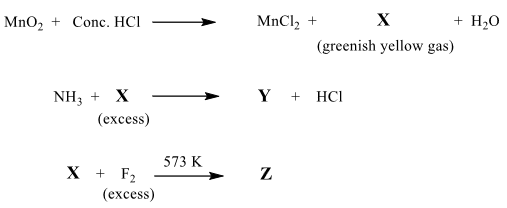
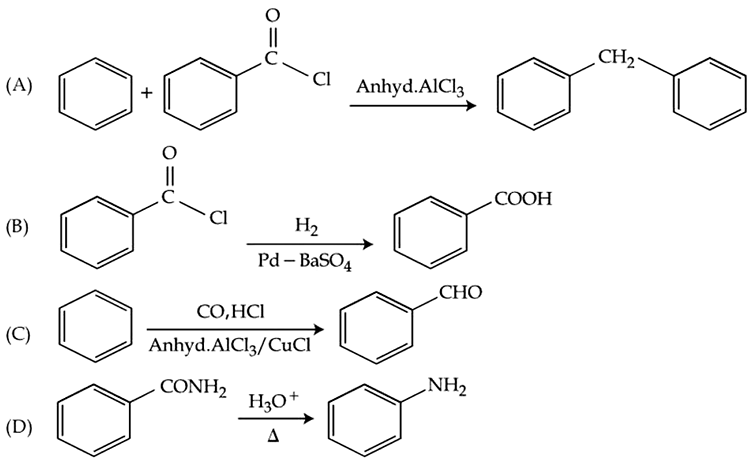
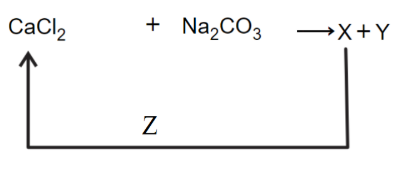
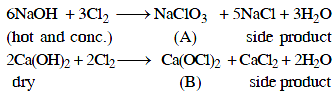
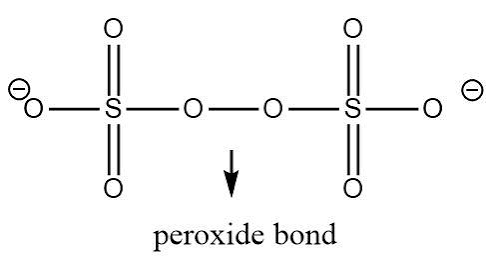
Correct statement(s) about the compounds $$\mathbf{X}$$, $$\mathbf{Y}$$ and $$\mathbf{Z}$$ is(are)

image
Question 2 JEE Advanced

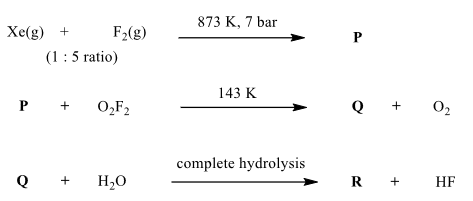
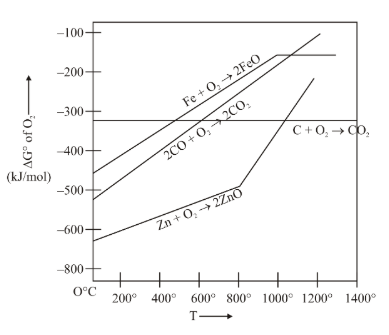
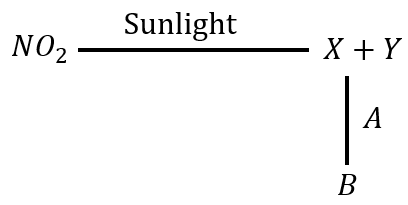
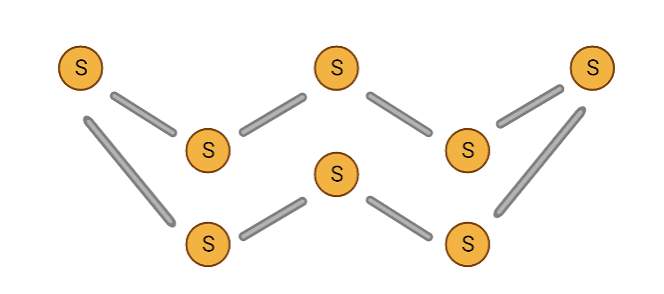
Correct statement(s) about the compounds P, Q and R is(are)

image
Question 3 JEE Mains

It is noticed that $$Pb^{2+}$$ is more stable than $$Pb^{4+}$$ but $$Sn^{2+}$$ is less stable than $$Sn^{4+}$$
Observe the following reactions.

$$ PbO_2+Pb\rightarrow 2PbO;\triangle_rG^{o}(1) $$
$$ SnO_2+Sn\rightarrow 2SnO;\triangle_rG^{o}(2) $$

Identify the correct set from the following

Question 4 JEE Mains

The correct statements from the following are:
A. Ionic radii of trivalent cations of group 13 elements decreases down the group.
B. Electronegativity of group 13 elements decreases down the group.
C. Among the group 13 elements, Boron has highest first ionisation enthalpy.
D. The trichloride and triiodide of group 13 elements are covalent in nature.
Choose the correct answer from the options given below :

Question 5 JEE Mains

"X" is an oxoanion of the lightest element of group 7 (in the periodic table). The metal is in +6 oxidation state in "X". The color of the potassium salt of X is

Question 6 JEE Mains

Given below are two statements:
Statement I: The correct order of electronegativity of fluorine, oxygen and nitrogen is $$F > O > N$$.
Statement II: The oxidation state of oxygen in $$OF_2$$ is +2 and in $$Na_2O$$ is $$-2$$.
In the light of the above statements, choose the correct answer from the options given below

Question 7 JEE Mains

Given below are two statements:

$$\textbf{Statement I :}$$ The number of pairs among $$[\text{Al}_2\text{O}_3, \text{Cr}_2\text{O}_3]$$, $$[\text{Cl}_2\text{O}_7, \text{Mn}_2\text{O}_7]$$, $$[\text{Na}_2\text{O}, \text{V}_2\text{O}_3]$$ and $$[\text{CO}, \text{N}_2\text{O}]$$ that contain oxides of same nature (acidic, basic, neutral or amphoteric) is 4.

$$\textbf{Statement II :}$$ Among $$\text{Na}_2\text{O}$$, $$\text{Al}_2\text{O}_3$$, $$\text{CO}$$ and $$\text{Cl}_2\text{O}_7$$, the most basic and acidic oxides are $$\text{Na}_2\text{O}$$ and $$\text{Cl}_2\text{O}_7$$, respectively.

In the light of the above statements, choose the correct answer from the options given below:

Question 8 JEE Mains

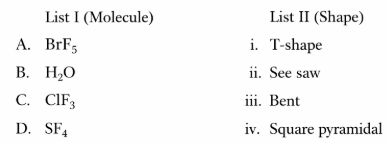
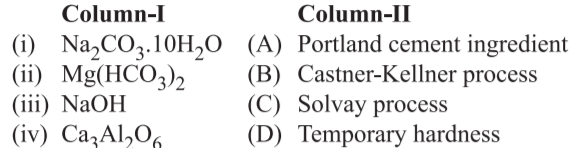
The correct set that contains all kinds (basic, acidic, amphoteric and neutral) of oxides is :

Question 9 JEE Mains

The electronegativity of a group 13 element 'E' is same as that of Ge (on Pauling scale and upto one decimal point). The CORRECT statements about E$$^{3+}$$ are

A. It can act as a reducing agent.

B. It can act as an oxidizing agent.

C. E$$^{3+}$$ is more stable than E$$^+$$.

D. The standard electrode potential value for E$$^{3+}$$/E is positive.
choose the correct answer from the options given below 

Question 10 JEE Mains

Which of the following statement(s) is incorrect?

(i) The order of electron gain enthalpy for halogens is: Cl > F > Br >I

(ii) The first ionization energy follows the order: C < O < N <F

(iii) Stability of +3 oxidation state in group 15 increases in the order: $$\mathrm{N^{+3} > P^{+3} > As^{+3} > Sb^{+3} > Bi^{+3}}$$

(iv) The order of atomic radii in group 13 is: Tl > In > Ga > Al > B

Question 11 JEE Mains

Correct statements from the following are:
A. Nitrogen in oxidation states from +1 to +4 disproportionates in acid medium.
B. Nitrogen has the ability to form d$$\pi$$ - p$$\pi$$ multiple bonds with itself and other elements with small size and high electronegativity.
C. N-N single bond is stronger than P-P single bond.
D. Nitrogen has highest density in its group due to small size.
E. The maximum covalency of nitrogen is four since it has only four valence orbitals for bonding.
Choose the correct answer from the options given below:

Question 12 JEE Mains

Find the correct statements related to group 15 hydrides.
A. Reducing nature increases from NH$$_3$$ to BiH$$_3$$
B. Tendency to donate lone pair of electrons decreases from NH$$_3$$ to BiH$$_3$$
C. The stability of hydrides decreases from NH$$_3$$ to BiH$$_3$$
D. HEH bond angle decreases from NH$$_3$$ to SbH$$_3$$ (E = Elements of group 15)
Choose the correct answer from the options given below :

Question 13 JEE Mains

Given below are two statements:

Statement I: Aluminium is more electropositive than thallium as the standard electrode potential value of E$$^\circ_{Al^{3+}/Al}$$ is negative and E$$^\circ_{Tl^{3+}/Tl}$$ is positive.

Statement II: The sum of first three ionization enthalpies of boron is very high when compared to that of aluminium. Due to this reason boron forms covalent compounds only and aluminium forms Al$$^{3+}$$ ion.

In the light of the above statements, choose the correct answer from the options given below:

Question 14 JEE Mains

Given below are two statements:
Statement I : Elements 'X' and 'Y' are the most and least electronegative elements, respectively among N, As, Sb and P. The nature of the oxides $$X_{2}O_{3}$$ and $$y_{2}O_{3}$$ is acidic and
amphoteric, respectively.
Statement II:$$BCl_{3}$$ is covalent in nature and gets hydrolysed in water. It produces $$[B(OH)_{4}]^{-}$$ and $$[B(H_{2}O)_{6}]^{3+}$$ in aqueous medium.
In the Light of the above statements, choose the correct answer from the options given below:

Question 15 JEE Mains

Given below are two statements :
Statement I : $$F_2O < H_2O < Cl_2O$$ is the correct trend in terms of bond angle.
Statement II : SiF$$_4$$, SnF$$_4$$ and PbF$$_4$$ are ionic in nature. In the light of the above statements, choose the correct answer from the options given below :

Question 16 JEE Mains

Given below are two statements:
Statement I: The covalency of oxygen is generally two but it can exceed upto four. The oxidation state of oxygen in $$\text{SO}_2$$ is $$-2$$ and in $$\text{OF}_2$$ it is $$+2$$.
Statement II: The anomalous behaviour of oxygen when compared to the other elements of group 16 is due to its small size and high electronegativity.
In the light of the above statements, choose the correct answer from the options given below

Question 17 JEE Mains

Given below are two statements:

$$\textbf{Statement I :}$$ Aluminium upon reaction with $$\text{NaOH}$$ forms $$[\text{Al(OH)}_6]^{3-}$$ ion.

$$\textbf{Statement II :}$$ The geometry of $$\text{ICl}_4^{-}$$, $$\text{ClO}_3^{-}$$ and $$\text{IBr}_2^{-}$$ is square planar, pyramidal and linear respectively.

In the light of the above statements, choose the correct answer from the options given below:

Question 18 JEE Mains

Choose the INCORRECT statement

Question 19 JEE Mains

Given below are two statements : 

Statement (I) : Oxidising power of halogens decreases in the order F$$_2$$ > Cl$$_2$$ > Br$$_2$$ > I$$_2$$, which is the basis of "Layer test". 

Statement (II) : "Layer test" to identify Br$$_2$$ and I$$_2$$ in aqueous solution involves the oxidation of bromide or iodide into Br$$_2$$ or I$$_2$$ respectively with Cl$$_2$$, which is a type of displacement redox reaction. 

In the light of the above statements, choose the correct answer from the options given below :

Question 20 JEE Mains

Given below are two statements:

Statement I: The halogen that makes longest bond with hydrogen in HX, has the smallest covalent radius in its group.

Statement II: A group 15 element's hydride $$EH_{3}$$ has the lowest boiling point among corresponding hydrides of other group 15 elements. The maximum covalency of that element E is 4.

In the light of the above statements, choose the correct answer from the options given below

Question 21 JEE Mains

A 'p'-block element (E) and hydrogen form a binary cation $$(EH_{x})^{+}$$ , while $$EH_{3}$$ on treatment with $$K_{2}HgI_{4}$$ in alkaline medium gives a precipitate of basic mercury(II)amido- iodine. Given below are first ionisation enthalpy values ($$kJ mol^{-1}$$) for first element each from group 13, 14, 15 and 16. Identify the correct first ionisation enthalpy value for element E.

Question 22 JEE Mains

Consider the following reactions
$$\begin{aligned}\mathrm{Na_2B_4O_7} & \xrightarrow{\Delta} 2X + Y \\[6pt]\mathrm{CuSO_4} + Y &\xrightarrow{\text{Non-luminous flame}} Z + \mathrm{SO_3}\\[6pt]2Z + 2X + \mathrm{C}&\xrightarrow{\text{Luminous flame}} 2Q +\mathrm{Na_2B_4O_7} + \mathrm{CO}\end{aligned}$$
The oxidation states of Cu in Z and Q, respectively are:

Question 23 JEE Mains

Regarding the hydrides of group 15 elements $$EH_{3}$$(E = N, P, As, Sb), select the correct statement from the following:
A. The stability of hydrides decreases down the group.
B. The basicity of hydrides decreases down the group.
C. The reducing character increases down the group.
D. The boiling point increases down the group.
Choose the correct answer from the options given below:

Question 24 JEE Mains

Treatment of a gas 'X' with a freshly prepared ferrous sulphate solution gives a compound 'Y' as a brown ring. The compounds X and Y are.

Question 25 JEE Mains

The first electron gain enthalpies of $$F$$, $$Cl$$, $$Br$$ and $$I$$ are given below in a random order:

$$-295,\quad -328,\quad -349,\quad -325;kJ,mol^{-1}$$

Identify and enter the numerical value of the magnitude of electron gain enthalpy of $$Br$$ in $$kJ,mol^{-1}$$.

Frequently Asked Questions