Treatment of buta-$$1,3$$-diyne with $$NaNH_2$$ ($$2$$ equivalents), followed by reaction with excess of trans-$$CH_3\text{-}CH\!=\!CH\text{-}CH_2\text{-}Br$$ gives $$\mathbf{X}$$ as the major product. The maximum number of carbon atoms that are collinear (in a straight line) in $$\mathbf{X}$$ is ___.
JEE Hydrocarbons - Alkynes Questions

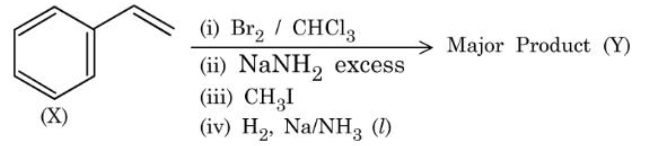
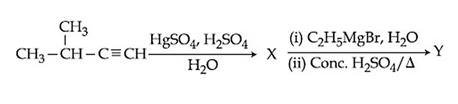
Compound (X) is subjected to the sequence of reactions as shown above:
Molar mass of the major product (Y) formed is ______ g mol$$^{-1}$$.
(Given molar mass in g mol$$^{-1}$$ C:12, H: 1, O: 16)
Step-1 Identification of the starting alkyne X
The product Y finally obtained after the dissolving-metal reduction (Na/NH3(l) + H2) must be a trans (E)-alkene because $$\text{Na}/\text{NH}_3(l)$$ converts an internal alkyne into a trans-alkene without disturbing an aromatic ring if present.
A molar mass of 118 g mol-1 corresponds to the molecular formula $$C_9H_{10}$$ ( $$9\times 12 + 10\times 1 = 118$$ ). Such a formula suggests the presence of a benzene ring ( $$C_6H_5$$ ) attached to a three-carbon side chain ( $$C_3H_5$$ ).
Therefore, compound Y is most plausibly trans-1-phenyl-1-propene (trans-β-methyl-styrene): $$\text{Ph-CH}=CH-CH_3$$.
Step-2 Retracing the sequence from Y to X
(i) The immediate precursor of this alkene in the given sequence must be the corresponding internal alkyne, $$\text{Ph-C}\equiv\text{C-CH}_3$$, because dissolving-metal reduction adds two hydrogens across a C≡C bond to give the trans-C=C product.
(ii) This alkyne is obtained by alkylating the sodium acetylide of a terminal alkyne with $$\text{CH}_3\text{I}$$. Hence the terminal alkyne just before step (iii) is phenylacetylene, $$\text{Ph-C}\equiv\text{C-H}$$, whose acidic proton has been removed by excess $$\text{NaNH}_2$$ to give $$\text{Ph-C}\equiv\text{C}^-\,\text{Na}^+$$.
(iii) That sodium acetylide itself is produced from the vic-dibromoalkene obtained in step (i) by double dehydro-bromination with excess $$\text{NaNH}_2$$.
(iv) Finally, the vic-dibromoalkene arises from the addition of one equivalent of $$\text{Br}_2$$ to the starting alkyne X.
Thus the only alkyne that fits all the steps is phenylacetylene, $$\text{Ph-C}\equiv\text{C-H}$$.
Step-3 Verification of the whole sequence
Case 1: $$\text{Ph-C}\equiv\text{C-H}\xrightarrow{\text{Br}_2/\text{CHCl}_3}$$ trans-1,2-dibromostyrene.
Case 2: trans-1,2-dibromostyrene $$\xrightarrow[\text{excess}]{\text{NaNH}_2}$$ phenylacetylene (regenerated) and then $$\text{Ph-C}\equiv\text{C}^-\,\text{Na}^+$$.
Case 3: $$\text{Ph-C}\equiv\text{C}^-\,\text{Na}^+\xrightarrow{\text{CH}_3\text{I}}$$ 1-phenyl-1-butyne, $$\text{Ph-C}\equiv\text{C-CH}_3$$.
Case 4: 1-phenyl-1-butyne $$\xrightarrow{\text{H}_2,\ \text{Na}/\text{NH}_3(l)}$$ trans-1-phenyl-1-propene (compound Y), $$\text{Ph-CH}=CH-CH_3$$.
Step-4 Molar-mass calculation of Y
Number of atoms in Y: 9 C and 10 H.
Molar mass $$M = 9\times 12\;(\text{C}) + 10\times 1\;(\text{H}) = 108 + 10 = 118\ \text{g mol}^{-1}$$.
Hence, the molar mass of compound Y is 118 g mol-1.
Option B which is: 118
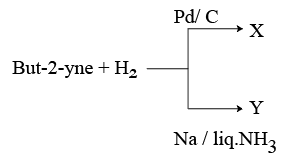
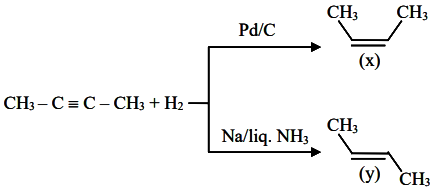
But-2-yne and hydrogen (one mole each) are separately treated with (i) Pd/C and (ii) Na/ liq. NH3 to give the products X and Y respectively.
Identify the incorrect statements.
A. X and Y are stereoisomers.
B. Dipole moment of X is zero.
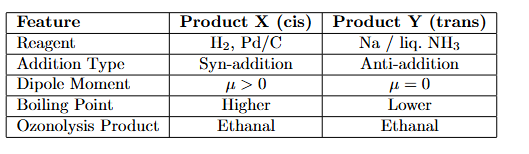
C. Boiling point of X is higher than Y.
D. X and Y react with $$O_{3}/Zn+H_{2}O$$ to give different products.
Choose the correct answer from the options given below :

- Reaction Name: Reductive Ozonolysis.
- Both cis and trans isomers of But-2-ene break at the double bond to yield two molecules of Ethanal ($$CH_3CHO$$). The connectivity is the same, so the products are identical.
CORRECT order of stability for the following is
$$CH_{2}=CH^{-},CH_{3}-CH_{2}^{-},CH\equiv C^{-}$$
We need to arrange three carbanions in decreasing order of stability.
Key Concept: Stability of carbanions depends on the hybridisation of the carbon bearing the negative charge. The greater the s-character of the orbital holding the lone pair, the closer the electrons are held to the nucleus, and the more stable the carbanion. The s-character of different hybridisations is:
- $$sp$$ hybrid: 50% s-character
- $$sp^2$$ hybrid: 33.3% s-character
- $$sp^3$$ hybrid: 25% s-character
The carbanion $$CH \equiv C^-$$ (acetylide ion) features an $$sp$$-hybridised carbon bearing the negative charge. With 50% s-character, its lone pair is held closest to the nucleus, making it the most stable of the three.
In the case of $$CH_2 = CH^-$$ (vinyl carbanion), the negatively charged carbon is $$sp^2$$ hybridised. With 33.3% s-character, this carbanion has intermediate stability.
The carbanion $$CH_3 - CH_2^-$$ (ethyl carbanion) is $$sp^3$$ hybridised, possessing only 25% s-character, so its lone pair is held furthest from the nucleus. Additionally, the methyl group exerts a +I (electron-donating inductive) effect that increases electron density on the negatively charged carbon, further destabilising it. This is the least stable carbanion.
Therefore, the decreasing order of stability is $$CH \equiv C^- > CH_2 = CH^- > CH_3 - CH_2^-$$.
The correct answer is Option 2: $$CH \equiv C^- > CH_2 = CH^- > CH_3 - CH_2^-$$.
Identify product [A],[B] and [C] in the following reaction sequence.
$$\mathrm{CH_3 - C \equiv CH \xrightarrow[\mathrm{H_2}]{\mathrm{Pd/C}} [A] \xrightarrow[\mathrm{(ii)\ Zn,\ H_2O}]{\mathrm{(i)\ O_3}} [B] + [C]}$$
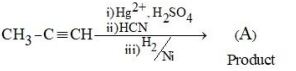
The product (A) formed in the following reaction sequence is
1,2-dibromocyclooctane is treated with

'P' is :
Given below are two statements : Statement I : One mole of propyne reacts with excess of sodium to liberate half a mole of $$H_2 $$ gas. Statement II : Four g of propyne reacts with $$ NaNH_2 \text{ to liberate } NH_3$$ gas which occupies 224 mL at STP. In the light of the above statements, choose the most appropriate answer from the options given below:
We need to evaluate two statements about propyne ($$CH_3-C \equiv CH$$, molecular weight = 40 g/mol).
Statement I: One mole of propyne reacts with excess of sodium to liberate half a mole of H₂ gas.
Propyne has one terminal acidic hydrogen (on the $$\equiv CH$$). Only terminal alkynes react with sodium metal:
$$2 CH_3C \equiv CH + 2Na \rightarrow 2 CH_3C \equiv CNa + H_2$$
So 2 moles of propyne give 1 mole of H₂. Therefore, 1 mole of propyne gives $$\frac{1}{2}$$ mole of H₂.
Statement I is CORRECT.
Statement II: Four g of propyne reacts with NaNH₂ to liberate NH₃ gas which occupies 224 mL at STP.
4 g of propyne = $$\frac{4}{40} = 0.1$$ mol
$$CH_3C \equiv CH + NaNH_2 \rightarrow CH_3C \equiv CNa + NH_3$$
0.1 mol propyne produces 0.1 mol NH₃.
At STP, 0.1 mol of gas occupies $$0.1 \times 22400 = 2240$$ mL.
The statement says 224 mL, which would correspond to 0.01 mol. This is incorrect.
Statement II is INCORRECT.
The correct answer is Option 3: Statement I is correct but Statement II is incorrect.
The least acidic compound, among the following is:
The compound with molecular formula $$C_{6}H_{6}$$, which gives only one monobromo derivative and takes up four moles of hydrogen per mole for complete hydrogenation has ________ electrons.
For any hydrocarbon $$C_nH_m$$, the number of degrees of unsaturation (also called index of hydrogen deficiency, IHD) is calculated by the relation
$$\text{IHD}=\,\frac{(2n+2)-m}{2}\,.$$
Here $$n=6$$ and $$m=6$$, so
$$\text{IHD}=\,\frac{(2\times6+2)-6}{2}=\,\frac{14-6}{2}=4.$$
Each unit of IHD represents either one $$\pi$$-bond or one ring.
The statement says that the compound “takes up four moles of hydrogen per mole for complete hydrogenation”.
• One mole of $$H_2$$ adds across a double bond (or one of the two $$\pi$$ bonds in a triple bond).
• A ring does not consume $$H_2$$ during hydrogenation.
Since four moles of $$H_2$$ are absorbed, all four units of IHD must be $$\pi$$ bonds; there are no rings contributing to IHD. Thus the molecule contains four distinct $$\pi$$ bonds.
Each $$\pi$$ bond is formed by a pair of electrons, therefore the total number of $$\pi$$ (unsaturated) electrons is
$$4 \times 2 = 8.$$
Hence, the compound possesses 8 electrons in its $$\pi$$ system (unsaturated electrons).
The sum of sigma $$(\sigma)$$ and pi$$(\pi)$$ bonds in Hex-1,3-dien-5-yne is _______.
We consider Hex-1,3-dien-5-yne, whose structure is $$CH_2=CH-CH=CH-C\equiv CH$$, a six-carbon chain with double bonds at positions 1-2 and 3-4 and a triple bond at positions 5-6.
For $$\sigma$$ bonds, there are C-C single bonds between C2-C3 and C4-C5 (2 $$\sigma$$), one $$\sigma$$ each from the two C=C bonds at C1=C2 and C3=C4 (2 $$\sigma$$), and one $$\sigma$$ from the C≡C bond at C5-C6 (1 $$\sigma$$), giving a total of 5 C-C $$\sigma$$ bonds. The C-H bonds contribute $$\sigma$$ bonds as follows: C1 has 2H, C2 has 1H, C3 has 1H, C4 has 1H, C5 has 0H and C6 has 1H, totaling 6 $$\sigma$$ bonds. Hence the overall $$\sigma$$ count is 5 + 6 = 11.
Each double bond has one $$\pi$$ bond, so the two C=C bonds provide 2 $$\pi$$ bonds, while the C≡C bond provides 2 $$\pi$$ bonds, for a total of 4 $$\pi$$ bonds.
Therefore, the molecule contains $$\sigma + \pi = 11 + 4 = 15$$ bonds in total.
Identify the incorrect statements regarding primary standard of titrimetric analysis. (A) It should be purely available in dry form. (B) It should not undergo chemical change in air. (C) It should be hygroscopic and should react with another chemical instantaneously and stoichiometrically. (D) It should be readily soluble in water. (E) $$KMnO_4$$ & $$NaOH$$ can be used as primary standard. Choose the correct answer from the options given below :
Identifying incorrect statements about primary standards:
(A) "It should be purely available in dry form" — Correct property of a primary standard.
(B) "It should not undergo chemical change in air" — Correct property.
(C) "It should be hygroscopic and should react with another chemical instantaneously and stoichiometrically" — Incorrect. A primary standard should be NON-hygroscopic (not absorb moisture from air).
(D) "It should be readily soluble in water" — Correct property.
(E) "$$KMnO_4$$ and NaOH can be used as primary standard" — Incorrect. Neither $$KMnO_4$$ nor NaOH are primary standards. $$KMnO_4$$ is not pure enough, and NaOH is hygroscopic and absorbs CO₂.
The incorrect statements are (C) and (E).
The correct answer is Option 2: (C) and (E) only.
The incorrect statement regarding ethyne is
Ethyne (acetylene, C₂H₂) has a C≡C triple bond.
(A) C-C bond in ethyne is shorter than ethene — TRUE (triple bond < double bond).
(B) Both carbons are sp hybridized — TRUE.
(C) Ethyne is linear — TRUE.
(D) C-C bond in ethyne is weaker than ethene — FALSE. Triple bond (837 kJ/mol) is stronger than double bond (614 kJ/mol).
The incorrect statement is Option 4.
Among the following halogens $$F_2, Cl_2, Br_2$$ and $$I_2$$. Which can undergo disproportionation reactions?
Which halogens can undergo disproportionation reactions?
Disproportionation is a reaction where the same element is simultaneously oxidized and reduced. For halogens in their elemental form (oxidation state 0), disproportionation requires the element to form both positive and negative oxidation states.
The analysis of each halogen is as follows.
$$F_2$$: Fluorine is the most electronegative element and can only exist in oxidation states 0 and $$-1$$. It cannot achieve positive oxidation states, so it cannot disproportionate.
$$Cl_2$$: Can form $$-1$$ (in $$Cl^-$$) and positive states like $$+1$$ (in $$OCl^-$$). For example: $$Cl_2 + 2NaOH \rightarrow NaCl + NaOCl + H_2O$$. It can disproportionate.
$$Br_2$$: Similarly, can form $$-1$$ and positive oxidation states. It can disproportionate.
$$I_2$$: Can form $$-1$$ and positive states (e.g., $$+5$$ in $$IO_3^-$$). It can disproportionate.
The correct answer is Option (4): $$Cl_2$$, $$Br_2$$ and $$I_2$$.
Compound $$A$$ formed in the following reaction reacts with $$B$$ gives the product $$C$$. Find out $$A$$ and $$B$$.
Thiosulphate reacts differently with iodine and bromine in the reactions given below: $$2S_2O_3^{2-} + I_2 \rightarrow S_4O_6^{2-} + 2I^-$$, $$S_2O_3^{2-} + 5Br_2 + 5H_2O \rightarrow 2SO_4^{2-} + 4Br^- + 10H^+$$. Which of the following statement justifies the above dual behaviour of thiosulphate?
Explain why thiosulphate reacts differently with iodine and bromine.
With $$I_2$$, thiosulphate reacts according to $$2S_2O_3^{2-} + I_2 \rightarrow S_4O_6^{2-} + 2I^-$$, in which sulfur is oxidized from +2 to +2.5, indicating mild oxidation; with $$Br_2$$, the reaction $$S_2O_3^{2-} + 5Br_2 + 5H_2O \rightarrow 2SO_4^{2-} + 4Br^- + 10H^+$$ shows sulfur oxidized from +2 to +6, indicating strong oxidation.
Bromine, being a stronger oxidizing agent than iodine, can oxidize thiosulphate all the way to sulfate ($$SO_4^{2-}$$, S in the +6 state), while iodine, being milder, oxidizes it only partially to tetrathionate ($$S_4O_6^{2-}$$).
The correct answer is Option (1): Bromine is a stronger oxidant than iodine.
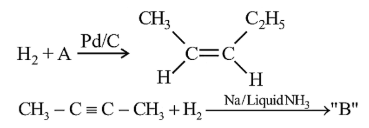
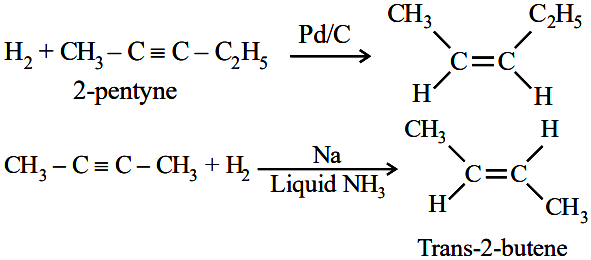
In the given reactions identify A and B.
1. Identification of Reactant 'A'
- The Reaction: Alkyne reduction over palladium on carbon ($$\text{Pd/C}$$) usually reduces an alkyne completely to an alkane.
- Analysis: The product has a 5-carbon continuous chain with a double bond at position 2. Therefore, the starting material A must be 2-Pentyne ($$\text{CH}_3-\text{C}\equiv\text{C}-\text{C}_2\text{H}_5$$).
2. Identification of Product 'B' (Birch Reduction)
- Mechanism: This is a classic Birch Reduction of an internal alkyne. It proceeds via a radical-anion mechanism that favors anti-addition of hydrogen atoms due to minimizing steric repulsion between the bulky alkyl groups.
- Product 'B': An internal alkyne reduced with $$\text{Na/liquid NH}_3$$ selectively yields a trans-alkene. Thus, B is trans-2-butene.
But-2-yne is reacted separately with one mole of Hydrogen as shown below:
B $$\xleftarrow{\text{Na/liq NH}_3}$$ CH$$_3$$-C$$\equiv$$C-CH$$_3$$ $$\xrightarrow[\Delta]{\text{Pd/C, +H}_2}$$ A
Identify the incorrect statements from the options given below:
A. A is more soluble than B.
B. The boiling point & melting point of A are higher and lower than B respectively.
C. A is more polar than B because dipole moment of A is zero.
D. Br$$_2$$ adds easily to B than A.
But-2-yne ($$CH_3-C \equiv C-CH_3$$) undergoes:
- With Pd/C + H₂ (catalytic hydrogenation): gives cis-but-2-ene (A) (syn addition)
- With Na/liq NH₃ (Birch reduction): gives trans-but-2-ene (B) (anti addition)
Let us check each statement:
Statement A: "A is more soluble than B" - cis-but-2-ene (A) has a higher dipole moment and is more polar, so it is slightly more soluble in polar solvents. This statement can be considered correct depending on context.
Statement B: "The boiling point and melting point of A are higher and lower than B respectively." - While cis isomers generally have higher boiling points due to higher polarity, and trans isomers have higher melting points due to better packing, the overall comparison needs careful analysis. This statement is INCORRECT as stated in the given context.
Statement C: "A is more polar than B because dipole moment of A is zero." - The first part is correct (cis is more polar), but the reasoning is completely wrong. The dipole moment of A (cis) is NOT zero; in fact, it is the trans isomer B that has zero (or near-zero) dipole moment due to symmetry. This statement is INCORRECT.
Statement D: "Br₂ adds easily to B than A." - Generally, cis-alkenes are more reactive toward electrophilic addition due to less steric strain in the transition state. So Br₂ should add more easily to A (cis) than B (trans). This statement is INCORRECT.
Therefore, the incorrect statements are B, C and D only.
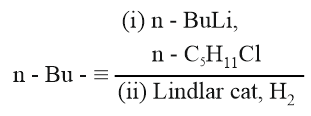
What will be the major product of following sequence of reactions?
Solution: Major Product Sequence
Step 1: Alkylation of the Terminal Alkyne
The starting material is a terminal alkyne: n-Bu-C≡CH.
- Reaction with n-BuLi: strong organolithium base deprotonates the terminal acetylenic proton to form a nucleophilic carbanion:
n-Bu-C≡C- Li+ - Reaction with n-C5H11Cl: The carbanion performs an SN2 nucleophilic substitution on the primary alkyl halide, extending the chain into an internal alkyne:
n-Bu-C≡C-C5H11
Step 2: Stereoselective Reduction
The internal alkyne is treated with Lindlar's Catalyst (Pd/CaCO3 poisoned with quinoline) and H2.
- Lindlar's catalyst is a heterogeneous, deactivated catalyst that reduces alkynes selectively into alkenes without reducing them all the way to alkanes.
- The mechanism occurs via syn-addition (both hydrogen atoms deliver to the same face of the triple bond simultaneously).
- This stereospecific addition yields exclusively a cis-alkene (Z-alkene) geometry.
The product must contain the n-Bu and -C5H11 groups positioned on the same side of the newly formed carbon-carbon double bond carbon axis. This matches structural geometry variant A.
In bromination of Propyne, with Bromine 1,1,2,2-tetrabromopropane is obtained in 27% yield. The amount of 1,1,2,2-tetrabromopropane obtained from 1 g of Bromine in this reaction is _____ $$\times 10^{-1}$$ g. (Molar Mass: Bromine = 80 g/mol)
We need to find the amount of 1,1,2,2-tetrabromopropane obtained from 1 g of bromine in the bromination of propyne, given that the yield is 27%.
The bromination of propyne ($$CH_3C \equiv CH$$) with two equivalents of $$Br_2$$ gives 1,1,2,2-tetrabromopropane:
$$CH_3C \equiv CH + 2Br_2 \rightarrow CH_3CBr_2CHBr_2$$
We have 1 g of bromine. The molar mass of $$Br_2$$ is $$2 \times 80 = 160$$ g/mol. So the moles of $$Br_2$$ available are:
$$n_{Br_2} = \frac{1}{160} \text{ mol}$$
Since 2 moles of $$Br_2$$ are needed per mole of product, the moles of 1,1,2,2-tetrabromopropane that can be formed (at 100% yield) are:
$$n_{product} = \frac{1}{160 \times 2} = \frac{1}{320} \text{ mol}$$
The molar mass of 1,1,2,2-tetrabromopropane ($$C_3H_6Br_4$$) is $$3(12) + 6(1) + 4(80) = 36 + 6 + 320 = 362$$ g/mol.
The theoretical mass of product is:
$$m_{theoretical} = \frac{362}{320} = 1.13125 \text{ g}$$
With a yield of 27%, the actual mass obtained is:
$$m_{actual} = 1.13125 \times 0.27 = 0.3054 \text{ g}$$
Expressing this as $$\times 10^{-1}$$ g: $$m_{actual} = 3.054 \times 10^{-1} \approx 3 \times 10^{-1}$$ g.
Hence, the correct answer is 3.
An unsaturated hydrocarbon X on ozonolysis gives A. Compound A when warmed with ammoniacal silver nitrate forms a bright silver mirror along the sides of the test tube. The unsaturated hydrocarbon X is:
The reaction requires identifying a hydrocarbon whose ozonolysis product gives a positive Tollens’ test.
Tollens’ reagent gives a positive test for aldehydes.
Among carboxylic acids, only $$\mathrm{HCOOH}$$ can also reduce Tollens’ reagent because it contains an aldehydic hydrogen.
For option $$\mathrm{(A)}$$, ozonolysis of $$\mathrm{2,3\text{-}Dimethyl\text{-}2\text{-}butene}$$ forms acetone, which is a ketone and does not respond to Tollens’ reagent.
For option $$\mathrm{(B)}$$, ozonolysis of isopropylidenecyclopropane forms acetone and cyclopropanone, both ketones, so Tollens’ test is negative.
For option $$\mathrm{(D)}$$, ozonolysis of $$\mathrm{2\text{-}Butyne}$$ forms acetic acid $$\mathrm{(CH_3COOH)}$$, which does not respond to Tollens’ reagent.
For option $$\mathrm{(C)}$$, ozonolysis of $$\mathrm{1\text{-}Butyne\ (HC\equiv C-CH_2-CH_3)}$$ produces propanoic acid and:
$$\mathrm{HCOOH}$$
Formic acid gives a positive Tollens’ test and forms the silver mirror.
Thus, compound $$\mathrm{A}$$ is:
$$\mathrm{HCOOH}$$
Thus, the correct option is C.
Metallic sodium does not react normally with:
Metallic sodium is a strong reducing agent and reacts with acidic hydrogen atoms in compounds. The key is to identify which compound among the given options does not have a sufficiently acidic hydrogen for sodium to react with under normal conditions.
Gaseous ammonia ($$\text{NH}_3$$) has N-H bonds that react with sodium: $$2\text{Na} + 2\text{NH}_3 \rightarrow 2\text{NaNH}_2 + \text{H}_2$$, though this reaction requires heating.
Ethyne ($$\text{HC \equiv CH}$$) has a terminal C-H bond that is acidic ($$pK_a \approx 25$$) because the carbon is $$sp$$ hybridised: $$2\text{Na} + 2\text{HC \equiv CH} \rightarrow 2\text{NaC \equiv CH} + \text{H}_2$$.
tert-Butyl alcohol has an O-H bond, which readily reacts with sodium: $$2\text{Na} + 2(CH_3)_3\text{COH} \rightarrow 2(CH_3)_3\text{CONa} + \text{H}_2$$.
But-2-yne ($$\text{CH}_3\text{C \equiv CCH}_3$$) is an internal alkyne. It has no terminal C-H bond on the triple-bond carbon. Both carbons of the triple bond bear methyl groups, so there is no acidic terminal alkynyl hydrogen. Sodium reacts with terminal alkynes by abstracting the acidic acetylenic proton, but since but-2-yne has no such proton, it does not react with metallic sodium under normal conditions.
Therefore, the correct answer is option (2): But-2-yne.
Which of the following is Lindlar catalyst?
Lindlar catalyst is a heterogeneous catalyst that consists of palladium deposited on calcium carbonate (or barium sulfate), which is then treated (poisoned) with various forms of lead or quinoline to reduce its activity. It is commonly described as partially deactivated palladised charcoal.
Let us examine each option. Option (1), zinc chloride and HCl, is Lucas reagent used to distinguish between primary, secondary, and tertiary alcohols. Option (2), cold dilute $$KMnO_4$$ solution, is Baeyer's reagent used for the test of unsaturation. Option (3), sodium in liquid $$NH_3$$, is Birch reduction conditions used to reduce alkynes to trans-alkenes. Option (4), partially deactivated palladised charcoal, is the correct description of Lindlar catalyst, which is used to selectively reduce alkynes to cis-alkenes.
Hence, the correct answer is option (4).
In the following sequence of reactions, the final product D is:
The major product (Y) in the following reactions is:
The major product [R] in the following sequence of reaction is:
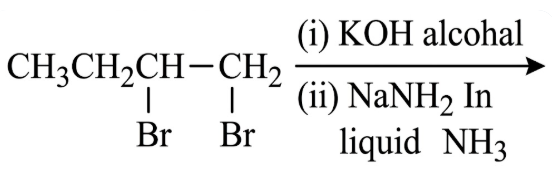
The major product of the following reaction is:
We first look carefully at the given substrate. $$CH_3CH_2CH(Br)CH_2Br$$ Numbering the carbon chain from the left it is $$C_1 = CH_3,\;C_2 = CH_2,\;C_3 = CH(Br),\;C_4 = CH_2Br$$ - that is, a vicinal (adjacent) 1,2-dibromide.
Step (i) : treatment with alcoholic $$KOH$$ - E2 dehydro-halogenation. The E2 rule tells us that one bromine atom and a β-hydrogen situated anti-periplanar to it are lost simultaneously as $$KBr$$ and $$H_2O$$ to give an alkene. On $$C_3$$ there is the leaving group $$Br$$; the β-hydrogens that can be removed are found on $$C_4$$. Removing the hydrogen from $$C_4$$ together with the bromine on $$C_3$$ produces the following alkene:
$$\displaystyle CH_3CH_2C(Br)=CH_2 $$
This product is called 3-bromobut-1-ene (or 1-bromo-1-butene). Note that only ONE molecule of $$HBr$$ has been removed, so the molecule still contains one bromine atom, now attached directly to the vinylic carbon $$C_3$$.
Step (ii) : treatment with $$NaNH_2$$ in liquid $$NH_3$$ - very strong base. A vinylic bromide such as $$CH_3CH_2C(Br)=CH_2$$ undergoes another elimination of $$HBr$$ when it is exposed to a base as strong as sodamide. The general rule (which should be stated) is: “A geminal or vinylic halide, when treated with excess $$NaNH_2$$ in liquid $$NH_3$$, loses a second molecule of $$HBr$$ to give an alkyne.”
Applying the rule, the base abstracts the sole vinylic hydrogen on $$C_4$$, the bromide ion departs from $$C_3$$, and a second π-bond is introduced between $$C_3$$ and $$C_4$$. Because there is already one π-bond there, a second π-bond converts it into a triple bond:
$$ \begin{aligned} CH_3CH_2C(Br)=CH_2 &\xrightarrow{NaNH_2/NH_3} CH_3CH_2C\!\equiv\!CH \;+\; NH_3Br^- \;+\; NH_2^-H^+\\ &\qquad\qquad(\text{1-butyne}) \end{aligned} $$
Thus after the two successive eliminations (one normal E2 and one very strong-base vinylic E2) the vicinal dibromide is transformed into the terminal alkyne $$CH_3CH_2C\!\equiv\!CH$$, i.e. 1-butyne.
Among the options supplied, this structure corresponds to Option C.
Hence, the correct answer is Option C.
The correct order for acid strength of compounds $$CH \equiv CH$$, $$CH_3 - C \equiv CH$$ and $$CH_2 = CH_2$$ is as follows:
First we recall that the acid strength of an organic molecule depends upon the stability of the conjugate base that is produced after loss of a proton. The more stable the conjugate base, the larger the acid dissociation constant $$K_a$$ and the smaller the $$pK_a\;(\;pK_a = -\log K_a\;),$$ hence the stronger the acid.
All the three compounds in the question lose a proton from a carbon atom, so we have to compare the stabilities of the corresponding carbanions:
$$CH \equiv CH \longrightarrow HC \equiv C^- + H^+$$
$$CH_3 - C \equiv CH \longrightarrow CH_3 - C \equiv C^- + H^+$$
$$CH_2 = CH_2 \longrightarrow CH_2 = CH^- + H^+$$
Now we analyse the factors that stabilise or destabilise each carbanion.
1. Hybridisation (s-character)
The electronegativity of a carbon atom increases with the percentage of s-character in its hybrid orbital. The order of s-character is
$$sp\;(50\%\,s) > sp^2\;(33\%\,s) > sp^3\;(25\%\,s).$$
Therefore a negative charge on an $$sp$$ carbon is held more tightly (more stabilised) than on an $$sp^2$$ carbon. Both alkynes have the negative charge on an $$sp$$ carbon, while the alkene places the charge on an $$sp^2$$ carbon. So immediately we get
$$\text{any terminal alkyne} \;\; > \;\; CH_2 = CH_2$$
in acid strength.
2. Inductive ( +I ) effect of the $$CH_3$$ group
Between the two terminal alkynes, $$CH_3 - C \equiv C^-$$ carries an additional $$CH_3$$ group next to the charged carbon. A methyl group exerts a +I (electron-releasing) effect which pushes electron density towards the negatively charged carbon, destabilising it.
In contrast, the carbanion $$HC \equiv C^-$$ has no such electron-releasing group; hence it is intrinsically more stable. Therefore
$$HC \equiv C^- \; >\; CH_3 - C \equiv C^-$$
in terms of stability, and consequently
$$HC \equiv CH \; >\; CH_3 - C \equiv CH$$
in acid strength.
3. Consolidating both factors
Combining the hybridisation argument (which places both alkynes ahead of the alkene) with the inductive argument (which distinguishes between the two alkynes), we obtain the complete order:
$$HC \equiv CH \; > \; CH_3 - C \equiv CH \; > \; CH_2 = CH_2.$$
Numerically this order is supported by the experimental $$pK_a$$ values:
$$pK_a(HC \equiv CH)\;\approx\;25,\qquad pK_a(CH_3 - C \equiv CH)\;\approx\;26,\qquad pK_a(CH_2 = CH_2)\;\approx\;44,$$
and the smaller the $$pK_a,$$ the stronger the acid.
Thus the correct sequence exactly matches Option B in the list.
Hence, the correct answer is Option B.
The major product of the following reaction is:
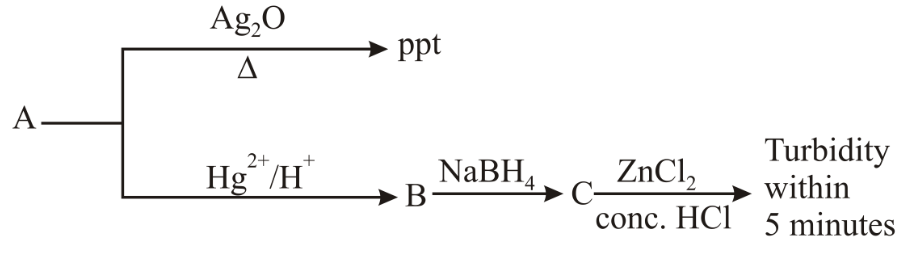
Consider the following reactions:
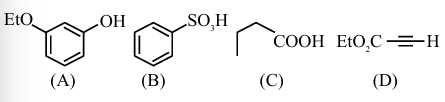
'A' is:
Reaction with Ag2O / Heat (Tollens'-like test for Alkynes)
When compound A is treated with silver oxide (Ag2O) and heat, it forms a precipitate (ppt).
- Deduction: This is a characteristic test for terminal alkynes (alkynes with a -C triple bond CH group). The acidic terminal hydrogen is replaced by a silver ion to form an insoluble silver acetylide precipitate.
- Therefore, A must be a terminal alkyne.
2. Hydration of Alkyne A to form B
When compound A (a terminal alkyne) undergoes hydration in the presence of Hg2+ / H+:
- Markovnikov addition of water occurs across the triple bond to form an enol, which quickly tautomerizes into a stable methyl ketone.
- Reaction path: R-C triple bond CH --> [ R-C(OH)=CH2 ] --> R-CO-CH3 (Compound B)
3. Reduction of B to C
Compound B (the methyl ketone) is reduced using sodium borohydride (NaBH4):
- NaBH4 selectively reduces ketones to secondary (2 degree) alcohols.
- Reaction path: R-CO-CH3 --> R-CH(OH)-CH3 (Compound C)
4. Reaction of C with Lucas Reagent (ZnCl2 / conc. HCl)
Compound C is treated with Lucas reagent, giving turbidity within 5 minutes.
- Lucas Test Rules:
- 3 degree alcohols give turbidity immediately.
- 2 degree alcohols give turbidity within 5 minutes.
- 1 degree alcohols do not give turbidity at room temperature.
- Since C gives turbidity within 5 minutes, it confirms that C is a secondary alcohol, which perfectly matches the deduction from Step 3.
Summary of Compounds
- A: A terminal alkyne (R-C triple bond CH)
- B: A methyl ketone (R-CO-CH3)
- C: A secondary alcohol (R-CH(OH)-CH3)
When 2-butyne is treated with H$$_2$$/Lindlar's catalyst, compound X is produced as the major product and when treated with Na/liq. NH$$_3$$ it produces Y as the major product. Which of the following statements is correct?
We have the starting alkyne $$CH_{3}-C\equiv C-CH_{3}$$, whose IUPAC name is 2-butyne.
First we consider the reaction with $$H_{2}$$ in the presence of Lindlar’s catalyst. The Lindlar system is a poisoned palladium catalyst that brings about syn addition of one molecule of hydrogen across the triple bond. The syn mode of addition places the two newly added hydrogens on the same side of the former $$\pi$$-bond. As a result the product is the cis (Z) alkene:
$$CH_{3}-C\equiv C-CH_{3} \overset{H_2,\;\text{Lindlar}}{\longrightarrow} \text{CH}_3\text{-CH}=\text{CH-CH}_3 \;(\text{cis})$$
Hence, the compound we call $$X$$ is $$\text{cis-2-butene}$$.
Now we examine the reaction with metallic sodium in liquid ammonia, $$Na/liq.\;NH_{3}$$. This Birch-type reduction donates electrons in anti fashion, giving trans addition of hydrogen atoms across the alkyne. Consequently the product is the trans (E) alkene:
$$CH_{3}-C\equiv C-CH_{3} \overset{Na,\;\text{liq. }NH_3}{\longrightarrow} \text{CH}_3\text{-CH}=\text{CH-CH}_3 \;(\text{trans})$$
Therefore, compound $$Y$$ is $$\text{trans-2-butene}$$.
Next we compare the physical properties of the two alkenes.
For dipole moment we recall that the molecular dipole $$\mu$$ is the vector sum of all individual bond dipoles. In $$\text{cis-2-butene}$$ both $$C-CH_{3}$$ bond dipoles are oriented toward the same side of the double bond, so they reinforce each other and give a net dipole moment different from zero. In $$\text{trans-2-butene}$$ the molecule is planar and the two $$C-CH_{3}$$ bond dipoles lie in opposite directions, so they effectively cancel:
$$\mu_{\text{cis}} \gt 0,\qquad \mu_{\text{trans}}\approx 0$$
Thus, $$X$$ (cis) has the higher dipole moment, while $$Y$$ (trans) has the lower dipole moment.
Boiling point is influenced both by molecular mass and by intermolecular attractions. The masses are identical, so the decisive factor is the strength of the attractive forces. Because $$X$$ possesses a non-zero dipole, it exhibits dipole-dipole interactions in addition to London dispersion forces. These interactions raise its boiling point. In contrast, $$Y$$ has almost no permanent dipole and relies mainly on dispersion forces, giving it a lower boiling point. Experimental data corroborate this reasoning:
$$\text{b.p. of cis-2-butene}\;(X)\approx 3.7^{\circ}\text{C}$$
$$\text{b.p. of trans-2-butene}\;(Y)\approx 1.0^{\circ}\text{C}$$
So we conclude that $$X$$ possesses both the higher dipole moment and the higher boiling point relative to $$Y$$.
Among the given statements, only Option D matches this conclusion.
Hence, the correct answer is Option D.
The reagent needed for converting:
A: $$Ph-C \equiv C-Ph + 2H_2 \xrightarrow{Pd/C} Ph-CH_2-CH_2-Ph$$
B: $$Ph-C \equiv C-Ph + H_2 \xrightarrow{\text{Lindlar's}} \text{cis-}Ph-CH=CH-Ph$$
C: $$Ph-C \equiv C-Ph \xrightarrow{Li/liq. NH_3} \text{trans-}Ph-CH=CH-Ph$$
D: $$Ph-C \equiv C-Ph \xrightarrow{LiAlH_4} \text{No Reaction}$$
$$2-$$Hexyne gives trans$$-2-$$Hexene on treatment with :
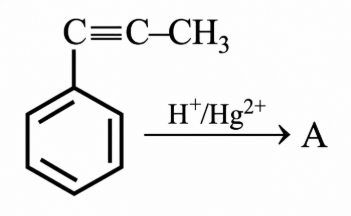
In the given reaction, the product 'A' is
The hydration of propyne results in formation of
The treatment of $$CH_3 MgX$$ with $$CH_3 C \equiv C - H$$ produces
The hydrocarbon which can react with sodium in liquid ammonia is
Which of the following reactions will yield $$2, 2-$$dibromopropane?