
Join Our JEE Preparation Group
Prep with like-minded aspirants; Get access to free daily tests and study material.
Sign in
Please select an account to continue using cracku.in
↓ →
Join Our JEE Preparation Group
Prep with like-minded aspirants; Get access to free daily tests and study material.
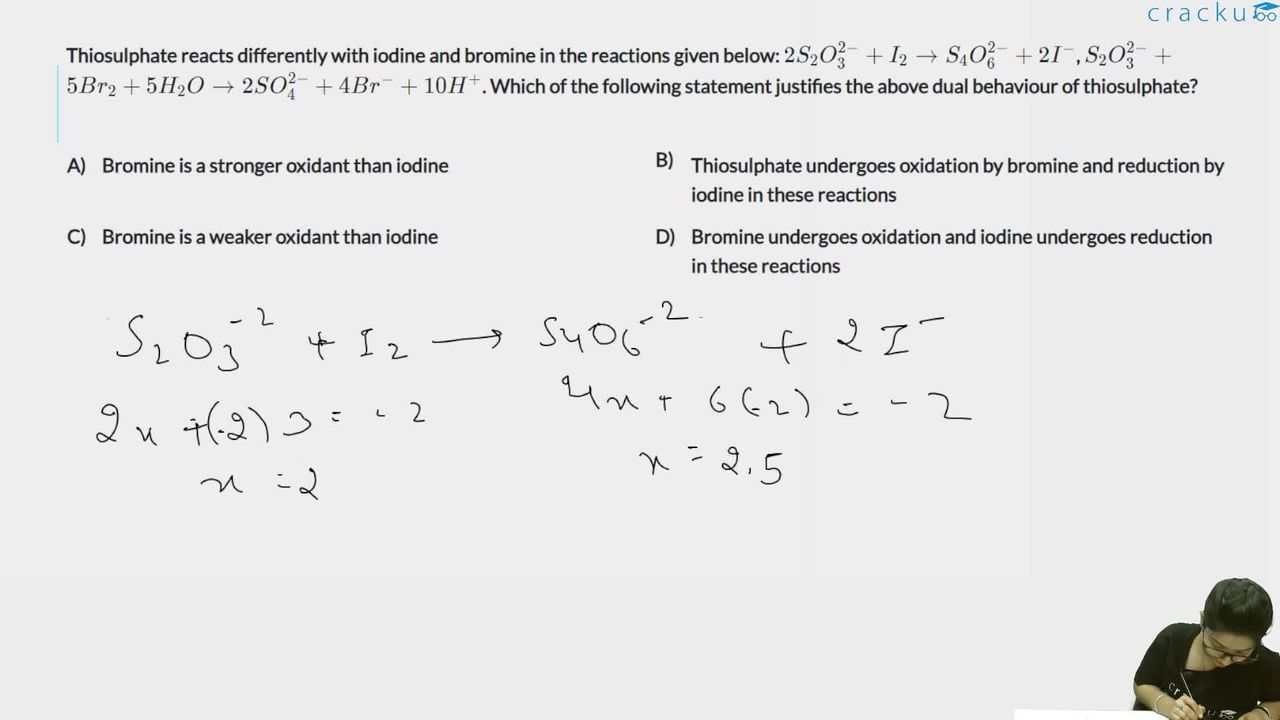
Thiosulphate reacts differently with iodine and bromine in the reactions given below: $$2S_2O_3^{2-} + I_2 \rightarrow S_4O_6^{2-} + 2I^-$$, $$S_2O_3^{2-} + 5Br_2 + 5H_2O \rightarrow 2SO_4^{2-} + 4Br^- + 10H^+$$. Which of the following statement justifies the above dual behaviour of thiosulphate?
Explain why thiosulphate reacts differently with iodine and bromine.
With $$I_2$$, thiosulphate reacts according to $$2S_2O_3^{2-} + I_2 \rightarrow S_4O_6^{2-} + 2I^-$$, in which sulfur is oxidized from +2 to +2.5, indicating mild oxidation; with $$Br_2$$, the reaction $$S_2O_3^{2-} + 5Br_2 + 5H_2O \rightarrow 2SO_4^{2-} + 4Br^- + 10H^+$$ shows sulfur oxidized from +2 to +6, indicating strong oxidation.
Bromine, being a stronger oxidizing agent than iodine, can oxidize thiosulphate all the way to sulfate ($$SO_4^{2-}$$, S in the +6 state), while iodine, being milder, oxidizes it only partially to tetrathionate ($$S_4O_6^{2-}$$).
The correct answer is Option (1): Bromine is a stronger oxidant than iodine.
Was this solution helpful?
Click on the Email ☝️ to Watch the Video Solution
Create a FREE account and get:
_1.webp)

Educational materials for JEE preparation

Ask our AI anything

AI can make mistakes. Please verify important information.
AI can make mistakes. Please verify important information.
