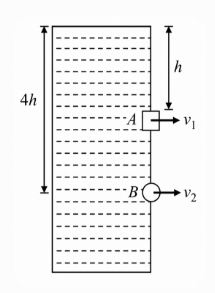
Let us denote the density of the liquid by $$d$$ and the acceleration due to gravity by $$g$$. Each cylindrical vessel has the same base-area $$S$$, but the initial heights of the liquid columns are different: one is at height $$x_1$$ while the other is at height $$x_2$$.
For a uniform vertical column of liquid of height $$h$$, the centre of mass lies exactly at its mid-height $$\dfrac{h}{2}$$. Therefore, the gravitational potential energy $$U$$ of such a column is obtained from the general expression $$U = mgh_{\text{cm}}$$. Substituting the mass $$m = \rho V = d(S\,h)$$ and $$h_{\text{cm}}=\dfrac{h}{2}$$, we have
$$
U = (d\,S\,h)\,g\;\frac{h}{2}
= \frac12\,d\,g\,S\,h^{2}.
$$
We first compute the total gravitational potential energy of the system before the two vessels are connected.
For the vessel with height $$x_1$$ the energy is
$$U_1 = \frac12\,d\,g\,S\,x_1^{2},$$
and for the vessel with height $$x_2$$ the energy is
$$U_2 = \frac12\,d\,g\,S\,x_2^{2}.$$
Hence the initial total energy is
$$
U_{\text{initial}} = U_1 + U_2
= \frac12\,d\,g\,S\bigl(x_1^{2}+x_2^{2}\bigr).
$$
Now we join the vessels by a tube of negligible volume fixed very near their bottoms. Because the liquid can now flow freely, it redistributes itself until both columns attain a common final height, which we shall call $$h_f$$.
The total volume of liquid is conserved. Initially the volume is
$$
V_{\text{total}}
= Sx_1 + Sx_2
= S\,(x_1 + x_2).
$$
After equilibrium the liquid occupies two cylinders, each of base area $$S$$, so the combined base area is $$2S$$. Therefore the common final height is obtained from
$$
2S\,h_{f}=S\,(x_1 + x_2)
\;\;\Longrightarrow\;\;
h_{f} = \frac{x_1 + x_2}{2}.
$$
For each vessel at this stage the liquid column has height $$h_f$$, so using the same energy formula we write
$$
U_{\text{one\,column\,(final)}} = \frac12\,d\,g\,S\,h_f^{2}.
$$
Because there are two identical columns, the total final energy is
$$
U_{\text{final}}
= 2\left(\frac12\,d\,g\,S\,h_f^{2}\right)
= d\,g\,S\,h_f^{2}.
$$
Next, we find the change in gravitational potential energy of the system:
$$
\Delta U = U_{\text{final}} - U_{\text{initial}}
= d\,g\,S\,h_f^{2}
- \frac12\,d\,g\,S\,(x_1^{2}+x_2^{2}).
$$
We now substitute $$h_f = \dfrac{x_1 + x_2}{2}$$. First evaluate $$h_f^{2}$$:
$$
h_f^{2} = \left(\frac{x_1 + x_2}{2}\right)^{2}
= \frac{(x_1 + x_2)^{2}}{4}.
$$
Putting this into the expression for $$\Delta U$$ gives
$$
\Delta U = d\,g\,S\left[\frac{(x_1 + x_2)^{2}}{4}
- \frac{1}{2}(x_1^{2}+x_2^{2})\right].
$$
To simplify the bracket, we write everything with the same denominator:
$$
\frac{(x_1 + x_2)^{2}}{4}
- \frac{1}{2}(x_1^{2}+x_2^{2})
= \frac{(x_1 + x_2)^{2}}{4}
- \frac{2(x_1^{2}+x_2^{2})}{4}.
$$
Expanding $$ (x_1 + x_2)^{2} = x_1^{2} + 2x_1x_2 + x_2^{2} $$, we have
$$
\frac{x_1^{2} + 2x_1x_2 + x_2^{2}
- 2x_1^{2} - 2x_2^{2}}{4}
= \frac{-\,x_1^{2} + 2x_1x_2 - x_2^{2}}{4}.
$$
Recognising the numerator as the negative of a perfect square,
$$
-\,x_1^{2} + 2x_1x_2 - x_2^{2}
= -\,(x_1^{2} - 2x_1x_2 + x_2^{2})
= -\,(x_1 - x_2)^{2}.
$$
Hence the entire bracket simplifies to
$$
\frac{-\,(x_1 - x_2)^{2}}{4}
= -\,\frac{(x_1 - x_2)^{2}}{4}.
$$
Substituting this back, the change in energy becomes
$$
\Delta U
= d\,g\,S
\left[-\,\frac{(x_1 - x_2)^{2}}{4}\right]
= -\,\frac{1}{4}\,d\,g\,S\,(x_1 - x_2)^{2}.
$$
The negative sign shows that energy has decreased. The magnitude of this decrease is
$$
\bigl|\Delta U\bigr|
= \frac{1}{4}\,d\,g\,S\,(x_2 - x_1)^{2},
$$
which exactly matches Option D.
Hence, the correct answer is Option D.
 JEE WhatsApp Group