
Join Our JEE Preparation Group
Prep with like-minded aspirants; Get access to free daily tests and study material.
Sign in
Please select an account to continue using cracku.in
↓ →
Join Our JEE Preparation Group
Prep with like-minded aspirants; Get access to free daily tests and study material.
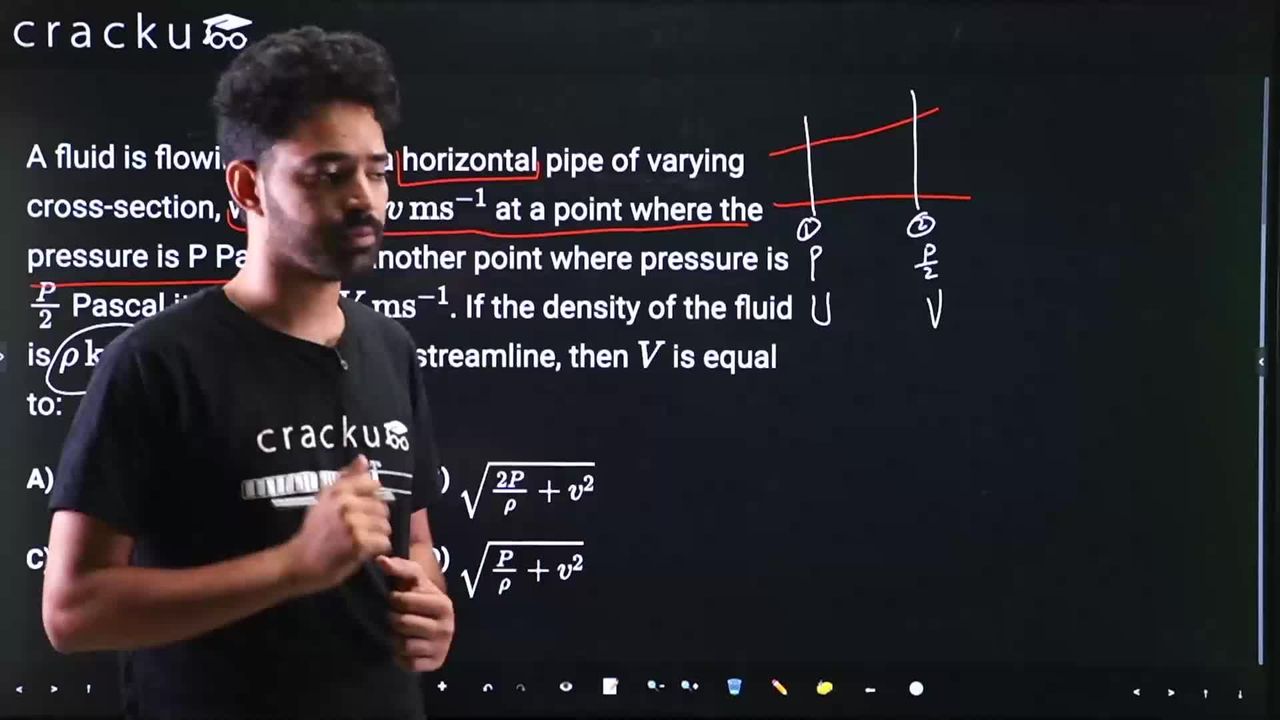
A fluid is flowing through a horizontal pipe of varying cross-section, with speed $$v\,\text{ms}^{-1}$$ at a point where the pressure is P Pascal. At another point where pressure is $$\frac{P}{2}$$ Pascal its speed is $$V\,\text{ms}^{-1}$$. If the density of the fluid is $$\rho\,\text{kg m}^{-3}$$ and the flow is streamline, then $$V$$ is equal to:
We consider the steady, streamline flow of an incompressible fluid through a horizontal pipe. For such a situation we can apply Bernoulli’s theorem, which states that for any two points 1 and 2 along the same streamline
$$P_1 \;+\; \frac{1}{2}\,\rho\,v_1^{\,2} \;+\; \rho g h_1 \;=\; P_2 \;+\; \frac{1}{2}\,\rho\,v_2^{\,2} \;+\; \rho g h_2.$$
Because the pipe is horizontal the heights are equal, so $$h_1 = h_2$$ and the gravitational potential energy terms cancel. Hence, in the horizontal case the relation reduces to
$$P_1 \;+\; \frac{1}{2}\,\rho\,v_1^{\,2} \;=\; P_2 \;+\; \frac{1}{2}\,\rho\,v_2^{\,2}.$$
At the first point the pressure is given as $$P$$ and the speed as $$v$$. At the second point the pressure is given as $$\dfrac{P}{2}$$ and the speed is $$V$$. Substituting these values into the simplified Bernoulli equation we obtain
$$P \;+\; \frac{1}{2}\,\rho\,v^{2} \;=\; \frac{P}{2} \;+\; \frac{1}{2}\,\rho\,V^{2}.$$
We next bring all pressure terms to one side and all kinetic-energy terms to the other side. First subtract $$\dfrac{P}{2}$$ from both sides:
$$P \;-\; \frac{P}{2} \;+\; \frac{1}{2}\,\rho\,v^{2} \;=\; \frac{1}{2}\,\rho\,V^{2}.$$
Simplifying the pressure difference $$P - \dfrac{P}{2}$$ gives $$\dfrac{P}{2}$$, so we have
$$\frac{P}{2} \;+\; \frac{1}{2}\,\rho\,v^{2} \;=\; \frac{1}{2}\,\rho\,V^{2}.$$
Now eliminate the common factor $$\frac{1}{2}$$ on both sides by multiplying the entire equation by 2:
$$P \;+\; \rho\,v^{2} \;=\; \rho\,V^{2}.$$
We want to isolate $$V^{2}$$, so divide every term by $$\rho$$:
$$\frac{P}{\rho} \;+\; v^{2} \;=\; V^{2}.$$
Finally, take the positive square root (speed is positive) to find $$V$$:
$$V \;=\; \sqrt{\frac{P}{\rho} \;+\; v^{2}}.$$
This expression matches Option D, which is written as $$\sqrt{\frac{P}{\rho} + v^{2}}.$$
Hence, the correct answer is Option D.
Was this solution helpful?
Click on the Email ☝️ to Watch the Video Solution
Create a FREE account and get:
_1.webp)

Educational materials for JEE preparation

Ask our AI anything

AI can make mistakes. Please verify important information.
AI can make mistakes. Please verify important information.


