
Join Our JEE Preparation Group
Prep with like-minded aspirants; Get access to free daily tests and study material.
Sign in
Please select an account to continue using cracku.in
↓ →
Join Our JEE Preparation Group
Prep with like-minded aspirants; Get access to free daily tests and study material.
Three rods of identical cross-section and length are made of three different materials of thermal conductivity $$K_1$$, $$K_2$$ and $$K_3$$, respectively. They are joined together at their ends to make a long rod (see figure). One end of the long rod is maintained at $$100^\circ\text{C}$$ and the other at $$0^\circ\text{C}$$ (see figure). If the joints of the rod are at $$70^\circ\text{C}$$ and $$20^\circ\text{C}$$ in steady state and there is no loss of energy from the surface of the rod, the correct relationship between $$K_1$$, $$K_2$$ and $$K_3$$ is:
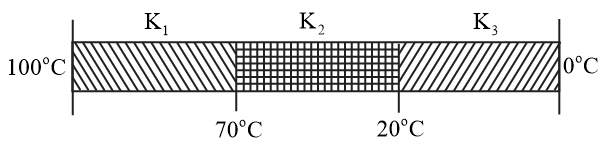
We have three rods, each of identical length $$L$$ and identical cross-sectional area $$A$$. Their thermal conductivities are $$K_1, K_2$$ and $$K_3$$, respectively. They are joined end to end. The left-most end is kept at $$100^\circ\text{C}$$, the right-most end is kept at $$0^\circ\text{C}$$. In steady state the temperatures at the two junctions are given to be $$70^\circ\text{C}$$ and $$20^\circ\text{C}$$, as shown below:
$$100^\circ\text{C}\;\; |\,\text{Rod }1\,| \;70^\circ\text{C}\;\; |\,\text{Rod }2\,| \;20^\circ\text{C}\;\; |\,\text{Rod }3\,| \;0^\circ\text{C}$$
Because no heat is lost through the lateral surfaces, the same heat current $$Q$$ flows through every section of the composite rod in steady state.
Fourier’s law of heat conduction states first:
$$Q \;=\; \dfrac{K\,A\,\Delta T}{L}$$
where $$K$$ is the thermal conductivity of that section, $$A$$ is the cross-sectional area, $$\Delta T$$ is the temperature difference across the length $$L$$ of that section.
Applying this formula to each rod separately and remembering that $$A$$ and $$L$$ are the same for all rods, we write the heat current for every rod explicitly.
For Rod 1 (from $$100^\circ\text{C}$$ to $$70^\circ\text{C}$$):
$$Q \;=\; \dfrac{K_1\,A\,(100 - 70)}{L} \;=\; \dfrac{K_1\,A\,(30)}{L}$$
For Rod 2 (from $$70^\circ\text{C}$$ to $$20^\circ\text{C}$$):
$$Q \;=\; \dfrac{K_2\,A\,(70 - 20)}{L} \;=\; \dfrac{K_2\,A\,(50)}{L}$$
For Rod 3 (from $$20^\circ\text{C}$$ to $$0^\circ\text{C}$$):
$$Q \;=\; \dfrac{K_3\,A\,(20 - 0)}{L} \;=\; \dfrac{K_3\,A\,(20)}{L}$$
Because the heat current is the same everywhere, we equate these three expressions:
$$\dfrac{K_1\,A\,(30)}{L} \;=\; \dfrac{K_2\,A\,(50)}{L} \;=\; \dfrac{K_3\,A\,(20)}{L}$$
The common factors $$A$$ and $$L$$ cancel from all three terms, giving the simpler equality
$$K_1\,(30) \;=\; K_2\,(50) \;=\; K_3\,(20)$$
We now obtain the required ratios by pairwise comparison. First, comparing the first two terms:
$$K_1\,(30) \;=\; K_2\,(50)$$
Dividing both sides by $$30\,K_2$$:
$$\dfrac{K_1}{K_2} \;=\; \dfrac{50}{30} \;=\; \dfrac{5}{3}$$
Next, comparing the second and third terms:
$$K_2\,(50) \;=\; K_3\,(20)$$
Dividing both sides by $$50\,K_3$$:
$$\dfrac{K_2}{K_3} \;=\; \dfrac{20}{50} \;=\; \dfrac{2}{5}$$
From the above two ratios, we can also find $$K_1 : K_3$$ logically. We already have
$$\dfrac{K_1}{K_3} \;=\; \left(\dfrac{K_1}{K_2}\right)\!\left(\dfrac{K_2}{K_3}\right) \;=\; \left(\dfrac{5}{3}\right)\!\left(\dfrac{2}{5}\right) \;=\; \dfrac{2}{3}$$
Therefore, writing all the ratios in the simplest integer form:
$$K_1 : K_3 \;=\; 2 : 3, \qquad K_2 : K_3 \;=\; 2 : 5$$
These two relations match exactly with Option A of the given choices. No other option is consistent with both ratios simultaneously.
Hence, the correct answer is Option A.
Was this solution helpful?
Create a FREE account and get:
_1.webp)

Educational materials for JEE preparation

Ask our AI anything

AI can make mistakes. Please verify important information.
AI can make mistakes. Please verify important information.


