JEE Chemical Thermodynamics Questions

Question 1 JEE Advanced

An ideal gas $$(0.5\ \mathrm{mol})$$, initially at $$2$$ bar pressure, is compressed at a constant temperature of $$600\ \mathrm{K}$$ in two steps: first, against a constant external pressure of $$P$$ bar $$(2 \lt P \lt 8)$$, and then against constant external pressure of $$8$$ bar. At each step, the compression is stopped only when the pressure of the gas becomes equal to the external pressure. The total work done on the gas in these steps is $$W$$. Considering all possible values of $$P$$ $$(2 \lt P \lt 8)$$ and taking the gas constant as $$R$$ (in $$\mathrm{J\ K^{-1}\ mol^{-1}}$$), the minimum value of $$|W|$$ (in $$\mathrm{J}$$) is

Question 2 JEE Advanced

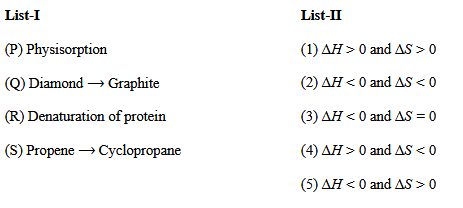
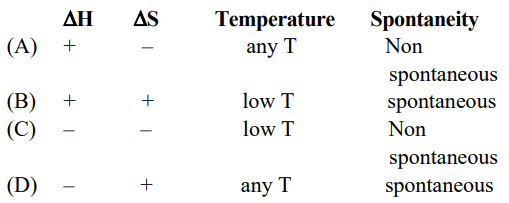
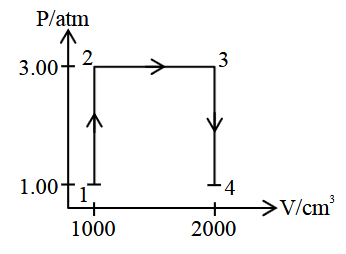
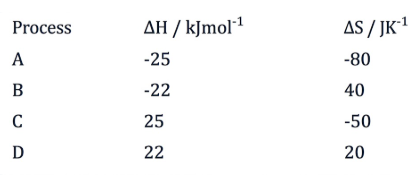
List-I contains various physical/chemical processes, and List-II contains combinations of changes in enthalpy $$(\Delta H)$$ and entropy $$(\Delta S)$$. Match each entry in List-I to the appropriate entry in List-II, and choose the correct option.

image
Question 3 JEE Mains

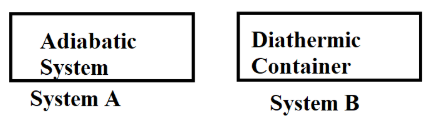
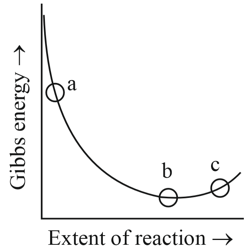
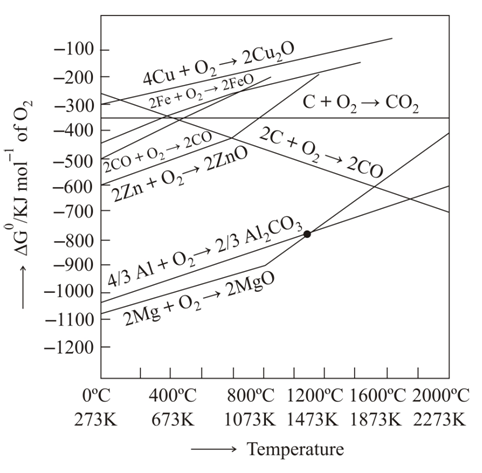
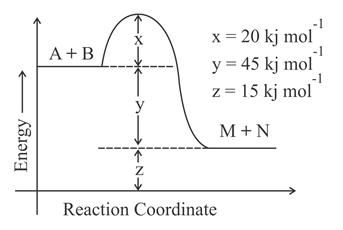
Which of the following statement is correct?

Question 4 JEE Mains

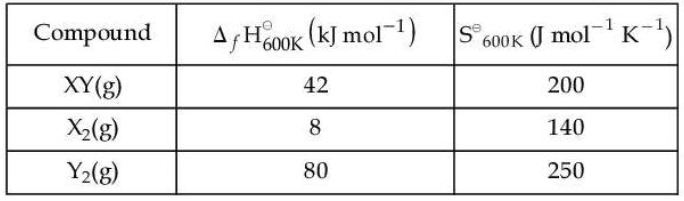
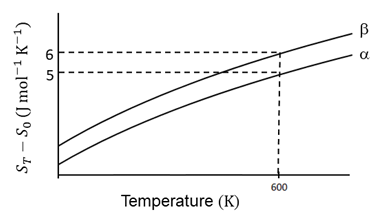
Consider the following data for the reaction 
$$\text{X}_2(g) + \text{Y}_2(g) \rightleftharpoons 2\text{XY}(g)$$
at 600 K.  The $$\Delta_r G^\circ$$ (in $$kJ/mol^{-1}$$) for the reaction is :

image
Question 5 JEE Mains

Consider the following data.
(i) 2Al(s) + 6HCl(aq) → Al$$_2$$Cl$$_6$$(aq) + 3H$$_2$$(g) + 1200 kJ/mol
(ii) H$$_2$$(g) + Cl$$_2$$(g) → 2HCl(g) + 164 kJ/mol.
(iii) HCl(g) + aq → HCl(aq) + 83 kJ/mol.
(iv) Al$$_2$$Cl$$_6$$(s) + aq → Al$$_2$$Cl$$_6$$(aq) + 663 kJ/mol
The enthalpy of formation of anhydrous solid Al$$_2$$Cl$$_6$$ is :

Question 6 JEE Mains

Gas 'A' undergoes change from state 'X' to state 'Y'. In this process, the heat absorbed and work done by the gas is 10 J and 18 J respectively. Now gas is brought back to state 'X' by another process during which 6 J of heat is evolved. In the reverse process of 'Y' to 'X' :

Question 7 JEE Mains

Given below are two statements:
Statement I: For an ideal gas, heat capacity at constant volume is always greater than the heat capacity at constant pressure.
Statement II: In a constant volume process, no work is produced and all the heat withdrawn goes into the chaotic motion and is reflected by a temperature increase of the ideal gas.
In the light of the above statement, choose the correct answer from the options given below.  

Question 8 JEE Mains

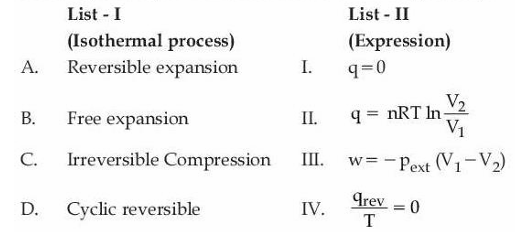
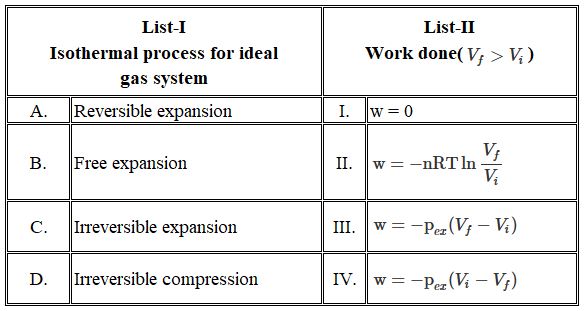
Match List - I with List - II.
Given $$V_1$$ and $$V_2$$ are initial and final volumes respectively. 

image

Choose the correct answer from the options given below :

Question 9 JEE Mains

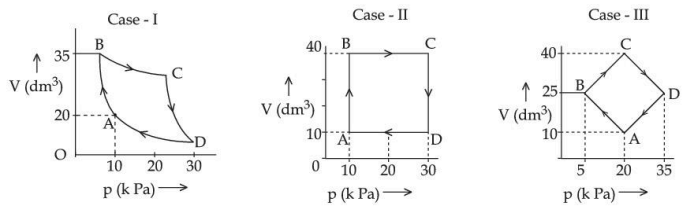
Arrange the following isothermal processes in order of the magnitude of the work (p - V) involved between states 1 and 2.

A. Expansion in single stage $$w_A$$
B. Expansion in multi stages $$w_B$$
C. Compression in single stage $$w_C$$
D. Compression in multi stages $$w_D$$

Choose the correct option.

Question 10 JEE Mains

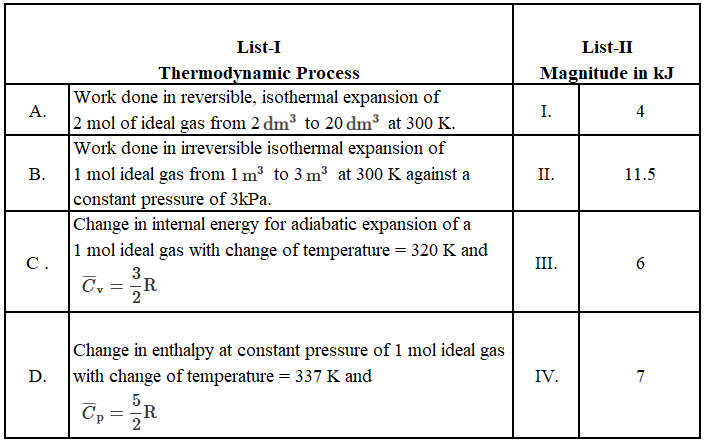
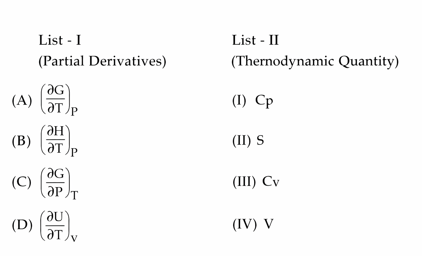
Match the LIST-I with LIST-II

Screenshot_50

Choose the correct answer from the options given below:

Question 11 JEE Mains

The correct order of molar heat capacities measured at 298 K and 1 bar is :

Question 12 JEE Mains

Consider the following data :
$$\Delta_f H^\ominus$$ (methane, g) = - X kJ $$mol^{-1}$$
Enthalpy of sublimation of graphite = Y kJ $$mol^{-1}$$
Dissociation enthalpy of $$H_{2}$$ = Zkj $$mol^{-1}$$
The bond enthalpy of C - H bond is given by :

Question 13 JEE Mains

The heat of atomisation of methane and ethane are 'x' kJ $$mol^{-1}$$ and 'y' kJ $$mol^{-1}$$ respectively. The longest wavelength ($$\lambda$$) of light capable of breaking the C-C bond
can be expressed in SI unit as:

Question 14 JEE Mains

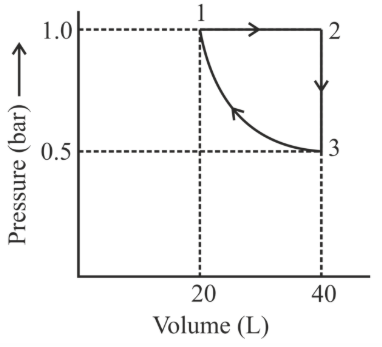
20.0 $$dm^{3}$$ of an ideal gas 'X' at 600 K and 0.5 MPa undergoes isothermal reversible expansion until pressure of the gas is 0.2 MPa. Which of the following option is correct?
(Given: $$\log 2 = 0.3010 and \log 5 = 0.6989$$)

Question 15 JEE Mains

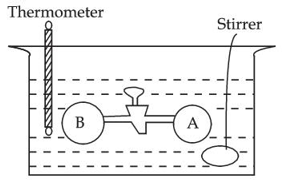
A cup of water at 5°C (system) is placed in a microwave oven and the oven is turned on for one minute during which the water begins to boil. Which of the following option is true ?

Question 16 JEE Mains

Match the LIST-I with LIST-II

Screenshot_59


Choose the correct answer from the options given befow:

Question 17 JEE Mains

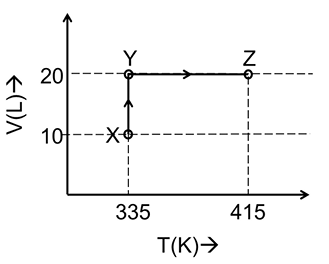
For an isothermal free expansion of an ideal gas into vacuum, which one of the following set of values is correct?

Question 18 JEE Mains

If 3.365 g of ethanol (l) is burnt completely in a bomb calorimeter at 298.15 K, the heat produced is 99.472 kJ. The $$|\Delta H_f°|$$ of ethanol at 298.15 K is _________ $$\times 10^2$$ kJ mol$$^{-1}$$. (Nearest integer)

Given: Standard enthalpy for combustion of graphite = $$-393.5$$ kJ mol$$^{-1}$$

Standard enthalpy of formation of water (l) = $$-285.8$$ kJ mol$$^{-1}$$

Molar mass in g mol$$^{-1}$$ of C, H, O are 12, 1 and 16 respectively

Question 19 JEE Mains

For the following reaction at 50 °C and at 2 atm pressure,

$$2N_2O_5(g) \rightleftharpoons 2N_2O_4(g) + O_2(g)$$

N$$_2$$O$$_5$$ is 50% dissociated.

The magnitude of standard free energy change at this temperature is $$x$$.

$$x$$ = _________ J mol$$^{-1}$$ [Nearest integer].

Given: $$R = 8.314$$ J mol$$^{-1}$$ K$$^{-1}$$, $$\log 2 = 0.30$$, $$\log 3 = 0.48$$, $$\ln 10 = 2.303$$, °C + 273 = K

Question 20 JEE Mains

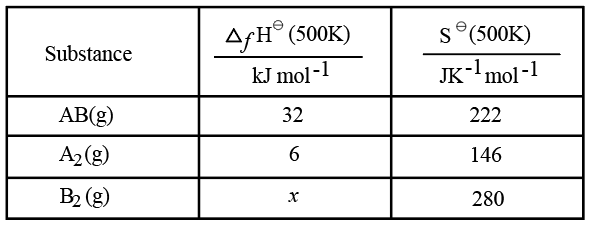
Use the following data :

Screenshot_31


One mole each of $$A_{2}(g)$$ and $$B_{2}(g)$$ are taken in a 1 L closed flask and allowed to establish the equilibrium at 500K
$$A_{2}(g)+B_{2}(g)\rightleftharpoons2AB(g)$$
The value of x in $$( kJ mol^{-1})$$ is ____ . (Nearest integer)
(Given: log K=2.2 R= 8.3 kJ $$K^{-1} mol^{-1}$$)

Question 21 JEE Mains

Consider the reaction
$$2\text{H}_2\text{S(g)} + 3\text{O}_2\text{(g)} \to 2\text{H}_2\text{O(l)} + 2\text{SO}_2\text{(g)}$$
The magnitude of enthalpy change for the reaction in kJ mol$$^{-1}$$ is __________. (Nearest integer)
Given :
$$\Delta_f H^\ominus(\text{H}_2\text{S}) = -20.1$$ kJ mol$$^{-1}$$
$$\Delta_f H^\ominus(\text{H}_2\text{O}) = -286.0$$ kJ mol$$^{-1}$$
$$\Delta_f H^\ominus(\text{SO}_2) = -297.0$$ kJ mol$$^{-1}$$

Question 22 JEE Mains

If the enthalpy of sublimation of Li is 155 kJ $$mol^{-1}$$, enthalpy of dissociation of $$F_{2}$$ is 150 kJ $$mol^{-1}$$, ionization enthalpy of Li is 520 kJ $$mol^{-1}$$, electron gain enthalpy of F is - 313 kJ $$mol^{-1}$$, standard enthalpy of formation of LiF is - 594 kJ $$mol^{-1}$$. The magnitude of lattice enthalpy of LiF is _________ kJ $$mol^{-1}$$. (Nearest Integer)

Question 23 JEE Mains

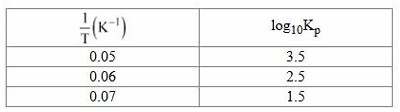
The values of pressure equilibrium constant recorded at different temperatures for the following equilibrium reaction have been given below
$$A(g) \rightleftharpoons B(g) + C(g)$$

image


The magnitude of $$\frac{\Delta H^\circ}{R}$$ calculated from the above data is _______. (Nearest integer)

Question 24 JEE Mains

At the transition temperature T, A ⇌ B and ΔG$$^0$$ = 105 − 35 log T where A and B are two states of substance X. The transition temperature in °C when pressure is 1 atm is __________. (Nearest integer)

Question 25 JEE Mains

Consider the reaction X $$\rightleftharpoons$$ Y at 300 K. If $$\Delta H^\theta$$ and K are 28.40 kJ mol$$^{-1}$$ and $$1.8 \times 10^{-7}$$ at the same temperature, then the magnitude of $$\Delta S^\theta$$ for the reaction in J K$$^{-1}$$ mol$$^{-1}$$ is _______. (Nearest integer)
(Given: R = 8.3 J K$$^{-1}$$ mol$$^{-1}$$, ln 10 = 2.3, log 3 = 0.48, log 2 = 0.30)

Frequently Asked Questions