JEE WhatsApp Group



IIT Admission Process 2026
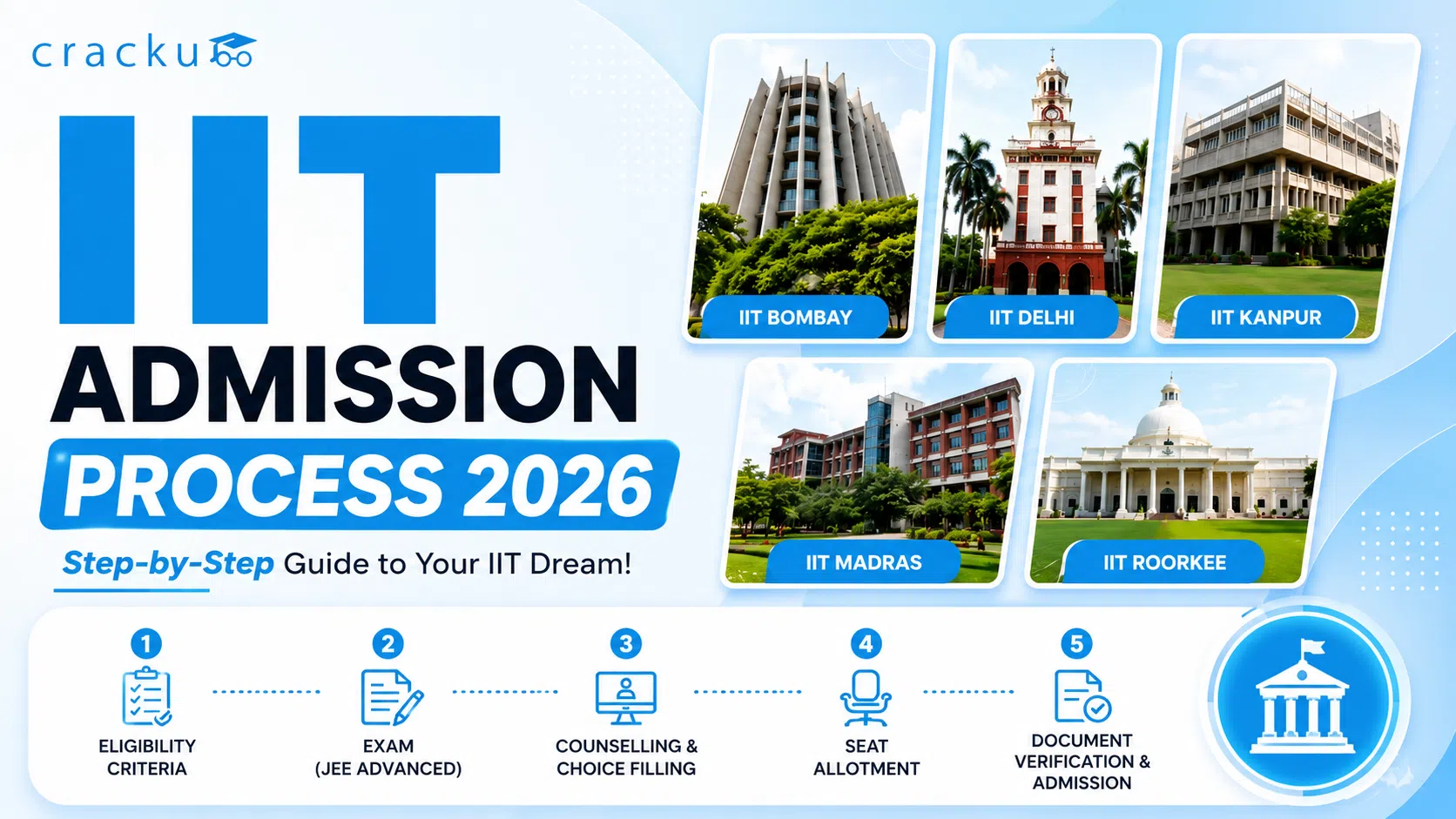
The IIT admission process 2026 is the most important journey for engineering aspirants in India who want to study at one of the 23 Indian Institutes of Technology. Admission to IITs is not based on a single exam alone. It is a multi-step process that includes qualifying JEE Main, clearing JEE Advanced, meeting Class 12 eligibility rules, and participating in JoSAA counselling. Every step has its own deadlines and conditions set by official bodies like the National Testing Agency (NTA), IIT Roorkee (the organising institute for JEE Advanced 2026), and the Joint Seat Allocation Authority (JoSAA). This blog explains the complete IIT admission process 2026 in simple terms so that students and parents know what to expect at each stage.
IIT Admission Through JEE Advanced
JEE Advanced is the only entrance test through which candidates can secure admission to undergraduate programmes at all 23 IITs. As per the official information on jeeadv.ac.in, JEE Advanced 2026 is being conducted by IIT Roorkee on May 17, 2026. Only the top 2,50,000 successful candidates of JEE Main 2026 across all categories are eligible to register for JEE Advanced. The exam has two compulsory papers, Paper 1 and Paper 2, both held on the same day in computer-based test (CBT) mode. After the result, IITs use the JEE Advanced rank list during JoSAA counselling to allot seats.
JEE Advanced 2026 Important Dates
Event | Date / Window |
|---|---|
JEE Advanced 2026 exam date | May 17, 2026 |
Admit card download | From May 11, 2026 |
Result announcement | June 1, 2026 (tentative) |
Organising institute | IIT Roorkee |
Official website | jeeadv.ac.in |
Students who want strong concept practice for both papers can use Cracku's JEE question bank to revise topic-wise problems before the exam.vvvvrvr
Eligibility Criteria and 75% Rule for IIT Admission
To be considered for IIT admission 2026, a candidate must clear JEE Advanced and also satisfy the eligibility rules set by the Joint Admission Board (JAB). The most well-known of these is the 75% rule, which says that students must score at least 75% aggregate marks in Class 12, or be among the top 20 percentile of their respective board. For SC, ST, and PwD candidates, this cutoff is 65%. Apart from this, candidates must meet the age limit, the attempt limit, and the year of first appearance criteria mentioned in the official JEE Advanced 2026 information brochure.
A simple summary of the main eligibility points is given below:
Eligibility Point | Requirement (as per official brochure) |
|---|---|
JEE Main rank | Within top 2.5 Lakhs qualifiers |
Class 12 marks (General/OBC/EWS) | 75% aggregate or top 20 percentile |
Class 12 marks (SC/ST/PwD) | 65% aggregate or top 20 percentile |
Number of attempts | Maximum two consecutive years |
Age limit (General/OBC/EWS) | Born on or after October 1, 2001 (tentative) |
Also Read: IIT CSE Cutoff 2026, JoSAA Opening & Closing Ranks
How JoSAA Counselling Works for IIT Admissions
JoSAA counselling is the final stage of the IIT admission process 2026. Conducted by the Joint Seat Allocation Authority on josaa.nic.in, it is a single, centralised platform for admissions to 23 IITs, 31 NITs, IIITs, and other Government Funded Technical Institutes (GFTIs). For IIT seats, only JEE Advanced 2026 qualifiers are considered. JoSAA counselling 2026 is expected to begin from June 2, 2026 (tentative), soon after the JEE Advanced result.
The process generally involves the following steps:
Online registration on josaa.nic.in using JEE Main credentials.
Choice filling, where candidates select their preferred institutes and branches in priority order.
Multiple rounds of seat allotment (recent years have had five to six rounds).
Choosing Float, Slide, or Freeze after every allotment.
Paying the seat acceptance fee, uploading documents, and reporting online or at the institute.
A consistent study routine helps students keep their preparation steady even during the long counselling wait. Many aspirants follow Cracku's JEE daily target to maintain regular practice.
Also Read: IIT Selection Process 2026, Explained Step by Step
IIT Admission Cutoff Trends for Different Categories
IIT cutoffs are released round-wise by JoSAA in the form of opening and closing ranks for every branch and institute. Cutoffs depend on factors like seat availability, branch popularity, and overall exam difficulty, so they change every year. Older IITs such as IIT Bombay, IIT Delhi, and IIT Madras usually have the lowest closing ranks, especially for Computer Science branches. Newer IITs tend to close at higher ranks, which gives more candidates a chance to secure a seat.
The table below shows the general direction of recent cutoff trends. Exact numbers vary by year, branch, and round, so this is meant only as a broad guide.
Category | Indicative closing rank trend for popular IIT B.Tech branches |
|---|---|
General | Tighter cutoffs for CSE at top IITs; wider range at newer IITs |
OBC-NCL | Generally higher closing ranks than General category |
EWS | Close to General with some relaxation |
SC / ST | Significant relaxation as per reservation rules |
PwD | Horizontal reservation applied within each category |
Also Read: Top 10 IIT Colleges in India 2026, Rankings, Placements, Cutoff
Important Mistakes to Avoid During IIT Counselling
A few common errors can cost candidates a good seat. Avoid these mistakes during JoSAA counselling 2026:
- Not registering on josaa.nic.in within the official deadline.
- Filling very few choices in the choice list, which reduces upgrade chances in later rounds.
- Choosing Freeze too early without checking previous years' opening and closing ranks.
- Missing deadlines for fee payment, document upload, or willingness submission.
- Uploading unclear or mismatched documents during reporting.
- Ignoring newer IITs or less popular branches that could still be a strong career option.
Reading the JoSAA business rules carefully and tracking each round's timeline can prevent most of these issues. A calm, well-planned approach to the IIT admission process 2026 will help candidates make the most of their JEE Advanced rank.
Also Read: IIT Closing Ranks 2026, Check College & Branch wise Analysis
IIT Admission Process 2026: Conclusion
The IIT admission process 2026 is a multi-step journey that requires careful preparation. From qualifying JEE Advanced to meeting the eligibility criteria, filling out the JoSAA counselling choices, and avoiding common mistakes, each step plays a crucial role. The JEE Advanced rank is just one part of the puzzle—candidates must also meet the 75% rule in Class 12 (or the top 20 percentile) to be considered for IIT admission.
To navigate the IIT admission process successfully, stay organized, track deadlines, and ensure you fill a diverse set of choices during JoSAA counselling. With a calm approach and strategic planning, you can maximize your chances of securing a seat in one of India’s top engineering institutes.
.webp)