91- 6303239042
Which multilateral development bank has been set up by BRICS as an alternative to the World Bank and the International Monetary Fund?
Sign in
Please select an account to continue using cracku.in
↓ →
Which multilateral development bank has been set up by BRICS as an alternative to the World Bank and the International Monetary Fund?
A new bank dedicated to the emerging BRICS countries opened for business in China's commercial hub of Shanghai on Tuesday, the official Xinhua news agency reported. The so-called emerging BRICS countries are made up of Brazil, Russia, India, China and South Africa, and their "New Development Bank" has been seen as a challenge to the Washington-based International Monetary Fund and World Bank.
Given below are some popular stock indices of the world. Match the stock index with the country and stock market it represents.

Loading solution...
The remains of which ancient civilization can be seen at the site of Machu Pichu in Peru?
Loading solution...
Who is acknowledged as the creator of Chandigarh’s Rock Garden?
Loading solution...
Which is the first Eurozone nation to exit its bailout package?
Loading solution...
Match the name of the city with the river on whose banks it is located

Loading solution...
What is the motto of the 2016 Summer Olympics to be held in Rio de Janeiro?
Loading solution...
Which film won the 2015 Oscar Award for the “Best Animated Feature Film”?
Loading solution...
Who among the following has won the maximum all time Grand Slam Women’s Singles title?
Loading solution...
Match the name of the Multinational Firm with whom the following Indians are/ have been associated as CEO

Loading solution...
A person with ‘AB’ blood group is also called a universal recipient because of the
Loading solution...
Who is the Vice Chairman of the NITI Aayog?
Loading solution...
The first Export Processing Zone of Asia was set up in
Loading solution...
Who launched a ‘crowd funding’ campaign to raise funds for bailing out Greece?
Loading solution...
Match the name of the book with its autor.

Loading solution...
The U.S. recently announced that its redesigned ten-dollar bill, to be issued in 2020, will include the
Loading solution...
The new Centre-State tax sharing model promised a 10% increase in the State’s share. This 10% increase will result from increasing the share from
Loading solution...
Which of the following countries is not a member of European Union?
Loading solution...
As per the monetary policy agreement between RBI and the Finance Ministry, the RBI is required to maintain inflation in the range of:
Loading solution...
Who discovered ‘Pluto’ in the year 1930?
Loading solution...
According to the World Investment Report 2015 published by UNCTAD, which of the following countries was the largest recipient of FDI inflows in 2014?
Loading solution...
Euro dollars are
Loading solution...
Match the Prime Ministers and Presidents of India who have been contemporaries in Office

Loading solution...
Mark the wrong combination
Loading solution...
Mother Teresa was born in
Loading solution...
In 1985-86, an official policy introduced by Gorbachev in Soviet Union that stressed on honest discussion about the country’s social issues and concerns was called
Loading solution...
The British Cosmologist Stephen Hawing and the Russian entrepreneur Yuri Milner have launched a project to search for the extra terrestrial life. This project is called:
Loading solution...
Match the name of the organization with the name of the city in which it is headquartered.

Loading solution...
The internal evaluation for Economics course in an Engineering programme is based on the score of four quizzes. Rahul has secured 70, 90 and 80 in the first three quizzes. The fourth quiz has ten True-False type questions, each carrying 10 marks. What is the probability that Rahul’s average internal marks for the Economics course is more than 80, given that he decides to guess randomly on the final quiz?
Loading solution...
In 2004, Rohini was thrice as old as her brother Arvind. In 2014, Rohini was only six years older than her brother. In which year was Rohini born?
Loading solution...

If p, q and r are three unequal numbers such that p, q and r are in A.P., and p, r-q and q-p are in G.P., then p : q : r is equal to:
Loading solution...
If $$log_{25}{5}$$ = a and $$log_{25}{15} $$ = b, then the value of $$log_{25}{27}$$ is:
Loading solution...
During the essay writing stage of MBA admission process in a reputed B-School, each group consists of 10 students. In one such group, two students are batchmates from the same IIT department. Assuming that the students are sitting in a row, the number of ways in which the students can sit so that the two batchmates are not sitting next to each other, is:
Loading solution...
The pre-paid recharge of Airtel gives 21% less talktime than the same price pre-paid recharge of Vodafone. The post-paid talktime of Airtel is 12% more than its pre-paid recharge, having the same price. Further, the post-paid talktime of same price of Vodafone is 15% less than its pre-paid recharge. How much percent less / more talktime (approximately) can one get from the Airtel post-paid service compared to the post-paid service of Vodafone?
Loading solution...
As a strategy towards retention of customers, the service centre of a split AC machine manufacturer offers discount as per the following rule: for the second service in a year, the customer can avail of a 10% discount; for the third and fourth servicing within a year, the customer can avail of 11% and 12% discounts respectively of the previous amount paid, Finally, if a customer gets more than four services within a year, he has to pay just 45% of the original servicing charges. If Rohan has availed 5 services from the same service centre in a given year, the total percentage discount availed by him is approximately:
Loading solution...
A tank is connected with both inlet pipes and outlet pipes. Individually, an inlet pipe can fill the tank in 7 hours and an outlet pipe can empty it in 5 hours. If all the pipes are kept open, it takes exactly 7 hours for a completely filled-in tank to empty. If the total number of pipes connected to the tank is 11, how many of these are inlet pipes?
Loading solution...
In a certain village, 22% of the families own agricultural land, 18% own a mobile phone and 1600 families own both agricultural land and a mobile phone. If 68% of the families neither own agricultural land nor a mobile phone, then the total number of families living in the village is:
Loading solution...
In the board meeting of a FMCG Company, everybody present in the meeting shakes hand with everybody else. If the total number of handshakes is 78, the number of members who attended the board meeting is:
Loading solution...
A firm is thinking of buying a printer for its office use for the next one year. The criterion for choosing is based on the least per-page printing cost. It can choose between an inkjet printer which costs Rs. 5000 and a laser printer which costs Rs. 8000. The per-page printing cost for an inkjet is Rs. 1.80 and that for a laser printer is Rs. 1.50. The firm should purchase the laser printer, if the minimum number of a pages to be printed in the year exceeds
Loading solution...
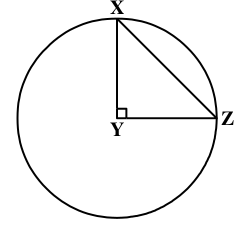
If in the figure below, angle XYZ = 90° and the length of the arc XZ = 10$$\pi$$, then the area of the sector XYZ is
Loading solution...
A chartered bus carrying office employees travels everyday in two shifts- morning and evening. In the evening, the bus travels at an average speed which is 50% greater than the morning average speed; but takes 50% more time than the amount of time it takes in the morning. The average speed of the chartered bus for the entire journey is greater/less than its average speed in the morning by
Loading solution...
If a right circular cylinder of height 14 $$cm$$ is inscribed in a sphere of radius 8 $$cm$$, then the volume of the cylinder is (assume $$\pi\ =\ \frac{22}{7}$$):
Loading solution...
Seema has joined a new Company after the completion of her B.Tech from a reputed engineering college in Chennai. She saves 10% of her income in each of the first three months of her service and for every subsequent month, her savings are Rs. 50 more than the savings of the immediate previous month. If her joining income was Rs. 3000, her total savings from the start of the service will be Rs. 11400 in:
Loading solution...
Sailesh is working as a sales executive with a reputed FMCG Company in Hyderabad. As per the Company’s policy, Sailesh gets a commission of 6% on all sales upto Rs. 1,00,000 and 5% on all sales in excess of this amount. If Sailesh remits Rs. 2,65,000 to the FMCG company after deducting his commission, his total sales were worth:
Loading solution...
Three carpenters P, Q and R are entrusted with office furniture work. P can do a job in 42 days. If Q is 26% more efficient than P and R is 50% more efficient than Q, then Q and R together can finish the job in approximately:
Loading solution...
There are two alloys P and Q made up of silver, copper and aluminium. Alloy P contains 45% silver and rest aluminum. Alloy Q contains 30% silver, 35% copper and rest aluminium. Alloys P and Q are mixed in the ratio of 1 : 4.5. The approximate percentages of silver and copper in the newly formed alloy is:
Loading solution...
A ladder of 7.6 m long is standing against a wall and the distance between the wall and the base of the a ladder is 6.4 m. If the top of the ladder now slips by 1.2m, then the foot of the ladder shifts by approximately:
Loading solution...
The value of x for which the equation $$\sqrt{4x - 9}$$ + $$\sqrt{4x + 9}$$ = 5 + $$\sqrt{7}$$ will be satisfied, is:
Loading solution...
The simplest value of the expression $$(\frac{4^{p+\frac{1}{4}}\times \sqrt{2 \times 2^{p}}}{2\times \sqrt{2^-p}})^\frac{1}{p}$$
Loading solution...
In a reputed engineering college in Delhi, students are evaluated based on trimesters. The probability that an Engineering student fails in the first trimester is 0.08. If he does not fail in the first trimester, the probability that he is promoted to the second year is 0.87. The probability that the student will complete the first year in the Engineering College is approximately:
Loading solution...
Solve the questions based on the information provided in the passage below:
Six engineers Anthony, Brad, Carla, Dinesh, Evan and Frank are offered jobs at six different locations -England, Germany, India, Australia, Singapore and UAE. The jobs offered are in six different branches, and are based on their competence as well as preference. The branches are IT, Mechanical, Chemical, Electronics, Metallurgy and Electrical, though not necessarily in the same order. Their placements are subject to the following conditions:
i.The engineer in the Electrical Department is not placed in Germany.
ii.Anthony is placed in Singapore while Dinesh in UAE.
iii.Frank is not in the Metallurgy Department but Brad is in the Chemical Department.
iv.Evan is placed in the Mechanical Department while Frank is offered a job in Australia.
v.The only department offering jobs in India is the Chemical Department while there are no vacancies for IT in Singapore.
vi. Anthony is interested in IT and Electrical Department while Frank is interested in IT and Mechanical Department. Both of them settle for the options available based on their interests in the locations allotted to them.
vii. In recent years, UAE has emerged as a hub for metallurgy exports and thus recruitment is done for the same while all mechanical posts are in England.
Who joined the Electronics Department?
Loading solution...
The person placed in UAE is in the _____________ Department
Loading solution...
Out of the following, which is the correct combination?
Loading solution...
Who joined the IT Department in Australia?
Loading solution...
Which combination is true for Dinesh?
Loading solution...
Based on the given statement, choose the right conclusion:
‘If the breakfast doesn’t have eggs, I will not go for a walk and will not have lunch.’
Loading solution...
Read the details below and answer the questions that follow.
For astrological reasons, a mother named all her daughters with the letter ‘K’ as Kamla, Kamlesh, Kriti, Kripa, Kranti, and Kalpana.
i. Kamla is not the tallest, while Kripa is not the most qualified.
ii. The shortest is the most qualified amongst them all.
iii. Kalpana is more qualified than Kamlesh, who is more qualified than Kriti.
iv. Kamla is less qualified than Kamlesh but is taller than Kamlesh.
v. Kalpana is shorter than Kriti but taller than Kranti.
vi. Kriti is more qualified than Kamla, while Kamlesh is taller than Kriti.
vii. Kripa is the least qualified amongst the daughters.
Who is the third tallest starting in decreasing order of height?
Loading solution...
Who is the most qualified?
Loading solution...
What is the rank of Kriti in increasing order of qualification?
Loading solution...
What is the rank of Kamla in increasing order of height?
Loading solution...
Based on the number series given, fill in the missing number. 18, 37, 76, 155, ________, 633, 1272
Loading solution...
Based on the conditions stated in the passage below, answer the questions that follow.
There are three countries, USA, UAE and UK. An exporter can select one country or two countries or all the three countries subject to the conditions below:
Condition 1: Both USA and UAE have to be selected.
Condition 2: Either USA or UK, but not both have to be selected.
Condition 3: UAE can be selected only if UK has been selected.
Condition 4: USA can be selected only if UK is selected.
How many ways countries can be selected if no condition is imposed?
Loading solution...
How many countries can be selected to meet only condition 1?
Loading solution...
How many countries can be selected to meet only conditions 2 and 3?
Loading solution...
Based on the following relations, which of the given options indicate that W is the niece of X?
A+B means that A is the brother of B.
A*B means that A is the father of B.
A-B means that A is the sister of B.
Loading solution...
Alex walks 1 mile towards East and then he turns towards South and walks further 5 miles. After that he turns East and walks 2 miles further. Finally he turns to his North and walks 9 miles. How far is he from the starting point?
Loading solution...
From the given statements, choose the conclusions which follow logically:
Statements:
i. Some iphones are mobiles
ii. Some mobiles are ipads
iii. Some ipads are tablets
Conclusions:
I. Some tablets are iphones
II. Some mobiles are tablets
III. Some ipads are iphones
IV. All iphones are tablets
Loading solution...
Read the passage below and answer the questions that follow.
Export cargo of a trader can go through seven cities P, Q, R, S, T, U and V. The following cities have a two way connection i.e., Cargo can move in both directions between them; S and U, P and Q, Q and R, V and T, R and T, V and U. Cargo can move only in one direction from U to Q.
If the trader wants the cargo to move from City S to City T then excluding cities S and T, what is the minimum number of cities that the cargo has to cross in transit?
Loading solution...
If the trader wants the cargo to go to City U from City P through the longest route, how many cities will he be required to cross (excluding cities P and U)?
Loading solution...
To move cargo from City P to City U, which of the following statements will minimise the number of cities to be crossed in transit?
Loading solution...
Read the following information and tables and answer the questions that follow.
Torrent Enterprises sells air conditioners of Eagle Brand in the retail market of Delhi. The month-wise total number of Window Air Conditioner (WAC) units sold by Torrent during April 2014 to March 2015 are shown below in Table A. Table B shows the share of different types of WACs in total monthly sales for the said period.
Number of Units Sold by Torrent Enterprises During the Period April 14 to March 15
Table A

Table B

Performance measures are as follows:
Half Yearly Sales Performance:
$$\frac{\text{Oct 14 to Mar 15 Average Sales - April 14 to Sep 14 Average Sales}}{\text{April 14 to Sep 14 Average Sales}}$$
Monthly Sales Performance:
$$\frac{\text{Current Month Sales - Pervious Month Sales}}{\text{Previous Month Sales}}$$
Sales Volatility:
$$\frac{\text{Maximum Monthly Sales - Minimum Monthly Sales}}{\text{Average Monthly Sales}}$$
What is the closest average number of 1 1⁄2 ton Window ACs sold by Torrent Enterprises during April 2014 - March 2015?
Loading solution...
The absolute difference between average annual sales (in units) of which pair of WACs type is the highest
Loading solution...
Which type of WAC has performed the second best in Half Yearly Sales Performance?
Loading solution...
In which of the months given below, the total WAC Monthly Sales Performance was the highest?
Loading solution...
Which type of WAC has the least Sales Volatility?
Loading solution...
Read the following information, graph and table and answer the questions that follow.
Ellen Inc. is a Mumbai based company which sells five products branded as A, B, C, D and E in India. Anita looks after entire sales of North India working from regional office in Delhi. She was preparing for annual review meeting scheduled next day in Mumbai. She was attempting to analyse sales in North India for the seven year period from 2009 to 2015. She first calculated average sales in rupees of all the five brands and constructed a table exhibiting the difference between average sales of each pair of brands as shown in the following table:

Average Sales of Product A minus Average Sales of Product B
After taking a print out of the above table, she attempted to look at the trend of sales and plotted a graph in MS Excel. Later she took a print out of the graph and left for a meeting. While on her way she figured out that due to some printer cartridge problem sales of Product A in 2013, Product C in 2010, and Product D in 2012 were not visible in the graph as reproduced below. Anita had to make some quick calculations to arrive at the information outlined in the following question.
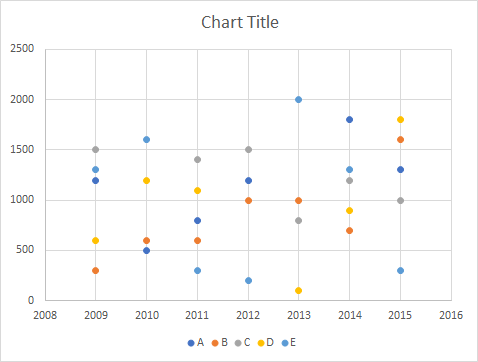
What are the sales of Product A in 2013, Product C in 2010 and Product D in 2012?
Loading solution...
Annual sales average of all products is the least in which year?
Loading solution...
Which product has the least average sales for the seven year period 2009-15?
Loading solution...
The difference between average sales of products for the period 2009-15 is the least for which pair of products?
Loading solution...
If Year on Year (YoY) Growth is
{Current Year Sales − Previous Year Sales }/ Previous Year Sales
then the YoY growth of combined sales of all products has suffered maximum decline in which year?
Loading solution...
Read the following information and graph and answer the questions that follow.
An international Organisation produces a Competitive Index of countries every two years based on eight factors (Institutions, Infrastructure, Macroeconomic Environment, Higher Education, Market Efficiency, Technological Readiness, Business Sophistication and Innovation). The last three indices were developed in 2010, 2012 and 2014. The scores for all eight factors of XYZ country are shown in the graph below:

If Factor performance is measured as 0.30 × Factor Score in 2014 + 0.35 × Factor Score in 2012 + 0.35 × Factor Score in 2010, then which of the following has best Factor Performance?
Loading solution...
If Factor Performance is measured as
$$\frac{ \text {Factor Score 2014 - Factor Score 2012 }}{ \text{Factor Score 2010}}$$
then which of the following has best Factor Performance?
Loading solution...
Which of the following factors has the highest average score across indices of 2010, 2012 and 2014?
Loading solution...
Which among the following factors had the least growth rate in 2014 versus scores of 2010?
Loading solution...
Read the following information and the accompanying graphs to answer the questions that follow.
www.jay.com spent $ 5,57,000 during last 12 months for online display advertisements, also called impressions, on five websites (Website A, Website B, Website C, Website D and Website E). In this arrangement, www.jay.com is the Destination Site, and the five websites are referred to as the Ad Sites. The allocation of online display advertising expenditure is shown in Graph A. The online display advertisements helped www.jay.com to get visitors on its site. Online visitors, visiting the Ad Sites, are served display advertisements of www.jay.com and on clicking they land on the Destination Site (Graph B). Once on the Destination Site, some of the visitors complete the purchase process(Graph C)


Quality traffic = $$\frac{\text{No. of site visitors who start purchase on destination site}}{\text{No. of visitors who click the online display advertisement}}$$
Leakage in online buying = 1 − $$\frac{\text {Complete buying on the destination website}}{\text{Start buying on the destination website}}$$
Efficiency of online display advertising expenditure on an Ad Site = $$\frac{\text{No. of visitors from the Ad Site who complete the purchase process}}{\text{Amount spent on the Ad Site}}$$
Which of following Ad Sites provide facility of least cost per advertisement?
Loading solution...
Which Ad Site has provided maximum quality traffic?
Loading solution...
Which Ad Site sent traffic to www.jay.com with maximum leakage?
Loading solution...
On which Ad Site is the advertising budget spent most efficiently?
Loading solution...
Read the following passages carefully and answer the questions given at the end of each passage
Because of the critical role played by steel in economic development, the steel industry is often considered, especially by the governments, which traditionally owned it, to be an indicator of economic prowess. World production has grown exponentially, but there were big highs and equally big lows all through the 1990s and up to 2002. Recovery from the two World Wars and the Great Depression of the 1930s caused massive disruption and lay-offs. Over-capacity and low steel prices continued to play havoc through the 1970s and 1980s and politicians began to lose their belief that the wealth of a nation was directly coupled to its steel production.
This led to a wave of privatisations, as state-owned enterprises shed their financial liabilities to hungry capitalists. A whole new breed of steel-makers came into being using a new technology, the mini-mill. This used a smaller electric-arc furnace fed that just melts down ‘cold’ scrap. It was a cheaper process than the traditional ‘hot metal integrated mills’ with their mountains of ore and coal and monumental machinery, but it was used almost exclusively for lower-grade building and other ‘long’ products.
By the beginning of 2005, the world steel industry was on a high, after decades of moving from apocalypse to break-even and then back to apocalypse. Since 2003, when a staggering 960 million tonnes were produced-compared to 21.9 million tonnes for aluminium-there had been unprecedented demand, mainly from China and India. China was both the biggest producer, the first country to exceed 200 million tonnes of crude steel in a year, and also its biggest consumer at 244 million tonnes. The global economy was also booming, but this was creating production bottlenecks for all steel-makers and by 2004 steel had for the first time hit an average of $650 per tonne shipped. Profit margins were better, but where was the growth to come from? In tandem, the costs of essential raw materials for steel-making - iron ore coking coal-had gone through the roof, along with bulk shipping costs. The key to future growth was to secure plants in emerging markets where ore and coal were close to production sites, labour costs were much lower and where technology and investment could spur greater savings.
But the central issue was that globally the industry remained a very fragmented one. No single company was producing 100 million tonnes a year, or 10 per cent of total world production. The name of the game was consolidation into fewer, bigger players. With this would come the chance for steel-makers to gain greater pricing power, increasing their profitability and the value of their shares.
Two groups had begun to move ahead of the pack. One was Mittal Steel with its operational headquarters in London’s prestigious Berkeley Square. Mittal Steel was the world’s biggest producer of ‘long’ products. It was young, aggressive, fast, and a big risk-taker, fuelled by its founder Lakshmi Mittal’s visionary zeal to consolidate the industry. Its nearest rival, Arcelor - the world’s most profitable steel company, focusing on ‘flat’ products - was headed by the Frenchman Guy Dolle, and was a combination of three former state-owned European steel plants: Arbed of Luxembourg, Usinor from France and Spain’s Aceralia. These three were now merged, restructured and administered from the grandiose, chateau-like former Arbed headquarters in Luxembourg’s Avenue de la Liberte.
Both groups were passionate about steel. Mittal, already dubbed ‘the Carnegie from Calcutta’, had a clearer vision of the need to streamline steel, but Arcelor was determined to become the biggest as well as the best. Dominating the market would enable either firm to increase its pricing position with customers, the car-makers, ship-builders and construction firms, as well as chasing growth in the new markets of Asia, South America and Eastern Europe.
Guy Dolle could hear the clump of Mittal’s feet marching ahead, and it hurt. Arcelor was Europe’s reigning steel champion and was arrogantly proud of it. It had a commanding market share of the specialised high-strength steel supplied to European car-makers, and a total overall production approaching 50 million tonnes a year, all with state-of-the-art technology. The group had repaired its consolidated balance sheet, ravished by decades of downturns and continual restructuring costs. It had invested heavily in the quest for best technology and had also acquired companies in Brazil, set up joint ventures in Russia, Japan and China and now was eagerly eyeing gateways to the North American car market. And to its long-suffering shareholders, starved of decent dividends, Arcelor was at last moving in the right direction, after the blood, sweat and tears of shifting from public to private sector. The Luxembourg group was clearly on a wake-up call, gunning to overtake Mittal Steel and keep it at bay.
By 2005, the battle for supremacy had begun to heat up. Two projected state sell-offs by public auction, in Turkey and Ukraine, were particularly attractive commercially. Both auctions were taking place in October, within three weeks of each other. The first, in Turkey, was for the 46.3 percent of government-owned shares in Erdemir, a steel-maker producing 3.5 million tonnes a year for car-makers and other industrial clients in a country of seventy million people shaping up to join the European Union. Mittal and Arcelor both already owned minitory stakes in the Turkish company and were eager to get majority control.
Which of the following statements is true?
Loading solution...
Which among the following is the common objective both Mittal and Arcelor had for aspiring to become bigger steel-makers?
Loading solution...
From the above passage, it clearly emerges that:
Loading solution...
What are the plausible reasons for privatization in steel industry?
Loading solution...
Read the following passages carefully and answer the questions given at the end of each passage:
In the decades that Otlet’s papers had sat gathering dust, his dream of a universal knowledge of network had found a new expression across the Atlantic, where a group of engineers and computer scientists laid the groundwork for what would eventually become the Internet. Beginning during the Cold War, the United States poured money into a series of advanced research projects that would eventually lead to the creation of the technologies underpinning the present-day Internet. In 1990s, the World Wide Web appeared and quickly attracted a widespread audience, eventually establishing itself as the foundation of a global knowledge- sharing network much like the one that Otlet envisioned.
Today, the emergence of that network has triggered a series of dramatic - perhaps even “axial” - transformation. In 2011, the world’s population generated more than 1.8 zettabytes of data, including documents, images, phone calls, and radio and television signals. More than a billion people now use Web browsers, and that number will almost certainly increase for years to come. In an era when almost anyone with a mobile phone can press a few keys to search the contents of the world’s libraries, when millions of people negotiate their personal relationships via online social networks, and when institutions of all stripes find their operations disrupted by the sometimes wrenching effects of networks, it scarcely seems like hyperbole - and has even become cliché - to suggest that the advent of the Internet ranks as an event of epochal significance.
While Otlet did not by any stretch of imagination “invent” the Internet - working as he did in an age before digital computers, magnetic storage, or packet - switching networks - nonetheless his vision looks nothing short of prophetic. In Otlet’s day, microfilm may have qualified as the most advanced information storage technology, and the closest thing anyone had ever seen to database was a drawer full of index cards. Yet despite these analog limitations, he envisioned a global network of interconnected institutions that would alter the flow of information around the world, and in the process lead to profound social, cultural, and political transformations.
By today’s standards, Otlet’s proto-Web was a clumsy affair, relying on a patchwork system of index cards, file cabinets, telegraphs machines, and a small army of clerical workers. But in his writing he looked far ahead to a future in which networks circled the globe and data could travel freely. Moreover, he imagined a wide range of expression taking shape across the network: distributed encyclopaedias, virtual classrooms, three-dimensional information spaces, social networks, and other forms of knowledge that anticipated the hyperlinked structure of today’s Web. He saw these developments as fundamentally connected to a
larger utopian project that would bring the world closer to a state of permanent and lasting peace and toward a state of collective spiritual enlightenment.
The conventional history of the Internet traces its roots through an Anglo-American lineage of early computer scientists like Charles Babbage, Ada Lovelace, and Alan Turing; networking visionaries like Vinton G. Cerf and Robert E. Kahn; as well as hypertext seers like Vannevar Bush, J.C. R. Licklider, Douglas Engelbart, Ted Nelson, and of course Tim Berners-Lee and Robert Cailliau, who in 1991 released their first version of the World Wide Web. The dominant influence of the modern computer industry has placed computer science at the center of this story.
Nonetheless Otlet’s work, grounded in an age before microchips and semiconductors, opened the door to an alternative stream of thought, one undergirding our present-day information age even though it has little to do with the history of digital computing. Well before the first Web servers started sending data packets across the Internet, a number of other early twentieth- century figures were pondering the possibility of a new, networked society: H.G. Wells, the English science fiction writer and social activist, who dreamed of building a World Brain, Emanuel Goldberg, a Russian Jew who invented a fully functional mechanical search engine in 1930s Germany before fleeing the Nazis; Scotland’s Patrick Geddes and Austria’s Otto Neurath, who both explored new kinds of highly designed, propagandistic museum exhibits designed to foster social change; Germany’s Wilhelm Ostwald, the Nobel Prize-winning chemist who aspired to build a vast new ‘brain of humanity’; the sculptor Hendrik Andersen and the architect Le Corbusier, both of whom dreamed of designing a World City to house a new, one-world government with a networked information repository at its epicentre. Each shared a commitment to social transformation through the use of available technologies. They also each shared a direct connection to Paul Otlet, who seems to connect a series of major turning points in the history of the early twentieth-century information age, synthesizing and incorporating their ideas along with his own, and ultimately coming tantalizingly close to building a fully integrated global information network.
What is the remark that the author of this passage considers a defensible one, rather than a hyperbole?
Loading solution...
In the above passage, Otlet is being credited with
Loading solution...
What has been said as the common commitment shared by the early twentieth-century figures who imagined and worked for a networked society?
Loading solution...
Otlet’s original idea of network can be described as:
Loading solution...
Read the following passages carefully and answer the questions given at the end of each passage:
Every loan has a lender and a borrower; both voluntarily engage in
the transaction. If the loan goes bad, there is at least a prima facie
case that the lender is as guilty as the borrower. In fact, since
lenders are supposed to be sophisticated in risk analysis and in making
judgments about a reasonable debt burden, they should perhaps bear even
more culpability.
Does it make a difference if we say there is
over-lending rather than over-borrowing? The difference in where we see
the problem affects where we seek the solution. Is the problem more on
the side of the lenders, that they are not exercising due diligence in
judging who is creditworthy? Or on the borrowers, being profligate and
irresponsible? If we consider the problem to be over borrowing, then we
naturally think of making it more difficult for borrowers
to
discharge their debts, on the contrary, if the problem is over lending,
we focus on strengthening incentives for lenders to exercise due
diligence.
The political economy of over-borrowing is easy to
understand. The current borrowing
government benefits and later
governments have to deal with the consequences. But why have
sophisticated, profit maximizing lenders so often over-lent? Lenders
encourage indebtedness because it is profitable. Developing country
governments are sometimes even pressured to over-borrow. There may be
kickbacks in loans, or even to be influenced by Western businessmen and
financiers. They wine and dine those responsible for borrowing as they
sell their loan packages, and tell them why this is good time to borrow,
why their particular package is attractive, why this is the right time
to restructure debt? Countries that are not sure that borrowing is worth
the risk are told how important it is to establish a credit rating:
borrow even if you really don’t need the money.
Excessive borrowing increases the chance of a crisis, and the cost of a crisis are borne not just by lenders but by all of society. In recent years, IMF programs may have resulted in significant further distortions in lenders’ incentives. When crisis occurred, the IMF lent money in what was called a ‘bail-out’- but the money was not really a bail-out for the country; it was a bail out for western banks. In both East Asia and Latin America, bail-outs provided money to repay foreign creditors, thus absolving creditors from having to bear the costs of their mistaken lending. In some instances, governments even assumed private liabilities, effectively socializing private risk. The creditors were left off the hook, but the IMF’s money wasn’t gift, just another loan- and the developing country was left to pay the bill. In effect, the poor country’s taxpayers paid for rich country’s lending mistakes.
The
bail-outs give rise to the famous ‘moral hazard’ problem. Moral hazard
arises when a party does not bear all the risks associated with his
action and as a result does not do everything he can to avoid risk. The
term originates in the insurance literature; it was deemed immoral for
an individual to take less care in preventing a fire simply because he
had insurance coverage. It is of course, simply a matter of incentives:
those with insurance may not set their houses on fire deliberately, but
their incentive to avoid a fire is still weakened. With loans, the risk
is default, with all of its consequences; lenders can reduce that risk
simply by lending less. If they perceive
a high likelihood of a
bail-out, they lend more than they otherwise would.
Lending markets are also characterized by, in the famous words of former chairman of the U.S. Federal Reserve Alan Greenspan, ‘irrational exuberance’, as well as irrational pessimism. Lenders rush into a market in a mood of optimism, and rush out when the mood changes. Markets move in fads and fashions, and it is hard to resist joining the latest fad. If only one firm were affected by a mood of irrational optimism, it would have to bear the cost of its mistake; but when large numbers share the mood, in a fad, there are macroeconomic consequences, potentially affecting everyone in the country.
The author is trying to find the underlying cause of:
Loading solution...
The moral hazard arises because:
Loading solution...
According to the author the IMF bail-outs for the countries in crisis have been in effect:
Loading solution...
The author believes that the cost of the crisis is ultimately borne by:
Loading solution...
Read the following passages carefully and answer the questions given at the end of each passage:
The mass media have been recognized as politically significant since the advent of mass literacy and the popular press in the late nineteenth century. However, it is widely accepted that, through a combination of social and technological changes, the media have become increasingly more powerful political actors and, in some respects, more deeply enmeshed in the political process. Three developments are particularly noteworthy. First, the impact of the so-called ‘primary’ agents of political socialization, such as the family and social class, has declined. Whereas once people acquired, in late childhood and adolescence in particular, a framework of political sympathies and leanings that adult experience tended to modify or deepen, but seldom radically transformed, this has been weakened in modern society by values. Abiding political allegiances and habitual voting patterns have thus given way to a more instrumental approach to politics, in which people make political choices according to a calculations of personal self-interest based on the issues and policy positions on offer. This, in turn, widens the scope for the media’s political influence, as they are the principal mechanism through which information about issues and policies, and therefore political choices, is presented to the public.
Second, the development of mass television audience from the 1950s onwards, and more recently the proliferation of channels and media output associated with the ‘new’ media, has massively increased the mass media’s penetration into people’s everyday lives. This means that the public now relies on the mass media more heavily than ever before: for instance, television is a much more important source of news and current affairs information than political meetings; many more people watch televised sport than participate in it; and even shopping in increasingly being carried out through shopping channels and the internet.
Third, the media have become more powerful economic actors. Not only have major media corporations become more powerful global players, but also a series of mergers has tended to incorporate the formerly discrete domains of publishing, television, film, music, computers and telecommunications into a single massive ‘infotainment’ industry. Media businesses such as Microsoft, AOL-Time Warner, Disney and Rupert Murdoch’s News Corporation have accumulated so much economic and market power that no government can afford to ignore them. Few commentators doubt the media’s ability to shape political attitudes and values or, at least, to structure political and electoral choice by influencing public perceptions about the nature and importance of issues and problems, thereby. However, there is considerable debate about the political significance of this influence. A series of rival theories offer contrasting views of the media’s political impact.
The pluralist model of the mass media portrays the media as an ideological marketplace in which wide range of political views are debated and discussed. While not rejecting the idea that the media can affect political views and sympathies, this nevertheless suggests that their impact is essentially neutral in that they reflect the balance of forces within the society at large. The pluralist view nevertheless portrays the media in strongly positive terms. In ensuring the ‘informed citizenry’, the mass media both enhance the quality of democracy and guarantee that government power is checked. This ‘watchdog’ role was classically demonstrated in the 1974 Washington Post investigation into the Watergate scandal, which led to the resignation of Richard Nixon as US President. Some, moreover, argue that the advent of the ‘new’ media, and particularly the Internet, has strengthened pluralism and political competition by giving protest groups a relatively cheap and highly effective means of disseminating information and organizing campaigns.
The dominant ideology model portrays media as a politically conservative force that is aligned to the interests of economic and social elites, and serves to promote compliance or passivity amongst the masses. The ownership ultimately determines the political and other views that the mass media disseminate, and ownerships are increasingly concentrated in the hands of a small number of global media corporations.
The elite-values model shifts attention away from the ownership of media corporations to the mechanism through which media output is controlled. This view suggests that editors, journalists and broadcasters enjoy significant professional independence, and that even the most interventionist of media moguls is able only to set a broad political agenda but not the day-to-day editorial decision-making. The media’s political bias therefore reflects the values of groups that are disproportionally represented amongst its senior professionals.
The market model of the mass media differs from the other models in that it dispenses with the idea of media bias: it holds that newspaper and television reflect, rather than shape, the views of general public. This occurs because, regardless of the personal views of media owners and senior professionals, private media outlets are first and foremost businesses concerned with profit maximization and thus with extending market share. The media therefore give people ‘what they want’, and cannot afford to alienate existing or potential viewers and readers by presenting political viewpoints with which they may disagree
Which of the following is the most appropriate title for the passage?
Loading solution...
Who, according to the author, are the primary agents of political socialization?
Loading solution...
According to the author the mass media is a powerful political actor because:
Loading solution...
Which of the following rival theories discussed in the passage portrays the media in a more positive light in term of its role in the society?
Loading solution...
The first line (SI) of each question is fixed. Arrange the other four lines P, Q, R and S in a logical sequence.
S1: The beginning of the universe had, of course, been discussed for a long time.
P: One argument of such a beginning was the feeling that it was necessary to have a first cause to explain the existence of the universe.
Q: He pointed out that civilization is progressing, and we remember who performed this deed or developed that technique;
R: According to a number of early cosmologies in the Jewish/Christian/Muslim tradition, the universe started at a finite and not very distant time in the past.
S: Another argument was put forward by St. Augustine in his book, The City of God.
Loading solution...
S1: I was so eager not to disappoint my parents that I ran errands for anyone.
P: On the way a boy on a bicycle crashed into me and my left shoulder hurt so much that my eyes watered.
Q: Only then did I cry
R: But I still went and bought the maize, took it to my neighbours and then went home.
S: One day my neighbours asked me to buy some maize for them from the bazaar
Loading solution...
Identify the option which gives the correct meaning of the Idiom/Phrase given below:
To drive home
Loading solution...
To have an axe to grind
Loading solution...
In each of the following options, the same word has been used in different sentences in different ways. Choose the option where the word has been used incorrectly.
Loading solution...
Loading solution...
Each of the following questions has a sentence with two blanks. Given below in the options are four pairs of words. Choose the pair that best completes the sentence.
Not for the last time, the British had grossly __________ the toughness of local fighters, and the very __________ kind of terrain from Europe.
Loading solution...
The complicated processes, which often __________ reason, forced us to become very creative in finding ways to work __________ the challenges.
Loading solution...
Given below are some French words commonly used in English language. What is the meaning of these French words?
Milieu
Loading solution...
Gaffe
Loading solution...
In the following sentences, fill in the blank space with the correct word from the options provided.
During the winter, many deer become __________ and die because of a food shortage.
Loading solution...
Though fictional; the story of Shylock is not removed __________ Venetian reality.
Loading solution...
Choose the option closest in meaning to the word ‘Qualm’
Loading solution...
Choose the correct option to fill in the blank spaces in the given sentences
Pipes are not a safer __________ to cigarettes because, though pipe smokers do not inhale,
they are still __________ higher rates of lung and mouth cancers than non-smokers.
Loading solution...
The conspirators met __________ in order to plot a(n) __________ against the oppressive governance of Julius Caesar.
Loading solution...
Identify the oxymoron
Loading solution...
Loading solution...
A part of the following sentence is left unfinished. From the alternatives given to complete the sentence, choose the best alternative.
Although these injuries are not fatal, ___
Loading solution...
The word in the following pair have a certain relationship with each other. Given in the options are four pairs of related words. Select the pair with the same relationship as the given pair.
Cacophony:Euphony
Loading solution...
Choose the option which is the antonym of the word ‘Blasphemous’
Loading solution...
Start your IIM journey with the right preparation and crack CAT 2026.

Educational materials for CAT preparation
 Share
Share