91- 6303239042
Which of the following year exhibited highest percentage decrease over the preceding year in the automobile production?
Sign in
Please select an account to continue using cracku.in
↓ →
Answer the questions based on the following graphs
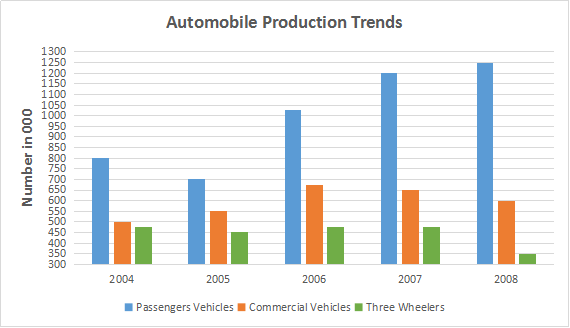
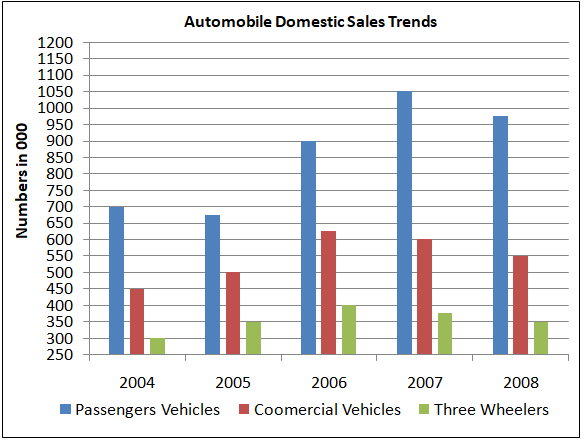
Which of the following year exhibited highest percentage decrease over the preceding year in the automobile production?
Total automobile production in the year 2004 = 800+500+475 = 1775
Total automobile production in the year 2005 = 700+550+450 = 1700
Total automobile production in the year 2006 = 1025+675+475 = 2175
Total automobile production in the year 2007 = 1200+650+475 = 2325
Total automobile production in the year 2008 = 1250+600+350 = 2200
We can see that production decreased only twice during the given period in the year 2005 and 2008.
Hence, the percentage decrease in the year 2005 over the year 2004 = $$\dfrac{1775-1700}{1775}\times 100$$ = 4.225 percent.
Similarly, the percentage decrease in the year 2008 over the year 2007 = $$\dfrac{2325-2200}{2325}\times 100$$ = 5.376 percent.
Therefore, we can say that option D is the correct answer.
Assume whatever that is not sold domestically was exported, then which year has registered highest growth in exports of automobiles?
Total automobile production exported in the year 2004 = (800+500+475)-(700+450+300) = 325
Total automobile production exported in the year 2005 = (700+550+450)-(675+500+350) = 175
Total automobile production exported in the year 2006 = (1025+675+475)-(900+625+400) = 250
Total automobile production exported in the year 2007 = (1200+650+475)-(1050+600+375) = 300
Total automobile production exported in the year 2008 = (1250+600+350)-(975+550+350) = 325
From the data itself we can see that highest growth occurred in the year 2006.
Therefore, we can say that option B is the correct answer.
If the ratio of the domestic sale price of a commercial vehicle, a passenger vehicle, and a three wheeler is 5 : 3 : 2 then what percent of earnings (approximately) is contributed by commercial vehicle segment to the overall earnings from domestic sales during the period 2004-2008?
Total commercial vehicles sold from the year 2004 to 2008 = 450+500+625+600+550 = 2725
Total passenger vehicles sold from the year 2004 to 2008 = 700+675+900+1050+975 = 4300
Total three wheelers sold from the year 2004 to 2008 = 300+350+400+375+350 = 1775
Hence, the percent of earnings is contributed by commercial vehicle segment alone = $$\dfrac{5*2725}{5*2725+3*4300+2*1775}\times 100$$ = 45.30 % $$\approx$$ 45%.
Hence, option A is the correct answer.
For which year were the domestic sales of automobiles closest to the average (2004-2008) domestic sales of automobiles?
Total domestic sales of automobiles in the year 2004 = (700+450+300) = 1450
Total domestic sales of automobiles in the year 2005 = (675+500+350) = 1525
Total domestic sales of automobiles in the year 2006 = (900+625+400) = 1925
Total domestic sales of automobiles in the year 2007 = (1050+600+375) = 2025
Total domestic sales of automobiles in the year 2008 = (975+550+350) = 1875
Average domestic sales of automobiles for the given period = $$\dfrac{1450+1525+1925+2025+1875}{5}$$ = 1760.
Hence, we can say that the domestic sales in the year 2008 is the closest to the average domestic sales. Hence, option D is the correct answer.
Which of the following years exhibited highest percentage increase over the preceding year in the automobile sales?
Total domestic sales of automobiles in the year 2004 = (700+450+300) = 1450
Total domestic sales of automobiles in the year 2005 = (675+500+350) = 1525
Total domestic sales of automobiles in the year 2006 = (900+625+400) = 1925
Total domestic sales of automobiles in the year 2007 = (1050+600+375) = 2025
Total domestic sales of automobiles in the year 2008 = (975+550+350) = 1875
We can see that the automobiles sales rose by the highest amount in the year 2006 as compared to other years. Also, the base is relatively smaller for remaining year except 2004. But the absolute growth is much higher in the year 2006 as compared to the year 2005. Hence, option B is the correct answer.
The ratio between absolute increase in domestic sales over preceding year and absolute increase in production over the preceding year is highest during which year?
Total automobile production in the year 2004 = 800+500+475 = 1775
Total automobile production in the year 2005 = 700+550+450 = 1700
Total automobile production in the year 2006 = 1025+675+475 = 2175
Total automobile production in the year 2007 = 1200+650+475 = 2325
Total automobile production in the year 2008 = 1250+600+350 = 2200
Total domestic sales of automobiles in the year 2004 = (700+450+300) = 1450
Total domestic sales of automobiles in the year 2005 = (675+500+350) = 1525
Total domestic sales of automobiles in the year 2006 = (900+625+400) = 1925
Total domestic sales of automobiles in the year 2007 = (1050+600+375) = 2025
Total domestic sales of automobiles in the year 2008 = (975+550+350) = 1875
In the year 2005 and 2008 the production and sales respectively are not increasing absolutely. Hence, we will check only for the year 2006 and 2007.
The ratio between absolute increase in domestic sales in the year 2006 over the year 2005 and absolute increase in production in the year 2006 over the year 2005 = $$\dfrac{1925-1525}{2175-1700}$$ = 0.84
Similarly, the required ratio for year 2007 = $$\dfrac{2025-1925}{2325-2175}$$ = 0.66
Hence, we can say that the ratio is the highest for the year 2006. Therefore, option B is the correct answer.
Answer the questions based on the following information.
The table below gives the details of money allocation by three Mutual funds namely, Alpha, Beta, and Gama. The return for each fund depends on the money they allocate to different sectors and the returns generated by the sectors. The last column of the table gives return for each of the sectors for a one year period.
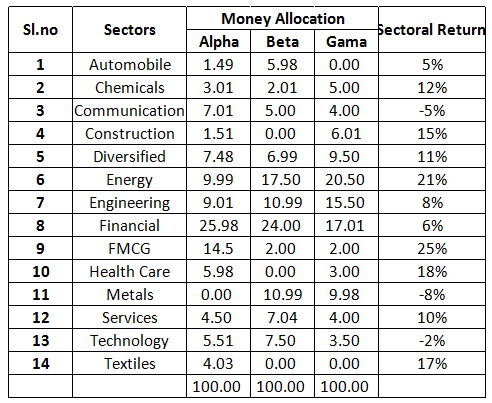
Which fund has received more return per rupee of investment for one year period?
As the numbers are far apart we can approximate the money allocation data to the nearest multiple of 0.5. The money allocation data can be approximated as below.
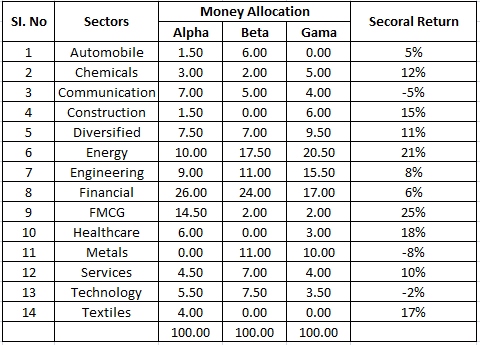
Let us assume that Rs. 100 is invested in each fund.
Total return on investing Rs. 100 in fund Alpha =
1.5*1.05+3*1.12+7*.95+1.5*1.15+7.5*1.11+10*1.21
+9*1.08+26*1.06+14.5*1.25+6*1.18+4.5*1.10+5.5*.98+4*1.17 = Rs. 111.24.
Hence, net return per rupee in fund Alpha = $$\dfrac{111.24}{100}$$ = Rs. 1.1124.
Similarly, we can calculate total return on investing Rs. 100 in fund Beta and Gama.
Net return per rupee in fund Beta = $$\dfrac{107.225}{100}$$ = Rs. 1.07225.
Net return per rupee in fund Gama = $$\dfrac{109.48}{100}$$ = Rs. 1.0948.
We can see that return per rupee is the highest for Alpha fund. Hence, option A is the correct answer.
If the allocation of money by the fund managers to different sectors is based on the internal ranking (i.e. Sector with 1st rank gets highest allocation). Sectors with 0 allocation of money should be considered as 14th rank irrespective of the number of sectors in that category. In the light of these examine the following
statements:
I. Automobile is ranked by both Alpha and Beta as same
II. Financial is most favoured by all three Mutual Funds
III. Services is ranked by all three Mutual Funds within top 9 ranks
Select the best option:
Let us tabulate the ranks of various sectors according to fund allocation.
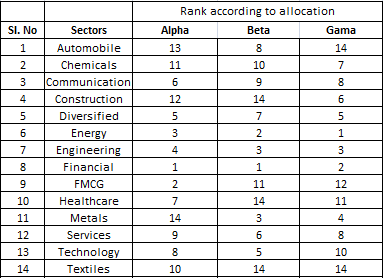
Statement I : Automobile is ranked by both Alpha and Beta as same. This statement is incorrect.
Statement II : Financial is most favoured by all three Mutual Funds. This statement is incorrect as Energy sector is most favored by fund Gama.
Statement III : Services is ranked by all three Mutual Funds within top 9 ranks. We can see that this statement is correct. Hence, option D is the correct answer.
Ms. Hema invested Rs. 10.00 lakhs in fund Gama in the beginning of the period. What will be the value of the investment at the end of 1 year period?
As the numbers are far apart we can approximate the money allocation data to the nearest multiple of 0.5. The money allocation data can be approximated as below.
Total return on investing Rs. 100 in fund Gama =
5*1.12+4*.95+6*1.15+9.5*1.11+20.5*1.21+15.5*1.08
+17*1.06+2*1.25+3*1.18+10*.92+4*1.1+3.5*.98 = Rs. 109.48.
Hence, total return of an investment of 10 lakhs in fund Gama after a year = $$\dfrac{109.48}{100}*10$$ = 10.948 lakhs $$\approx$$ 10.95 lakhs.
Hence, option B is the correct answer.
Answer the questions based on the following Table
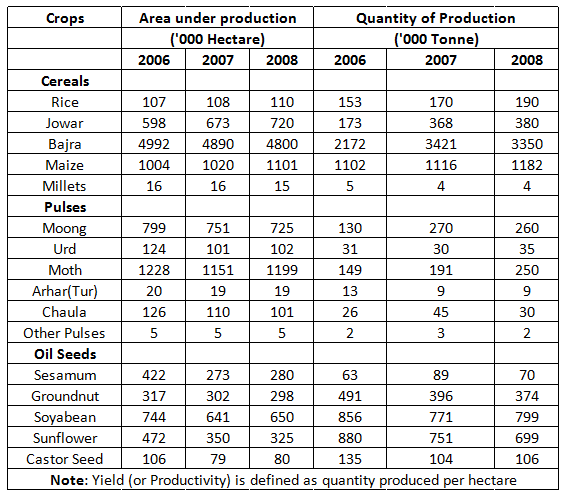
What is the ratio between Jowar yield (2007) and Soyabean yield (2008)?
Jowar's yield in the year 2007 = $$\dfrac{368}{673}$$ $$\approx$$ 0.55
Soyabean's yield in the year 2008 = $$\dfrac{799}{650}$$ $$\approx$$ 1.23
Hence, the required ratio = 0.55 : 1.23 = 0.445 : 1 or 0.89: 2.00
Therefore, option C is the correct answer.
Top 3 crops by yield in the year 2006 are:
Caster Seed's yield in the year 2006 = $$\dfrac{135}{106}$$ = 1.273
Groundnut's yield in the year 2006 = $$\dfrac{491}{317}$$ = 1.55
Maize's yield in the year 2006 = $$\dfrac{1102}{1004}$$ = 1.097
Sunflower's yield in the year 2006 = $$\dfrac{880}{472}$$ = 1.864
Rice's yield in the year 2006 = $$\dfrac{153}{107}$$ = 1.429
Bazra's yield in the year 2006 = $$\dfrac{2172}{4992}$$ =0.435
Top 3 yields in 2006: Sunflower,Groundnut,Rice
Bottom 3 crops by yield in the year 2008 are:
Moth's yield in the year 2008 = $$\dfrac{250}{1199}$$ = 0.2083
Sesamum's yield in the year 2008 = $$\dfrac{70}{280}$$ = 0.25
Millets's yield in the year 2008 = $$\dfrac{4}{15}$$ = 0.266
Moong's yield in the year 2008 = $$\dfrac{260}{725}$$ = 0.358
Arhar's yield in the year 2008 = $$\dfrac{9}{19}$$ = 0.474
Urd's yield in the year 2008 = $$\dfrac{35}{102}$$ = 0.343
Chaula's yield in the year 2008 = $$\dfrac{30}{101}$$ = 0.297
Bottom 3 yields in 2008: Moth, Sesamum, Millets
Examine the following statements:
I. Total productivity of pulses has gone down over the years
II. Maize is the most stable cereal in terms of productivity over the years
III. Percentage growth in area and quantity of production is highest in the case of Jowar during the entrie period.
Select the best option:
Productivity is defined as total production per hectare.
Total productivity of pulses in the year 2006 = $$\frac{130+31+149+13+26+2}{799+124+1228+20+126+5}$$ = $$0.1524$$
Total productivity of pulses in the year 2007 = $$\frac{270+30+191+9+45+3}{751+101+1151+19+110+5}$$ = $$0.2564$$
Total productivity of pulses in the year 2008 = $$\frac{260+35+250+9+30+2}{725+102+1199+19+101+5}$$ = $$0.2724$$
We can see that clearly, Total productivity of pulses in the year 2008 > Total productivity of pulses in the year 2007 >Total productivity of pulses in the year 2006. Hence, statement I is incorrect. Hence, we can reject option A and B.
Productivity of Maize in the year 2006 = $$\dfrac{1102}{1004}$$ = 1.097
Productivity of Maize in the year 2007 = $$\dfrac{1116}{1020}$$ = 1.094
Productivity of Maize in the year 2008 = $$\dfrac{1182}{1101}$$ = 1.073
We can see that productivity is approximately same during the given period for Maize. Hence, statement II is correct. Therefore, we can reject option D.
Thus, we can say that option C is the correct answer.
Examine the following statements:
I. Over the period total cereal productivity has gone up
II. Area, Production and yield of the total oil seeds is on decline
III. Though there is a decline in the area under Urd production but the quantity of production and yield has gone up over the years.
Select the best option:
Productivity is defined as total production per hectare.
Total productivity of cereals in the year 2006 = $$\frac{153+173+2172+1102+5}{107+598+4992+1004+16}$$ = $$0.5366$$
Total productivity of cereals in the year 2008 = $$\frac{190+380+3350+1182+4}{110+720+4800+1101+15}$$ = $$0.756$$
We can see that clearly, Total productivity of cereals in the year 2008 > Total productivity of cereals in the year 2006. Hence, statement I is correct.
Now let us check statement II.
Total yield of oil seeds in the year 2006 = $$\frac{63+491+856+880+135}{422+317+744+472+106}$$ = $$1.1766$$
Total yield of oil seeds in the year 2008 = $$\frac{70+374+799+699+106}{280+298+650+325+80}$$ = $$1.254$$
We can see that yield of Oil seeds is not on decline. Hence, statement II is incorrect.
Now let us check statement III.
Area under Urd production in the year 2006 = 124
Area under Urd production in the year 2008 = 102
Total Urd production in the year 2006 = 31
Total Urd production in the year 2008 = 35
Urd's yield in the year 2006 = $$\frac{31}{124}$$ = 0.25
Urd's yield in the year 2008 = $$\frac{35}{102}$$ = 0.34
Hence, we can say that statement III is correct. Therefore, option A is the correct answer.
Study the following carefully and answer the questions.
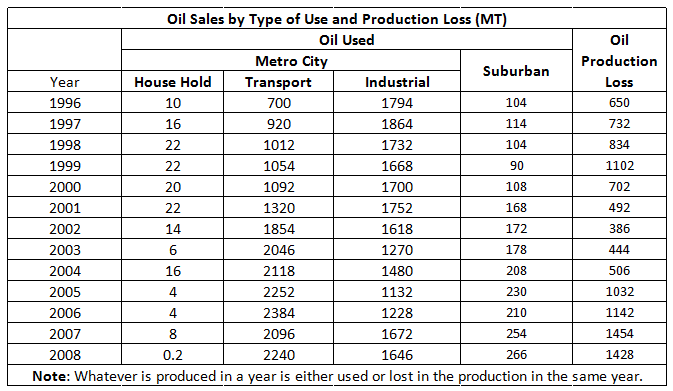
During which year the Oil used for House Hold as a percentage of Total Oil Used is highest?
Total Oil used in the year 1998 = 22+1012+1732+104 = 2870.
Therefore, the percentage of total used that is used for House Hold = $$\frac{22}{2870}\times 100$$ = 0.766.
Similarly we can calculate for remaining year.
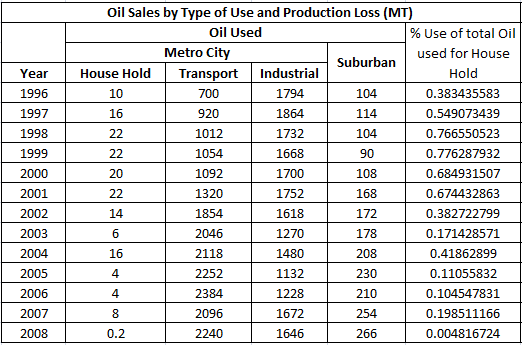
From the table we can see that, in the year 1999 the Oil used for House Hold as a percentage of total Oil Used is highest. Hence, option B is the correct answer.
During which year the ‘Oil Production Loss’ as a proportion of ‘Total Oil Produced’ is the lowest?
Total oil produced in the year 1996 = 10+700+1794+104+650 = 3258.
Therefore, oil production loss as a percentage of total oil produced in the year = $$\dfrac{650}{3258}\times 100$$ = 19.95%.
Similarly, we can calculate for the remaining year. Tabulating the same data,
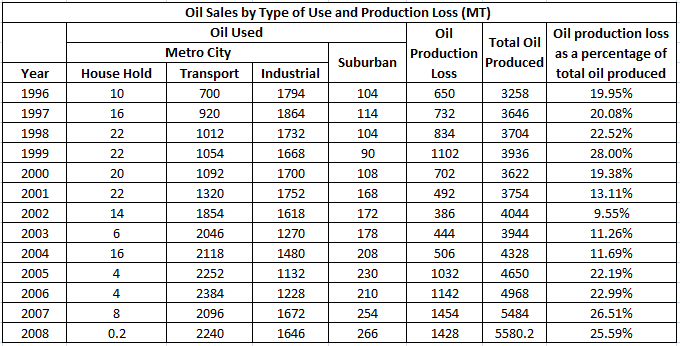
From the table, we can see that the oil production loss as a percentage of total oil produced is the lowest for the year 2002. Hence, option A is the correct answer.
During which year use of oil by ‘Suburban’ as a proportion of ‘Total Oil Used’ was the highest?
Total oil used in the year 1996 = 10+700+1794+104 = 2608.
Therefore, Oil used by Suburban as a proportion of Total Oil Used = $$\dfrac{104}{2608}\times 100$$ = 3.99 percent.
Similarly, we can calculate for the remaining years.
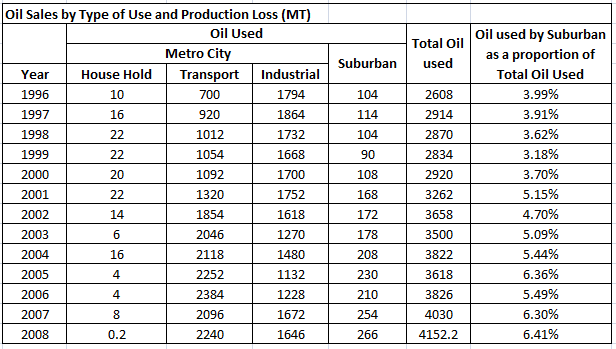
From the table, we can see that oil used by suburban as a proportion of total oil used is the highest for the year 2008. Hence, option D is the correct answer.
For how many number of years the growth rate in ‘Production of Oil’ is more than the growth rate in ‘Total Oil Used’?
Total oil used in the year 1996 = 10+700+1794+104 = 2608.
Total oil produced in the year 1996 = 10+700+1794+104+650 = 3258.
Similarly, we can calculate for the remaining quantities for both the years. Tabulating the same data,
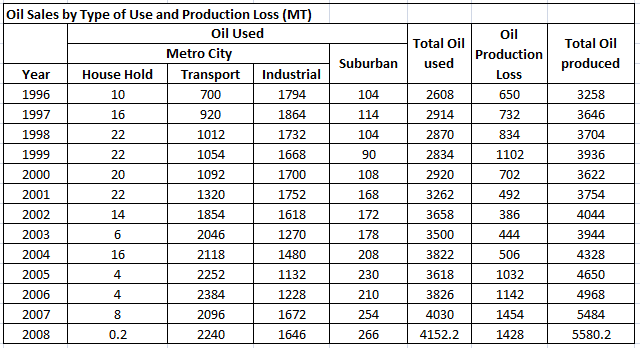
Therefore, growth rate of total oil used in the year 1997 as compared to 1996 = $$\dfrac{2914-2608}{2608}\times 100$$ = 11.73%
Therefore, growth rate of total oil produced in the year 1997 as compared to 1996 = $$\dfrac{3646-3258}{3258}\times 100$$ = 11.91%
Similarly, we can calculate for the remaining year. Tabulating the same data,
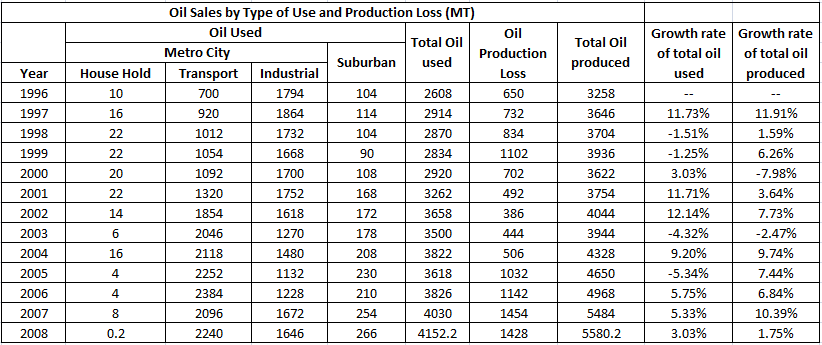
From the table we can see that, the growth rate in ‘Production of Oil’ is more than the growth rate in ‘Total Oil Used’ in eight years.
{Year 1996, 1997, 1998, 2003, 2004, 2005, 2006, 2007}. Hence, option D is the correct answer.
Which of the below statements are true, based on the data in the above table?
Total oil used in the year 1996 = 10+700+1794+104 = 2608.
Total oil produced in the year 1996 = 10+700+1794+104+650 = 3258.
Similarly, we can calculate for the remaining quantities for both the years. Tabulating the same data,
From the table, we can see that quantity of 'total oil Produced’ is increasing every year since 2003. Hence, option D is the correct answer.
Study the following information carefully and answer the questions.
Four houses Blue, Green, Red and Yellow are located in a row in the given order. Each of the houses is occupied by a person earning a fixed amount of salary. The four persons are Paul, Krishna, Laxman, and Som.
Read the following instruction carefully:
I. Paul lives between Som and Krishna
II. Laxman does not stay in Blue house
III. The person living in Red house earns more than that of person living in Blue
IV. Salary of Som is more than that of Paul but lesser than that of Krishna
V. One of the person earns Rs. 80, 000
VI. The person earning Rs. 110,000 is not Laxman
VII. The salary difference between Laxman and Som is Rs. 30,000
VIII. The House in which Krishna lives is located between houses with persons earning salaries of Rs. 30,000 and Rs. 50,000
IX. Krishna does not live in the Yellow House, and the person living in the Yellow House is not earning the lowest salary among the four persons.
Who lives in Red house?
The first point tells us that "Paul lives between Som and Krishna".
This gives us an initial thought that these three can occupy the houses 1, 2, 3 in the row with Paul occupying the 2nd house and Som and Krishna sharing houses 1 and 3 in no particular order. In this case Laxman has to occupy the 4th house, i.e. the Yellow house. OR they can occupy the houses 2,3,4 with Paul occupying the 3rd house and Som and Krishna sharing houses 2 and 4 in no particular order. In this case Laxman has to occupy the 1st house, i.e. the Blue house.
However, since we know from point (II) that Laxman does not stay in the Blue house we reject this possibility.
Consequently, we can fix the position of Paul and Laxman in the Green and Yellow houses respectively.

At this point if we use point (VIII), we see that since ԋrishna lives in between two houses he cannot be in the first house. Hence, Krishna takes the third house and Som takes the 1st one.
Thus, the grid converts to:

From this point we need to focus on fixing the values of the salaries of the 4 individuals.
The values of the four salaries can first be identified as 30000, 50000 (from point VIII), 80000 ( point ) and 110000 (point VI). We also know from Point VIII that Krishna lives between the people
earning 30000 and 50000 which means that 30000 and 50000 could be Laxman and Paul's salary.
Further, the salary difference between Laxman and Som being 30000, their salaries would have to be 50000 and 80000, with Laxman getting 50000 and Som getting 80000. Consequently Paul gets 30000 and Krishna would earn 110000. The solution grid would then look like below:

So Krishna lives in Red house
Which house is occupied by person earning highest salary?
The first point tells us that "Paul lives between Som and Krishna".
This
gives us an initial thought that these three can occupy the houses 1,
2, 3 in the row with Paul occupying the 2nd house and Som and Krishna
sharing houses 1 and 3 in no particular order. In this case Laxman has
to occupy the 4th house, i.e. the Yellow house. OR they can occupy the
houses 2,3,4 with Paul occupying the 3rd house and Som and Krishna
sharing houses 2 and 4 in no particular order. In this case Laxman has
to occupy the 1st house, i.e. the Blue house.
However, since we know from point (II) that Laxman does not stay in the Blue house we reject this possibility.
Consequently, we can fix the position of Paul and Laxman in the Green and Yellow houses respectively.
At this point if we use point (VIII), we see that since ԋrishna lives in between two houses he cannot be in the first house. Hence, Krishna takes the third house and Som takes the 1st one.
Thus, the grid converts to:
From this point we need to focus on fixing the values of the salaries of the 4 individuals.
The
values of the four salaries can first be identified as 30000, 50000
(from point VIII), 80000 ( point ) and 110000 (point VI). We also know
from Point VIII that Krishna lives between the people
earning 30000 and 50000 which means that 30000 and 50000 could be Laxman and Paul's salary.
Further,
the salary difference between Laxman and Som being 30000, their
salaries would have to be 50000 and 80000, with Laxman getting 50000 and
Som getting 80000. Consequently Paul gets 30000 and Krishna would earn
110000. The solution grid would then look like below:
Red house is occupied by person earning highest salary
What is the salary earned by person living in Green house?
The first point tells us that "Paul lives between Som and Krishna".
This
gives us an initial thought that these three can occupy the houses 1,
2, 3 in the row with Paul occupying the 2nd house and Som and Krishna
sharing houses 1 and 3 in no particular order. In this case Laxman has
to occupy the 4th house, i.e. the Yellow house. OR they can occupy the
houses 2,3,4 with Paul occupying the 3rd house and Som and Krishna
sharing houses 2 and 4 in no particular order. In this case Laxman has
to occupy the 1st house, i.e. the Blue house.
However, since we know from point (II) that Laxman does not stay in the Blue house we reject this possibility.
Consequently, we can fix the position of Paul and Laxman in the Green and Yellow houses respectively.
At this point if we use point (VIII), we see that since ԋrishna lives in between two houses he cannot be in the first house. Hence, Krishna takes the third house and Som takes the 1st one.
Thus, the grid converts to:
From this point we need to focus on fixing the values of the salaries of the 4 individuals.
The
values of the four salaries can first be identified as 30000, 50000
(from point VIII), 80000 ( point ) and 110000 (point VI). We also know
from Point VIII that Krishna lives between the people
earning 30000 and 50000 which means that 30000 and 50000 could be Laxman and Paul's salary.
Further,
the salary difference between Laxman and Som being 30000, their
salaries would have to be 50000 and 80000, with Laxman getting 50000 and
Som getting 80000. Consequently Paul gets 30000 and Krishna would earn
110000. The solution grid would then look like below:
Rs. 30,000 is earned by person living in green house .
Mr Raghav went in his car to meet his friends John. He Drove 30 kms towards north and then 40 kms towards west. He then turned to south and covered 8 kms. Further he turned to east and moved 26 kms. Finally he turned right and drove 10 kms and then turned left to travel 19 kms. How far and in which direction is he from the starting point?
We can draw a direction diagram according to the problem statement.
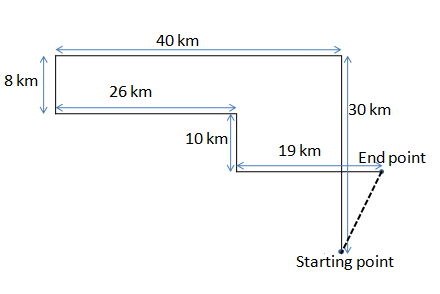
Net displacement in the east direction = 26 + 19 - 40 = 5 km.
Net displacement in the north direction = 30 - 8 - 10 = 12 km.
Hence, net distance from the starting point = $$\sqrt{12^2+5^2}$$ = 13 km.
Therefore, option C is the correct answer.
Mr. Raju took the members of his family for a picnic. His father’s mother and mother’s father including each of their child were in one car. His father’s son and sister’s husband, brother’s wife were in second car. He along with his wife, wife’s sister, wife’s brother and son’s wife with a kid was in the third car. How many members of Mr. Raju’s family were there in the picnic and how many were left behind (assuming all members of the third generation are married and Raju had 2 grandparents in the family)?
In the first car - Raju's father, grandmother, mother and maternal grandfather - 4 members
In the second car - Raju's brother, sister-in-law, and brother-in-law - 3 members
In the third car - Raju, Raju's wife, sister-in-law, brother-in-law, daughter-in-law, grandson - 6 members
Total = (4 + 3 + 6) = 13
Members not present - Raju's sister, sister-in-law's husband, brother-in-law's wife, son - 4 members.
Hence, option A is the correct answer.

ABCDE play a game of cards. ‘A’ tells ‘B’ that if ‘B’ gives him five cards ‘A’ will have as many cards as ‘E’ has. However if A gives five cards to ‘B’ then ‘B’ will have as many cards as ‘D’. A and B together has 20 cards more than what D and E have together. B has four cards more than what C has and total number of cards are 201. How many cards B have?
Let 'a' be the number of cards with B. If A gives five cards to ‘B’ then ‘B’ will have as many cards as ‘D’.
Hence, the number of cards with D = 'a+5'.
B has four cards more than what C has. Hence, the number of cards with c = 'a-4'.
Let us assume that number of cards with A = 'x'. It is given that if ‘B’ gives 'A' five cards the A will have as many cards as ‘E’ has.
Hence, the number of cards with 'E' = x+5.
It is also given that A and B together has 20 cards more than what D and E have together.
Hence, (a+x) - (a+5+x+5) = 20.
Data given in the question contradicts with th information. Hence, this question can't be answer. Therefore, option D is the correct answer.
Ganesh Cultural Centre for promoting arts has appointed 3 instructors for music, dance, and painting. Music instructor takes session from 12 noon to 4:00 pm on Monday, Thursday and Sunday. The sessions of dance instructor are scheduled on Tuesday, Thursday, Wednesday and Sunday between 10:00 a to 2:00 pm. The 9:00 am to 12:00 noon slot on Tuesday, Friday and Thursday and also 2:00 pm to 4:00 pm slot on Wednesday, Saturday and Sunday is filled up by Painting Instructor. On which day(s) of a week the dance and painting sessions are simultaneously held?
According to the given information we can classify the working of instructors as :-
Music Instructor works from 12-4 pm on - Monday, Thursday and Sunday.
Dance Instructor works from 10 am-2 pm on - Tuesday, Wednesday, Thursday and Sunday
Painting Instructor works from -9 am - 12 noon on - Tuesday, Thursday and Friday
2 - 4 pm on - Wednesday, Saturday and Sunday
After this classification it is clear that Tuesday and Thursday are the days of the week the dance and painting sessions are simultaneously held.
Study the information given below and answer the questions.
The following table contains the pre and post revision pay structure of a Government department

The revision has been done based on the following terms:
-In pre-revised pay scale, the basic pay is the sum of the minimum pay in the appropriate pay scale and the admissible increment. After revision, the basic pay is the sum of minimum pay in the appropriate pay scale and the respective grade pay and the admissible increments.
-Annual increment of 3% of the basic pay (on a compounded basic) is paid under the revised pay rules.
-Monthly Dearness Allowance (DA) is calculated as percentage of basic pay.
-In pre-revised pay scales, the increment was given after the completion of each year of service, but, after revision annual increments are given only in the month of July every year and there should be a gap of six months between the increments.
The employees who had joined the department in the month of September, October, November and December are given an increment at the time of revised pay fixation in September, 2008.
The revised pay is applicable from 1st September, 2008.
Abhijit joins the department on November 10, 2006 in the pay scale of Rs. 18,400-500-22,400 with the pay of Rs. 18,400 plus 2 increments. What is his basic salary, after revision, on August 1, 2009?
Abhijit's revised minimum pay will be Rs. $$37400$$ and his grade pay will be Rs. $$10000$$.
Abhijit already had 2 increments and by 2009 will have 3 more. Thus, a total of 5 increments.
Thus his salary in 2009 = $$(37400+10000)\times (1.03)^5=54949.6\approx 54950$$
Hence, the answer is option C.
Nitin joined the department on November 24, 2004 in the pay scale of Rs. 8,000-275-13,500, at the minimum pay. At the time of pay revision, due to some error, his pay was fixed at the base (minimum) of the corresponding revised pay scale. The loss in his total emoluments for September 2008, due to this error, will be:
The new basic pay would have been = $$(15600+5400)(1.03)^4=23636$$
Due to the error, the pay is = $$15600+5400=21000$$
DA + HRA = $$28\% + 30\% = 58\%$$ of the basic pay
Thus, total loss in pay = $$1.58\times (23636-21000)=4164$$
Hence, the answer is option C.
Sunitha joined the department at the basic pay of Rs. 13,500 in the pay scale of Rs. 12,000-16,500. On completion of her four years of service in December, 2008, she was promoted to the next higher pay scale, the percentage increase in her gross salary is:
Dinesh joined on July 1, 2008 in the pay scale of Rs. 16,400-20,000 at the basic pay of Rs. 16,850. On August 10, 2009, the department revised the rates of DA to 31% with effect from January, 2009 and further to 36% effective from July 2009. How much arrear will Dinesh get in August, 2009 because of these revisions?

Study the information given below and answer the questions.
A word arrangement machine, when given a particular input, rearranges it using a particular rule. The following is the illustration and the steps of the arrangement
INPUT: Smile Nile Style Mile Shine Wine Mine Swine Bovine Feline
STEP 1: Smile Nile Style Mile Shine Wine Bovine Feline Mine Swine
STEP 2: Style Mile Smile Nile Shine Wine Bovine Feline Mine Swine
STEP 3: Style Mile Smile Nile Wine Shine Bovine Feline Mine Swine
STEP 4: Mile Style Nile Smile Wine Shine Feline Bovine Swine Mine
STEP 5: Nile Smile Mile Style Wine Shine Swine Mine Feline Bovine
STEP 6: Nile Smile Mile Style Wine Shine Feline Bovine Swine Mine
STEP 7: Mile Style Nile Smile Wine Shine Feline Bovine Swine Mine
Which of the following will be step 14 for the given input:
Divide the whole sequence into group of words of 4, 2 and 4 so in the input the-
First group will be- Smile Nile Style Mile
Second group will be - Shine Wine
Third group will be - Mine Swine Bovine Feline
In step 1 the 1 and 2 of Third group are exchanging their position with the 3 and 4 respectively i.e. Mine Swine are exchanging their position with Bovine Feline respectively with everything else constant
therefore step 1 is- Smile Nile Style Mile Shine Wine Bovine Feline Mine Swine
In step 2 the 1 and 2 of First group are exchanging their position with the 3 and 4 respectively i.e. Smile Nile are exchanging their position with Style Mile respectively with everything else constant
therefore step 2 is- Style Mile Smile Nile Shine Wine Bovine Feline Mine Swine
In step 3 the 1 and 2 of Second group are exchanging their position i.e. Shine is exchanging it's position with Wine with everything else constant
therefore step 3 is- Style Mile Smile Nile Wine Shine Bovine Feline Mine Swine
In step 4 the 1 and 2 of First group are exchanging their position i.e. Style is exchanging it's position with Mile , 3 and 4 of First group are exchanging their position i.e. Smile is exchanging it's position with Nile and Similarly the 1 and 2 of Third group are exchanging their position i.e. Bovine is exchanging it's position with Feline , 3 and 4 of Third group are exchanging their position i.e. Mine is exchanging it's position with Swine with the positions of Shine and Wine remaining same
therefor step 4 is- Mile Style Nile Smile Wine Shine Feline Bovine Swine Mine
In step 5 the 1 and 2 of First group are exchanging their position with the 3 and 4 respectively i.e. Mile Style are exchanging their position with Nile Smile respectively and the 1 and 2 of Third group are exchanging their position with the 3 and 4 respectively i.e. Feline Bovine are exchanging their position with Swine Mine respectively with everything else constant
therefor step 5 is- Nile Smile Mile Style Wine Shine Swine Mine Feline Bovine
In step 6 the 1 and 2 of Third group are exchanging their position with the 3 and 4 respectively i.e. Swine Mine are exchanging their position with Feline Bovine respectively with everything else constant
therefor step 6 is- Nile Smile Mile Style Wine Shine Feline Bovine Swine Mine
In step 7 the 1 and 2 of First group are exchanging their position with the 3 and 4 respectively i.e. Nile Smile are exchanging their position with Mile Style respectively with everything else constant
therefor step 7 is- Mile Style Nile Smile Wine Shine Feline Bovine Swine Mine
As can be observed the pattern is repeating
therefore step 8 will be Mile Style Nile Smile Shine Wine Feline Bovine Swine Mine
step 9- Style Mile Smile Nile Shine Wine Bovine Feline Mine Swine
step 10- Smile Nile Style Mile Shine Wine Mine Swine Bovine Feline
step 11- Smile Nile Style Mile Shine Wine Bovine Feline Mine Swine
step 12- Style Mile Smile Nile Shine Wine Bovine Feline Mine Swine
step 13- Style Mile Smile Nile Wine Shine Bovine Feline Mine Swine
step 14- Mile Style Nile Smile Wine Shine Feline Bovine Swine Mine
Therefore the answer is option 'C'
Mark the arrangement that does not fall between step numbers 12 and 14.
Divide the whole sequence into group of words of 4, 2 and 4 so in the input the-
First group will be- Smile Nile Style Mile
Second group will be - Shine Wine
Third group will be - Mine Swine Bovine Feline
In step 1 the 1 and 2 of Third group are exchanging their position with the 3 and 4 respectively i.e. Mine Swine are exchanging their position with Bovine Feline respectively with everything else constant
therefore step 1 is- Smile Nile Style Mile Shine Wine Bovine Feline Mine Swine
In step 2 the 1 and 2 of First group are exchanging their position with the 3 and 4 respectively i.e. Smile Nile are exchanging their position with Style Mile respectively with everything else constant
therefore step 2 is- Style Mile Smile Nile Shine Wine Bovine Feline Mine Swine
In step 3 the 1 and 2 of Second group are exchanging their position i.e. Shine is exchanging it's position with Wine with everything else constant
therefore step 3 is- Style Mile Smile Nile Wine Shine Bovine Feline Mine Swine
In step 4 the 1 and 2 of First group are exchanging their position i.e. Style is exchanging it's position with Mile , 3 and 4 of First group are exchanging their position i.e. Smile is exchanging it's position with Nile and Similarly the 1 and 2 of Third group are exchanging their position i.e. Bovine is exchanging it's position with Feline , 3 and 4 of Third group are exchanging their position i.e. Mine is exchanging it's position with Swine with the positions of Shine and Wine remaining same
therefor step 4 is- Mile Style Nile Smile Wine Shine Feline Bovine Swine Mine
In step 5 the 1 and 2 of First group are exchanging their position with the 3 and 4 respectively i.e. Mile Style are exchanging their position with Nile Smile respectively and the 1 and 2 of Third group are exchanging their position with the 3 and 4 respectively i.e. Feline Bovine are exchanging their position with Swine Mine respectively with everything else constant
therefor step 5 is- Nile Smile Mile Style Wine Shine Swine Mine Feline Bovine
In step 6 the 1 and 2 of Third group are exchanging their position with the 3 and 4 respectively i.e. Swine Mine are exchanging their position with Feline Bovine respectively with everything else constant
therefor step 6 is- Nile Smile Mile Style Wine Shine Feline Bovine Swine Mine
In step 7 the 1 and 2 of First group are exchanging their position with the 3 and 4 respectively i.e. Nile Smile are exchanging their position with Mile Style respectively with everything else constant
therefor step 7 is- Mile Style Nile Smile Wine Shine Feline Bovine Swine Mine
As can be observed the pattern is repeating
therefore step 8 will be Mile Style Nile Smile Shine Wine Feline Bovine Swine Mine
step 9- Style Mile Smile Nile Shine Wine Bovine Feline Mine Swine
step 10- Smile Nile Style Mile Shine Wine Mine Swine Bovine Feline
step 11- Smile Nile Style Mile Shine Wine Bovine Feline Mine Swine
step 12- Style Mile Smile Nile Shine Wine Bovine Feline Mine Swine
step 13- Style Mile Smile Nile Wine Shine Bovine Feline Mine Swine
step 14- Mile Style Nile Smile Wine Shine Feline Bovine Swine Mine
As can be observed from steps 12-14 option D is not present
Therefore the answer is option 'D'
If the arrangement is repeated which of the steps given below is same as the INPUT row?
Divide the whole sequence into group of words of 4, 2 and 4 so in the input the-
First group will be- Smile Nile Style Mile
Second group will be - Shine Wine
Third group will be - Mine Swine Bovine Feline
In step 1 the 1 and 2 of Third group are exchanging their position with the 3 and 4 respectively i.e. Mine Swine are exchanging their position with Bovine Feline respectively with everything else constant
therefore step 1 is- Smile Nile Style Mile Shine Wine Bovine Feline Mine Swine
In step 2 the 1 and 2 of First group are exchanging their position with the 3 and 4 respectively i.e. Smile Nile are exchanging their position with Style Mile respectively with everything else constant
therefore step 2 is- Style Mile Smile Nile Shine Wine Bovine Feline Mine Swine
In step 3 the 1 and 2 of Second group are exchanging their position i.e. Shine is exchanging it's position with Wine with everything else constant
therefore step 3 is- Style Mile Smile Nile Wine Shine Bovine Feline Mine Swine
In step 4 the 1 and 2 of First group are exchanging their position i.e. Style is exchanging it's position with Mile , 3 and 4 of First group are exchanging their position i.e. Smile is exchanging it's position with Nile and Similarly the 1 and 2 of Third group are exchanging their position i.e. Bovine is exchanging it's position with Feline , 3 and 4 of Third group are exchanging their position i.e. Mine is exchanging it's position with Swine with the positions of Shine and Wine remaining same
therefor step 4 is- Mile Style Nile Smile Wine Shine Feline Bovine Swine Mine
In step 5 the 1 and 2 of First group are exchanging their position with the 3 and 4 respectively i.e. Mile Style are exchanging their position with Nile Smile respectively and the 1 and 2 of Third group are exchanging their position with the 3 and 4 respectively i.e. Feline Bovine are exchanging their position with Swine Mine respectively with everything else constant
therefor step 5 is- Nile Smile Mile Style Wine Shine Swine Mine Feline Bovine
In step 6 the 1 and 2 of Third group are exchanging their position with the 3 and 4 respectively i.e. Swine Mine are exchanging their position with Feline Bovine respectively with everything else constant
therefor step 6 is- Nile Smile Mile Style Wine Shine Feline Bovine Swine Mine
In step 7 the 1 and 2 of First group are exchanging their position with the 3 and 4 respectively i.e. Nile Smile are exchanging their position with Mile Style respectively with everything else constant
therefor step 7 is- Mile Style Nile Smile Wine Shine Feline Bovine Swine Mine
As can be observed the pattern is repeating
therefore step 8 will be Mile Style Nile Smile Shine Wine Feline Bovine Swine Mine
step 9- Style Mile Smile Nile Shine Wine Bovine Feline Mine Swine
step 10- Smile Nile Style Mile Shine Wine Mine Swine Bovine Feline
step 11- Smile Nile Style Mile Shine Wine Bovine Feline Mine Swine
step 12- Style Mile Smile Nile Shine Wine Bovine Feline Mine Swine
step 13- Style Mile Smile Nile Wine Shine Bovine Feline Mine Swine
step 14- Mile Style Nile Smile Wine Shine Feline Bovine Swine Mine
As can be seen the answer cannot be step 9/11/14 therefore by eliminating the options we get the answer as step 20
Therefore the answer is option 'C'
Study the information given below and answer the questions.
A Prime Minister is contemplating the expansion of his cabinet. There are four ministerial berths and there are eight probable candidates (C1-C8) to choose from. The selection should be in a manner that each selected person shares a liking with at least one of the other three selected members. Also, the selected must also hate at least one of the likings of any of the other three persons selected.
I. C1 likes travelling and sightseeing, but hates river rafting.
II. C2 likes sightseeing and squash, but hates travelling.
III. C3 likes river rafting, but hates sightseeing.
IV. C4 likes trekking, but hates squash.
V. C5 likes squash, but hates sightseeing and trekking.
VI. C6 likes travelling, but hates sightseeing and trekking.
VII. C7 likes river rafting and trekking, but hates travelling.
VIII. C8 likes sightseeing and river rafting, but hates trekking.
Who are the four people selected by the Prime Minister?
Option A:- C1, C2, C5, C6
therefore according to the given conditions if C1 is selected and since he hates river rafting then at least one of the C2, C5, C6 must like river rafting but C2 likes sightseeing and squash, C5 likes squash and C6 likes travelling i.e. none of C2, C5, C6 likes river rafting, therefore conditions are not getting satisfied therefore option A cannot be the answer
Option B:-C3, C4, C5, C6
therefore according to the given conditions if C3 is selected and since he hates sightseeing then at least one of the C4, C5, C6 must like sightseeingbut C4 likes trekking, C5 likes squash and C6 likes travelling i.e. none of C4, C5, C6 likes sightseeing, therefore conditions are not getting satisfied therefore option B cannot be the answer
Option C:-C1, C2, C4, C7
Here C1 hates river rafting and C7 likes river rafting also C1 likes sightseeing and so does C2 therefore C1 can be on the team, C2 hates travelling and C1 likes travelling also C2 likes sightseeing and so does C1 therefore C2 can be on the team, C4 hates squash and C2 likes squash also C4 likes trekking and so does C7 therefore C4 can be on the team and finally C7 hates travelling and C1 likes travelling also C7 likes trekking and so does C4 therefore C7 can be on the team.
Since all the conditions are getting satisfied option 'C' is the answer.
Arcelor, acquired by Mittal steel, was formed by merger of which of the following three steel companies?
Arcelor was created in February 2002 through the merger of Arbed (Luxembourg) founded in 1911, Aceralia (Spain) and Usinor (France).
Hence, option C is the correct answer.
Select the correct author - book match.

Imagining India is written by Nandan Nilekani.
Remaking India is written by Arun Maira.
A Better India A Better World is written by Narayan Murthy.
A Vision for the New Millennium is written by A P J Abdul Kalam.
Hence, option A is the correct answer.
There is a mistake in the question. Arun Maira is replaced by Ratan Tata.
The company Fem Care Pharma Limited, the manufacturer of Fem Bleach, was acquired by?
The company Fem Care Pharma Limited, the manufacturer of Fem Bleach, was acquired by Dabur India Limited.
Hence, option D is the correct answer.
Which is the correct Stock Index - Country Match?

HANG SENG is the Stock Index of Hong Kong.
NASDAQ is the Stock index of USA.
FTSE is the Stock index of United Kingdom.
KOSPI is the Stock index of South Korea.
Hence, option B is the correct answer.
Which is the correct Legal Act and Jurisdiction Match?

Companies Act 1956 is related to the formation and regulation of companies.
Competition Act 2002 is related to prohibition of anti-competitive agreements.
SEBI Act 1992 was enacted to protect the interests of the investors.
FEMA Act 1999 was enacted to facilitate external trade and payments.
Therefore, option A is the right answer.
Match the President, Country and Currency.

Nicolas Sarkozy is from France.
Dmitry Medvedev is from Russia.
Yoweri Museveni if from Uganda.
Horst Kohler is from Germany.
Hence, option C is the correct answer.
The abbreviations given in the first column are explained in the second column. Select the option which has all wrong explanations of the abbreviations.

UNCTAD : United Nations Conference on Trade and Development
UNCED : United Nations Conference on Environment and Development
PFRDA : Pension Fund Regulatory and Development Authority
ASSOCHAM : Associated Chambers of Commerce and Industry of India.
There is no such acronym as TAFTA.
Hence, option A is the correct answer.
Who amongst the following was not nominated by the Government of India on the board of Satyam Computers Services?
T N Manoharan, Suryakant Balakrishnan Mainak, Kiran Karnik were nominated by the Government of India on the board of Satyam Computers Services.
Hence, option B is the correct answer.
CDS which has been in news recently stands for?
CDS stands for Credit Default Swap.
Hence, option C is the correct answer.
The table given below matches the company with its auto brand. Choose the correct match.

Land Rover is of TATA, Jetta is of Volkswagen, Lexus is of Toyota and Xylo is of Mahindra.
Hence, option C is the correct answer.
The slogans in the table given below have been matched with the company they relate to. Choose the correct match.

HP's slogan is Technology you can trust.
Philips' slogan is Let's make things better.
Microsoft's slogan is You potential our passion.
Intel's slogan is Sponsors of tomorrow.
Hence, option C is the correct answer.
In the financial year 2008-09, the top three investing countries in terms of FDI inflows were:
In the financial year 2008-09, the top three investing countries in terms of FDI inflows were Mauritius, Singapore, USA.
Hence, option B is the correct answer.
Negative inflation is also called:
Negative inflation is also called deflation.
Deflation is when consumer and asset prices decrease over time, and purchasing power increases. Essentially, you can buy more goods or services tomorrow with the same amount of money you have today.
Hence, option B is the correct answer.
The co-founders of Google are:
The co-founders of Google are Sergey Brin & Larry Page.
Hence, option C is the correct answer.
Which of the following Public Sector Units does not fall in the category of ‘Navratna’ PSUs:
Which one of the following statements does not relate to the concept of carbon credits?
Except option D, all other statements are related to carbon credits.
Hence, option D is correct answer.
India signed the Kyoto Protocol in the year:
India signed the Kyoto Protocol on 26 August 2002.
Hence, option C is the correct answer.
Match Column A with Column B.
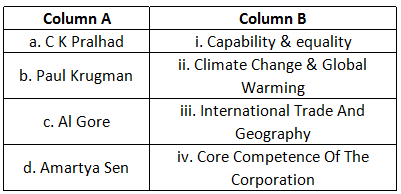
C. K Prahlad wrote the book Core Competence of the Corporation.
Paul Krugman wrote International Trade and New Economic Geography.
Al gore is related to Climate Change and Global Warming.
Amartya Sen is related to Capability and Equality.
Hence, option B is the correct answer.
Match the women CEOs with the company.

Ms Sikha Sharma is the CEO of Axis Bank.
Ms. Naina Lal Kidwaiekani was the CEO of HSBC.
Ms Indra Nooyi is the CEO of PepsiCo.
Ms. kiran Mazumdar Shaw is the CEO of Biocon India.
Hence, option C is the correct answer.
Match the company and the place where it originates from

Section III
Read carefully the four passages that follow and answer the questions given at the end of each passage:
PASSAGE I
The most important task is revitalizing the institution of independent directors. The independent directors of a company should be faithful fiduciaries protecting, the long-term interests of shareholders while ensuring fairness to employees, investor, customer, regulators, the government of the land and society. Unfortunately, very often, directors are chosen based of friendship and, sadly, pliability. Today, unfortunately, in the majority of cases, independence is only true on paper.
The need of the hour is to strengthen the independence of the board. We have to put in place stringent standards for the independence of directors. The board should adopt global standards for director-independence, and should disclose how each independent director meets these standards. It is desirable to have a comprehensive report showing the names of the company employees of fellow board members who are related to each director on the board. This report should accompany the annual report of all listed companies.
Another important step is to regularly assess the board members for performance. The assessment should focus on issues like competence, preparation, participation and contribution. Ideally, this evaluation should be performed by a third party. Underperforming directors should be allowed to leave at the end of their term in a gentle manner so that they do not lose face. Rather than being the rubber stamp of a company’s management policies, the board should become a true active partner of the management. For this, independent directors should be trained in their in their in roles and responsibilities. Independent directors should be trained on the business model and risk model of the company, on the governance practices, and the responsibilities of various committees of the board of the company. The board members should interact frequently with executives to understand operational issues. As part of the board meeting agenda, the independent directors should have a meeting among themselves without the management being present.
The independent board members should periodically review the performance of the company’s CEO, the internal directors and the senior management. This has to be based on clearly defined objective criteria, and these criteria should be known to the CEO and other executive directors well before the start of the evolution period. Moreover, there should be a clearly laid down procedure for communicating the board’s review to the CEO and his/her team of executive directors. Managerial remuneration should be based on such reviews. Additionally, senior management compensation should be determined by the board in a manner that is fair to all stakeholders. We have to look at three important criteria in deciding managerial remuneration-fairness accountability and transparency. Fairness of compensation is determined by how employees and investors react to the compensation of the CEO. Accountability is enhanced by splitting the total compensation into a small fixed component and a large variable component. In other words, the CEO, other executive directors and the senior management should rise or fall with the fortunes of the company. The variable component should be linked to achieving the long-term objectives of the firm. Senior management compensation should be reviewed by the compensation committee of the board consisting of only the independent directors. This should be approved by the shareholders. It is important that no member of the internal management has a say in the compensation of the CEO, the internal board members or the senior management.
The SEBI regulations and the CII code of conduct have been very helpful in enhancing the level of accountability of independent directors. The independent directors should decide voluntarily how they want to contribute to the company. Their performance should decide voluntarily how they want to contribute to the company. Their performance should be appraised through a peer evaluation process. Ideally, the compensation committee should decide on the compensation of each independent director based on such a performance appraisal.
Auditing is another major area that needs reforms for effective corporate governance. An audit is the Independent examination of financial transactions of any entity to provide assurance to shareholder and other stakeholders that the financial statements are free of material misstatement. Auditors are qualified professionals appointed by the shareholders to report on the reliability of financial statements prepared by the management. Financial markets look to the auditor’s report for an independent opinion on the financial and risk situation of a company. We have to separate such auditing form other services. For a truly independent opinion, the auditing firm should not provide services that are perceived to be materially in conflict with the role of the auditor. These include investigations, consulting advice, sub contraction of operational activities normally undertaken by the management, due diligence on potential acquisitions or investments, advice on deal structuring, designing/implementing IT systems, bookkeeping, valuations and executive recruitment. Any departure from this practice should be approved by the audit committee in advance. Further, information on any such exceptions must be disclosed in the company’s quarterly and annual reports. To ensure the integrity of the audit team, it is desirable to rotate auditor partners. The lead audit partner and the audit partner responsible for reviewing a company’s audit must be rotated at least once every three to five years. This eliminates the possibility of the lead auditor and the company management getting into the kind of close, cozy relationship that results in lower objectivity in audit opinions. Further, a registered auditor should not audit a chief accounting office was associated with the auditing firm. It is best that members of the audit teams are prohibited from taking up employment in the audited corporations for at least a year after they have stopped being members of the audit team.
A competent audit committee is essential to effectively oversee the financial accounting and reporting process. Hence, each member of the audit committee must be ‘financially literate’, further, at least one member of the audit committee, preferably the chairman, should be a financial expert-a person who has an understanding of financial statements and accounting rules, and has experience in auditing. The audit committee should establish procedures for the treatment of complaints received through anonymous submission by employees and whistleblowers. These complaints may be regarding questionable accounting or auditing issues, any harassment to an employee or any unethical practice in the company. The whistleblowers must be protected.
Any related-party transaction should require prior approval by the audit committee, the full board and the shareholders if it is material. Related parties are those that are able to control or exercise significant influence. These include; parent- subsidiary relationships; entities under common control; individuals who, through ownership, have significant influence over the enterprise and close members of their families; and dey management personnel.
Accounting standards provide a framework for preparation and presentation of financial statements and assist auditors in forming an opinion on the financial statements. However, today, accounting standards are issued by bodies comprising primarily of accountants. Therefore, accounting standards do not always keep pace with changes in the business environment. Hence, the accounting standards-setting body should include members drawn from the industry, the profession and regulatory bodies. This body should be independently funded.
Currently, an independent oversight of the accounting profession does not exist. Hence, an independent body should be constituted to oversee the functioning of auditors for Independence, the quality of audit and professional competence. This body should comprise a "majority of non- practicing accountants to ensure independent oversight. To avoid any bias, the chairman of this body should not have practiced as an accountant during the preceding five years. Auditors of all public companies must register with this body. It should enforce compliance with the laws by auditors and should mandate that auditors must maintain audit working papers for at least seven years.
To ensure the materiality of information, the CEO and CFO of the company should certify annual and quarterly reports. They should certify that the information in the reports fairly presents the financial condition and results of operations of the company, and that all material facts have been disclosed. Further, CEOs and CFOs should certify that they have established internal controls to ensure that all information relating to the operations of the company is freely available to the auditors and the audit committee. They should also certify that they have evaluated the effectiveness of these controls within ninety days prior to the report. False certifications by the CEO and CFO should be subject to significant criminal penalties (fines and imprisonment, if willful and knowing). If a company is required to restate its reports due to material non-compliance with the laws, the CEO and CFO must face severe punishment including loss of job and forfeiting bonuses or equity-based compensation received during the twelve months following the filing.
The problem with the independent directors has been that:
I. Their selection has been based upon their compatibility with the company management
II. There has been lack of proper training and development to improve their skill set
III. Their independent views have often come in conflict with the views of company management. This has hindered the company’s decision-making process
IV. Stringent standards for independent directors have been lacking
Statement (I) can be inferred from the first paragraph: "directors are chosen based of friendship and, sadly, pliability"
Statement (II) can directly be inferred from the third paragraph: "For this, independent directors should be trained in their in their in roles and responsibilities."
Statement (IV) can be inferred from the second paragraph: "The need of the hour is to strengthen the independence of the board. We have to put in place stringent standards for the independence of directors."
Statement (III) is incorrect.
Hence, the answer is option D.
Which of the following, according to author, does not have an impact on effective corporate governance?
The author says, "Ideally, the compensation committee should decide on the compensation of each independent director based on such a performance appraisal.", i.e., the compensation should depend upon the performance of independent directors and not the other way round.
Hence, the answer is option B.
To improve the quality and reliability of the information reported in the financial statements:
I. Accounting standards should keep pace with the dynamic business environment
II. There should be a body of internal auditors to oversee the functioning of external auditors
III. Reports should be certified by key company officials
IV. Accounting standards should be set by a body comprising of practicing accountants only and this body should be funded from a corpus built up from the contributions made by the companies
Statement I can be inferred from the eleventh paragraph
Internal auditors have not been mentioned in the passage. Statement II is incorrect.
Statement III can be inferred from the last paragraph.
It is given in the passage that the body should comprise a "majority of non- practicing accountants to ensure independent oversight. Statement IV is wrong.
Hence, option C is the correct answer.
Which of the following may not help in improving in the accountability of management to the shareholders?
Option A : Consider the sentence:- The assessment should focus on issues like competence, preparation, participation and contribution. Ideally, this evaluation should be performed by a third party. This option surely improves accountability. Hence it is incorrect
Option B : The lead audit partner and the audit partner responsible for reviewing a company’s audit must be rotated at least once every three to five years. This option is also incorrect
Option D : The audit committee should establish procedures for the treatment of complaints received through anonymous submission by employees and whistle-blowers. This option also improves the accountability of the management to the shareholders. Hence this option is also incorrect.
Option C is not mentioned anywhere in the passage. Hence it is the most suitable option.
The author of the passage does not advocate:
Option A : Consider the sentence "As part of the board meeting agenda, the independent directors should have a meeting among themselves without the management being present." The author definitely advocates increased activism by the independent directors.
Option B : Consider the sentence "Hence, an independent body should be constituted to oversee the functioning of auditors for Independence, the quality of audit and professional competence." The author calls for measures to improve the independence of auditors.
Option C : Consider the sentence "Accounting standards do not always keep pace with changes in the business environment. Hence, the accounting standards-setting body should include members drawn from the industry, the profession and regulatory bodies." The author says that the accounting standards should be modified based on the changing business conditions.
Hence all these options are advocated by the author.
The author does not advocate option D. Hence option D is the correct answer.
I suggest that the essential character of the Trade Cycle and, especially, the regularity of time-sequence and of duration which justifies us in calling it a cycle, is mainly due to the way in which the marginal efficiency of capital fluctuates. The Trade Cycle is best regarded, I think, as being occasioned by a cyclical change in the marginal efficiency of capital, though complicated and often aggravated by associated changes in the other significant short period variables of the economic system.
By a cyclical movement we mean that as the system progresses in, e.g. the upward direction, the forces propelling it upwards at first gather force and have a cumulative effect on one another but gradually lose their strength until at a certain point they tend to be replaced by forces operating in the opposite direction; which in turn gather force for a time and accentuate one another, until they too, having reached their maximum development, wane and give place to their opposite. We do not, however, merely mean by a cyclical movement that upward and downward tendencies, once started, do not persist for ever in the same direction but are ultimately reversed. We mean also that there is some recognizable degree of regularity in the time-sequence and duration of the upward and downward movements. There is, however, another characteristic of what we call the Trade Cycle which our explanation must cover if it is to be adequate; namely, the phenomenon of the ‘crisis’ the fact that the substitution of a downward for an upward tendency often takes place suddenly and violently, whereas there is, as a rule, no such sharp turning-point when an upward is substituted for a downward tendency. Any fluctuation in investment not offset by a corresponding change in the propensity to consume will, of course, result in a fluctuation in employment. Since, therefore, the volume of investment is subject to highly complex influences, it is highly improbable that all fluctuations either in investment itself or in the marginal efficiency of capital will be of a cyclical character.
We have seen above that the marginal efficiency of capital depends, not only on the existing abundance or scarcity of capital-goods and the current cost of production of capital- goods, but also on current expectations as to the future yield of capital-goods. In the case of durable assets it is, therefore, natural and reasonable that expectations of the future should play a dominant part in determining the scale on which new investment is deemed advisable. But, as we have seen, the basis for such expectations is very precarious. Being based on shifting and unreliable evidence, they are subject to sudden and violent changes. Now, we have been accustomed in explaining the ‘crisis’ to lay stress on the rising tendency of the rate of interest under the influence of the increased demand for money both for trade and speculative purposes. At times this factor may certainly play an aggravating and, occasionally perhaps, an initiating part. But I suggest that a more typical, and often the predominant, explanation of the crisis is, not primarily a rise in the rate of interest, but a sudden collapse in the marginal efficiency of capital. The later stages of the boom are characterized by optimistic expectations as to the future yield of capital goods sufficiently strong to offset their growing abundance and their rising costs of production and, probably, a rise in the rate of interest also. It is of the nature of organized investment markets, under the influence of purchasers largely ignorant of what they are buying and of speculators who are more concerned with forecasting the next shift of market sentiment than with a reasonable estimate of the future yield of capital-assets, that, when disillusion falls upon an over-optimistic and over- bought market, it should fall with sudden and even catastrophic force. Moreover, the dismay and uncertainty as to the future which accompanies a collapse in the marginal efficiency of capital naturally precipitates a sharp increase in liquidity-preference and hence a rise in the rate of interest. Thus the fact that a collapse in the marginal efficiency of capital tends to be associated with a rise in the rate of interest may seriously aggravate the decline in investment. But the essence of the situation is to be found, nevertheless, in the collapse in the marginal efficiency of capital, particularly in the case of those types of capital which have been contributing most to the previous phase of heavy new investment. Liquidity preference, except those manifestations of it which are associated with increasing trade and speculation, does not increase until after the collapse in the marginal efficiency of capital. It is this, indeed, which renders the slump so intractable.
Which of the following does not describe the features of cyclical movement?
From the second paragraph, we can infer that the cycle can be reversed. So, option B is factually wrong.
Hence, option B is the correct answer.
Marginal efficiency of the capital does not depend on which of following factors?
We have seen above that the marginal efficiency of capital depends, not only on the existing abundance or scarcity of capital-goods and the current cost of production of capital- goods, but also on current expectations as to the future yield of capital-goods - From these lines, options A, B and C can be inferred.
Availability of capital is nowhere mentioned as a factor on which marginal efficiency depends.
Hence, option D is the correct answer.
Which of the following explains the phenomenon of crisis?
I. A sudden collapse in the marginal efficiency of capital
II. Increase in the rate of interest causing the decline in investments
III. A sudden and violent substitution of upward movement by a downward tendency
IV. Decline in the liquidity preference of the investors
In the 1st paragraph it is mentioned that "the phenomenon of the ‘crisis’ the fact that the substitution of a downward for an upward tendency often takes place suddenly", from this option III can be concluded.
In the 2nd paragraph it is mentioned that "explanation of the crisis is, not primarily a rise in the rate of interest, but a sudden collapse in the marginal efficiency of capital. The later stages of the boom are characterized by optimistic expectations as to the future yield of capital goods sufficiently strong to offset their growing abundance and their rising costs of production and, probably, a rise in the rate of interest also.
From this option I and II can be concluded.
Thus, option B is the correct answer.
The broad scientific understanding today is that our planet is experiencing a warming trend over and above natural and normal variations that is almost certainly due to human activities associated with large-scale manufacturing. The process began in the late 1700s with the Industrial Revolution, when manual labor, horsepower, and water power began to be replaced by or enhanced by machines. This revolution, over time, shifted Britain, Europe, and eventually North America from largely agricultural and trading societies to manufacturing ones, relying on machinery and engines rather than tools and animals.
The Industrial Revolution was at heart a revolution in the use of energy and power. Its beginning is usually dated to the advent of the steam engine, which was based on the conversion of chemical energy in wood or coal to thermal energy and then to mechanical work primarily the powering of industrial machinery and steam locomotives. Coal eventually supplanted wood because, pound for pound, coal contains twice as much energy as wood (measured in BTUs, or British thermal units, per pound) and because its use helped to save what was left of the world's temperate forests. Coal was used to produce heat that went directly into industrial processes, including metallurgy, and to warm buildings, as well as to power steam engines. When crude oil came along in the mid- 1800s, still a couple of decades before electricity, it was burned, in the form of kerosene, in lamps to make light replacing whale oil. It was also used to provide heat for buildings and in manufacturing processes, and as a fuel for engines used in industry and propulsion.
In short, one can say that the main forms in which humans need and use energy are for light, heat, mechanical work and motive power, and electricity which can be used to provide any of the other three, as well as to do things that none of those three can do, such as electronic communications and information processing. Since the Industrial Revolution, all these energy functions have been powered primarily, but not exclusively, by fossil fuels that emit carbon dioxide (CO2), To put it another way, the Industrial Revolution gave a whole new prominence to what Rochelle Lefkowitz, president of Pro-Media Communications and an energy buff, calls "fuels from hell" - coal, oil, and natural gas. All these fuels from hell come from underground, are exhaustible, and emit CO2 and other pollutants when they are burned for transportation, heating, and industrial use. These fuels are in contrast to what Lefkowitz calls "fuels from heaven" -wind, hydroelectric, tidal, biomass, and solar power. These all come from above ground, are endlessly renewable, and produce no harmful emissions.
Meanwhile, industrialization promoted urbanization, and urbanization eventually gave birth to suburbanization. This trend, which was repeated across America, nurtured the development of the American car culture, the building of a national highway system, and a mushrooming of suburbs around American cities, which rewove the fabric of American life. Many other developed and developing countries followed the American model, with all its upsides and downsides. The result is that today we have suburbs and ribbons of highways that run in, out, and around not only America s major cities, but China's, India's, and South America's as well. And as these urban areas attract more people, the sprawl extends in every direction.
All the coal, oil, and natural gas inputs for this new economic model seemed relatively cheap, relatively inexhaustible, and relatively harmless-or at least relatively easy to clean up afterward. So there wasn't much to stop the juggernaut of more people and more development and more concrete and more buildings and more cars and more coal, oil, and gas needed to build and power them. Summing it all up, Andy Karsner, the Department of Energy's assistant secretary for energy efficiency and renewable energy, once said to me: "We built a really inefficient environment with the greatest efficiency ever known to man."
Beginning in the second half of the twentieth century, a scientific understanding began to emerge that an excessive accumulation of largely invisible pollutants-called greenhouse gases - was affecting the climate. The buildup of these greenhouse gases had been under way since the start of the Industrial Revolution in a place we could not see and in a form we could not touch or smell. These greenhouse gases, primarily carbon dioxide emitted from human industrial, residential, and transportation sources, were not piling up along roadsides or in rivers, in cans or empty bottles, but, rather, above our heads, in the earth's atmosphere. If the earth's atmosphere was like a blanket that helped to regulate the planet's temperature, the CO2 buildup was having the effect of thickening that blanket and making the globe warmer.
Those bags of CO2 from our cars float up and stay in the atmosphere, along with bags of CO2 from power plants burning coal, oil, and gas, and bags of CO2 released from the burning and clearing of forests, which releases all the carbon stored in trees, plants, and soil. In fact, many people don't realize that deforestation in places like Indonesia and Brazil is responsible for more CO2 than all the world's cars, trucks, planes, ships, and trains combined - that is, about 20 percent of all global emissions. And when we're not tossing bags of carbon dioxide into the atmosphere, we're throwing up other greenhouse gases, like methane (CH4) released from rice farming, petroleum drilling, coal mining, animal defecation, solid waste landfill sites, and yes, even from cattle belching. Cattle belching? That's right-the striking thing about greenhouse gases is the diversity of sources that emit them. A herd of cattle belching can be worse than a highway full of Hummers. Livestock gas is very high in methane, which, like CO2, is colorless and odorless. And like CO2, methane is one of those greenhouse gases that, once released into the atmosphere, also absorb heat radiating from the earth's surface. "Molecule for molecule, methane's heat-trapping power in the atmosphere is twenty-one times stronger than carbon dioxide, the most abundant greenhouse gas.." reported Science World (January 21, 2002). “With 1.3 billion cows belching almost constantly around the world (100 million in the United States alone), it's no surprise that methane released by livestock is one of the chief global sources of the gas, according to the U.S. Environmental Protection Agency ... 'It's part of their normal digestion process,' says Tom Wirth of the EPA. 'When they chew their cud, they regurgitate [spit up] some food to rechew it, and all this gas comes out.' The average cow expels 600 liters of methane a day, climate researchers report."
What is the precise scientific relationship between these expanded greenhouse gas emissions and global warming? Experts at the Pew Center on Climate Change offer a handy summary in their report "Climate Change 101. " Global average temperatures, notes the Pew study, "have experienced natural shifts throughout human history. For example; the climate of the Northern Hemisphere varied from a relatively warm period between the eleventh and fifteenth centuries to a period of cooler temperatures between the seventeenth century and the middle of the nineteenth century. However, scientists studying the rapid rise in global temperatures during the late twentieth century say that natural variability cannot account for what is happening now." The new factor is the human factor-our vastly increased emissions of carbon dioxide and other greenhouse gases from the burning of fossil fuels such as coal and oil as well as from deforestation, large-scale cattle-grazing, agriculture, and industrialization.
“Scientists refer to what has been happening in the earth’s atmosphere over the past century as the ‘enhanced greenhouse effect’”, notes the Pew study. By pumping man- made greenhouse gases into the atmosphere, humans are altering the process by which naturally occurring greenhouse gases, because of their unique molecular structure, trap the sun’s heat near the earth’s surface before that heat radiates back into space.
"The greenhouse effect keeps the earth warm and habitable; without it, the earth's surface would be about 60 degrees Fahrenheit colder on average. Since the average temperature of the earth is about 45 degrees Fahrenheit, the natural greenhouse effect is clearly a good thing. But the enhanced greenhouse effect means even more of the sun's heat is trapped, causing global temperatures to rise. Among the many scientific studies providing clear evidence that an enhanced greenhouse effect is under way was a 2005 report from NASA's Goddard Institute for Space Studies. Using satellites, data from buoys, and computer models to study the earth's oceans, scientists concluded that more energy is being absorbed from the sun than is emitted back to space, throwing the earth's energy out of balance and warming the globe."
Which of the following statements is correct?
(I) Greenhouse gases are responsible for global warming. They should be eliminated to save the planet
(II) CO2 is the most dangerous of the greenhouse gases. Reduction in the release of CO2 would surely bring down the temperature
(III) The greenhouse effect could be traced back to the industrial revolution. But the current development and the patterns of life have enhanced their emissions
(IV) Deforestation has been one of the biggest factors contributing to the emission of greenhouse gases Choose the correct option:
Statement (I) talks about eliminating greenhouse gases, but this sentiment is not expressed by the author in the passage. In fact, in the last paragraph, the author says that the natural greenhouse effect is beneficial for us. The additional greenhouse gases released by human activities are what's making it worse. Thus, this statement can be ruled out.
Statement (II) can be clearly ruled out as the author says that methane is far more dangerous than CO2.
Statement (III) is the main theme of the passage as thus, can be inferred.
Statement (IV) can be inferred from paragraph 7.
Hence, the answer is option D.
Which of the following statements is incorrect?
Option A can be inferred from the last paragraph where the author says that a natural level of global warming is beneficial for us as it keeps the planet habitable. Thus, it is true.
Option B can be inferred from the 7th paragraph, where the author states that deforestation causes more damage than all the vehicular emissions combined. Thus, this statement is also true.
Option C is mentioned in the last paragraph of the passage and is thus, true.
Option D is incorrect as the author has given the example of the Northern Hemisphere to indicate the historical changes in climate in that region.
Hence, the answer is option D.
Increasing warming of earth has been due to:
(I) Increased manual intervention in the manufacturing process
(II) The fallout of mechanization of production
(III) Industrial revolution
(IV) Over reliance on non- replenishible energy sources
Choose the correct option:
The author mentions in the second paragraph that as mechanisation increased, the use of fossil fuels also increased to power those machines which gave rise to greenhouse emissions. Thus, statement (II) is one of the reasons.
The author says in the first paragraph that the process of global warming began with the Industrial Revolution. Thus, statement (III) is true.
Statement (IV) is given as the main reason for greenhouse emissions and global warming throughout the passage. Thus, statement (IV) is true.
Statement (I) is contrary to what the author has said. The author says in the first paragraph that manual intervention decreased with the emergence of machines and that led to global warming. Thus, statement (I) is false.
Hence, the answer is option D.
Which of the following according to the passage are the features of “fuels from heaven”?
(I) Replenishability
(II) Storability
(III) Cost-effectiveness
(IV) Harmlessness
Talking about the fuels from heaven, the author says, "These all come from above ground, are endlessly renewable, and produce no harmful emissions."
Hence, the answer is option D.
"All raw sugar comes to us this way. You see, it is about the color of maple or brown sugar, but it is not nearly so pure, for it has a great deal of dirt mixed with it when we first get it." "Where does it come from?" inquired Bob.
"Largely from the plantations of Cuba and Porto Rico. Toward the end of the year we also get raw sugar from Java, and by the time this is refined and ready for the market the new crop from the West Indies comes along. In addition to this we get consignments from the Philippine Islands, the Hawaiian Islands, South America, Formosa, and Egypt. I suppose it is quite unnecessary to tell you young men anything of how the cane is grown; of course you know all that."
"I don't believe we do, except in a general way," Bob admitted honestly. "I am ashamed to be so green about a thing at which Dad has been working for years. I don't know why I never asked about it before. I guess I never was interested. I simply took it for granted."
"That's the way with most of us," was the superintendent's kindly answer. "We accept many things in the world without actually knowing much about them, and it is not until something brings our ignorance before us that we take the pains to focus our attention and learn about them. So do not be ashamed that you do not know about sugar raising; I didn't when I was your age. Suppose, then, I give you a little idea of what happens before this raw sugar can come to us."
"I wish you would," exclaimed both boys in a breath.
"Probably in your school geographies you have seen pictures of sugar-cane and know that it is a tall perennial not unlike our Indian corn in appearance; it has broad, flat leaves that sometimes measure as many as three feet in length, and often the stalk itself is twenty feet high. This stalk is jointed like a bamboo pole, the joints being about three inches apart near the roots and increasing in distance the higher one gets from the ground."
"How do they plant it?" Bob asked.
"It can be planted from seed, but this method takes much time and patience; the usual way is to plant it from cuttings, or slips. The first growth from these cuttings is called plant cane; after these are taken off the roots send out ratoons or shoots from which the crop of one or two years, and sometimes longer, is taken. If the soil is not rich and moist replanting is more frequently necessary and in places like Louisiana, where there is annual frost, planting must be done each year. When the cane is ripe it is cut and brought from the field to a central sugar mill, where heavy iron rollers crush from it all the juice. This liquid drips through into troughs from which it is carried to evaporators where the water portion of the sap is eliminated and the juice left; you would be surprised if you were to see this liquid. It looks like nothing so much as the soapy, bluish gray dish-water that is left in the pan after the dishes have been washed."
"A tempting picture!" Van exclaimed.
"I know it. Sugar isn't very attractive during its process of preparation," agreed Mr. Hennessey. "The sweet liquid left after the water has been extracted is then poured into vacuum pans to be boiled until the crystals form in it, after which it is put into whirling machines, called centrifugal machines that separate the dry sugar from the syrup with which it is mixed. This syrup is later boiled into molasses. The sugar is then dried and packed in these burlap sacks such as you see here, or in hogsheads, and shipped to refineries to be cleansed and whitened."
"Isn't any of the sugar refined in the places where it grows?" queried Bob.
"Practically none. Large refining plants are too expensive to be erected everywhere; it therefore seems better that they should be built in our large cities, where the shipping facilities are good not only for receiving sugar in its raw state but for distributing it after it has been refined and is ready for sale. Here, too, machinery can more easily be bought and the business handled with less difficulty."
Which one of the following is not a essential condition for setting up sugar refining plants?
Options A, B and C are mentioned in the last paragraph.
Option D is not a necessary condition as per the passage.
Hence, option D is the correct answer.
Which of the following is the correct sequence of sugar preparation process?
"It can be planted from seed, but this method takes much time and patience; the usual way is to plant it from cuttings, or slips. The first growth from these cuttings is called plant cane; after these are taken off the roots send out ratoons or shoots from which the crop of one or two years, and sometimes longer, is taken. If the soil is not rich and moist replanting is more frequently necessary and in places like Louisiana, where there is annual frost, planting must be done each year. When the cane is ripe it is cut and brought from the field to a central sugar mill, where heavy iron rollers crush from it all the juice. This liquid drips through into troughs from which it is carried to evaporators where the water portion of the sap is eliminated and the juice left; you would be surprised if you were to see this liquid.
Sugar isn't very attractive during its process of preparation," agreed Mr. Hennessey. "The sweet liquid left after the water has been extracted is then poured into vacuum pans to be boiled until the crystals form in it, after which it is put into whirling machines, called centrifugal machines that separate the dry sugar from the syrup with which it is mixed.
From these lines, we can infer that option A depicts the appropriate sequence of processes in sugar preparation.
Hence, option A is the correct answer.
Which of the following statements, as per the paragraph, is incorrect?
"Largely from the plantations of Cuba and Porto Rico. Toward the end of the year we also get raw sugar from Java, and by the time this is refined and ready for the market the new crop from the West Indies comes along. In addition to this we get consignments from the Philippine Islands, the Hawaiian Islands, South America, Formosa, and Egypt. - From these lines, we can infer that cane plantation and sugar production process is not equally spread across the countries.
Hence, option D is the correct answer.
Each of the questions presents a sentence, part of which is underlined. Beneath the sentence you will find four ways of phrasing the underlined part. Follow the requirements of standard written English to choose your answer, paying attention to grammar, word choice, and sentence construction. Select the answer that produces the most effective sentence; your answer should make the sentence clear, exact, and free of grammatical error. It should also minimize awkwardness, ambiguity, and redundancy.
When I first became brand manager, we were spending most of our advertising budget to promote our products in the winter. It had worked in North America and Europe, where people caught colds mainly in that season. Our monthly volume data suggested however stubbornly we were shipping a lot of VapoRub between July and September, the hot monsoon season.
Options B, C and D suggest that the data was stubbornly suggesting something, which would not be logically coherent.
Leaving us with option A fit for replacing the underlined portion in the text.
This would suggest that they (the company) were being stubborn in shipping.
Therefore, Option A is the correct answer.
The growth rate of companies in several sectors like food, personal care, automobiles, banking and retail in the developed world are flattening. These companies for maintaining their growth rates and margins are looking upon the emerging market in Asia and Latin America.
The main point presented by the underlined sentence is that the companies are looking at the emerging markets in Asia and Latin America. The reason for this is given as, to maintain their growth rates and margins, which is the subordinate clause.
This structure is correctly represented in option D.
The answer is option D.
People who do good work to the corporation wherever they are whatever they do will be assets to the valued corporation.
"Wherever they are" and "Whatever they do" is given as additional information about the people mentioned. Thus, it has to be separated from the primary sentence using a hyphen or a comma.
Hence, the answer is option B.
From what landscapes or flowerbeds would future painters draw their inspiration? Would move poets to craft their symphonies, composers to contemplate the meaning of God, and philosophers write their sonnets.
A "sonnet" is a short poem. Thus, it has to be paired with poets.
"Symphonies" are composed by composers, and "contemplation about God" is done by philosophers.
All these are properly paired in option B.
Thus, the answer is option B.
Car sales in the country rose at an annualized rate of 7.8% in June, helped by a spate of new models and falling borrowing costs bringing new buyers back.
The main idea is that car sales have increased due to two factors: the introduction of new models and the decrease in borrowing costs, both of which have contributed to bringing new buyers back to the market. Option A effectively represents this sequence, maintaining clear connections between the causes (new models and falling borrowing costs) and the result (new buyers returning).
Thus, the correct answer is indeed option A, as it presents the idea in a grammatically sound and logically coherent manner.
Select the most suitable synonym for the underlined word in the sentence.
The book did not get much acclaim because of its pedantic style of writing.
In the context of the sentence, "pedantic" means difficult to understand.
"Esoteric" means something that is understood by very few people. Thus, they are both synonymous in this context.
Hence, the answer is option C.
The policy announcement was made to the much chagrin of the farmers.
"Chagrin" means to be annoyed or distressed.
Option A: Intense happiness or excitement, often overwhelming.
Option B: The act of calming or soothing someone, often to reduce anger.
Option C: Joyful delight or amusement, often with a sense of mischief.
Option D: Deep embarrassment or stress, often due to humiliation.
Of the given options, Mortification works best as a synonym for chagrin.
Hence, the answer is option D.
The leader summoned the group and told that the time has come to act and not genuflect.
"Genuflect" means to bow or bend the knee to somebody.
"Grovel" also refers to kneeling in front of someone. Thus, both these words can be used in the same context.
Hence, the answer is option A.
The stentorian honks of the marching fleet could be heard for miles.
"Stentorian" refers to something loud.
Among the options, only "blaring" can be used to refer to loud noises.
Hence, the answer is option C.
Noticing the behavior of the audience in the amphitheater the performer was more bemused than bitter.
The word "bemused" means confused or puzzled. Among the given options, Option B) bewildered, is the closest synonym, as it also means being perplexed or confused. The other options have different meanings:
Amused: entertained, finding something funny
Enlightened: having a deeper understanding or awareness
Enthused: excited or enthusiastic
Select the most suitable antonym for the underlined word in the sentences.
The arguments put forth by the speaker were rather specious, but somehow he got away with them.
"Specious" refers to something that seems right but is actually wrong.
"Unfeigned" means "genuine". Thus, it is an antonym of the given word.
Hence, the answer is option B.
The trends suggest that most of the new members got themselves deregistered within 7 - 10 days of their joining due to the exacting instructor.
"Exacting" means very demanding.
"Insouciant" means showing a casual lack of concern. Thus, it is an antonym of the given word.
Hence, the answer is option A.
The congregation was awestruck at the sight of the levitating saint.
"Levitating" means floating or rising in the air.
"Gravitating" means to move toward something [land in this case].
Hence, the answer is option A.
By the time she could realize the gravity of the situation she found herself ensnared in the labyrinth of accusations.
"Ensnared" means to get trapped in.
"Released" means to set free. Thus, it is an antonym of the given word.
Hence, the answer is option D.
The sub-prime crisis has pushed millions of people in the quagmire of financial indebtedness.
Quagmire means an awkward, complex, or hazardous situation.
Tranquility means the quality or state of being calm.
So, tranquility and quagmire are antonyms.
Hence, option C is the correct answer.
Select the most appropriate set of words from the given choices to fill in the blanks.
The organization takes its cue from the person on the top. I always told our business leaders their personal____ determined their organization’s ___.
A. "Serendipity" refers to something happening by chance, and "faux pas" refers to a mistake. These do not fit the sentence.
B. "Predilection" means "preference", and "Despair" means "loss of hope". These do not fit the sentence either.
C. "Intensity" means "force of feelings", and "success" means to accomplish something. These go well with the overall sentence.
D. "Oddity" means strangeness, and "conformity" means compliance. These do not fit the sentence.
Hence, the answer is option C.
The Himalayas ran from east to west and cut off the cold winds from the north. This allowed agriculture to prosper and _____ wealth, but it also _____ barbarian invaders from the north.
The "but" indicates that the second part is a negative/undesirable effect.
Only option B conforms with the given situation.
Hence, the answer is option B.
Our ______diversity may also be of some value. Because we have always learned to live with pluralism, it is possible that we may be better prepared to ______ the diversity of global economy.
Since the sentence is talking about diversity in a positive way, "alleviate"[make less severe], "annihilate"[destroy], and exasperate[frustrate] are inappropriate for the second blank.
Option A: "stupefying" [astonishing/amazing] and "negotiate" [to reach acceptance] make the sentence meaningful.
Hence, the answer is option A.
My inward petition was instantly______. First, a delightful cold wave descended over my back and under my feet, _________ all discomfort.
Since the sentence is in a positive tone, "repudiated" and "decimated" are inappropriate for the first blank. Thus, options B and D are ruled out.
"Exacerbate" means to make something worse. Since the discomfort was removed, it is the wrong choice for the second blank.
Hence, the answer is option A.
A number of sentences are given below which, when properly sequenced, form a COHERENT PARAGRAPH. Choose the most LOGICAL ORDER of sentence from the choices given to construct a COHERENT PARAGRAPH.
A number of sentences are given below which, when properly sequenced, form a COHERENT PARAGRAPH. Choose the most LOGICAL ORDER of sentence from the choices given to construct a COHERENT PARAGRAPH.
I. As a retention strategy, the company has issued many schemes including ESOPs.
II. Given the track record and success of our employees, other companies often look to us as hunting ground for talent.
III. The growth of the Indian economy has led to an increased requirement for talented managerial personnel and we believe that the talented manpower is our key strength.
IV. Further, in order to mitigate the risk we place considerable emphasis on development of leadership skills and on building employee motivation.
Statement 2 talks about talented employees being poached, while, statement 1 suggests a retention strategy to this problem..
Statement 4 has the word "Further", suggesting that the 4 is an extended solution to the existing risk or problem(poaching)
Therefore 214 becomes a logical block.
I. It reverberates throughout the entire Universe. And you are transmitting that frequency with your thoughts!
II. The frequency you transmit reaches beyond cities, beyond cities, beyond countries beyond the world.
III. You are a human transmission tower, and you are more powerful than any television tower created on earth.
IV. Your transmission creates your life and it creates the world.
3 will be the starting statement as it introduces the topic of discussion. (by calling humans a transmission tower)
4 will continue the thought about the transmissions.
2 will be the next sentence as it talks about the reach of the frequencies transferred by us.
1 will be the concluding statement as it continues the idea in statement 2.
Hence, the required sequence is 3421 and the answer is option C.
I. Asian economies will need alternative sources of growth to compensate for the rapid fall in demand from the western markets.
II. But the crisis has exposed the limits of region’s dominant economic- growth model.
III. The export- led model that propelled many Asian economies so effectively for the past 30 years must be adapted to a different global economic context.
IV. Asia is less exposed to the financial turmoil than the west is, because Asian countries responded to the previous decade’s regional crisis by improving their current-account positions, accumulating reserves, and ensuring that their banking systems operated prudently.
4 is the starting statement as it introduces the topic of discussion. (Asia being less exposed to the crisis)
2 will follow as it puts forth a counterpoint.
1 will follow 2 as it mentions a possible solution for the situation in 2.
3 explains the solution mentioned in 1.
Hence, the sequence is 4213 and the answer is option A.
I. The dangers of conflicting irrational majoritarianism with enlightened consensus are, indeed, great in developing democracy.
II. Real democracy is about mediating the popular will through a network of institutional structure and the law of the land.
III. While law making and governance are meant to articulate the latter, the judiciary is supposed to protect the former from any kind of excess that might occur, unwittingly or otherwise, in the conduct of legislative and governmental functions.
IV. The principle of separation of powers is meant to embody a desirable tension between individual rights and social consensus.
Let’s consider the content of each sentence. Sentence IV introduces the "principle of separation of powers" and its purpose—creating a tension between individual rights and social consensus. This is a foundational concept, making it a strong starting point as it sets the stage for discussing how democracy functions within this framework.
Sentence III follows logically, explaining the judiciary’s role in protecting individual rights (the "former" from IV) from excesses in legislative and governmental actions (which relate to social consensus, the "latter" from IV). It directly ties to IV by detailing how this separation is implemented.
Next, sentence I warns about the "dangers of conflicting irrational majoritarianism with enlightened consensus," introducing a specific challenge within this system—majoritarianism versus a balanced consensus—which connects to the tension mentioned in IV and the judiciary’s protective role in III.
Finally, sentence II defines "real democracy" as mediating popular will through institutions and law, providing a broader conclusion that ties together the roles of governance, judiciary, and the balance of rights and consensus discussed earlier.
I. First may be necessary for immediate relief.
II. However, to cure the problem from the root the treatment at the elemental level is a must.
III. Therefore synergy of modern medical science and ancient Indian wisdom is in the interest of humanity.
IV. Allopathic treatment is symptomatic while Ayurveda treats at an elemental level.
4 will be the starting sentence as it introduces Allopathy and Ayurveda.
1 will follow as it talks about Allopathy by using the pronoun "first".
2 will follow 1 as it mentions the significance of Ayurveda.
3 is the perfect concluding statement as it talks about the synergy between the two types of medicine.
Hence, the required sequence is 4123 and the answer is option B.
I. He somehow knew he would find what he was looking for. So, with missionary zeal, he started to climb.
II. So instead, for perhaps the first in his life he shed the shackles of reason and placed his trust in his intuition.
III. At first he thought about hiring a Sherpa guide to aid him in his climb through the mountains, but, for some strange reason, his instincts told him this was one journey he would have to make alone.
IV. The next morning, as the first rays of the Indian sun danced along the colorful horizon, Julian set out his trek to the lost land of Savana.
4 will start the topic as it introduces Julian and talks about the beginning of the journey.
3 mentions Julian's first thought after beginning the journey of hiring a Sherpa but deciding otherwise. Thus, it will follow 4.
2 mentions what he did instead of hiring a Sherpa. Thus, it will come directly after 3.
1 will be the concluding statement as it mentions the final start of the climb.
Hence, the required sequence is 4321 and the answer is option D.
Fortuner, the latest SUV by Toyota Motors, consumes diesel at the rate of $$\frac{1}{400}{(\frac{100}{x}+x})$$ liters per km, when driven at the speed of x km per hour. If the cost of diesel is Rs. 35 per litre and the driver is paid at the rate of Rs. 125 per hour then find the approximate optimal speed (in km per hour) of Fortuner that will minimize the total cost of the round trip of 800 kms.
SUV consumes diesel at the rate of $$\frac{1}{400}{(\frac{100}{x}+x})$$ liters per km
Cost of 1 liter diesel is Rs. 35
Total distance to be covered is 800 kms
Therefore total cost of diesel consumption by SUV is $$\frac{1}{400}{(\frac{100}{x}+x})$$*35*800
Per hour Chargers of Driver is Rs. 125 and total time is $$\frac{800}{x}$$
Therefore total cost of driver is $$\frac{100000}{x}$$
Total Cost = $$\frac{100000}{x}$$ + $$\frac{1}{400}{(\frac{100}{x}+x})$$*35*800
= $$\frac{107000}{x}$$ + 70x
We need total cost to be minimum so differentiating total cost w.r.t x and equating to 0 we get
0 = -$$\frac{107000}{x^2}$$ + 70
i.e. $$x^2$$ = $$\frac{107000}{70}$$
x = 39 approximately
Therefore option 'A' is the answer
Two motorists Anil and Sunil are practising with two different sports cars: Ferrari and Maclaren, on the circular racing track, for the car racing tournament to be held next month. Both Anil and Sunil start from the same point on the circular track. Anil completes one round of the track in 1 minute and Sunil takes 2 minutes to complete for a round. While Anil maintains same speed for all the rounds, Sunil halves his speed after the completion of each round. How many times Anil and Sunil will meet between the 6th round and 9th round of Sunil (6th and 9th rounds are excluded and the starting point is excluded)? Assume that the speed of Sunil remains steady throughout each round and changes only after the completion of that round.
The ratio of initial speeds of Anil and Sunil is 2:1 (Since speed is inversely proportional to time )
So in the time Sunil covers 'x' distance, Anil will cover '2x' distance.
Thus, at the start of the second round, they will meet for the first time time(Since Anil will complete 2 rounds while Sunil will complete his round).
Now, since the speed of Sunil is halved, the ratio will become 4:1.
At the starting point of the third round, they will meet for $$1+3=4^{th}$$ time(Since Anil will complete 4 rounds while Sunil will complete his round).
Now we can observe a pattern that at the starting point of every $$n^{th}$$ round, they are meeting at the $$\Sigma\ \left(2^k-1\right)^{th}time$$, where k ranges from 1 to (n-1).
Thus, at the start of the 7th round, they will meet for the 120th time, and at the starting point of the 9th round, they will meet for the 502th time.
The $$n^{th}$$ time they will meet between the 6th and 9th rounds (excluding the 6th and 9th rounds) are $$120^{st}$$, $$122^{nd}$$, $$123^{rd}$$....... $$501^{st}$$, $$502^{nd}$$.
So, the total meeting points will be 383 points.
Since the starting point of the $$7^{th}$$ round is excluded,
Total meets = 383 - 1 (Starting of 7thround) = 382 meets
Alternate explanation:
Since Time = $$\frac{Distance}{Speed}$$ therefore as Sunil halves his speed the time required to complete the round will double therefore time required for Round 1 = 2 mins
Round 2 = 4 mins
Round 3 = 8 mins
Round 4 = 16 mins
Round 5 = 32 mins
Round 6 = 64 mins
Round 7 = 128 mins
Round 8 = 256 mins
Round 9 = 512 mins
The time required by Anil for Round 1 to Round 9 = 1 mins each
Thus, in the first two minutes, Sunil finished his 1st round, at the same time Anil finished 2 rounds.
When Sunil finished his 6th round, at the same time Anil finished his =2+4+8+16+32+64 rounds
.
Now for the 7th round of Sunil, he will take 128 mins.
Thus Anil will run 128 rounds.
Thus both of them will meet 128-1 =127 times
.
Now for the 8th round of Sunil, he will take 256 mins.
Thus Anil will run 256 rounds.
Thus both of them will meet 256-1 =255 times
= 255 + 127
= 382
Therefore answer is option 'C'
The sum of the series is:
$$\frac{1}{1.2.3}+\frac{1}{3.4.5}+\frac{1}{5.6.7}+...$$
$$\frac{1}{1.2.3}+\frac{1}{3.4.5}+\frac{1}{5.6.7}+...$$ = 0.166..+0.0166..+0.00476..+..... which is always <0.2 but a positive number.
Option A = $$e^2$$ - 1 = 7.34 - 1 = 6.34 therefore this cannot be the Answer
Option B = $$\log_{e}{2}-1$$ = $$\frac{log_{10}{2}}{log_{10}{e}}$$ - 1 = $$\frac{log_{10}{2}}{log_{10}{2.72}}$$ - 1
We know that the value of $$\frac{log_{10}{2}}{log_{10}{2.72}}$$ < 1 and therefore value of $$\frac{log_{10}{2}}{log_{10}{2.72}}$$ - 1 < 0
therefore this cannot be the Answer
Option C = $$2\log_{10}{2}-1$$ = $$\log_{10}{4}-1$$
We know that the value of $$\log_{10}{4}$$ < 1 and therefore value of $$\log_{10}{4}-1$$ < 0
therefore this cannot be the Answer
Therefore the Answer is option 'D'
If $$\log_{2}{x}.\log_{\frac{x}{64}}{2}=\log_{\frac{x}{16}}{2}$$. Then x is
$$\log_{2}{x}.\log_{\frac{x}{64}}{2}=\log_{\frac{x}{16}}{2}$$
i.e. $$\frac{log{x}}{log{2}} * \frac{log_{2}}{log{x}-log{64}} = \frac{log{2}}{log{x}-log{16}}$$
i.e. $$\frac{log{x} * (log{x}-log{16})}{log{x}-log{64}}$$ = $$\log{2}$$
let t = log x
Therefore, $$\frac{t * (t-log{16})}{t-log{64}}$$ = $$\log{2}$$
$$t^2-4*log 2*t = t*log 2-6*(log 2)^2$$
I.e. $$t^2-5*log 2*t-6*(log 2)^2$$ = 0
I.e. $$t^2-3*log 2*t-2*log 2*t-6*(log 2)^2$$ = 0
i.e. $$t*(t-3*log 2)-2*log 2*(t-3*log 2)$$ = 0
i.e $$t=2*log 2$$ or $$t=3*log 2$$
i.e $$log x=log 4$$ or $$log x=log 8$$
therefore $$x=4$$ or $$8$$
therefore our answer is option 'B'
A right circular cone is enveloping a right circular cylinder such that the base of the cylinder rests on the base of the cone. If the radius and the height of the cone is 4 cm and 10 cm respectively, then the largest possible curved surface area of the cylinder of radius r is:
Top face will look like the figure shown below.
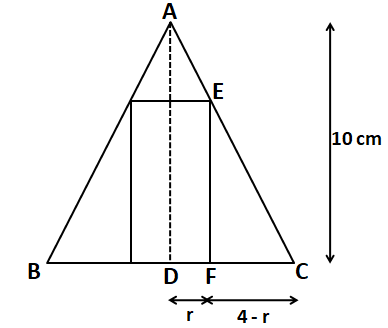
Curved surface area of the cylinder = $$2*\pi*r*h$$
To calculate height of the cylinder in terms of 'r', we can see that $$\triangle$$ADC is similar to $$\triangle$$EFC.
Therefore,
$$\dfrac{AD}{DC}=\dfrac{EF}{FC}$$
$$\Rightarrow$$ $$\dfrac{10}{4} = \dfrac{h}{4-r}$$
$$\Rightarrow$$ $$h = \dfrac{5}{2}(4-r)$$
Therefore, the curved surface area of the cylinder = $$2*\pi*r*\dfrac{5}{2}(4-r)$$ = $$5πr(4 - r)$$.
Hence, option B is the correct answer.
Radius of a spherical balloon, of radii 30 cm, increases at the rate of 2 cm per second. Then its curved surface area increases by:
It is given that radius, R = 30 cm.
Curved surface area, S= $$4\pi*R^2$$
$$\dfrac{dS}{dt}$$ = $$4\pi*(2R)*\dfrac{dR}{dt}$$
It is given that $$\dfrac{dR}{dt}$$ = 2.
Hence, $$\dfrac{dS}{dt}$$ = $$4\pi*(2*30)*2$$ = $$480\pi$$. Hence, option B is the correct answer.
Mohan was playing with a square cardboard of side 2 metres. While playing, he sliced off the corners of the cardboard in such a manner that a figure having all its sides equal was generated. The area of this eight sided figure is:
We can see that we will get a regular octagon as shown in the figure below.
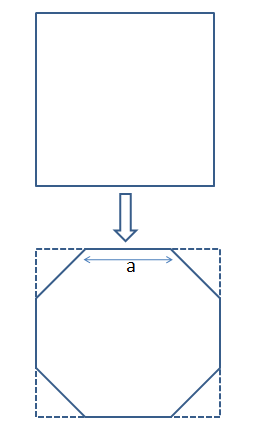
Let 'a' be the length of the side of the regular octagon.
Hence, we can say that, $$\dfrac{a}{\sqrt{2}}+a+\dfrac{a}{\sqrt{2}} = 2$$
$$\Rightarrow$$ $$a = \dfrac{2}{\sqrt{2}+1}$$.
Area of a regular octagon = $$2*(1+\sqrt{2})*a^2$$
$$\Rightarrow$$ $$2*(1+\sqrt{2})*(\dfrac{2}{\sqrt{2}+1})^2$$
$$\Rightarrow$$ $$\dfrac{8}{(\sqrt{2}+1)}$$.
Therefore, option D is the correct answer.
Because of economic slowdown, a multinational company curtailed some of the allowances of its employees. Rashid, the marketing manager of the company whose monthly salary has been reduced to Rs.42000 is unable to cut down his expenditure. He finds that there is a deficit of Rs.2000 between his earnings and expenses in the first month. This deficit, because of inflationary pressure, will keep on increasing by Rs.500 every month. Rashid has a saving of Rs.60000 which will be used to fill this deficit. After his savings get exhausted, Rashid would start borrowing from his friends. How soon will he start borrowing?
first month he will have deficiency of 2000, second month he will have deficiency of 2500, Third month he will have deficiency of 3000, and so on
He won't borrow until all of his savings (60000) gets exhausted i.e. until 60000 - (2000 + 2500 + 3000 + ........ up to nth month ) becomes negative
i.e $$60000<\frac{n}{2}*(4000+(n-1)500)$$
I.e. 1200<n*(35+5n)
i.e 240<n*(7+n)
This condition first becomes true for n=13 therefore Rashid will have to borrow from 13th month
Therefor the answer is option 'D'
The number of distinct terms in the expansion of $$(X + Y + Z + W)^{30}$$ are:
All the terms of the expansion $$(X + Y + Z + W)^{30}$$ are of the form $$k*X^a*Y^b*Z^c*W^d$$ where a,b,c,d are all positive integers and a+b+c+d=30
We need to find number of solutions of above equation and that will be the number of distinct terms in the expansion
number of solutions of equation a+b+c+d=30 is given by $$(n+r-1)C_{r-1}$$ here n = 30 and r = 4
therefore number of solutions = $$(33)C_{3}$$ = 5456
Therefore our answer is Option 'B'
A card is drawn at random from a well shuffled pack of 52 cards.
X: The card drawn is black or a king.
Y: The card drawn is a club or a heart or a jack.
Z: The card drawn is an ace or a diamond or a queen.
Then which of the following is correct?
For X:-
Probability that the card drawn is a black card = $$\frac{26}{52}$$
Probability that the card drawn is a king = $$\frac{4}{52}$$
Probability that the card drawn is a black king = $$\frac{2}{52}$$
Therefore probability The card drawn is black or a king. = $$\frac{26}{52}$$ + $$\frac{4}{52}$$ - $$\frac{2}{52}$$ = $$\frac{28}{52}$$
For Y:-
Probability that the card drawn is a club card = $$\frac{13}{52}$$
Probability that the card drawn is a heart card = $$\frac{13}{52}$$
Probability that the card drawn is a jack = $$\frac{4}{52}$$
Probability that the card drawn is a jack of club or a jack of heart = $$\frac{2}{52}$$
Therefore probability The card drawn is a club or a heart or a jack = $$\frac{13}{52}$$ + $$\frac{13}{52}$$ + $$\frac{4}{52}$$ - $$\frac{2}{52}$$ = $$\frac{28}{52}$$
For Z:-
Probability that the card drawn is a diamond card = $$\frac{13}{52}$$
Probability that the card drawn is an ace card = $$\frac{4}{52}$$
Probability that the card drawn is a queen card = $$\frac{4}{52}$$
Probability that the card drawn is a diamond card of ace or queen = $$\frac{2}{52}$$
Therefore the probability The card drawn is an ace or a diamond or a queen. = $$\frac{13}{52}$$ + $$\frac{4}{52}$$ + $$\frac{4}{52}$$ - $$\frac{2}{52}$$ = $$\frac{19}{52}$$
Therefore, $$P(X) = P(Y) > P(Z)$$
Therefore option C is the correct answer.
Let $$A_{1}$$ be a square whose side is a metres. Circle $$C_{1}$$ circumscribes the square $$A_{1}$$ such that all its vertices are on $$C_{1}$$. Another square $$A_{2}$$ circumscribes $$C_{1}$$. Circle $$C_{2}$$ circumscribes $$A_{2}$$, and $$A_{3}$$ circumscribes $$C_{2}$$, and so on. If $$D_{N}$$ is the area between the square $$A_{N}$$ and the circle $$C_{N}$$, where N is a natural number, then the ratio of the sum of all $$D_{N}$$ to $$D_{1}$$ is:

Is the condition for n = 2 and this will go on for higher values of n
as can be seen the area between square 1 and circle 1 is finite , square 2 and circle 2 is finite and so on
sum of all these areas for a higher value of n will become infinite
Therefore our answer is option 'C'
Mr. Raheja, the president of Alpha Ltd., a construction company, is studying his company’s chances of being awarded a Rs. 1,000 crore bridge building contract in Delhi. In this process, two events interest him. First, Alpha’s major competitor Gamma Ltd, is trying to import the latest bridge building technology from Europe, which it hopes to get before the deadline of the award of contact. Second, there are rumors that Delhi Government is investigating all recent contractors and Alpha Ltd is one of those contractors, while Gamma Ltd is not one of those. If Gamma is able to import the technology and there is no investigation by the Government, then Alpha’s chance of getting contract is 0.67. If there is investigation and Gamma Ltd is unable to import the technology in time, the Alpha’s chance is 0.72. If both events occur, then Alpha’s chance of getting the contract is 0.58 and if none events occur, its chances are 0.85. Raheja knows that the chance of Gamma Ltd being able to complete the import of technology before the award date is 0.80. How low must the probability of investigation be, so that the probability of the contract being awarded to Alpha Ltd is atleast 0.65? (Assume that occurrence of investigation and Gamma’s completion of import in time is independent to each other.)
Let x be the probability of investigation.
Let us indicate the event of the investigation happening to be I.
=>Event of investigation not happening = I'
Similarly, let us indicate the event of importing the technology to be T.
=> The event of technology not getting imported before the deadline = T'
The probability of Alpha getting the contract, P(A) = P(A|I&T)P(I&T)+P(A|I'&T)P(I'&T)+P(A|I&T')P(I&T')+P(A|I'&T')P(I'&T')
Alpha's chances of getting a contract:-
1. If Gamma is able to import the technology and there is no investigation by the Government, P(A|I'&T)P(I'&T) = 0.8*0.67*(1-x)
2. If there is investigation and Gamma Ltd is unable to import the technology in time, P(A|I&T')P(I&T') = 0.72*0.2*x
3. If both events occur, P(A|I&T)P(I&T) = 0.8*0.58*x
4. If none events occur,P(A|I'&T')P(I'&T') = 0.85*0.2*(1-x)
The probability of the contract being awarded to Alpha Ltd is = 0.8*0.67*(1-x) + 0.72*0.2*x + 0.8*0.58*x + 0.85*0.2*(1-x)$$\geq$$0.65
0.536 - 0.536x + 0.144x + 0.464x + 0.17 - 0.17x$$\geq$$0.65
i.e. 0.056 $$\geq$$ 0.098x
i.e. 0.057 $$\geq$$ x
Therefore, option B is the right answer.
A, V and Y alone can do a job in 6 weeks, 9 weeks and 12 weeks respectively. They work together for 2 weeks. Then A leaves the job. V leaves the job a week earlier to the completion of the work. The job would be completed in:
Amount of work done by A in one week = $$\frac{1}{6}$$
Amount of work done by V in one week = $$\frac{1}{9}$$
Amount of work done by Y in one week = $$\frac{1}{12}$$
Therefore Amount of work done by A, V and Y in one week = $$\frac{1}{6}$$ + $$\frac{1}{9}$$ + $$\frac{1}{12}$$ = $$\frac{13}{36}$$
They work together for 2 weeks therefore work done in these 2 weeks is = $$\frac{26}{36}$$
Amount of work remaining is = 1 - $$\frac{26}{36}$$ = $$\frac{10}{36}$$
Amount of work done by V and Y in one week = $$\frac{1}{9}$$ + $$\frac{1}{12}$$ = $$\frac{7}{36}$$
If total number of weeks required to complete the work is n then only V and Y work together for (n-3) weeks
Therefore work done in these (n-3) weeks is = $$\frac{7*(n-3)}{36}$$
Remaining $$\frac{10}{36}$$ - $$\frac{7*(n-3)}{36}$$ is completed by Y in one week
Therefore $$\frac{10}{36}$$ - $$\frac{7*(n-3)}{36}$$ = $$\frac{1}{12}$$
Solving we get n = 4
Therefore The job would be completed in 4 weeks
Therefore our answer is option 'A'
In 2006, Raveendra was allotted 650 shares of Sun Systems Ltd in the initial public offer, at the face value of Rs. 10 per share. In 2007, Sun Systems declared the bonus at the rate of 3 : 13. In 2008, the company again declared the bonus at the rate of 2 : 4. In 2009, the company declared a dividend of 12.5%. How much dividend does Raveendra get in 2009 as a percentage of his initial investment?
Bonus share received in 2007 = 650 * (3/13) = 150
Bonus share received in 2008 = 800 * (1/2) = 400
So, has has (150 + 400) = 550 extra shares
Dividend of the share is always issued on face value irrespective of market value
Dividend = (Total value of shares) * (Percentage of dividend)
Dividend he will get $$= \dfrac{1200 * 10 * \frac{12.5}{100}}{650 * 10} = \dfrac{1200}{650} * \dfrac{1}{8} = \dfrac{3}{13} = 23$$%
Hence, option D is the correct answer.
Read the following information carefully and answer the questions
A warship and a submarine (completely submerged in water) are moving horizontally in a straight line. The Captain of the warship observers that the submarine makes an angle of depression of 30°, and the distance between them from the point of observation is 50 km. After 30 minutes, the angle of depression becomes 60°.
Find the distance between them after 30 min from the initial point of reference.

Let the initial position of the warship be A and initial and final positions of the submarine be P and Q respectively.
$$AP = 50 km$$
In $$\triangle$$ APN
=> $$sin 30 = \frac{AN}{AP}$$
=> $$\frac{1}{2} = \frac{AN}{50}$$
=> $$AN = \frac{50}{2} = 25 km$$
=> $$BM = AN = 50 km$$
$$\therefore$$ In $$\triangle$$ BMQ
=> $$sin 60 = \frac{BM}{BQ}$$
=> $$\frac{\sqrt{3}}{2} = \frac{25}{BQ}$$
=> $$BQ = \frac{50}{\sqrt{3}} km$$
If both are moving in same direction and the submarine is ahead of the warship in both the situations, then the speed of the warship, if the ratio of the speed of warship to that of the submarine is 2 : 1, is:
.PNG)
Let the initial position of the warship be A and initial and final positions of the submarine be P and Q respectively.
$$AP = 50 km$$
Ratio of speed of warship to submarine = $$2 : 1$$
=> $$AB = 2 PQ$$ ---------------Eqn(I)
In $$\triangle$$ APN
=> $$sin 30 = \frac{AN}{AP}$$
=> $$\frac{1}{2} = \frac{AN}{50}$$
=> $$AN = \frac{50}{2} = 25 km$$
=> $$BM = AN = 25 km$$
Similarly, $$PN = 25\sqrt{3} = AR$$
$$\therefore$$ In $$\triangle$$ BMQ
=> $$sin 60 = \frac{BM}{BQ}$$
=> $$\frac{\sqrt{3}}{2} = \frac{25}{BQ}$$
=> $$BQ = \frac{50}{\sqrt{3}} km$$
Similarly, $$MQ = \frac{25}{\sqrt{3}}$$
Let $$RB = PM = x$$ and using Eqn (I), we get :
=> $$(AR + RB) = 2 (PM + MQ)$$
=> $$(25\sqrt{3} + x) = 2 (x + \frac{25}{\sqrt{3}}$$
=> $$(25\sqrt{3} + x) = 2x + \frac{50}{\sqrt{3}}$$
=> $$2x - x = 25\sqrt{3} - \frac{50}{\sqrt{3}}$$
=> $$x = \frac{25}{\sqrt{3}}$$
$$\therefore AB = 25\sqrt{3} + \frac{25}{\sqrt{3}}$$
=> $$AB = \frac{100}{\sqrt{3}}$$
$$\therefore$$ Speed of warship = $$2 \times \frac{100}{\sqrt{3}} = \frac{200}{\sqrt{3}} km/h$$
Kartik’s mother asked him to get the vegetables, milk and butter from the market and gave him the money in the denomination of 1 Rupee, 2 Rupee and 5 Rupee coins. Kartik first goes to the grocery shop to buy vegetables. At the grocery shop he gives half of his 5 Rupee coins and in return receives the same number of 1 Rupee coins. Next he goes to a dairy shop to buy milk and butter and gives all 2 Rupee coins and in return gets thirty 5 Rupee coins which increases the number of 5 Rupee coins to 75% more than the original number. If the number of 1 Rupee coins now is 50, the number of 1 Rupee and 5 Rupee coins originally were:
Let the number of 1 rupee , 2 rupee and 5 rupee coins be x, y and z respectively
At the grocery store he gives half of his 5 Rupee coins and in return receives the same number of 1 Rupee coins i.e z now become 0.5z and x now becomes x+0.5z
At the dairy store he gives all 2 Rupee coins and in return gets thirty 5 Rupee coins which increases the number of 5 Rupee coins to 75% more than the original number i.e now y = 0 and 0.5z = 0.5z+30
Also given 0.5z+30 = 1.75z
i.e. z=24
Also given that number of 1 Rupee coins now is 50 i.e. x+0.5z = 50
i.e. x = 38
Therefore the number of 1 Rupee and 5 Rupee coins originally were 38 and 24 respectively.
Therefore our answer is Option 'D'
Sukriti and Saloni are athletes. Sukriti covers a distance of 1 km in 5 minutes and 50 seconds, while Saloni covers the same distance in 6 minutes and 4 seconds. If both of them start together and run at uniform speed, approximately by what distance will Sukriti win a 5 km mini marathon:
Sukriti covers a distance of 1 km in 5 minutes and 50 seconds therefore will cover 5 kms in 25 mins 250 secs = 29.16 mins
Saloni covers the 1 km in 6 minutes and 4 seconds therefore her speed is $$\frac{1}{6.06}$$ kms per minute
Therefore Distance Covered by Saloni in 29.16 mins is 29.16 mins*$$\frac{1}{6.06}$$ $$\approx$$ 4.8 kms
Therefore the distance with which Sukriti will win a 5 km mini marathon is $$\approx$$ 200 meters
therefore our answer is option 'B'
Find the ratio of shaded area to unshaded area

Area of a equilateral triangle is $$\frac{\sqrt3}{4}$$*$$a^2$$
Area of a regular pentagon is $$\frac{5}{4}$$*$$\sqrt{1+\frac{2}{\sqrt{5}}}$$*$$a^2$$
Therefore ratio of shaded area to unshaded area = $$\frac{\frac{5}{4}*\sqrt{1+\frac{2}{\sqrt{5}}}}{\frac{5*\sqrt3}{4}}$$.
i.e. $$\frac{\sqrt{1+\frac{2}{\sqrt{5}}}}{{\sqrt3}}$$
therefore our answer is Option 'D'.
A cylindrical overhead tank is filled by two pumps - P1 and P2. P1 can fill the tank in 8 hours while P2 can fill the tank in 12 hours. There is a pipe P3 which can empty the tank in 8 hours. Both the pumps are opened simultaneously. The supervisor of the tank, before going out on a work, sets a timer to open P3 when the tank is half filled so that tank is exactly filled up by the time he is back. Due to technical fault P3 opens when tank is one third filled. If the supervisor comes back as per the plan what percent of the tank is still empty?
P1 can fill the tank in 8 hours while P2 can fill the tank in 12 hours therefore when Both the pumps are opened simultaneously they can fill $$\frac{1}{8}$$ + $$\frac{1}{12}$$ = $$\frac{5}{24}$$ this much of tank in an hour.Therefore Time required by P1 and P2 to fill full tank is $$\frac{24}{}$$ Hence they can fill half the tank in $$\frac{12}{5}$$ = 2.4 hours. After all the 3 pipes are opened the tank will be filled at the rate of $$\frac{1}{8}$$ + $$\frac{1}{12}$$ - $$\frac{1}{8}$$ = $$\frac{1}{12}$$ therefore for filling the remaining tank we will need 6 more hours. If supervisor was planning to come exactly when the tank is fully filled then he must come after 8.4 hours
Time required by P1 and P2 to fill 1/3rd of the tank is $$\frac{24}{5*3}$$ = $$\frac{8}{5}$$ = 1.6 hours therefore supervisor will come after = 8.4 - 1.6 = 6.8 hours
In 6.8 hours all the three pipe will fill $$\frac{6.8}{12}$$ = 0.56 of the capacity of tank
therefore remaining tank to be filled when the supervisor comes = 1- 0.56 - 0.33 $$\approx$$ 0.1 i.e. 10%
Therefore option 'C' is our answer
A ping pong ball is dropped from a 45 metres high multi-storey building. The ball bounces back three fifth of the distance each time before coming to rest. The total distance traversed by the ball is:
When the ball is dropped from 45m height it will cover a distance of 45m while going down after rebound it'll cover a distance of $$45*\frac{3}{5}$$ while going up and a distance of $$45*\frac{3}{5}$$ while going down again. after 2nd rebound it'll cover a distance of $$45*\frac{3}{5}*\frac{3}{5}$$ while going up and a distance of $$45*\frac{3}{5}*\frac{3}{5}$$ while going down again and so on
i.e. total distance traveled by the ball is 45 + $$45*\frac{3}{5}$$ + $$45*\frac{3}{5}$$ + $$45*\frac{3}{5}*\frac{3}{5}$$ + $$45*\frac{3}{5}*\frac{3}{5}$$ +...........
this form 2 infinite GPs as 45 + $$45*\frac{3}{5}$$ + $$45*\frac{3}{5}*\frac{3}{5}$$+....... and $$45*\frac{3}{5}$$+$$45*\frac{3}{5}*\frac{3}{5}$$+....
For 1st GP a=45 and r=$$\frac{3}{5}$$ therefore sum of this infinite GP is $$\frac{45}{1-\frac{3}{5}}$$ = $$\frac{225}{2}$$
For 2nd GP a=45*$$\frac{3}{5}$$ and r=$$\frac{3}{5}$$ therefore sum of this infinite GP is $$\frac{45*\frac{3}{5}}{1-\frac{3}{5}}$$ = $$\frac{135}{2}$$
Therefore our answer = $$\frac{225}{2}+\frac{135}{2}$$ = 180 m i.e. option 'B'
A petrol tank at a filling station has a capacity of 400 litres. The attendant sells 40 litres of petrol from the tank to one customer and then replenishes it with kerosene oil. This process is repeated with six customers. What quantity of pure petrol will the seventh customer get when he purchases 40 litres of petrol?
From 2nd customer for each customer the purity of oil becomes 0.9 of it's previous value i.e. 2nd customer will get only 40*0.9=36 liters of pure petrol 3rd customer will get 36*0.9= 32.4 liters of pure petrol and so on. Therefore the 7th customer will get $$40*(0.9)^6$$= 21.25 liters of pure petrol
Therefore our answer is option 'B'.
A doctor has decided to prescribe two new drugs D1and D2 to 200 heart patients such that 50 get drug D1, 50 get drug D2 and 100 get both. The 200 patients are chosen so that each had 80% chance of having a heart attack if given neither of the drugs. Drug D1 reduces the probability of a heart attack by 35 %, while drug D2 reduces the probability by 20%. The two drugs when taken together, work independently. If a patient, selected randomly from the chosen 200 patients, has a heart attack then the probability that the selected patient was given both the drug is:
Given that probability of getting a heart attack before any drug = 0.80
Drug D1 reduces the probability of a heart attack by 35 %. Therefore, the probability of a patient getting heart attack after he has taken D1 = (1-0.35)*0.80 = 0.52
Drug D2 reduces the probability of a heart attack by 20 %. Therefore, the probability of a patient getting heart attack after he has taken D2 = (1-0.20)*0.80 = 0.64
It is given that both D1 and D2 work independently. Therefore, the probability of a patient getting heart attack after he has taken both D1 and D2 = (1-0.35)*(1-0.20)*0.80 = 0.416
A total of 100 patients have taken both the drugs whereas only 50-50 patients took drug D1 and D2.
Hence, the probability that the selected patient was given both the drug is = $$\dfrac{0.416}{0.416+0.5*0.52+0.5*0.64}$$ = 0.417 $$\approx$$ 0.42
Therefore, we can say that option A is the correct answer.
Bennett distribution company, a subsidiary of a major cosmetics manufacturer Bavlon, is forecasting the zonal sales for the next year. Zone I with current yearly sales of Rs. 193.8 lakh is expected to achieve a sales growth of 7.25%; Zone II with current sales of Rs. 79.3 lakh is expected to grow by 8.2%; and Zone
III with sales of Rs. 57.5 lakh is expected to increase sales by 7.15%. What is the Bennett’s expected sales growth for the next year?
zone 1 will grow to become 193.8*1.0725= 207.85
zone 2 will grow to become 79.3*1.082=85.8
zone 3 will grow to become 57.5*1.0715=61.61
Total sales this year = 355.26
Total sales last year = 330.6
Growth = $$\frac{355}{330}$$ = 1.0746 i.e. growth of 7.46%
M/s. Devi Radiograms, a shop which sells electronic gadgets, marks its merchandise 35% above the purchase price. Until four months ago, purchase price of one Philips DVD player was Rs. 3,000. During the last four months M/s. Devi Radiograms has received four monthly consignments of Philips DVD player at the purchase price of Rs. 2,750, Rs. 2,500, Rs. 2,400, and Rs. 2250. The average rate of decrease in the purchase price of DVD player during these four months is:
decrease in purchase price for first month was $$\frac{3000-2750}{3000}$$ = 0.083
decrease in purchase price for second month was $$\frac{2750-2500}{2750}$$ = 0.0909
decrease in purchase price for the third month was $$\frac{2500-2400}{2500}$$ = 0.04
decrease in purchase price for the fourth month was $$\frac{2400-2250}{2400}$$ = 0.0625
Average decrease = $$\frac{0.083+0.0909+0.04+0.0625}{4}$$ = 0.069 i.e 6.9%
Therefore our answer is option'C'
The coefficient of $$x^{7}$$ in the expansion of $$(1 - x^{2} + x^{3})(1 + x)^{10}$$ is:
We need to find the coefficient of $$x^7$$ in the expansion $$(1-x^{2}+x^{3})(1 + x)^{10}$$
Now, $$(1 + x)^{10}$$ will have all the powers of x from 0 to 10. Multiplying these powers by 1, $$x^2$$ and $$x^3$$ will yield different results but we are interested in finding only the coefficient of $$x^7$$. When we multiply $$x^7$$ of $$(1 + x)^{10}$$ by 1, $$x^5$$ of $$(1 + x)^{10}$$ by $$x^2$$ and $$x^4$$ of $$(1 + x)^{10}$$ by $$x^3$$ we will get $$x^7$$. coefficient of $$x^7$$ in $$(1 + x)^{10}$$ is $$10C_7$$ = 120, coefficient of $$x^5$$ in $$(1 + x)^{10}$$ is $$10C_5$$ = 252, coefficient of $$x^4$$ in $$(1 + x)^{10}$$ is $$10C_4$$ = 210 adding 120 and 210 and subtracting(since $$x^2$$ has a negative sign) 252 we get coefficient of $$x^7$$ as 78
Therefore our answer is option 'B'
An arc AB of a circle subtends an angle x radian at centre O of the circle. If the area of the sector AOB is equal to the square of the length of the arc AB, then x is:
We know length of an arc is = angle subtended in radians * radius of the circle
Therefore in our case Length of the arc = x*r
Also, area of sector = $$\frac{\textrm{angle subtended in radians}}{2}$$ * $$radius^2$$
Therefore in our case area of sector = $$\frac{x}{2}$$ * $$r^2$$
Also given that area of sector = length of an arc^2
Therefore $$x^2*r^2$$ = $$\frac{x}{2}$$ * $$r^2$$
Solving we get x= 0.5
Therefore our answer is Option "A"
If there is threefold increase in all the sides of a cyclic quadrilateral, then the percentage increase in its area will be:
Let $$a, b, c$$ and $$d$$ be the sides of the cyclic quadrilateral.
Thus, $$s = \frac{(a+b+c+d)}{2}$$
$$Area = \sqrt{(s-a)(s-b)(s-c)(s-d)}$$
Thus, after a threefold increase in the sides the sides will become $$4a, 4b, 4c$$ and $$4d$$.
Thus new $$s = s_{new} = (4a+4b+4c+4d)/2 = 4s$$
Thus, $$Area_{new} = \sqrt{(4s-4a)(4s-4b)(4s-4c)(4s-4d)}$$
= $$\sqrt{4*4*4*4*(s-a)(s-b)(s-c)(s-d)}$$ = $$16*Area$$
Thus, there is 1500% increase in the area.
Hence, option D is the correct answer.
Start your IIM journey with the right preparation and crack CAT 2026.

Educational materials for CAT preparation
 Share
Share