
Join Our JEE Preparation Group
Prep with like-minded aspirants; Get access to free daily tests and study material.
Sign in
Please select an account to continue using cracku.in
↓ →
Join Our JEE Preparation Group
Prep with like-minded aspirants; Get access to free daily tests and study material.
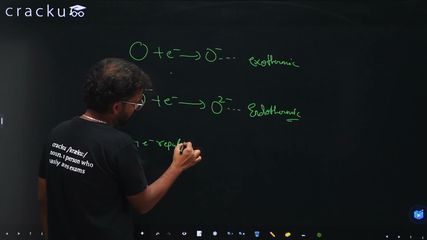
The formation of the oxide ion $$O^{2-}(g)$$ requires first an exothermic and then an endothermic step as shown below: $$O(g) + e^- \rightarrow O^-(g)$$, $$\Delta H^\circ = -142$$ kJ mol$$^{-1}$$; $$O^-(g) + e^- \rightarrow O^{2-}(g)$$, $$\Delta H^\circ = 844$$ kJ mol$$^{-1}$$. This is because
First Step (Exothermic):
$$O(g) + e^- \rightarrow O^-(g), \quad \Delta H^\circ = -142 \text{ kJ mol}^{-1}$$
Second Step (Endothermic):
$$O^-(g) + e^- \rightarrow O^{2-}(g), \quad \Delta H^\circ = +844 \text{ kJ mol}^{-1}$$
When we attempt to add a second electron to the already negatively charged $$O^-$$ ion, a strong inter-electronic repulsion occurs between the incoming electron and the existing negative charge of the ion.
To overcome this powerful electrostatic repulsion and force the second electron into the valence shell, a significant amount of external energy must be supplied. This is why the second electron gain enthalpy is heavily endothermic.
[C]: $$O^-$$ ion will tend to resist the addition of another electron.
Was this solution helpful?
Click on the Email ☝️ to Watch the Video Solution
Create a FREE account and get:
_1.webp)

Educational materials for JEE preparation

Ask our AI anything

AI can make mistakes. Please verify important information.
AI can make mistakes. Please verify important information.
