
Join Our JEE Preparation Group
Prep with like-minded aspirants; Get access to free daily tests and study material.
Sign in
Please select an account to continue using cracku.in
↓ →
Join Our JEE Preparation Group
Prep with like-minded aspirants; Get access to free daily tests and study material.
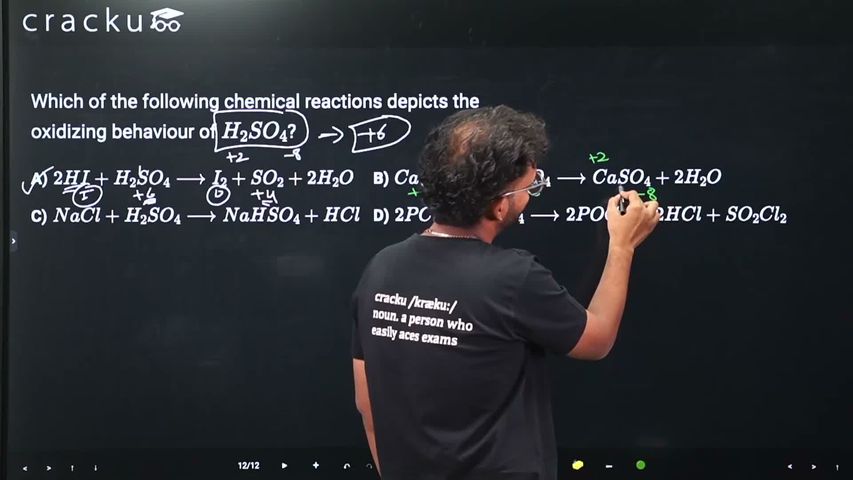
Which of the following chemical reactions depicts the oxidizing behaviour of $$H_2SO_4$$?
The term “oxidizing behaviour” means that the substance itself gets reduced by gaining electrons while causing some other species to lose electrons (get oxidized).
For $$H_2SO_4$$, the sulphur atom is in the $$+6$$ oxidation state. To act as an oxidizing agent, sulphur must come down to a lower oxidation state (e.g. $$+4, +2, 0, -2$$) during the reaction.
Let us inspect each option by writing the oxidation numbers before and after reaction.
Case A:
$$2HI + H_2SO_4 \longrightarrow I_2 + SO_2 + 2H_2O$$
• In $$HI$$, iodine is $$-1$$. In $$I_2$$, iodine is $$0$$. Therefore iodine is oxidized from $$-1$$ to $$0$$ (loss of electrons).
• In $$H_2SO_4$$, sulphur is $$+6$$. In $$SO_2$$, sulphur is $$+4$$. Therefore sulphur is reduced from $$+6$$ to $$+4$$ (gain of electrons).
Because $$H_2SO_4$$ gets reduced while oxidizing $$HI$$, this reaction illustrates the oxidizing behaviour of $$H_2SO_4$$.
Case B:
$$Ca(OH)_2 + H_2SO_4 \longrightarrow CaSO_4 + 2H_2O$$
This is a simple acid-base neutralization. Oxidation states of all elements remain unchanged. No redox process occurs, so oxidizing behaviour is absent.
Case C:
$$NaCl + H_2SO_4 \longrightarrow NaHSO_4 + HCl$$
This reaction is an acid-salt displacement. Chlorine stays at $$-1$$, sulphur stays at $$+6$$. Again, no redox change; $$H_2SO_4$$ is not acting as an oxidizing agent here.
Case D:
$$2PCl_5 + H_2SO_4 \longrightarrow 2POCl_3 + 2HCl + SO_2Cl_2$$
This is mainly a dehydrating/chlorinating reaction. Check sulphur: it is $$+6$$ in both $$H_2SO_4$$ and $$SO_2Cl_2$$, so no reduction of sulphur. Hence no oxidizing action is displayed.
Only in Case A does sulphur in $$H_2SO_4$$ undergo reduction and thereby oxidizes another species. Therefore the reaction in Option A is the one that depicts the oxidizing behaviour of sulphuric acid.
Final Answer: Option A which is: $$2HI + H_2SO_4 \longrightarrow I_2 + SO_2 + 2H_2O$$
Was this solution helpful?
Click on the Email ☝️ to Watch the Video Solution
Create a FREE account and get:
_1.webp)

Educational materials for JEE preparation

Ask our AI anything

AI can make mistakes. Please verify important information.
AI can make mistakes. Please verify important information.
