
Join Our JEE Preparation Group
Prep with like-minded aspirants; Get access to free daily tests and study material.
Sign in
Please select an account to continue using cracku.in
↓ →
Join Our JEE Preparation Group
Prep with like-minded aspirants; Get access to free daily tests and study material.
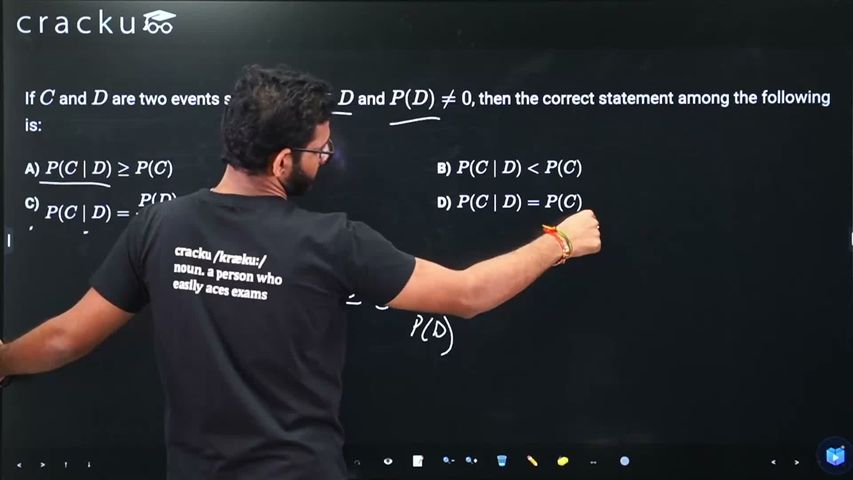
If $$C$$ and $$D$$ are two events such that $$C \subset D$$ and $$P(D) \neq 0$$, then the correct statement among the following is:
The definition of conditional probability is
$$P(C \mid D)=\frac{P(C\cap D)}{P(D)}, \quad P(D)\neq 0.$$
Because $$C\subset D,$$ we have $$C\cap D=C.$$ Therefore
$$P(C \mid D)=\frac{P(C)}{P(D)}.$$
Since probabilities never exceed $$1,$$ we have $$P(D)\le 1.$$ Furthermore, when $$C\subset D,$$ the probability of $$C$$ cannot exceed that of $$D,$$ so $$0\le P(C)\le P(D)\le 1.$$
Dividing the same positive number $$P(C)$$ by a quantity $$P(D)$$ that is at most $$1$$ (and at least $$P(C)$$) makes the fraction at least as large as $$P(C):$$
$$\frac{P(C)}{P(D)}\ge P(C).$$
Hence
$$P(C \mid D)\ge P(C).$$
Equality holds only in the two boundary cases: (i) $$P(C)=0$$ (then both sides are $$0$$), or (ii) $$P(D)=1$$ (conditioning on the whole sample space does not change probability).
Therefore the correct statement is:
Option A which is: $$P(C \mid D) \geq P(C).$$
Was this solution helpful?
Click on the Email ☝️ to Watch the Video Solution
Create a FREE account and get:
_1.webp)

Educational materials for JEE preparation

Ask our AI anything

AI can make mistakes. Please verify important information.
AI can make mistakes. Please verify important information.


