
Join Our JEE Preparation Group
Prep with like-minded aspirants; Get access to free daily tests and study material.
Sign in
Please select an account to continue using cracku.in
↓ →
Join Our JEE Preparation Group
Prep with like-minded aspirants; Get access to free daily tests and study material.
In figure (A), mass $$2m$$ is fixed on mass $$m$$ which is attached to two springs of spring constant $$k$$. In figure (B), mass $$m$$ is attached to two springs of spring constant $$k$$ and $$2k$$. If mass $$m$$ in (A) and (B) are displaced by distance $$x$$ horizontally and then released, then time period $$T_1$$ and $$T_2$$ corresponding to (A) and (B) respectively follow the relation.
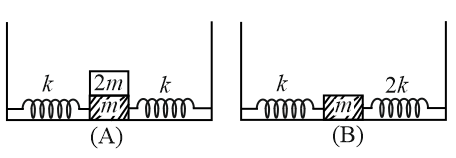
We need to find the relationship between the time periods $$T_1$$ and $$T_2$$ for the two spring-mass systems shown in the figures.
$$m_1 = m + 2m = 3m$$
$$k_{eq1} = k + k = 2k$$
The time period ($$T_1$$) for system A is given by:
$$T_1 = 2\pi \sqrt{\frac{m_1}{k_{eq1}}} = 2\pi \sqrt{\frac{3m}{2k}}$$
$$m_2 = m$$
$$k_{eq2} = k + 2k = 3k$$
The time period ($$T_2$$) for system B is given by:
$$T_2 = 2\pi \sqrt{\frac{m_2}{k_{eq2}}} = 2\pi \sqrt{\frac{m}{3k}}$$
Divide the expression for $$T_1$$ by $$T_2$$:
$$\frac{T_1}{T_2} = \frac{2\pi \sqrt{\frac{3m}{2k}}}{2\pi \sqrt{\frac{m}{3k}}}$$
Cancel out common terms ($$2\pi$$, $$m$$, and $$k$$):
$$\frac{T_1}{T_2} = \frac{\sqrt{\frac{3}{2}}}{\sqrt{\frac{1}{3}}} = \sqrt{\frac{3}{2} \times \frac{3}{1}} = \sqrt{\frac{9}{2}} = \frac{3}{\sqrt{2}}$$
The correct relationship is $$\frac{T_1}{T_2} = \frac{3}{\sqrt{2}}$$, which corresponds to Option A .
Was this solution helpful?
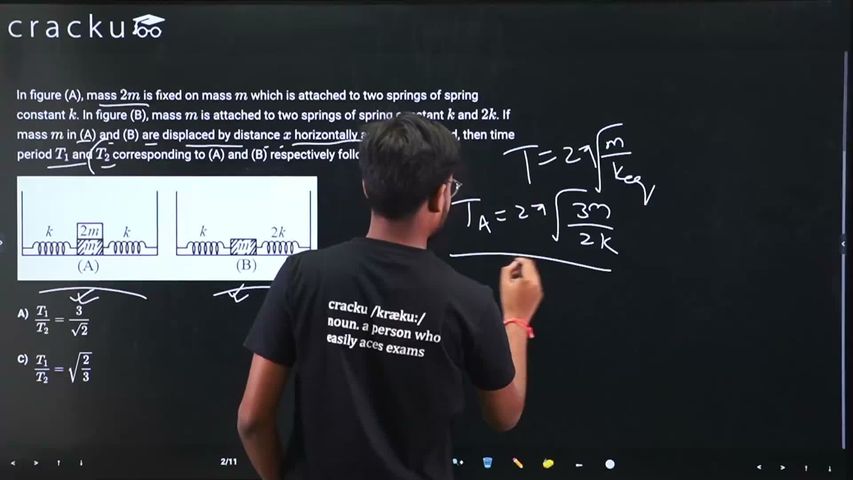
Click on the Email ☝️ to Watch the Video Solution
Create a FREE account and get:
_1.webp)

Educational materials for JEE preparation

Ask our AI anything

AI can make mistakes. Please verify important information.
AI can make mistakes. Please verify important information.
