
Join Our JEE Preparation Group
Prep with like-minded aspirants; Get access to free daily tests and study material.
Sign in
Please select an account to continue using cracku.in
↓ →
Join Our JEE Preparation Group
Prep with like-minded aspirants; Get access to free daily tests and study material.
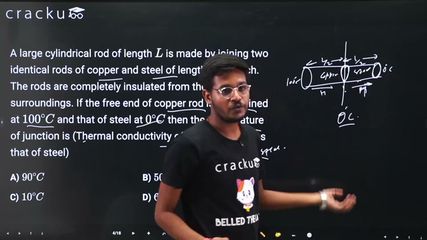
A large cylindrical rod of length $$L$$ is made by joining two identical rods of copper and steel of length $$\left(\frac{L}{2}\right)$$ each. The rods are completely insulated from the surroundings. If the free end of copper rod is maintained at $$100^\circ C$$ and that of steel at $$0^\circ C$$ then the temperature of junction is (Thermal conductivity of copper is $$9$$ times that of steel)
Since the two identical rods (copper and steel) are joined end-to-end and completely insulated from the surroundings, the heat transfer takes place under a steady-state condition. This implies that the rate of heat flow ($$H$$) through the copper rod must be exactly equal to the rate of heat flow through the steel rod:
$$H_{\text{copper}} = H_{\text{steel}}$$
The rate of heat conduction is given by Fourier's law:
$$H = \frac{KA(\Delta T)}{l}$$
Where:
Let $$\theta$$ be the temperature at the junction. We are given:
Equating the heat flow rates for both segments:
$$\frac{K_{\text{copper}} \cdot A \cdot (100 - \theta)}{l} = \frac{K_{\text{steel}} \cdot A \cdot (\theta - 0)}{l}$$
Since the physical dimensions $$A$$ and $$l$$ are identical, they cancel out from both sides:
$$K_{\text{copper}}(100 - \theta) = K_{\text{steel}}(\theta)$$
Substitute $$K_{\text{copper}} = 9K_{\text{steel}}$$ into the simplified equation:
$$9K_{\text{steel}}(100 - \theta) = K_{\text{steel}}(\theta)$$
Divide both sides by $$K_{\text{steel}}$$:
$$9(100 - \theta) = \theta$$
$$900 - 9\theta = \theta$$
$$10\theta = 900 \implies \theta = 90^\circ\text{C}$$
Concept Check: Because copper has a much higher thermal conductivity than steel ($$9$$ times higher), it requires a significantly smaller temperature drop ($$10^\circ\text{C}$$) to transfer the exact same amount of heat that steel transfers over a much larger temperature drop ($$90^\circ\text{C}$$).
Correct Option Key: Option A ($$90^\circ\text{C}$$)
Was this solution helpful?
Click on the Email ☝️ to Watch the Video Solution
Create a FREE account and get:
_1.webp)

Educational materials for JEE preparation

Ask our AI anything

AI can make mistakes. Please verify important information.
AI can make mistakes. Please verify important information.
