
Join Our JEE Preparation Group
Prep with like-minded aspirants; Get access to free daily tests and study material.
Sign in
Please select an account to continue using cracku.in
↓ →
Join Our JEE Preparation Group
Prep with like-minded aspirants; Get access to free daily tests and study material.
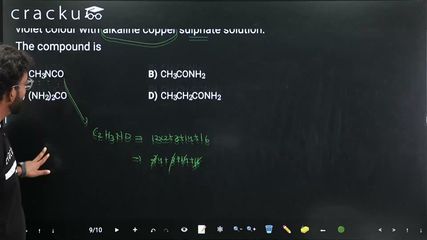
An organic compound having molecular mass $$60$$ is found to contain C $$= 20\%$$, H $$= 6.67\%$$ and N $$= 46.67\%$$ while rest is oxygen. On heating it gives NH$$_3$$ alongwith a solid residue. The solid residue give violet colour with alkaline copper sulphate solution. The compound is
First check which formula among the options matches the given percentage composition (C = 20 %, H = 6.67 %, N = 46.67 %, remainder O).
Let the unknown molecular formula be $$C_xH_yN_zO_w$$ with molar mass $$M = 60\ \text{g mol}^{-1}$$.
Convert percentages to gram-atoms in a 60 g sample:
Carbon: $$\dfrac{20}{100}\times 60 = 12\ \text{g} \;\Rightarrow\; \dfrac{12}{12}=1\ \text{mol}$$
Hydrogen: $$\dfrac{6.67}{100}\times 60 = 4\ \text{g} \;\Rightarrow\; \dfrac{4}{1}=4\ \text{mol}$$
Nitrogen: $$\dfrac{46.67}{100}\times 60 = 28\ \text{g} \;\Rightarrow\; \dfrac{28}{14}=2\ \text{mol}$$
Oxygen (by difference): $$60-(12+4+28)=16\ \text{g} \;\Rightarrow\; \dfrac{16}{16}=1\ \text{mol}$$
Hence the empirical formula is $$C_1H_4N_2O_1$$, i.e. $$CH_4N_2O$$.
The molar mass calculated from this empirical formula is
$$12 + 4(1) + 2(14) + 16 = 60\ \text{g mol}^{-1}$$, exactly the given molecular mass. Therefore the molecular formula is also $$CH_4N_2O$$, which is written structurally as $$(NH_2)_2CO$$ (urea).
Now examine the qualitative tests mentioned:
1. On heating, urea decomposes according to
$$\text{(NH}_2)_2CO \;\xrightarrow{\ \Delta\ }\; NH_3 + HNCO$$,
so evolution of $$NH_3$$ is observed — matching the statement.
2. Further heating of urea partially condenses molecules to form biuret, which contains the linkage $$-CO-NH-CO-NH-$$. Biuret gives a violet colour with alkaline $$CuSO_4$$ solution (the biuret test). The solid residue left after heating urea therefore answers this test, exactly as described.
Among the options, only Option C, $$(NH_2)_2CO$$, satisfies both the elemental composition and the heating/biuret observations.
Option C which is: (NH$$_2$$)$$_2$$CO
Was this solution helpful?
Click on the Email ☝️ to Watch the Video Solution
Create a FREE account and get:
_1.webp)

Educational materials for JEE preparation

Ask our AI anything

AI can make mistakes. Please verify important information.
AI can make mistakes. Please verify important information.
