
Join Our JEE Preparation Group
Prep with like-minded aspirants; Get access to free daily tests and study material.
Sign in
Please select an account to continue using cracku.in
↓ →
Join Our JEE Preparation Group
Prep with like-minded aspirants; Get access to free daily tests and study material.
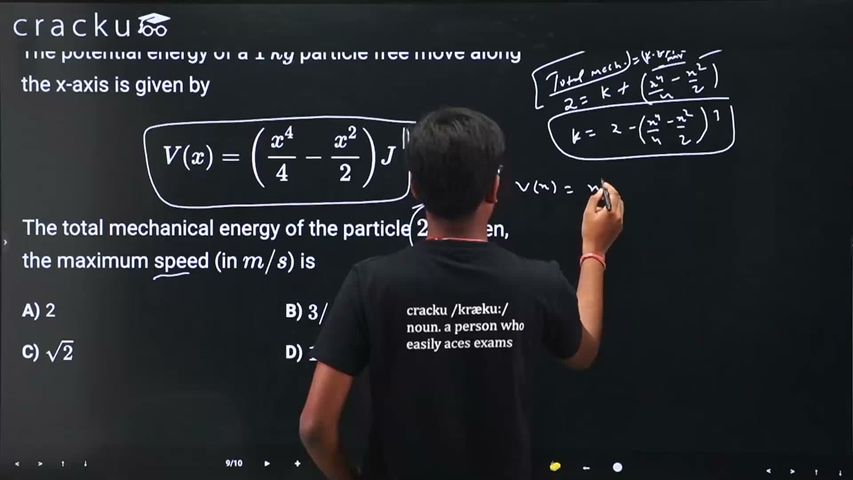
The potential energy of a $$1\,kg$$ particle free move along the x-axis is given by $$$V(x) = \left(\frac{x^4}{4} - \frac{x^2}{2}\right)J$$$ The total mechanical energy of the particle $$2\,J$$. Then, the maximum speed (in $$m/s$$) is
The total mechanical energy ($$E$$) of a particle is the sum of its kinetic energy ($$K$$) and its potential energy ($$V(x)$$):
$$E = K + V(x)$$
We are given the total mechanical energy $$E = 2 \,\, \text{J}$$ and the potential energy function:
$$V(x) = \frac{x^4}{4} - \frac{x^2}{2}$$
Substituting these values into the energy conservation equation allows us to express kinetic energy as a function of position:
$$K = E - V(x)$$
$$K = 2 - \left( \frac{x^4}{4} - \frac{x^2}{2} \right) \quad \text{--- (Eq. 1)}$$
The speed (and consequently the kinetic energy) of the particle reaches its maximum value when the potential energy ($$V(x)$$) is at a local minimum value. To find this minimum, we differentiate $$V(x)$$ with respect to $$x$$ and set it equal to zero:
$$\frac{dV}{dx} = \frac{d}{dx}\left( \frac{x^4}{4} - \frac{x^2}{2} \right) = 0$$
$$x^3 - x = 0$$
$$x(x^2 - 1) = 0 \implies x = 0 \quad \text{or} \quad x = \pm 1$$
To verify which point corresponds to a minimum potential energy well, we take the second derivative:
$$\frac{d^2V}{dx^2} = 3x^2 - 1$$
Thus, the minimum potential energy occurs at $$x = \pm 1$$. Let us compute this minimum potential energy value ($$V_{\text{min}}$$):
$$V_{\text{min}} = \frac{(\pm 1)^4}{4} - \frac{(\pm 1)^2}{2} = \frac{1}{4} - \frac{1}{2} = -\frac{1}{4} \,\, \text{J}$$
Substitute the value of $$V_{\text{min}}$$ back into Equation 1 to find the maximum possible kinetic energy ($$K_{\text{max}}$$):
$$K_{\text{max}} = E - V_{\text{min}} = 2 - \left(-\frac{1}{4}\right) = 2 + \frac{1}{4} = \frac{9}{4} \,\, \text{J}$$
The formula for kinetic energy in terms of mass ($$m = 1 \,\, \text{kg}$$) and maximum speed ($$v_{\text{max}}$$) is:
$$K_{\text{max}} = \frac{1}{2} \cdot m \cdot v_{\text{max}}^2$$
$$\frac{9}{4} = \frac{1}{2} \cdot (1) \cdot v_{\text{max}}^2$$
Multiply both sides by 2 to isolate the velocity variable:
$$v_{\text{max}}^2 = \frac{9}{2}$$
$$v_{\text{max}} = \sqrt{\frac{9}{2}} = \frac{3}{\sqrt{2}} \,\, \text{m/s}$$
Concept Check: Because total energy stays conserved, the particle exchanges potential and kinetic energy back and forth as it oscillates. It travels fastest precisely as it passes through the bottom valleys ($$x = \pm 1$$) of the potential graph where it converts maximum possible potential configurations into pure translational kinetic velocity.
Correct Option Key: Option B ($$3/\sqrt{2}$$)
Was this solution helpful?
Click on the Email ☝️ to Watch the Video Solution
Create a FREE account and get:
_1.webp)

Educational materials for JEE preparation

Ask our AI anything

AI can make mistakes. Please verify important information.
AI can make mistakes. Please verify important information.
