
Join Our JEE Preparation Group
Prep with like-minded aspirants; Get access to free daily tests and study material.
Sign in
Please select an account to continue using cracku.in
↓ →
Join Our JEE Preparation Group
Prep with like-minded aspirants; Get access to free daily tests and study material.
In 1st case, Carnot engine operates between temperatures 300 K and 100 K. In 2nd case, as shown in the figure, a combination of two engines is used. The efficiency of this combination (in 2nd case) will be :
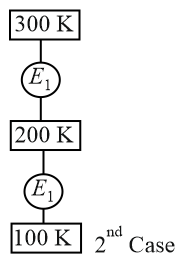
In the first case, a single Carnot engine operates between 300 K and 100 K. In the second case, a combination of two Carnot engines is used between the same temperature limits.
Since the efficiency of a Carnot engine is given by $$\eta = 1 - \frac{T_C}{T_H}$$, for the single engine we have $$\eta_1 = 1 - \frac{T_C}{T_H} = 1 - \frac{100}{300} = 1 - \frac{1}{3} = \frac{2}{3}$$.
Next, consider the series combination of two Carnot engines: Engine 1 operates between the hot reservoir at $$T_H = 300\text{ K}$$ and an intermediate temperature $$T$$, while Engine 2 operates between $$T$$ and the cold reservoir at $$T_C = 100\text{ K}$$. The heat rejected by Engine 1 becomes the heat absorbed by Engine 2.
Let $$Q_1$$ be the heat absorbed by Engine 1. Then the work done by Engine 1 is $$W_1 = Q_1\left(1 - \frac{T}{300}\right)$$, and the heat rejected by Engine 1 is $$Q_2 = Q_1 \cdot \frac{T}{300}$$, which is absorbed by Engine 2.
For Engine 2, the work done is $$W_2 = Q_2\left(1 - \frac{100}{T}\right) = Q_1 \cdot \frac{T}{300}\left(1 - \frac{100}{T}\right)$$. Simplifying this gives $$W_2 = Q_1\left(\frac{T}{300} - \frac{100}{300}\right) = Q_1\left(\frac{T - 100}{300}\right)$$.
Therefore, the total work output from the combination is $$W_{\text{total}} = W_1 + W_2 = Q_1\left(1 - \frac{T}{300}\right) + Q_1\left(\frac{T - 100}{300}\right)$$. Substituting and combining terms yields $$W_{\text{total}} = Q_1\left(1 - \frac{100}{300}\right) = Q_1 \times \frac{2}{3}$$.
It follows that the overall efficiency of the combination is $$\eta_{\text{combination}} = \frac{W_{\text{total}}}{Q_1} = \frac{2}{3}$$, which is exactly the same as the efficiency of the single Carnot engine between 300 K and 100 K.
This result is consistent with the principle that two Carnot engines arranged in series have the same overall efficiency as a single Carnot engine operating between the same extreme temperatures, regardless of the choice of intermediate temperature.
Answer: Option A: same as the 1st case
Was this solution helpful?
Create a FREE account and get:
_1.webp)

Educational materials for JEE preparation

Ask our AI anything

AI can make mistakes. Please verify important information.
AI can make mistakes. Please verify important information.
