
Join Our JEE Preparation Group
Prep with like-minded aspirants; Get access to free daily tests and study material.
Sign in
Please select an account to continue using cracku.in
↓ →
Join Our JEE Preparation Group
Prep with like-minded aspirants; Get access to free daily tests and study material.
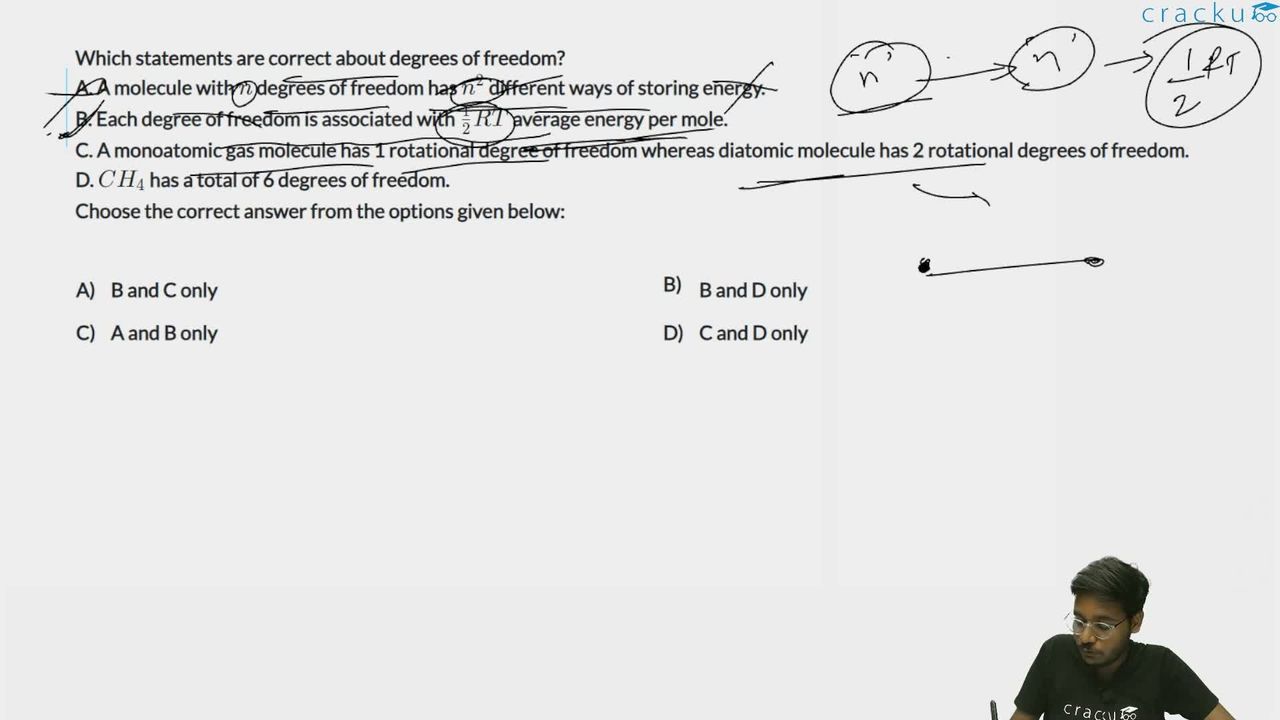
Which statements are correct about degrees of freedom?
A. A molecule with $$n$$ degrees of freedom has $${n^{2}}$$ different ways of storing energy.
B. Each degree of freedom is associated with $$\frac{1}{2}RT$$ average energy per mole.
C. A monoatomic gas molecule has 1 rotational degree of freedom whereas diatomic molecule has 2 rotational degrees of freedom.
D. $$CH_4$$ has a total of 6 degrees of freedom.
Choose the correct answer from the options given below:
Let's understand degrees of freedom step by step. Degrees of freedom refer to the independent ways a molecule can store energy, including translational, rotational, and vibrational motions. We'll evaluate each statement one by one.
Starting with statement A: "A molecule with $$n$$ degrees of freedom has $$n^{2}$$ different ways of storing energy." This is incorrect. The number of degrees of freedom (n) directly corresponds to the number of independent quadratic terms in the energy expression (like $$\frac{1}{2}mv_x^2$$ for translational motion). There is no squaring involved; the energy is distributed equally among the n degrees of freedom according to the equipartition theorem. Thus, statement A is false.
Now statement B: "Each degree of freedom is associated with $$\frac{1}{2}RT$$ average energy per mole." This is correct. The equipartition theorem states that each quadratic degree of freedom contributes $$\frac{1}{2}kT$$ per molecule. Since $$R = N_A k$$ (where $$N_A$$ is Avogadro's number), per mole, this becomes $$\frac{1}{2}RT$$. This applies to translational and rotational degrees of freedom at standard temperatures. Therefore, statement B is true.
Statement C: "A monoatomic gas molecule has 1 rotational degree of freedom whereas diatomic molecule has 2 rotational degrees of freedom." This is partially incorrect. A monoatomic molecule (like helium or argon) is a point mass with no significant rotational inertia. It has 0 rotational degrees of freedom. A diatomic molecule (like nitrogen or oxygen) has 2 rotational degrees of freedom, as it can rotate about two axes perpendicular to the molecular axis (rotation along the molecular axis is negligible). Since the monoatomic part is wrong (it should be 0, not 1), statement C is false.
Statement D: "$$CH_4$$ has a total of 6 degrees of freedom." For methane ($$CH_4$$), which is a non-linear polyatomic molecule (tetrahedral structure), we calculate degrees of freedom as follows: Total atoms = 5 (1 carbon + 4 hydrogen). Total degrees of freedom without constraints = 3N = 3 × 5 = 15. However, at standard temperatures, vibrational modes are not excited, so we only consider translational and rotational degrees of freedom. Translational degrees of freedom = 3 (for any molecule in 3D space). Rotational degrees of freedom for a non-linear molecule = 3. Thus, total degrees of freedom = 3 (translational) + 3 (rotational) = 6. Therefore, statement D is true.
Summarizing: A is false, B is true, C is false, D is true. The true statements are B and D.
Now, looking at the options:
Hence, the correct answer is Option B.
Was this solution helpful?
Click on the Email ☝️ to Watch the Video Solution
Create a FREE account and get:
_1.webp)

Educational materials for JEE preparation

Ask our AI anything

AI can make mistakes. Please verify important information.
AI can make mistakes. Please verify important information.
