
Join Our JEE Preparation Group
Prep with like-minded aspirants; Get access to free daily tests and study material.
Sign in
Please select an account to continue using cracku.in
↓ →
Join Our JEE Preparation Group
Prep with like-minded aspirants; Get access to free daily tests and study material.
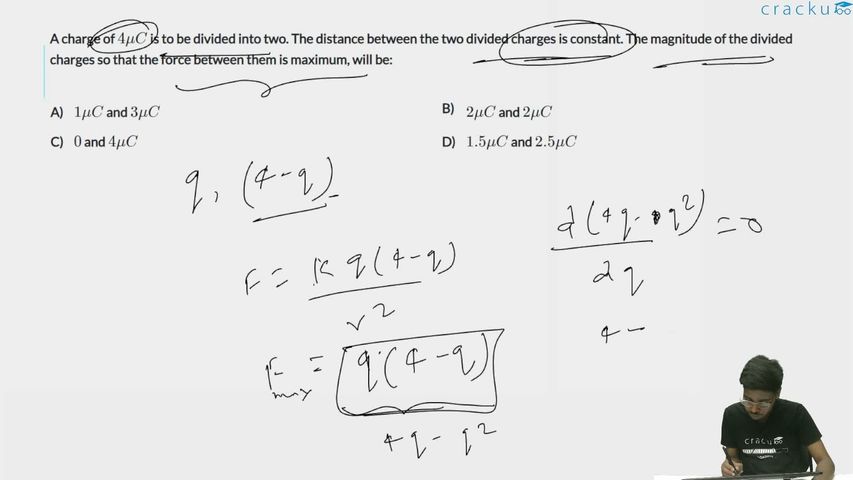
A charge of $$4\mu C$$ is to be divided into two. The distance between the two divided charges is constant. The magnitude of the divided charges so that the force between them is maximum, will be:
Total charge available: $$Q = 4\,\mu C$$. This charge is split into two parts: one part is $$q$$ and the other is $$Q-q = 4 - q$$, with $$0 \le q \le 4$$.
The two charges are kept at a fixed separation $$r$$. Coulomb’s law gives the magnitude of the electrostatic force between them as
$$F = k\,\frac{q\,(4-q)}{r^{2}}$$
where $$k = 9 \times 10^{9}\,{\rm N\,m^{2}\,C^{-2}}$$ is Coulomb’s constant.
Since $$k$$ and $$r$$ are constants, maximising $$F$$ is the same as maximising the product
$$f(q) = q\,(4-q)$$
Expand $$f(q)$$:
$$f(q) = 4q - q^{2}$$
This is a concave-down parabola in $$q$$. The maximum of a quadratic $$-q^{2}+4q$$ occurs at its vertex.
For a quadratic $$ax^{2}+bx+c$$ with $$a \lt 0$$, the vertex is at $$x = -\frac{b}{2a}$$.
Here, $$a = -1$$ and $$b = 4$$, so
$$q_{\text{max}} = -\frac{4}{2(-1)} = 2$$
Thus the first charge should be $$q = 2\,\mu C$$ and the second charge is
$$(4 - q)\,\mu C = (4 - 2)\,\mu C = 2\,\mu C$$
Therefore, to obtain the maximum possible electrostatic force, the charge should be divided equally:
Case of maximum force: $$2\,\mu C$$ and $$2\,\mu C$$
Option B is correct.
Was this solution helpful?
Click on the Email ☝️ to Watch the Video Solution
Create a FREE account and get:
_1.webp)

Educational materials for JEE preparation

Ask our AI anything

AI can make mistakes. Please verify important information.
AI can make mistakes. Please verify important information.
