
Join Our JEE Preparation Group
Prep with like-minded aspirants; Get access to free daily tests and study material.
Sign in
Please select an account to continue using cracku.in
↓ →
Join Our JEE Preparation Group
Prep with like-minded aspirants; Get access to free daily tests and study material.
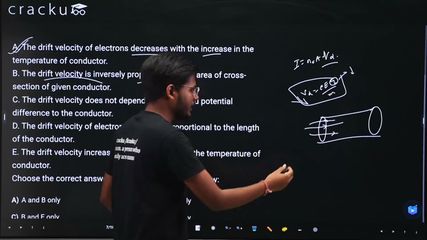
A. The drift velocity of electrons decreases with the increase in the temperature of conductor.
B. The drift velocity is inversely proportional to the area of cross-section of given conductor.
C. The drift velocity does not depend on the applied potential difference to the conductor.
D. The drift velocity of electron is inversely proportional to the length of the conductor.
E. The drift velocity increases with the increase in the temperature of conductor.
Choose the correct answer from the options given below:
We need to identify the correct statements about the drift velocity of electrons in a conductor.
Key Formula for Drift Velocity:
The drift velocity is given by:
$$v_d = \frac{eE\tau}{m}$$
where $$e$$ is the electron charge, $$E$$ is the electric field, $$\tau$$ is the mean relaxation time, and $$m$$ is the electron mass.
Since the electric field $$E = \frac{V}{L}$$ (where $$V$$ is the potential difference and $$L$$ is the conductor length):
$$v_d = \frac{e\tau}{m} \cdot \frac{V}{L}$$
Also, from $$I = neAv_d$$, we get $$v_d = \frac{I}{neA}$$, and using Ohm's law $$I = \frac{V}{R} = \frac{VA}{\rho L}$$:
$$v_d = \frac{V}{neA} \cdot \frac{A}{\rho L} = \frac{V}{ne\rho L}$$
Statement A: "The drift velocity of electrons decreases with increase in temperature."
When temperature increases, lattice vibrations increase, causing more frequent collisions with electrons. This reduces the relaxation time $$\tau$$.
Since $$v_d = \frac{eE\tau}{m}$$, a decrease in $$\tau$$ leads to a decrease in $$v_d$$ (for a given electric field).
Also, since resistivity $$\rho$$ increases with temperature, from $$v_d = \frac{V}{ne\rho L}$$, $$v_d$$ decreases when $$\rho$$ increases (for a given $$V$$ and $$L$$).
Statement A is CORRECT.
Statement B: "The drift velocity is inversely proportional to the area of cross-section."
From $$v_d = \frac{e\tau}{m} \cdot \frac{V}{L}$$, the drift velocity depends on $$V$$ and $$L$$ but NOT on the cross-sectional area $$A$$.
Similarly, from $$v_d = \frac{V}{ne\rho L}$$, the area $$A$$ does not appear.
Note: While $$v_d = \frac{I}{neA}$$ has $$A$$ in the denominator, for a given $$V$$, $$I$$ itself is proportional to $$A$$ (since $$R = \frac{\rho L}{A}$$, so $$I = \frac{VA}{\rho L}$$). These effects cancel out, making $$v_d$$ independent of $$A$$.
Statement B is INCORRECT.
Statement C: "The drift velocity does not depend on the applied potential difference."
From $$v_d = \frac{e\tau}{m} \cdot \frac{V}{L}$$, the drift velocity is directly proportional to the applied potential difference $$V$$.
Statement C is INCORRECT.
Statement D: "The drift velocity of electron is inversely proportional to the length of the conductor."
From $$v_d = \frac{e\tau}{m} \cdot \frac{V}{L}$$, for a given potential difference $$V$$, the drift velocity is inversely proportional to the length $$L$$ of the conductor.
This is because a longer conductor has a weaker electric field $$E = V/L$$ for the same applied voltage, resulting in lower drift velocity.
Statement D is CORRECT.
Statement E: "The drift velocity increases with increase in temperature."
As explained in Statement A, drift velocity decreases (not increases) with temperature, because the relaxation time $$\tau$$ decreases due to increased lattice vibrations.
Statement E is INCORRECT.
The correct statements are A and D.
Answer: Option B: A and D only
Was this solution helpful?
Click on the Email ☝️ to Watch the Video Solution
Create a FREE account and get:
_1.webp)

Educational materials for JEE preparation

Ask our AI anything

AI can make mistakes. Please verify important information.
AI can make mistakes. Please verify important information.
