
Join Our JEE Preparation Group
Prep with like-minded aspirants; Get access to free daily tests and study material.
Sign in
Please select an account to continue using cracku.in
↓ →
Join Our JEE Preparation Group
Prep with like-minded aspirants; Get access to free daily tests and study material.
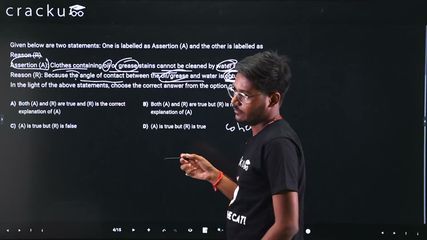
Given below are two statements: One is labelled as Assertion (A) and the other is labelled as Reason (R).
Assertion (A): Clothes containing oil or grease stains cannot be cleaned by water wash.
Reason (R): Because the angle of contact between the oil/grease and water is obtuse.
In the light of the above statements, choose the correct answer from the option given below.
We consider the Assertion (A) which states that clothes with oil or grease stains cannot be cleaned by water wash alone. This is a well-known fact — water alone cannot remove oil or grease stains because water does not wet oily surfaces effectively; a detergent or soap is needed. So the Assertion is true.
Now we consider the Reason (R), which states that the angle of contact between oil/grease and water is obtuse. When water comes in contact with a greasy surface, the adhesive forces between water and grease are much weaker than the cohesive forces within water. This results in an obtuse (greater than $$90^\circ$$) contact angle, meaning water does not spread over the greasy surface. Since the contact angle is obtuse, water cannot penetrate and dissolve the grease, which is precisely why water alone fails to clean such stains. So the Reason is true, and it correctly explains the Assertion.
Hence, the correct answer is Option A.
Was this solution helpful?
Click on the Email ☝️ to Watch the Video Solution
Create a FREE account and get:
_1.webp)

Educational materials for JEE preparation

Ask our AI anything

AI can make mistakes. Please verify important information.
AI can make mistakes. Please verify important information.
