
Join Our JEE Preparation Group
Prep with like-minded aspirants; Get access to free daily tests and study material.
Sign in
Please select an account to continue using cracku.in
↓ →
Join Our JEE Preparation Group
Prep with like-minded aspirants; Get access to free daily tests and study material.
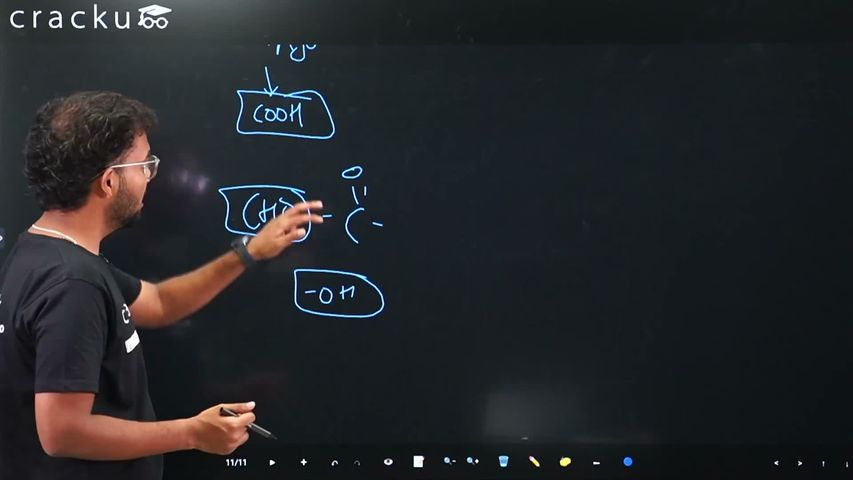
Alkyl side-chains attached to an aromatic ring that contain at least one benzylic hydrogen are oxidised by strong oxidising agents such as alkaline or acidic $$KMnO_4$$ to a single product: the carboxylic acid $$\left(-COOH\right)$$ derivative of the ring, irrespective of the length of the side chain.
Ethyl benzene is $$C_6H_5CH_2CH_3$$. The benzylic carbon (the $$CH_2$$ directly bonded to the ring) possesses benzylic hydrogens, so it is susceptible to oxidation.
On treatment with hot, acidic or basic $$KMnO_4$$:
$$C_6H_5CH_2CH_3 \;\xrightarrow[\text{heat}]{KMnO_4} \; C_6H_5COOH + CO_2 + H_2O$$
The entire side-chain—here $$CH_2CH_3$$—is ultimately cleaved down to one carbon attached to the ring, which is converted into the carboxyl group $$-COOH$$. Hence the aromatic product is benzoic acid $$C_6H_5COOH$$.
Checking the options:
Option A: benzophenone - requires oxidation of two phenyl rings attached to a carbonyl; not formed here.
Option B: acetophenone - has a carbonyl group but no oxidising pathway from ethyl benzene under these conditions.
Option C: benzoic acid - matches the reaction product.
Option D: benzyl alcohol - is formed by mild reduction, not oxidation.
Therefore, the compound obtained is benzoic acid.
Option C which is: benzoic acid
Was this solution helpful?
Click on the Email ☝️ to Watch the Video Solution
Create a FREE account and get:
_1.webp)

Educational materials for JEE preparation

Ask our AI anything

AI can make mistakes. Please verify important information.
AI can make mistakes. Please verify important information.
