
Join Our JEE Preparation Group
Prep with like-minded aspirants; Get access to free daily tests and study material.
Sign in
Please select an account to continue using cracku.in
↓ →
Join Our JEE Preparation Group
Prep with like-minded aspirants; Get access to free daily tests and study material.
Acid strength in covalent compounds is governed mainly by two factors:
1. Ease of $$H^+$$ release (polarity of the $$H-X$$ bond and its bond strength).
2. Stability of the conjugate base that remains after the proton leaves (greater stability ⇒ stronger acid).
With these ideas, examine each statement:
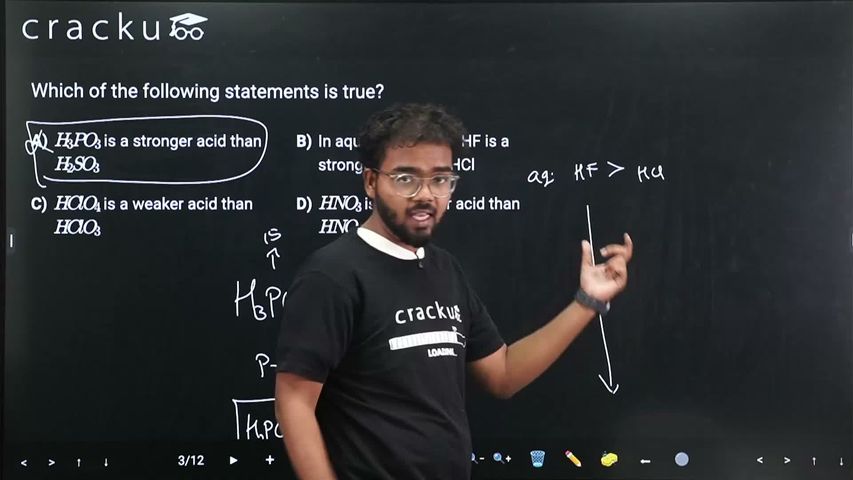
Case A:
$$H_3PO_3$$ vs $$H_2SO_3$$
• Both are oxy-acids, but the central atoms differ. Phosphorus is less electronegative than sulphur, so the $$P-O$$ bond is less polar than the $$S-O$$ bond.
• Moreover, the conjugate base $$H_2PO_3^-$$ is less stabilised by resonance than $$HSO_3^-$$.
Hence $$H_2SO_3$$ is the stronger acid.
Statement A is false.
Case B:
Binary hydrogen halides in water become stronger acids down the group: $$HF \lt HCl \lt HBr \lt HI$$.
• Although $$F$$ is the most electronegative, the very strong $$H-F$$ bond (and partial hydrogen bonding) makes dissociation difficult.
• Therefore HF is the weakest of the common hydrogen halides in aqueous solution.
Statement B is false.
Case C:
Oxo-acids of the same halogen: acid strength increases with oxidation number of the central atom because extra $$O$$ atoms pull electron density away and stabilise the conjugate base by resonance.
• $$Cl$$ oxidation states: $$+7$$ in $$HClO_4$$ vs $$+5$$ in $$HClO_3$$.
• Thus $$HClO_4$$ ≫ $$HClO_3$$ in acid strength.
Statement C is false.
Case D:
Oxo-acids of nitrogen: $$HNO_3$$ (oxidation state $$+5$$) and $$HNO_2$$ (oxidation state $$+3$$). Greater oxidation state gives better delocalisation and stability of the conjugate base $$NO_3^-$$ compared with $$NO_2^-$$, so $$HNO_3$$ is indeed the stronger acid. Statement D is true.
Hence the only correct statement is
Option D which is: $$HNO_3$$ is a stronger acid than $$HNO_2$$.
Was this solution helpful?
Click on the Email ☝️ to Watch the Video Solution
Create a FREE account and get:
_1.webp)

Educational materials for JEE preparation

Ask our AI anything

AI can make mistakes. Please verify important information.
AI can make mistakes. Please verify important information.
