
Join Our JEE Preparation Group
Prep with like-minded aspirants; Get access to free daily tests and study material.
Sign in
Please select an account to continue using cracku.in
↓ →
Join Our JEE Preparation Group
Prep with like-minded aspirants; Get access to free daily tests and study material.
Statement 1: If the system of equations $$x + ky + 3z = 0$$, $$3x + ky - 2z = 0$$, $$2x + 3y - 4z = 0$$ has a nontrivial solution, then the value of $$k$$ is $$\frac{31}{2}$$. Statement 2: A system of three homogeneous equations in three variables has a non trivial solution if the determinant of the coefficient matrix is zero.
The coefficient matrix of the given homogeneous system is
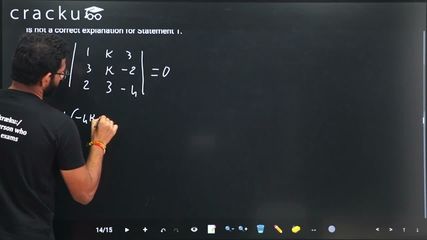
$$A=\begin{vmatrix} 1 & k & 3 \\ 3 & k & -2 \\ 2 & 3 & -4 \end{vmatrix}$$
A homogeneous system of three linear equations in three unknowns possesses a non-trivial solution iff $$\det(A)=0$$ (this is the content of Statement 2).
Compute the determinant by expanding along the first row:
$$\det(A)= 1\Big(k(-4)-(-2)(3)\Big) -k\Big(3(-4)-(-2)(2)\Big) +3\Big(3\cdot3-k\cdot2\Big)$$
Simplify term by term:
1st term $$=1(-4k+6)=6-4k$$
2nd term $$=-k(-12+4)=8k$$
3rd term $$=3(9-2k)=27-6k$$
Add them:
$$\det(A)=(6-4k)+(8k)+(27-6k)=33-2k$$
Setting $$\det(A)=0$$ for a non-trivial solution gives
$$33-2k=0\quad\Longrightarrow\quad k=\frac{33}{2}$$
Statement 1 claims $$k=\frac{31}{2}$$, which is incorrect. Statement 2 is the well-known theorem just used and is therefore true.
Hence the correct option is:
Option A which is: Statement 1 is false, Statement 2 is true.
Was this solution helpful?
Click on the Email ☝️ to Watch the Video Solution
Create a FREE account and get:
_1.webp)

Educational materials for JEE preparation

Ask our AI anything

AI can make mistakes. Please verify important information.
AI can make mistakes. Please verify important information.


