
Join Our JEE Preparation Group
Prep with like-minded aspirants; Get access to free daily tests and study material.
Sign in
Please select an account to continue using cracku.in
↓ →
Join Our JEE Preparation Group
Prep with like-minded aspirants; Get access to free daily tests and study material.
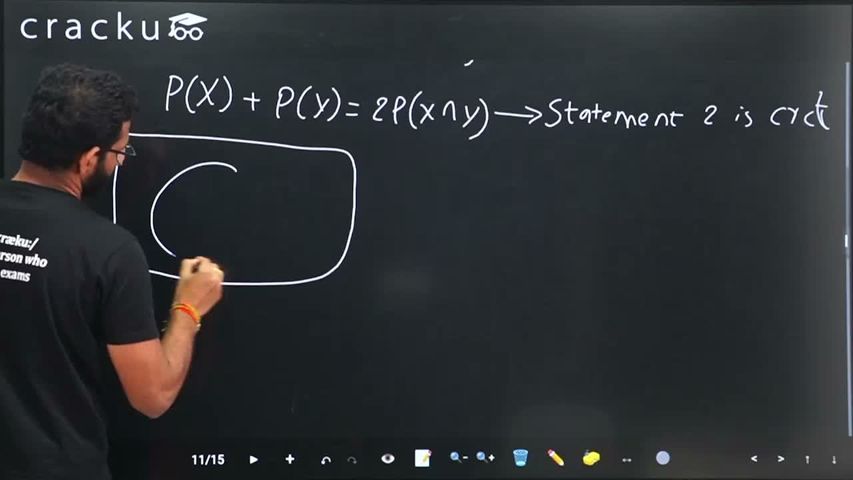
Let $$X$$ and $$Y$$ are two events such that $$P(X \cup Y) = P(X \cap Y)$$. Statement 1: $$P(X \cap Y') = P(X' \cap Y) = 0$$ Statement 2: $$P(X) + P(Y) = 2 P(X \cap Y)$$
For any two events $$X$$ and $$Y$$ in the same sample space, the addition theorem of probability says
$$P(X \cup Y)=P(X)+P(Y)-P(X \cap Y) \qquad -(1)$$
The question states that $$P(X \cup Y)=P(X \cap Y)$$. Substituting this into $$-(1)$$ gives
$$P(X \cap Y)=P(X)+P(Y)-P(X \cap Y)$$
$$\Longrightarrow$$ $$P(X)+P(Y)=2\,P(X \cap Y) \qquad -(2)$$
Equation $$-(2)$$ is exactly Statement 2, so Statement 2 is true.
Next, compare the sets $$X \cup Y$$ and $$X \cap Y$$. Since $$X \cap Y \subseteq X \cup Y$$, we always have $$P(X \cap Y)\le P(X \cup Y)$$. The given equality tells us that no probability lies in the parts of $$X$$ and $$Y$$ that are outside their intersection.
The parts outside the intersection are
• $$X \cap Y'$$ (elements in $$X$$ but not in $$Y$$) and
• $$X' \cap Y$$ (elements in $$Y$$ but not in $$X$$).
Hence
$$P(X \cap Y')=0, \qquad P(X' \cap Y)=0 \qquad -(3)$$
which is exactly Statement 1, so Statement 1 is also true.
Does Statement 2 explain Statement 1? Statement 2 is a consequence of the given equality via the addition theorem, whereas Statement 1 is obtained by comparing the regions of a Venn diagram (or by writing $$P(X\cup Y)=P(X\cap Y)+P(X\cap Y')+P(X'\cap Y)$$ and using the equality). Thus Statement 2 does not logically lead to Statement 1; both are independent consequences of the same given condition.
Therefore, the correct choice is:
Option B - Statement 1 is true, Statement 2 is true, but Statement 2 is not a correct explanation of Statement 1.
Was this solution helpful?
Click on the Email ☝️ to Watch the Video Solution
Create a FREE account and get:
_1.webp)

Educational materials for JEE preparation

Ask our AI anything

AI can make mistakes. Please verify important information.
AI can make mistakes. Please verify important information.


