
Join Our JEE Preparation Group
Prep with like-minded aspirants; Get access to free daily tests and study material.
Sign in
Please select an account to continue using cracku.in
↓ →
Join Our JEE Preparation Group
Prep with like-minded aspirants; Get access to free daily tests and study material.
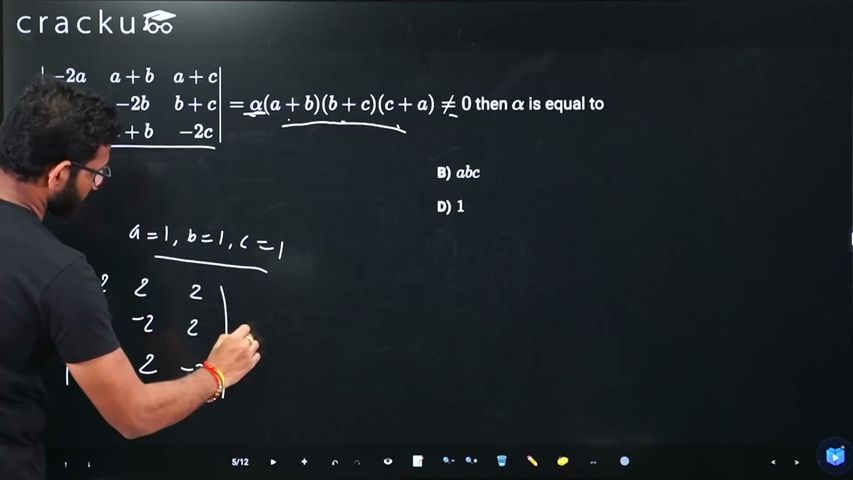
If $$\begin{vmatrix}-2a & a+b & a+c \\ b+a & -2b & b+c \\ c+a & c+b & -2c\end{vmatrix} = \alpha(a+b)(b+c)(c+a) \ne 0$$ then $$\alpha$$ is equal to
Let
$$D=\begin{vmatrix}-2a & a+b & a+c \\ a+b & -2b & b+c \\ a+c & b+c & -2c\end{vmatrix}.$$
Since
$$D=\alpha(a+b)(b+c)(c+a),$$
the determinant is a homogeneous polynomial of degree $$3$$ in $$a,b,c$$.
To determine the constant $$\alpha$$, it is sufficient to substitute convenient values of $$a,b,c$$ such that
$$(a+b)(b+c)(c+a)\neq0.$$
Choose
$$a=b=c=1.$$
Then
$$D=\begin{vmatrix}-2 & 2 & 2 \\ 2 & -2 & 2 \\ 2 & 2 & -2\end{vmatrix}.$$
For a matrix of order $$3$$ having diagonal entry $$x$$ and all off-diagonal entries equal to $$y,$$ the determinant is
$$(x-y)^2(x+2y).$$
Here
$$x=-2,\qquad y=2.$$
Therefore,
$$D=(-2-2)^2(-2+2\cdot2).$$
Hence,
$$D=(-4)^2(2)=32.$$
Also,
$$(a+b)(b+c)(c+a)=(1+1)(1+1)(1+1)=8.$$
Using
$$D=\alpha(a+b)(b+c)(c+a),$$
we get
$$32=8\alpha.$$
Therefore,
$$\alpha=4.$$
Was this solution helpful?
Click on the Email ☝️ to Watch the Video Solution
Create a FREE account and get:
_1.webp)

Educational materials for JEE preparation

Ask our AI anything

AI can make mistakes. Please verify important information.
AI can make mistakes. Please verify important information.
