
Join Our JEE Preparation Group
Prep with like-minded aspirants; Get access to free daily tests and study material.
Sign in
Please select an account to continue using cracku.in
↓ →
Join Our JEE Preparation Group
Prep with like-minded aspirants; Get access to free daily tests and study material.
The frequency distribution of daily working expenditure of families in a locality is as follows:
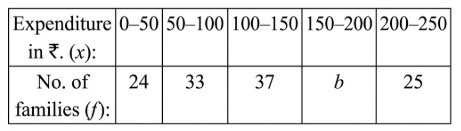
If the mode of the distribution is Rs. 140, then the value of $$b$$ is
The class-interval that contains the modal value Rs. 140 is the interval $$140\!-\!160$$. Hence this is the modal class.
Let
$$l = 140$$ be the lower boundary of the modal class,
$$h = 20$$ be the class width,
$$f_1 = b$$ be the frequency of the modal class,
$$f_0 = 36$$ be the frequency of the class just before the modal class, and
$$f_2 = 31$$ be the frequency of the class just after the modal class.
The empirical formula for the mode of a grouped frequency distribution is
$$
\text{Mode} = l + \frac{f_1 - f_0}{2f_1 - f_0 - f_2}\;h
$$
Substituting the numerical values and the given mode (Rs. 140), we get
$$
140 = 140 + \frac{b - 36}{2b - 36 - 31}\;(20)
$$
Since the two 140’s on either side are the same, the additive term on the right must be zero. That happens only when the numerator vanishes, i.e.
$$
b - 36 = 0 \quad\Longrightarrow\quad b = 36.
$$
Thus the missing frequency is $$b = 36$$.
Option D which is: 36
Was this solution helpful?
Create a FREE account and get:
_1.webp)

Educational materials for JEE preparation

Ask our AI anything

AI can make mistakes. Please verify important information.
AI can make mistakes. Please verify important information.


