
Join Our JEE Preparation Group
Prep with like-minded aspirants; Get access to free daily tests and study material.
Sign in
Please select an account to continue using cracku.in
↓ →
Join Our JEE Preparation Group
Prep with like-minded aspirants; Get access to free daily tests and study material.
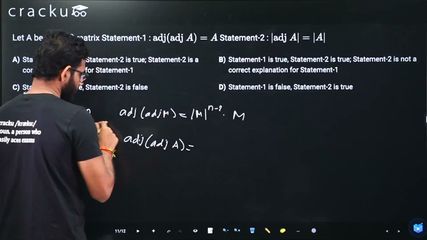
Let A be a $$2 \times 2$$ matrix Statement-1 : $$\text{adj}(\text{adj } A) = A$$ Statement-2 : $$|\text{adj } A| = |A|$$
Let $$A=\begin{pmatrix}a & b\\c & d\end{pmatrix}$$ be any $$2\times2$$ matrix. We test each statement separately and then examine the linkage.
Statement-1 : $$\text{adj}(\text{adj }A)=A$$
Recall the general result for an $$n\times n$$ matrix $$M$$: $$\text{adj}(\text{adj }M)=|M|^{\,n-2}\,M$$.
Here $$n=2$$, so $$n-2=0$$ and hence $$|M|^{\,0}=1$$. Therefore, for every $$2\times2$$ matrix $$A$$,
$$\text{adj}(\text{adj }A)=|A|^{\,0}\,A =A.$$
This equality holds whether $$|A|$$ is zero or non-zero because the factor $$|A|^{\,0}$$ is always $$1$$. Thus Statement-1 is true.
Statement-2 : $$|\text{adj }A|=|A|$$
For any square matrix of order $$n$$, $$|\text{adj }A|=|A|^{\,n-1}$$.
Setting $$n=2$$ gives
$$|\text{adj }A|=|A|^{\,2-1}=|A|.$$
Hence Statement-2 is also true for every $$2\times2$$ matrix.
Relation between the statements
Statement-1 talks about taking the adjugate twice, whereas Statement-2 only gives the determinant of the first adjugate. Knowing $$|\text{adj }A|$$ does not, by itself, prove that $$\text{adj}(\text{adj }A)=A$$. Therefore Statement-2 is not the reason for Statement-1.
Thus the correct choice is:
Option B — both statements are true, but Statement-2 is not a correct explanation for Statement-1.
Was this solution helpful?
Click on the Email ☝️ to Watch the Video Solution
Create a FREE account and get:
_1.webp)

Educational materials for JEE preparation

Ask our AI anything

AI can make mistakes. Please verify important information.
AI can make mistakes. Please verify important information.
