
Join Our JEE Preparation Group
Prep with like-minded aspirants; Get access to free daily tests and study material.
Sign in
Please select an account to continue using cracku.in
↓ →
Join Our JEE Preparation Group
Prep with like-minded aspirants; Get access to free daily tests and study material.
Let $$A$$ and $$B$$ be two symmetric matrices of order 3. This question has Statement-1 and Statement-2. Of the four choices given after the statements, choose the one that best describes the two statements. Statement-1: $$A(BA)$$ and $$(AB)A$$ are symmetric matrices. Statement-2: $$AB$$ is symmetric matrix if matrix multiplication of $$A$$ and $$B$$ is commutative.
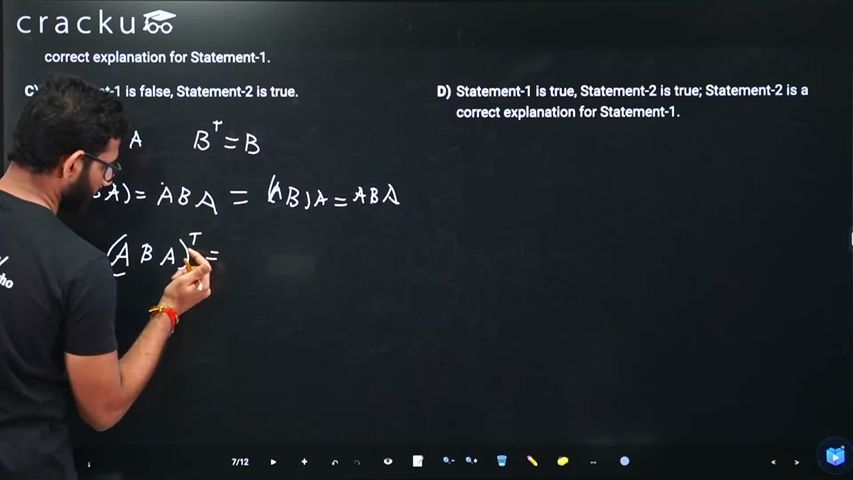
Let $$A$$ and $$B$$ be symmetric $$3 \times 3$$ matrices, so $$A^{T}=A$$ and $$B^{T}=B$$.
Case 1: Matrix $$A(BA)$$
Write it in the compact form $$ABA$$ (associativity of matrix multiplication).
Take the transpose:
$$\bigl(ABA\bigr)^{T}=A^{T}B^{T}A^{T}\;$$ (because $$\left(XY\right)^{T}=Y^{T}X^{T}$$).
Since $$A^{T}=A$$ and $$B^{T}=B$$, we get
$$\bigl(ABA\bigr)^{T}=ABA.$$
Thus $$A(BA)=ABA$$ is symmetric.
Case 2: Matrix $$(AB)A$$
Again, by associativity, $$(AB)A=ABA$$, the same product as above.
Hence its transpose is identical to the previous case:
$$\bigl((AB)A\bigr)^{T}=(ABA)^{T}=ABA=(AB)A.$$
Therefore $$(AB)A$$ is also symmetric.
Consequently, Statement-1 is true.
Verification of Statement-2: If the multiplication of $$A$$ and $$B$$ is commutative, i.e. $$AB=BA$$, then
$$(AB)^{T}=B^{T}A^{T}=BA.$$
Using the given commutativity, $$BA=AB$$, so
$$ (AB)^{T}=AB,$$
which shows that $$AB$$ is symmetric whenever $$AB=BA$$. Hence Statement-2 is also true.
Does Statement-2 explain Statement-1?
The symmetry of $$A(BA)$$ and $$(AB)A$$ was obtained solely from the facts that $$A$$ and $$B$$ are symmetric and from associativity; we never used the additional condition $$AB=BA$$. Therefore Statement-2 is not the reasoning behind Statement-1.
Option A is correct: Statement-1 is true, Statement-2 is true, but Statement-2 is not a correct explanation of Statement-1.
Was this solution helpful?
Click on the Email ☝️ to Watch the Video Solution
Create a FREE account and get:
_1.webp)

Educational materials for JEE preparation

Ask our AI anything

AI can make mistakes. Please verify important information.
AI can make mistakes. Please verify important information.


