
Join Our JEE Preparation Group
Prep with like-minded aspirants; Get access to free daily tests and study material.
Sign in
Please select an account to continue using cracku.in
↓ →
Join Our JEE Preparation Group
Prep with like-minded aspirants; Get access to free daily tests and study material.
Given $$\frac{b+c}{11} = \frac{c+a}{12} = \frac{a+b}{13}$$ for a $$\triangle ABC$$ with usual notation. If $$\frac{\cos A}{\alpha} = \frac{\cos B}{\beta} = \frac{\cos C}{\gamma}$$, then the ordered triad $$(\alpha, \beta, \gamma)$$ has a value:
1. Find the sides in terms of a constant
Let us set the given equations to a constant $$k$$.
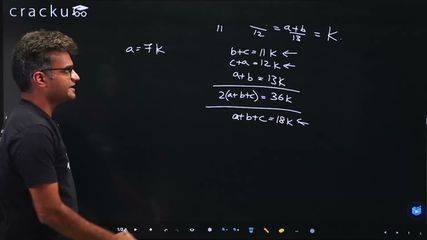
$$\frac{b+c}{11} = \frac{c+a}{12} = \frac{a+b}{13} = k$$
This gives us a system of three simple equations:
Add all three equations together to find the perimeter in terms of $$k$$:
$$2(a + b + c) = 36k$$
$$a + b + c = 18k$$
Now, subtract each original equation from this sum to find the individual sides $$a$$, $$b$$, and $$c$$:
2. Apply the Cosine Rule
Since we know the sides are proportional to 7, 6, and 5, we can drop the $$k$$ for the ratio calculations or keep it. It will cancel out anyway. Let us use the standard cosine formulas.
For angle A:
$$\cos A = \frac{b^2 + c^2 - a^2}{2bc}$$
$$\cos A = \frac{36k^2 + 25k^2 - 49k^2}{2(6k)(5k)}$$
$$\cos A = \frac{12k^2}{60k^2} = \frac{1}{5}$$
For angle B:
$$\cos B = \frac{a^2 + c^2 - b^2}{2ac}$$
$$\cos B = \frac{49k^2 + 25k^2 - 36k^2}{2(7k)(5k)}$$
$$\cos B = \frac{38k^2}{70k^2} = \frac{19}{35}$$
For angle C:
$$\cos C = \frac{a^2 + b^2 - c^2}{2ab}$$
$$\cos C = \frac{49k^2 + 36k^2 - 25k^2}{2(7k)(6k)}$$
$$\cos C = \frac{60k^2}{84k^2} = \frac{5}{7}$$
3. Equate to the given condition
We are given that $$\frac{\cos A}{\alpha} = \frac{\cos B}{\beta} = \frac{\cos C}{\gamma}$$.
This implies the ratio $$\alpha : \beta : \gamma$$ is exactly equal to the ratio $$\cos A : \cos B : \cos C$$.
Let us write out that ratio:
$$\alpha : \beta : \gamma = \frac{1}{5} : \frac{19}{35} : \frac{5}{7}$$
To convert these fractions into integers, multiply the entire ratio by 35 (the least common multiple of the denominators 5, 35, and 7).
$$\alpha : \beta : \gamma = \left(\frac{1}{5} \times 35\right) : \left(\frac{19}{35} \times 35\right) : \left(\frac{5}{7} \times 35\right)$$
$$\alpha : \beta : \gamma = 7 : 19 : 25$$
The ordered triad $$(\alpha, \beta, \gamma)$$ is $$(7, 19, 25)$$.
Was this solution helpful?
Click on the Email ☝️ to Watch the Video Solution
Create a FREE account and get:
_1.webp)

Educational materials for JEE preparation

Ask our AI anything

AI can make mistakes. Please verify important information.
AI can make mistakes. Please verify important information.


