
Join Our JEE Preparation Group
Prep with like-minded aspirants; Get access to free daily tests and study material.
Sign in
Please select an account to continue using cracku.in
↓ →
Join Our JEE Preparation Group
Prep with like-minded aspirants; Get access to free daily tests and study material.
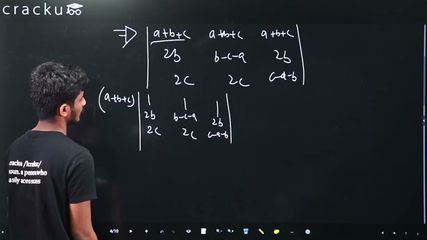
If $$\begin{vmatrix} a-b-c & 2a & 2a \\ 2b & b-c-a & 2b \\ 2c & 2c & c-a-b \end{vmatrix} = (a + b + c)(x + a + b + c)^2$$, $$x \neq 0$$ and $$a + b + c \neq 0$$, then x is equal to
Let us denote the determinant by $$\Delta$$:
$$\Delta=\begin{vmatrix} a-b-c & 2a & 2a \\ 2b & b-c-a & 2b \\ 2c & 2c & c-a-b \end{vmatrix}.$$
We shall expand $$\Delta$$ along the first row. The cofactor (minor) of each element of the first row will be written explicitly.
First element of the first row is $$(a-b-c).$$ Its minor is
$$M_1=\begin{vmatrix} b-c-a & 2b \\[2pt] 2c & c-a-b \end{vmatrix}=(b-c-a)(c-a-b)-2b\cdot 2c.$$
Second element is $$2a$$ with sign $(-1)^{1+2}=-1.$$ Its minor is
$$M_2=\begin{vmatrix} 2b & 2b \\[2pt] 2c & c-a-b \end{vmatrix}=2b(c-a-b)-2b\cdot 2c.$$
Third element is $$2a$$ with sign $(-1)^{1+3}=+1.$$ Its minor is
$$M_3=\begin{vmatrix} 2b & b-c-a \\[2pt] 2c & 2c \end{vmatrix}=2b\cdot 2c-2c(b-c-a).$$
Therefore, by the expansion formula
$$\Delta=(a-b-c)M_1-2aM_2+2aM_3.$$
Now introduce the shorthand $$S=a+b+c.$$ This single symbol greatly lightens all forthcoming algebra.
Expressing everything through $$S$$
Notice
$$a-b-c=2a-S,\qquad b-c-a=2b-S,\qquad c-a-b=2c-S.$$
Using these, let us simplify each minor.
1. For $$M_1$$ we have
$$\begin{aligned} M_1 &=(2b-S)(2c-S)-4bc \\ &=4bc-2bS-2cS+S^2-4bc \\ &=-2bS-2cS+S^2\\ &=S^2-2S(b+c). \end{aligned}$$
Since $$b+c=S-a,$$ we may rewrite
$$M_1=S^2-2S(S-a)=S\bigl(2a-S\bigr).$$
2. For $$M_2$$:
$$\begin{aligned} M_2&=2b(2c-S)-4bc\\ &=4bc-2bS-4bc\\ &=-2bS. \end{aligned}$$
3. For $$M_3$$:
$$\begin{aligned} M_3&=4bc-2c(2b-S)\\ &=4bc-4bc+2cS\\ &=2cS. \end{aligned}$$
Substituting the minors back into the expansion
$$\begin{aligned} \Delta &=(2a-S)\,M_1-2a\,M_2+2a\,M_3 \\ &=(2a-S)\,S(2a-S)-2a(-2bS)+2a(2cS)\\ &=S(2a-S)^2+4abS+4acS. \end{aligned}$$
Factor $$S$$ out of every term:
$$\Delta=S\Bigl[(2a-S)^2+4a(b+c)\Bigr].$$
Expand the square:
$$\begin{aligned} (2a-S)^2&=(2a-(a+b+c))^2\\ &=(a-b-c)^2\\ &=a^2+b^2+c^2-2ab-2ac+2bc. \end{aligned}$$
Add $$4a(b+c)=4ab+4ac$$ and collect all like terms:
$$\begin{aligned} (a-b-c)^2+4a(b+c)&=a^2+b^2+c^2-2ab-2ac+2bc+4ab+4ac\\ &=a^2+b^2+c^2+2ab+2ac+2bc\\ &=(a+b+c)^2\\ &=S^2. \end{aligned}$$
Thus
$$\Delta=S\cdot S^2=S^3=(a+b+c)^3.$$
Comparing with the given factorisation
The problem states
$$\Delta=(a+b+c)\bigl(x+a+b+c\bigr)^2=S\,(x+S)^2.$$ Since $$S\neq0,$$ we can cancel one factor of $$S$$ on both sides, obtaining
$$S^2=(x+S)^2.$$
Taking square roots,
$$x+S=\pm S.$$
Case $$+$$ gives $$x=0,$$ but the question explicitly requires $$x\neq0.$$ Therefore we must take the negative root:
$$x+S=-S\quad\Longrightarrow\quad x=-2S=-2(a+b+c).$$
Hence, the correct answer is Option D.
Was this solution helpful?
Click on the Email ☝️ to Watch the Video Solution
Create a FREE account and get:
_1.webp)

Educational materials for JEE preparation

Ask our AI anything

AI can make mistakes. Please verify important information.
AI can make mistakes. Please verify important information.


