
Join Our JEE Preparation Group
Prep with like-minded aspirants; Get access to free daily tests and study material.
Sign in
Please select an account to continue using cracku.in
↓ →
Join Our JEE Preparation Group
Prep with like-minded aspirants; Get access to free daily tests and study material.
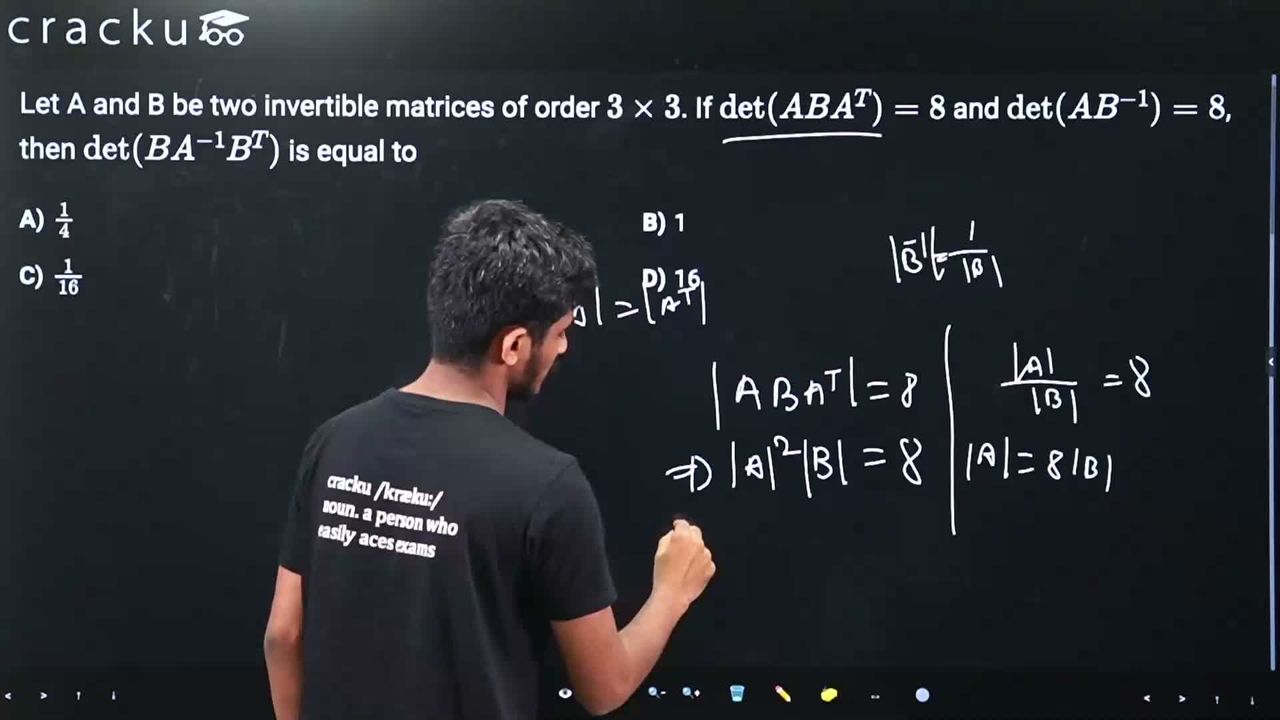
Let A and B be two invertible matrices of order $$3 \times 3$$. If $$\det(ABA^T) = 8$$ and $$\det(AB^{-1}) = 8$$, then $$\det(BA^{-1}B^T)$$ is equal to
We recall a basic property of determinants: for any two square matrices of the same order we have the formula $$\det(AB)=\det(A)\,\det(B)$$. We also know that $$\det(A^T)=\det(A)$$ and $$\det(A^{-1})=\dfrac{1}{\det(A)}$$. All matrices here are of order $$3 \times 3$$, so these facts apply directly.
First, we are told that
$$\det(ABA^T)=8.$$
Using the determinant product rule and the fact that a transpose does not change a determinant, we write
$$\det(ABA^T)=\det(A)\,\det(B)\,\det(A^T)=\det(A)\,\det(B)\,\det(A).$$
Simplifying, this becomes
$$\det(ABA^T)=\bigl(\det(A)\bigr)^2\,\det(B)=8.$$
Next, we are also given
$$\det(AB^{-1})=8.$$
Again applying the product rule and the inverse‐determinant relation, we have
$$\det(AB^{-1})=\det(A)\,\det(B^{-1})=\det(A)\,\dfrac{1}{\det(B)}=8.$$
To keep the algebra clear, let us denote
$$x=\det(A), \qquad y=\det(B).$$
The two pieces of information now translate to the pair of equations
$$x^{2}y=8 \qquad (1)$$
and
$$\dfrac{x}{y}=8 \qquad (2).$$
From equation (2) we immediately find
$$y=\dfrac{x}{8}.$$
Substituting this value of $$y$$ into equation (1) gives
$$x^{2}\left(\dfrac{x}{8}\right)=8.$$
This simplifies step by step:
$$\dfrac{x^{3}}{8}=8,$$
so
$$x^{3}=64,$$
and therefore
$$x=4.$$
Using $$x=4$$ in the relation $$y=\dfrac{x}{8}$$ we get
$$y=\dfrac{4}{8}=\dfrac{1}{2}.$$
Now we need the determinant
$$\det(BA^{-1}B^{T}).$$
Applying the same determinant properties, we write
$$\det(BA^{-1}B^{T})=\det(B)\,\det(A^{-1})\,\det(B^{T}).$$
Since $$\det(B^{T})=\det(B)$$ and $$\det(A^{-1})=\dfrac{1}{\det(A)}$$, this becomes
$$\det(BA^{-1}B^{T})=y \times \dfrac{1}{x} \times y=\dfrac{y^{2}}{x}.$$
Substituting $$x=4$$ and $$y=\dfrac{1}{2}$$, we calculate
$$\det(BA^{-1}B^{T})=\dfrac{\left(\dfrac{1}{2}\right)^{2}}{4}=\dfrac{\dfrac{1}{4}}{4}=\dfrac{1}{16}.$$
Hence, the correct answer is Option C.
Was this solution helpful?
Click on the Email ☝️ to Watch the Video Solution
Create a FREE account and get:
_1.webp)

Educational materials for JEE preparation

Ask our AI anything

AI can make mistakes. Please verify important information.
AI can make mistakes. Please verify important information.


