
Join Our JEE Preparation Group
Prep with like-minded aspirants; Get access to free daily tests and study material.
Sign in
Please select an account to continue using cracku.in
↓ →
Join Our JEE Preparation Group
Prep with like-minded aspirants; Get access to free daily tests and study material.
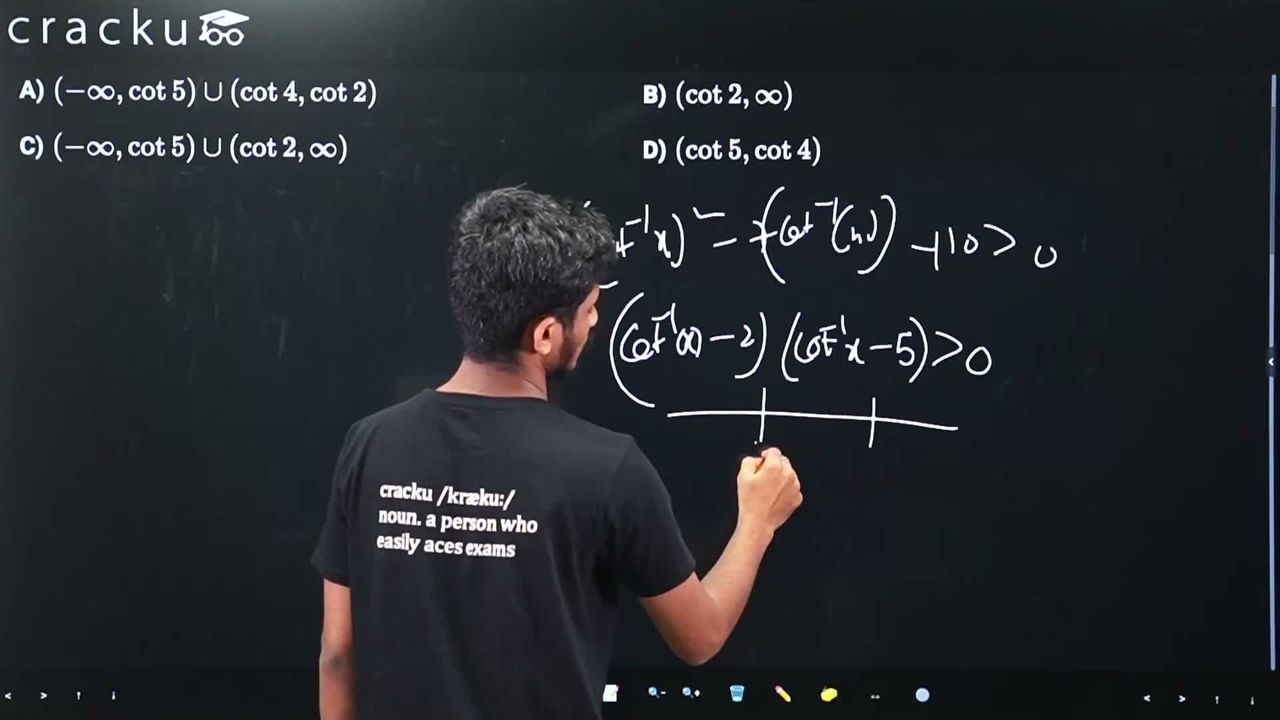
All $$x$$ satisfying the inequality $$(\cot^{-1} x)^2 - 7(\cot^{-1} x) + 10 > 0$$, lie in the interval:
We begin by introducing a simpler symbol. Put
$$y=\cot^{-1}x.$$
By definition of the principal value, the inverse cotangent always satisfies
$$0<y<\pi.$$
Substituting $$y$$ into the given inequality we obtain
$$y^{2}-7y+10>0.$$
Now we treat this as an ordinary quadratic inequality in $$y$$. First we factor the left-hand side:
$$y^{2}-7y+10=(y-5)(y-2).$$
The general rule for a product of two real factors is:
• If $$(y-a)(y-b)>0$$, then $$y<\min\{a,b\}\quad\text{or}\quad y>\max\{a,b\}.$$
Applying the rule with $$a=5,\;b=2$$ gives
$$y<2\quad\text{or}\quad y>5.$$
But we must keep in mind the principal-value restriction $$0<y<\pi\;(=3.14159\ldots).$$ The part $$y>5$$ is impossible because $$5>\pi$$, so it is thrown away. The only admissible portion is
$$0<y<2.$$
So far we have shown that
$$0<\cot^{-1}x<2.$$
We now convert this back to a statement about $$x$$. For that we recall a key fact about the inverse cotangent:
• The function $$y=\cot^{-1}x$$ is strictly decreasing on the entire real line. In symbols, if $$x_{1}<x_{2},$$ then $$\cot^{-1}x_{1}>\cot^{-1}x_{2}.$$
Because of this monotonic behaviour, reversing an inequality inside $$\cot^{-1}$$ flips the inequality sign. From
$$\cot^{-1}x<2$$
we therefore get
$$x>\cot 2.$$
(The value $$\cot 2$$ is a fixed negative number, approximately $$-0.4577$$.)
No further restriction is necessary, since every real $$x$$ already forces $$\cot^{-1}x>0$$ automatically. Consequently the complete solution set in terms of $$x$$ is
$$\boxed{(\,\cot 2,\;\infty\,)}.$$
When we compare this with the four alternatives supplied in the question, we see that it matches Option B.
Hence, the correct answer is Option 2.
Was this solution helpful?
Click on the Email ☝️ to Watch the Video Solution
Create a FREE account and get:
_1.webp)

Educational materials for JEE preparation

Ask our AI anything

AI can make mistakes. Please verify important information.
AI can make mistakes. Please verify important information.


