
Join Our JEE Preparation Group
Prep with like-minded aspirants; Get access to free daily tests and study material.
Sign in
Please select an account to continue using cracku.in
↓ →
Join Our JEE Preparation Group
Prep with like-minded aspirants; Get access to free daily tests and study material.
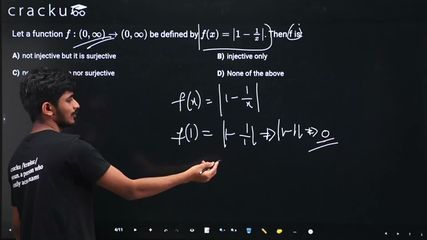
Let a function $$f : (0, \infty) \to (0, \infty)$$ be defined by $$f(x) = \left|1 - \frac{1}{x}\right|$$. Then f is:
First remember the definition of a function: every element of the domain must be assigned an image that actually lies inside the codomain. The codomain fixed by the question is $$(0,\infty),$$ i.e. the set of strictly positive real numbers.
Now we examine the value of the given rule at the point $$x=1.$$ Substituting in the formula
$$f(x)=\left|1-\frac1x\right|,$$
we obtain
$$f(1)=\left|1-\frac11\right|=\left|1-1\right|=\left|0\right|=0.$$
But $$0\notin(0,\infty).$$ Therefore the image of the point $$x=1$$ does not belong to the declared codomain. This violates the very definition of a function from $$(0,\infty)$$ to $$(0,\infty).$$
Because the mapping is not even well-defined with the announced codomain, questions about injectivity or surjectivity are meaningless: the object under discussion fails to be a bona-fide function in the first place. Consequently none of the descriptions “injective only”, “not injective but surjective”, or “neither injective nor surjective” can be accepted.
Hence, the correct answer is Option D.
Was this solution helpful?
Click on the Email ☝️ to Watch the Video Solution
Create a FREE account and get:
_1.webp)

Educational materials for JEE preparation

Ask our AI anything

AI can make mistakes. Please verify important information.
AI can make mistakes. Please verify important information.


