
Join Our JEE Preparation Group
Prep with like-minded aspirants; Get access to free daily tests and study material.
Sign in
Please select an account to continue using cracku.in
↓ →
Join Our JEE Preparation Group
Prep with like-minded aspirants; Get access to free daily tests and study material.
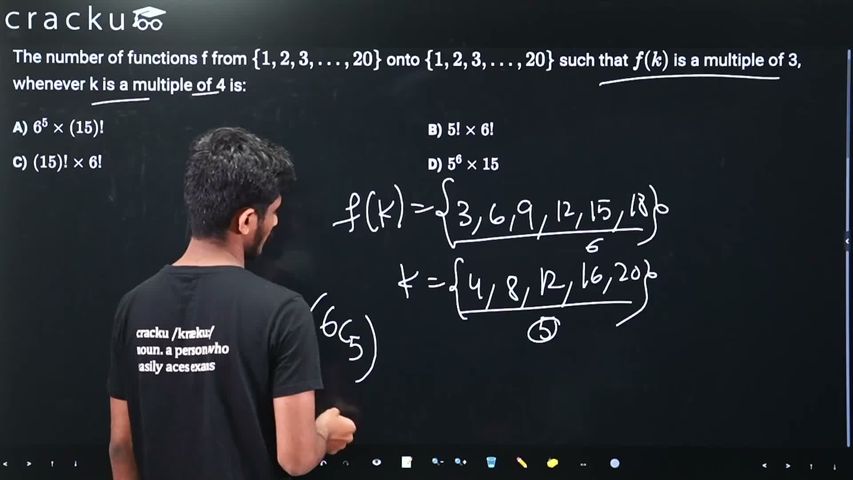
The number of functions f from $$\{1, 2, 3, \ldots, 20\}$$ onto $$\{1, 2, 3, \ldots, 20\}$$ such that $$f(k)$$ is a multiple of 3, whenever k is a multiple of 4 is:
We have the domain $$D=\{1,2,3,\ldots ,20\}$$ and the codomain $$S=\{1,2,3,\ldots ,20\}.$$
The condition “$$f(k)$$ is a multiple of $$3$$ whenever $$k$$ is a multiple of $$4$$” affects exactly the five domain points
$$A=\{4,8,12,16,20\}$$
and forces their images to lie in the six-element set
$$B=\{3,6,9,12,15,18\}.$$
The remaining fifteen domain points
$$C=D\setminus A,\qquad |C|=15$$
are free to go anywhere in $$S,$$ but the whole function must be onto, i.e. every element of $$S$$ must appear at least once as a value.
Because the points of $$A$$ never hit the $$14$$ elements
$$B' = S\setminus B=\{1,2,4,5,7,8,10,11,13,14,16,17,19,20\},$$
those $$14$$ elements must be hit by the points of $$C.$$ Hence the $$15$$ images of the set $$C$$ have to cover all the $$14$$ elements of $$B'$$, leaving at most one point of $$C$$ that may go to $$B.$$
Therefore two distinct cases are possible:
• Case 1 : exactly one element of $$C$$ goes to $$B$$.
• Case 2 : no element of $$C$$ goes to $$B$$.
Case 2 is impossible, because then the five images of $$A$$ could cover at most five elements of $$B$$, leaving one element of $$B$$ unmapped and destroying surjectivity. So only Case 1 survives.
Proceeding with Case 1 step by step:
1. Choose the single element of $$C$$ that will go to $$B$$: $$\binom{15}{1}=15$$ possibilities.
2. Choose its image inside $$B$$: $$6$$ possibilities.
3. The remaining $$14$$ elements of $$C$$ must now hit the $$14$$ elements of $$B'$$ bijectively (no element of $$B'$$ may be missed): that gives $$14!$$ different mappings.
4. At this stage exactly one element of $$B$$ is already hit (the one chosen in step 2), so the five images of $$A$$ must cover the other five elements of $$B.$$ They must therefore form a bijection between the set $$A$$ and $$B\setminus\{\text{chosen element}\},$$ giving $$5!$$ possibilities.
5. The choices in steps 1-4 are independent, so we multiply:
$$15 \times 6 \times 14! \times 5! \;=\; (15 \times 14!) \times (6 \times 5!) \;=\; 15! \times 6!.$$
Thus the required number of onto functions is $$15! \times 6!.$$ This matches Option C.
Hence, the correct answer is Option C.
Was this solution helpful?
Click on the Email ☝️ to Watch the Video Solution
Create a FREE account and get:
_1.webp)

Educational materials for JEE preparation

Ask our AI anything

AI can make mistakes. Please verify important information.
AI can make mistakes. Please verify important information.


