
Join Our JEE Preparation Group
Prep with like-minded aspirants; Get access to free daily tests and study material.
Sign in
Please select an account to continue using cracku.in
↓ →
Join Our JEE Preparation Group
Prep with like-minded aspirants; Get access to free daily tests and study material.
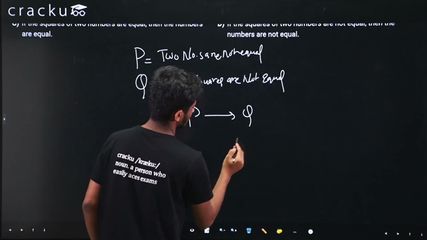
Contrapositive of the statement "If two numbers are not equal, then their squares are not equal" is:
We begin by recalling the basic logical rule for conditional statements. For any implication of the form $$p \rightarrow q,$$ the contrapositive is obtained by first negating the conclusion $$q$$ and then making this negation the hypothesis, while simultaneously negating the original hypothesis $$p$$ and making this negation the new conclusion. Symbolically, the rule is stated as:
$$\text{If } p \rightarrow q,$$ then its contrapositive is $$\; \lnot q \rightarrow \lnot p.$$
Now we identify the parts of the given English sentence. The original statement is:
“If two numbers are not equal, then their squares are not equal.”
We translate this into symbolic form. Let
$$p : \text{“the two numbers are not equal”},$$ $$q :$$ “the squares of the two numbers are not equal” $$.$$
Thus the given statement is precisely $$p \rightarrow q.$$
To form the contrapositive, we negate $$q$$ and $$p$$ in turn:
First the negation of $$q$$ is
$$\lnot q :$$ “the squares of the two numbers are equal” $$.$$
Second the negation of $$p$$ is
$$\lnot p : \text{“the two numbers are equal”}.$$
Applying the rule $$\lnot q \rightarrow \lnot p,$$ we obtain the contrapositive sentence in everyday language:
“If the squares of two numbers are equal, then the numbers are equal.”
Now we compare this derived sentence with the options provided. Option C reads:
“If the squares of two numbers are equal, then the numbers are equal.”
This matches word for word with our contrapositive.
Hence, the correct answer is Option C.
Was this solution helpful?
Click on the Email ☝️ to Watch the Video Solution
Create a FREE account and get:
_1.webp)

Educational materials for JEE preparation

Ask our AI anything

AI can make mistakes. Please verify important information.
AI can make mistakes. Please verify important information.


